CMOS Battery Contributions to Modern Computing Systems
JUL 22, 20259 MIN READ
Generate Your Research Report Instantly with AI Agent
PatSnap Eureka helps you evaluate technical feasibility & market potential.
CMOS Battery Evolution
The evolution of CMOS (Complementary Metal-Oxide-Semiconductor) batteries in modern computing systems represents a significant technological advancement that has greatly impacted the functionality and reliability of electronic devices. This evolution can be traced back to the early days of personal computing in the 1980s when the need for a persistent power source to maintain system settings became apparent.
Initially, CMOS batteries were introduced as a solution to maintain the system clock and BIOS settings when the main power was disconnected. These early batteries were typically lithium-based and had a lifespan of several years. As computing systems became more complex, the role of CMOS batteries expanded to include maintaining a wider range of system configurations and security settings.
Throughout the 1990s and early 2000s, CMOS battery technology saw incremental improvements in terms of capacity and longevity. Manufacturers began to focus on developing batteries that could last longer and provide more stable voltage output. This period also saw the integration of CMOS batteries into laptop computers, where their role became even more critical due to the portable nature of these devices.
The mid-2000s marked a significant shift in CMOS battery design, with the introduction of rechargeable options. These new batteries could be charged by the system's main power supply, reducing the need for frequent replacements and improving overall system reliability. This innovation was particularly beneficial for servers and other systems that required continuous uptime.
As computing systems continued to evolve, so did the demands placed on CMOS batteries. The advent of cloud computing and the Internet of Things (IoT) in the 2010s led to an increased focus on energy efficiency and miniaturization. CMOS batteries had to adapt to these trends, resulting in the development of smaller, more energy-dense options that could still provide long-term power stability.
Recent years have seen further advancements in CMOS battery technology, including the integration of smart charging systems and improved power management techniques. These innovations have extended battery life and enhanced the overall performance of computing systems. Additionally, environmental concerns have driven the development of more eco-friendly CMOS battery options, with a focus on reducing toxic materials and improving recyclability.
Looking ahead, the evolution of CMOS batteries is likely to continue, with research focusing on new materials and technologies that can provide even greater energy density, longevity, and environmental sustainability. As computing systems become increasingly complex and interconnected, the role of CMOS batteries in maintaining system integrity and security is expected to grow, making their ongoing evolution a critical aspect of modern computing technology.
Initially, CMOS batteries were introduced as a solution to maintain the system clock and BIOS settings when the main power was disconnected. These early batteries were typically lithium-based and had a lifespan of several years. As computing systems became more complex, the role of CMOS batteries expanded to include maintaining a wider range of system configurations and security settings.
Throughout the 1990s and early 2000s, CMOS battery technology saw incremental improvements in terms of capacity and longevity. Manufacturers began to focus on developing batteries that could last longer and provide more stable voltage output. This period also saw the integration of CMOS batteries into laptop computers, where their role became even more critical due to the portable nature of these devices.
The mid-2000s marked a significant shift in CMOS battery design, with the introduction of rechargeable options. These new batteries could be charged by the system's main power supply, reducing the need for frequent replacements and improving overall system reliability. This innovation was particularly beneficial for servers and other systems that required continuous uptime.
As computing systems continued to evolve, so did the demands placed on CMOS batteries. The advent of cloud computing and the Internet of Things (IoT) in the 2010s led to an increased focus on energy efficiency and miniaturization. CMOS batteries had to adapt to these trends, resulting in the development of smaller, more energy-dense options that could still provide long-term power stability.
Recent years have seen further advancements in CMOS battery technology, including the integration of smart charging systems and improved power management techniques. These innovations have extended battery life and enhanced the overall performance of computing systems. Additionally, environmental concerns have driven the development of more eco-friendly CMOS battery options, with a focus on reducing toxic materials and improving recyclability.
Looking ahead, the evolution of CMOS batteries is likely to continue, with research focusing on new materials and technologies that can provide even greater energy density, longevity, and environmental sustainability. As computing systems become increasingly complex and interconnected, the role of CMOS batteries in maintaining system integrity and security is expected to grow, making their ongoing evolution a critical aspect of modern computing technology.
Market Demand Analysis
The market demand for CMOS batteries in modern computing systems has been steadily growing, driven by the increasing reliance on these components in various electronic devices. CMOS batteries play a crucial role in maintaining system settings, real-time clock functions, and BIOS configurations in computers, servers, and other digital equipment.
The global CMOS battery market has experienced significant expansion due to the proliferation of personal computers, laptops, and enterprise-level servers. As businesses and individuals continue to adopt digital technologies, the demand for reliable power sources to maintain system integrity has surged. This trend is particularly evident in sectors such as IT, telecommunications, healthcare, and finance, where uninterrupted system operation is critical.
In recent years, the rise of Internet of Things (IoT) devices and smart home technologies has further fueled the demand for CMOS batteries. These compact power sources are essential for maintaining low-power states and preserving critical data in IoT sensors and smart devices, even when the main power is disconnected.
The automotive industry has also emerged as a significant driver of CMOS battery demand. Modern vehicles rely heavily on electronic control units (ECUs) and advanced driver assistance systems (ADAS), which require constant power to maintain settings and calibration data. As the automotive sector continues its shift towards electric and autonomous vehicles, the need for reliable CMOS batteries is expected to grow substantially.
Market analysts have observed a trend towards the development of more energy-efficient and longer-lasting CMOS batteries. This shift is driven by the increasing emphasis on sustainability and the need for extended battery life in portable devices. Manufacturers are investing in research and development to create batteries with improved capacity and reduced environmental impact.
The COVID-19 pandemic has had a mixed impact on the CMOS battery market. While it initially caused disruptions in supply chains and manufacturing processes, the subsequent increase in remote work and digital communication has boosted demand for personal computing devices, indirectly benefiting the CMOS battery sector.
Looking ahead, the market for CMOS batteries is projected to continue its growth trajectory. Factors such as the ongoing digital transformation across industries, the expansion of cloud computing infrastructure, and the increasing adoption of IoT technologies are expected to sustain demand. Additionally, the development of 5G networks and edge computing solutions will likely create new opportunities for CMOS battery applications in telecommunications and data center equipment.
The global CMOS battery market has experienced significant expansion due to the proliferation of personal computers, laptops, and enterprise-level servers. As businesses and individuals continue to adopt digital technologies, the demand for reliable power sources to maintain system integrity has surged. This trend is particularly evident in sectors such as IT, telecommunications, healthcare, and finance, where uninterrupted system operation is critical.
In recent years, the rise of Internet of Things (IoT) devices and smart home technologies has further fueled the demand for CMOS batteries. These compact power sources are essential for maintaining low-power states and preserving critical data in IoT sensors and smart devices, even when the main power is disconnected.
The automotive industry has also emerged as a significant driver of CMOS battery demand. Modern vehicles rely heavily on electronic control units (ECUs) and advanced driver assistance systems (ADAS), which require constant power to maintain settings and calibration data. As the automotive sector continues its shift towards electric and autonomous vehicles, the need for reliable CMOS batteries is expected to grow substantially.
Market analysts have observed a trend towards the development of more energy-efficient and longer-lasting CMOS batteries. This shift is driven by the increasing emphasis on sustainability and the need for extended battery life in portable devices. Manufacturers are investing in research and development to create batteries with improved capacity and reduced environmental impact.
The COVID-19 pandemic has had a mixed impact on the CMOS battery market. While it initially caused disruptions in supply chains and manufacturing processes, the subsequent increase in remote work and digital communication has boosted demand for personal computing devices, indirectly benefiting the CMOS battery sector.
Looking ahead, the market for CMOS batteries is projected to continue its growth trajectory. Factors such as the ongoing digital transformation across industries, the expansion of cloud computing infrastructure, and the increasing adoption of IoT technologies are expected to sustain demand. Additionally, the development of 5G networks and edge computing solutions will likely create new opportunities for CMOS battery applications in telecommunications and data center equipment.
Technical Challenges
CMOS batteries, while seemingly simple components, face several technical challenges in modern computing systems. One of the primary issues is the limited lifespan of these batteries. Despite advancements in battery technology, CMOS batteries typically last only 3-5 years before requiring replacement. This short lifespan can lead to unexpected system failures and data loss if not properly monitored and maintained.
Another significant challenge is the increasing power demands of modern computing systems. As computers become more complex and feature-rich, the power requirements for maintaining CMOS memory have grown. This puts additional strain on the CMOS battery, potentially shortening its effective lifespan and increasing the frequency of replacements.
The miniaturization trend in computing devices presents another hurdle for CMOS battery implementation. As devices become smaller and more compact, finding adequate space for a traditional CMOS battery becomes increasingly difficult. This has led to the need for innovative battery designs and alternative power solutions that can fit within the constraints of modern device form factors.
Environmental concerns also pose challenges for CMOS battery usage. Many CMOS batteries contain lithium, which can be harmful to the environment if not properly disposed of. As electronic waste becomes a growing global issue, there is increasing pressure to develop more environmentally friendly alternatives or improve recycling processes for these batteries.
Compatibility issues arise as computing systems evolve. Newer motherboard designs may require different types of CMOS batteries or alternative power solutions, creating challenges for manufacturers and users in terms of standardization and replacement availability. This lack of uniformity can lead to increased costs and complexity in system maintenance.
The reliability of CMOS batteries in extreme conditions is another area of concern. In industrial or outdoor computing applications, where systems may be exposed to high temperatures or vibrations, standard CMOS batteries may fail prematurely. This necessitates the development of more robust battery solutions capable of withstanding harsh environmental conditions.
Security implications related to CMOS batteries have also emerged as a technical challenge. Malicious actors may exploit the CMOS battery's role in maintaining system settings to launch attacks or bypass security measures. This has led to increased focus on developing secure CMOS implementations that can resist tampering and unauthorized access.
As computing systems become more energy-efficient, paradoxically, this can sometimes exacerbate CMOS battery issues. Lower power consumption in standby modes means systems may remain unplugged for longer periods, relying more heavily on the CMOS battery. This extended reliance can lead to faster battery depletion and more frequent replacement needs.
Another significant challenge is the increasing power demands of modern computing systems. As computers become more complex and feature-rich, the power requirements for maintaining CMOS memory have grown. This puts additional strain on the CMOS battery, potentially shortening its effective lifespan and increasing the frequency of replacements.
The miniaturization trend in computing devices presents another hurdle for CMOS battery implementation. As devices become smaller and more compact, finding adequate space for a traditional CMOS battery becomes increasingly difficult. This has led to the need for innovative battery designs and alternative power solutions that can fit within the constraints of modern device form factors.
Environmental concerns also pose challenges for CMOS battery usage. Many CMOS batteries contain lithium, which can be harmful to the environment if not properly disposed of. As electronic waste becomes a growing global issue, there is increasing pressure to develop more environmentally friendly alternatives or improve recycling processes for these batteries.
Compatibility issues arise as computing systems evolve. Newer motherboard designs may require different types of CMOS batteries or alternative power solutions, creating challenges for manufacturers and users in terms of standardization and replacement availability. This lack of uniformity can lead to increased costs and complexity in system maintenance.
The reliability of CMOS batteries in extreme conditions is another area of concern. In industrial or outdoor computing applications, where systems may be exposed to high temperatures or vibrations, standard CMOS batteries may fail prematurely. This necessitates the development of more robust battery solutions capable of withstanding harsh environmental conditions.
Security implications related to CMOS batteries have also emerged as a technical challenge. Malicious actors may exploit the CMOS battery's role in maintaining system settings to launch attacks or bypass security measures. This has led to increased focus on developing secure CMOS implementations that can resist tampering and unauthorized access.
As computing systems become more energy-efficient, paradoxically, this can sometimes exacerbate CMOS battery issues. Lower power consumption in standby modes means systems may remain unplugged for longer periods, relying more heavily on the CMOS battery. This extended reliance can lead to faster battery depletion and more frequent replacement needs.
Current CMOS Solutions
01 CMOS battery power management
Systems and methods for managing power in CMOS batteries, including techniques for monitoring battery voltage, implementing power-saving modes, and extending battery life through efficient power distribution and consumption in electronic devices.- CMOS battery power management: Systems and methods for managing power in CMOS batteries, including techniques for monitoring battery voltage, implementing power-saving modes, and extending battery life through efficient power distribution and consumption.
- CMOS battery replacement and backup systems: Innovations in CMOS battery replacement procedures and backup power systems to ensure continuous operation of critical components during battery changes or failures, including hot-swappable designs and temporary power storage solutions.
- Integration of CMOS batteries in electronic devices: Advancements in integrating CMOS batteries into various electronic devices, focusing on compact designs, improved connectivity, and enhanced compatibility with different device architectures.
- CMOS battery monitoring and diagnostics: Development of sophisticated monitoring and diagnostic systems for CMOS batteries, including real-time voltage tracking, predictive maintenance algorithms, and early warning systems for potential battery failures.
- CMOS battery circuit design improvements: Innovations in CMOS battery circuit designs, focusing on reducing power consumption, improving charge retention, and enhancing overall performance and longevity of the battery system in various applications.
02 CMOS battery replacement and backup systems
Innovations in CMOS battery replacement procedures and backup power systems, ensuring continuous operation of critical components during battery changes or failures, and improving overall system reliability in various electronic devices.Expand Specific Solutions03 CMOS battery integration in semiconductor devices
Advancements in integrating CMOS batteries with semiconductor devices, focusing on miniaturization, improved performance, and enhanced compatibility with various electronic components and systems.Expand Specific Solutions04 CMOS battery charging and monitoring circuits
Development of specialized circuits for charging CMOS batteries and monitoring their status, including voltage regulation, charge level indication, and protection against overcharging or deep discharge.Expand Specific Solutions05 CMOS battery applications in specific devices
Utilization of CMOS batteries in various electronic devices such as cameras, mobile phones, and automotive systems, addressing specific power requirements and enhancing device functionality through reliable backup power solutions.Expand Specific Solutions
Key Industry Players
The CMOS battery market in modern computing systems is in a mature stage, with a stable global market size estimated in the hundreds of millions of dollars annually. The technology is well-established, with key players like Intel, Samsung Electronics, and Apple dominating the market due to their extensive experience in semiconductor manufacturing and integration. These companies have refined CMOS battery technology over decades, improving power efficiency and longevity. However, emerging players like SK hynix and GlobalFoundries are also making significant contributions, particularly in areas of miniaturization and energy density improvements. The competitive landscape is characterized by incremental innovations rather than disruptive changes, focusing on enhancing battery life, reducing power consumption, and improving overall system reliability.
Intel Corp.
Technical Solution: Intel has made significant contributions to CMOS battery technology in modern computing systems. They have developed advanced power management techniques that optimize CMOS battery usage and extend its lifespan. Intel's latest chipsets incorporate a feature called "Intel Rapid Start Technology" which utilizes the CMOS battery to maintain system state during low-power modes, enabling faster wake-up times and improved energy efficiency[1]. Additionally, Intel has implemented enhanced security measures to protect CMOS battery-backed data, including encryption and tamper-detection mechanisms[3].
Strengths: Advanced power management, improved system wake-up times, enhanced security features. Weaknesses: Potential compatibility issues with older systems, reliance on proprietary technologies.
Apple, Inc.
Technical Solution: Apple has innovated in CMOS battery technology for their Mac lineup. They have developed a custom T2 security chip that works in conjunction with the CMOS battery to provide enhanced security features. This chip stores critical system information and encryption keys, leveraging the CMOS battery's persistent power to maintain data integrity even when the main battery is depleted[2]. Apple has also implemented an advanced power management system that optimizes CMOS battery usage, extending its lifespan and improving overall system reliability. In recent Mac models, Apple has integrated the CMOS battery functionality into their custom-designed M1 and M2 chips, further enhancing power efficiency and system integration[4].
Strengths: Enhanced security features, improved system integration, optimized power management. Weaknesses: Proprietary technology limiting third-party repairs, potential higher replacement costs.
Core CMOS Innovations
Computing device and method for clearing data stored in complementary metal-oxide semiconductor chip
PatentInactiveUS20120047307A1
Innovation
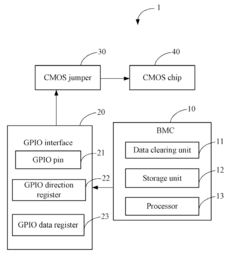
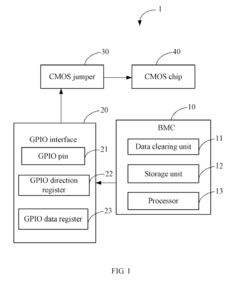
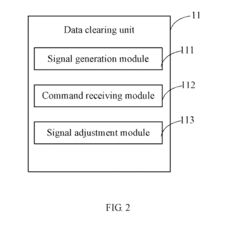
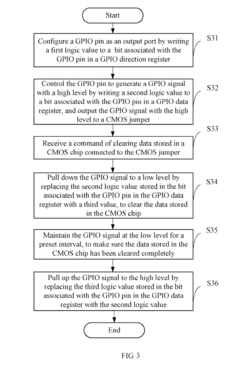
- A computing device with a data clearing unit that uses a GPIO interface to configure a CMOS jumper, generating a high-level signal to maintain data and then pulling it down to clear data stored in the CMOS chip, allowing for safe and controlled data reset.
Memory cell structure
PatentInactiveUS20050111251A1
Innovation
- The design of a 6T-SRAM and 8T-SRAM memory cell layout with a unit memory cell having a long side at least twice as long as the short side, where the source-to-drain axis is parallel to the shorter side, and strategic p-well strap placement to minimize resistance and enhance capacitance, reducing the impact of excess charge carriers.


Power Management
Power management is a critical aspect of modern computing systems, and CMOS batteries play a significant role in this domain. These small, coin-shaped batteries are essential for maintaining system configurations and real-time clock functions when the main power source is disconnected. In the context of power management, CMOS batteries contribute to energy efficiency and system reliability in several ways.
Firstly, CMOS batteries enable the preservation of BIOS settings and system configurations during power-off states. This capability allows computers to quickly resume operations without the need for time-consuming reconfigurations upon startup. By maintaining these settings, CMOS batteries indirectly contribute to power savings by reducing boot times and minimizing the energy required for system initialization.
Moreover, CMOS batteries support the continuous operation of real-time clocks (RTCs) in computing systems. RTCs are crucial for various power management functions, including scheduled wake-ups and power state transitions. The ability to maintain accurate time even when the main power is off enables more sophisticated power-saving strategies, such as powering down systems during periods of inactivity and automatically resuming operations when needed.
In laptop and mobile computing devices, CMOS batteries work in conjunction with advanced power management features to optimize battery life. They help maintain system states during sleep or hibernation modes, allowing for quick resume times while conserving energy. This seamless transition between power states is essential for balancing performance and energy efficiency in portable devices.
CMOS batteries also play a role in supporting power management features in server environments. In data centers, where energy efficiency is paramount, these batteries help maintain system configurations and time synchronization across multiple servers. This consistency is crucial for coordinated power management strategies and load balancing across server clusters.
Furthermore, CMOS batteries contribute to the overall reliability of power management systems. By providing a stable power source for critical low-power functions, they help prevent data loss and system instability that could result from unexpected power interruptions. This reliability is particularly important in environments where uninterrupted operation is essential, such as in industrial computing applications or critical infrastructure systems.
As computing systems evolve, the role of CMOS batteries in power management continues to adapt. While some modern systems are moving towards alternative technologies for maintaining system configurations and time, CMOS batteries remain a cost-effective and reliable solution for many computing devices. Their simplicity and long lifespan make them an enduring component in the complex landscape of power management strategies in modern computing systems.
Firstly, CMOS batteries enable the preservation of BIOS settings and system configurations during power-off states. This capability allows computers to quickly resume operations without the need for time-consuming reconfigurations upon startup. By maintaining these settings, CMOS batteries indirectly contribute to power savings by reducing boot times and minimizing the energy required for system initialization.
Moreover, CMOS batteries support the continuous operation of real-time clocks (RTCs) in computing systems. RTCs are crucial for various power management functions, including scheduled wake-ups and power state transitions. The ability to maintain accurate time even when the main power is off enables more sophisticated power-saving strategies, such as powering down systems during periods of inactivity and automatically resuming operations when needed.
In laptop and mobile computing devices, CMOS batteries work in conjunction with advanced power management features to optimize battery life. They help maintain system states during sleep or hibernation modes, allowing for quick resume times while conserving energy. This seamless transition between power states is essential for balancing performance and energy efficiency in portable devices.
CMOS batteries also play a role in supporting power management features in server environments. In data centers, where energy efficiency is paramount, these batteries help maintain system configurations and time synchronization across multiple servers. This consistency is crucial for coordinated power management strategies and load balancing across server clusters.
Furthermore, CMOS batteries contribute to the overall reliability of power management systems. By providing a stable power source for critical low-power functions, they help prevent data loss and system instability that could result from unexpected power interruptions. This reliability is particularly important in environments where uninterrupted operation is essential, such as in industrial computing applications or critical infrastructure systems.
As computing systems evolve, the role of CMOS batteries in power management continues to adapt. While some modern systems are moving towards alternative technologies for maintaining system configurations and time, CMOS batteries remain a cost-effective and reliable solution for many computing devices. Their simplicity and long lifespan make them an enduring component in the complex landscape of power management strategies in modern computing systems.
Environmental Impact
The environmental impact of CMOS batteries in modern computing systems is a multifaceted issue that warrants careful consideration. These small but essential components contribute to electronic waste and pose potential environmental hazards if not properly managed. CMOS batteries typically contain lithium, a reactive metal that can be harmful to ecosystems if released into the environment. The production process of these batteries also involves the extraction and processing of raw materials, which can have significant environmental implications.
As computing devices become more prevalent and their lifecycles shorten, the volume of discarded CMOS batteries increases. This trend exacerbates the challenge of electronic waste management, particularly in regions with limited recycling infrastructure. The improper disposal of these batteries can lead to soil and water contamination, affecting both terrestrial and aquatic ecosystems. Furthermore, the energy-intensive manufacturing processes associated with CMOS batteries contribute to carbon emissions and resource depletion.
However, it is important to note that CMOS batteries play a crucial role in maintaining system settings and real-time clocks in computing devices, thereby extending the overall lifespan of these systems. This longevity can potentially offset some of the environmental impacts by reducing the frequency of device replacement. Additionally, advancements in battery technology have led to the development of more environmentally friendly alternatives, such as rechargeable CMOS batteries and low-power designs that extend battery life.
The tech industry has begun to address these environmental concerns through various initiatives. Many manufacturers now offer battery take-back and recycling programs, aiming to reduce the environmental footprint of their products. There is also a growing emphasis on designing devices with easily replaceable CMOS batteries, facilitating proper disposal and recycling. Some companies are exploring alternative power sources for maintaining system settings, such as supercapacitors or energy harvesting technologies, which could potentially eliminate the need for traditional CMOS batteries altogether.
As environmental regulations become more stringent, the computing industry faces increasing pressure to minimize the ecological impact of CMOS batteries. This has spurred research into more sustainable materials and manufacturing processes. The development of biodegradable battery components and the use of recycled materials in battery production are promising areas of innovation that could significantly reduce the environmental burden of these essential components in modern computing systems.
As computing devices become more prevalent and their lifecycles shorten, the volume of discarded CMOS batteries increases. This trend exacerbates the challenge of electronic waste management, particularly in regions with limited recycling infrastructure. The improper disposal of these batteries can lead to soil and water contamination, affecting both terrestrial and aquatic ecosystems. Furthermore, the energy-intensive manufacturing processes associated with CMOS batteries contribute to carbon emissions and resource depletion.
However, it is important to note that CMOS batteries play a crucial role in maintaining system settings and real-time clocks in computing devices, thereby extending the overall lifespan of these systems. This longevity can potentially offset some of the environmental impacts by reducing the frequency of device replacement. Additionally, advancements in battery technology have led to the development of more environmentally friendly alternatives, such as rechargeable CMOS batteries and low-power designs that extend battery life.
The tech industry has begun to address these environmental concerns through various initiatives. Many manufacturers now offer battery take-back and recycling programs, aiming to reduce the environmental footprint of their products. There is also a growing emphasis on designing devices with easily replaceable CMOS batteries, facilitating proper disposal and recycling. Some companies are exploring alternative power sources for maintaining system settings, such as supercapacitors or energy harvesting technologies, which could potentially eliminate the need for traditional CMOS batteries altogether.
As environmental regulations become more stringent, the computing industry faces increasing pressure to minimize the ecological impact of CMOS batteries. This has spurred research into more sustainable materials and manufacturing processes. The development of biodegradable battery components and the use of recycled materials in battery production are promising areas of innovation that could significantly reduce the environmental burden of these essential components in modern computing systems.
Unlock deeper insights with PatSnap Eureka Quick Research — get a full tech report to explore trends and direct your research. Try now!
Generate Your Research Report Instantly with AI Agent
Supercharge your innovation with PatSnap Eureka AI Agent Platform!