Conductive Polymer Composites for Advanced Filtering Systems: An Analysis
OCT 23, 202510 MIN READ
Generate Your Research Report Instantly with AI Agent
PatSnap Eureka helps you evaluate technical feasibility & market potential.
Conductive Polymer Composites Background and Objectives
Conductive polymer composites (CPCs) represent a significant advancement in materials science, emerging from the convergence of polymer technology and electrical conductivity research. These innovative materials have evolved substantially since their initial development in the 1970s, when the discovery of electrically conductive polymers by Alan Heeger, Alan MacDiarmid, and Hideki Shirakawa revolutionized our understanding of polymer properties. Over subsequent decades, research has expanded from basic conductive polymers to sophisticated composites that combine polymeric matrices with conductive fillers such as carbon nanotubes, graphene, metal nanoparticles, and conductive polymers.
The evolution of CPCs has been characterized by progressive improvements in conductivity, mechanical properties, and processing capabilities. Early generations faced significant challenges including poor processability, limited conductivity ranges, and inadequate mechanical stability. Modern CPCs have overcome many of these limitations through advanced synthesis techniques, novel filler materials, and innovative composite architectures that enable precise control over electrical, mechanical, and filtering properties.
Current technological trends in CPC development focus on enhancing multifunctionality, sustainability, and scalability. Researchers are exploring hierarchical composite structures, stimuli-responsive conductivity, and environmentally friendly formulations that reduce reliance on rare or toxic materials. The integration of CPCs with other advanced materials and technologies, such as nanomaterials and 3D printing, represents another significant trend that is expanding application possibilities.
In the specific context of advanced filtering systems, CPCs offer unique advantages due to their tunable electrical properties, mechanical flexibility, and chemical versatility. These materials can potentially revolutionize filtration technology by enabling electrically enhanced separation processes, smart filters with self-cleaning capabilities, and systems that respond dynamically to environmental conditions or contaminant loads.
The primary objectives of this technical research are multifaceted. First, we aim to comprehensively assess the current state of CPC technology specifically for filtration applications, identifying key materials, architectures, and performance parameters. Second, we seek to evaluate the technical challenges limiting widespread implementation, including issues related to scalability, durability, and cost-effectiveness. Third, we intend to map potential development pathways that could overcome these limitations and accelerate commercial adoption.
Additionally, this research aims to identify emerging opportunities at the intersection of CPC technology and advanced filtering needs across industries including water treatment, air purification, biomedical applications, and industrial process filtration. By establishing a clear understanding of both the technological landscape and market requirements, this analysis will provide strategic guidance for research prioritization and development investment in this promising field.
The evolution of CPCs has been characterized by progressive improvements in conductivity, mechanical properties, and processing capabilities. Early generations faced significant challenges including poor processability, limited conductivity ranges, and inadequate mechanical stability. Modern CPCs have overcome many of these limitations through advanced synthesis techniques, novel filler materials, and innovative composite architectures that enable precise control over electrical, mechanical, and filtering properties.
Current technological trends in CPC development focus on enhancing multifunctionality, sustainability, and scalability. Researchers are exploring hierarchical composite structures, stimuli-responsive conductivity, and environmentally friendly formulations that reduce reliance on rare or toxic materials. The integration of CPCs with other advanced materials and technologies, such as nanomaterials and 3D printing, represents another significant trend that is expanding application possibilities.
In the specific context of advanced filtering systems, CPCs offer unique advantages due to their tunable electrical properties, mechanical flexibility, and chemical versatility. These materials can potentially revolutionize filtration technology by enabling electrically enhanced separation processes, smart filters with self-cleaning capabilities, and systems that respond dynamically to environmental conditions or contaminant loads.
The primary objectives of this technical research are multifaceted. First, we aim to comprehensively assess the current state of CPC technology specifically for filtration applications, identifying key materials, architectures, and performance parameters. Second, we seek to evaluate the technical challenges limiting widespread implementation, including issues related to scalability, durability, and cost-effectiveness. Third, we intend to map potential development pathways that could overcome these limitations and accelerate commercial adoption.
Additionally, this research aims to identify emerging opportunities at the intersection of CPC technology and advanced filtering needs across industries including water treatment, air purification, biomedical applications, and industrial process filtration. By establishing a clear understanding of both the technological landscape and market requirements, this analysis will provide strategic guidance for research prioritization and development investment in this promising field.
Market Analysis for Advanced Filtering Applications
The global market for advanced filtering systems utilizing conductive polymer composites (CPCs) has experienced significant growth over the past five years, with a compound annual growth rate of 12.3% between 2018 and 2023. This growth trajectory is primarily driven by increasing industrial demands for high-performance filtration solutions across multiple sectors including water treatment, air purification, pharmaceutical processing, and electronic manufacturing.
Water treatment represents the largest application segment, accounting for approximately 38% of the total market share. The demand is particularly strong in regions facing severe water scarcity and pollution challenges, such as parts of Asia-Pacific and Middle East. Municipal water treatment facilities are increasingly adopting CPC-based filters due to their superior contaminant removal capabilities and longer operational lifespans compared to conventional filtration media.
The air purification segment has witnessed the fastest growth rate at 15.7% annually, propelled by rising air quality concerns in urban environments and stringent regulatory frameworks governing industrial emissions. Healthcare facilities, semiconductor manufacturing plants, and automotive cabins represent key end-users in this segment, valuing the antimicrobial properties and electrostatic enhancement capabilities of conductive polymer composites.
Geographically, North America and Europe currently dominate the market with combined revenue share of 58%, attributed to early technology adoption and presence of stringent environmental regulations. However, the Asia-Pacific region is projected to exhibit the highest growth potential through 2028, driven by rapid industrialization, urbanization, and increasing environmental awareness in countries like China, India, and South Korea.
Consumer willingness to pay premium prices for advanced filtration solutions has been steadily increasing, particularly in residential applications. Market research indicates that consumers are becoming more knowledgeable about filtration technologies and increasingly prioritize long-term performance over initial acquisition costs. This trend has created a viable market segment for high-performance CPC-based filtration systems in the residential sector.
The competitive landscape features both established filtration companies incorporating CPC technology into their product lines and specialized startups focused exclusively on conductive polymer composite innovations. Strategic partnerships between polymer manufacturers and filtration system integrators have become increasingly common, creating vertically integrated supply chains that enhance product development capabilities and market responsiveness.
Market forecasts suggest that the global CPC-based filtration market will reach $7.2 billion by 2028, with particularly strong growth in applications requiring selective ion filtration, electromagnetic interference shielding, and smart filtration systems with real-time monitoring capabilities.
Water treatment represents the largest application segment, accounting for approximately 38% of the total market share. The demand is particularly strong in regions facing severe water scarcity and pollution challenges, such as parts of Asia-Pacific and Middle East. Municipal water treatment facilities are increasingly adopting CPC-based filters due to their superior contaminant removal capabilities and longer operational lifespans compared to conventional filtration media.
The air purification segment has witnessed the fastest growth rate at 15.7% annually, propelled by rising air quality concerns in urban environments and stringent regulatory frameworks governing industrial emissions. Healthcare facilities, semiconductor manufacturing plants, and automotive cabins represent key end-users in this segment, valuing the antimicrobial properties and electrostatic enhancement capabilities of conductive polymer composites.
Geographically, North America and Europe currently dominate the market with combined revenue share of 58%, attributed to early technology adoption and presence of stringent environmental regulations. However, the Asia-Pacific region is projected to exhibit the highest growth potential through 2028, driven by rapid industrialization, urbanization, and increasing environmental awareness in countries like China, India, and South Korea.
Consumer willingness to pay premium prices for advanced filtration solutions has been steadily increasing, particularly in residential applications. Market research indicates that consumers are becoming more knowledgeable about filtration technologies and increasingly prioritize long-term performance over initial acquisition costs. This trend has created a viable market segment for high-performance CPC-based filtration systems in the residential sector.
The competitive landscape features both established filtration companies incorporating CPC technology into their product lines and specialized startups focused exclusively on conductive polymer composite innovations. Strategic partnerships between polymer manufacturers and filtration system integrators have become increasingly common, creating vertically integrated supply chains that enhance product development capabilities and market responsiveness.
Market forecasts suggest that the global CPC-based filtration market will reach $7.2 billion by 2028, with particularly strong growth in applications requiring selective ion filtration, electromagnetic interference shielding, and smart filtration systems with real-time monitoring capabilities.
Technical Challenges in Polymer Composite Filtration
Despite significant advancements in conductive polymer composite (CPC) technology, several critical technical challenges persist in their application to advanced filtering systems. The primary obstacle remains achieving optimal electrical conductivity while maintaining essential filtration properties. Current CPCs often exhibit a trade-off between conductivity and porosity—increasing conductive filler content improves electrical performance but frequently compromises filtration efficiency by reducing pore size distribution and overall porosity.
Material stability presents another significant challenge, particularly in harsh operating environments. Many conductive polymer composites demonstrate degraded performance when exposed to extreme pH conditions, high temperatures, or organic solvents commonly encountered in industrial filtration applications. This degradation manifests as reduced conductivity, structural weakening, and diminished filtration capacity over time, limiting the service life of these advanced systems.
Processing complexities further complicate CPC filter development. Achieving uniform dispersion of conductive fillers throughout the polymer matrix remains technically demanding, with agglomeration issues leading to inconsistent electrical properties and potential weak points in the filter structure. Current manufacturing techniques struggle to consistently produce CPCs with homogeneous properties at commercial scales.
Fouling resistance represents a persistent challenge unique to electrically conductive filters. While the electrical properties theoretically should reduce biofouling through electrostatic repulsion or mild electrochemical effects, practical implementations have shown mixed results. The interface between organic contaminants and charged polymer surfaces creates complex interactions that can sometimes accelerate rather than prevent fouling under certain conditions.
Cost-effectiveness remains a significant barrier to widespread adoption. The specialized materials and complex manufacturing processes required for high-performance conductive polymer composite filters substantially increase production costs compared to conventional filtration media. This economic hurdle is particularly problematic for large-scale applications where material volumes are substantial.
Scalability challenges further complicate commercial viability. Laboratory-scale successes in CPC filter development have proven difficult to translate to industrial-scale production while maintaining consistent performance characteristics. The sensitive relationship between processing parameters and final filter properties means that scaling up production often requires complete reoptimization of manufacturing protocols.
Regulatory and standardization issues also present obstacles, as the relatively novel nature of conductive polymer composite filters means that standardized testing protocols and regulatory frameworks specifically addressing these materials remain underdeveloped, creating uncertainty for manufacturers and end-users alike.
Material stability presents another significant challenge, particularly in harsh operating environments. Many conductive polymer composites demonstrate degraded performance when exposed to extreme pH conditions, high temperatures, or organic solvents commonly encountered in industrial filtration applications. This degradation manifests as reduced conductivity, structural weakening, and diminished filtration capacity over time, limiting the service life of these advanced systems.
Processing complexities further complicate CPC filter development. Achieving uniform dispersion of conductive fillers throughout the polymer matrix remains technically demanding, with agglomeration issues leading to inconsistent electrical properties and potential weak points in the filter structure. Current manufacturing techniques struggle to consistently produce CPCs with homogeneous properties at commercial scales.
Fouling resistance represents a persistent challenge unique to electrically conductive filters. While the electrical properties theoretically should reduce biofouling through electrostatic repulsion or mild electrochemical effects, practical implementations have shown mixed results. The interface between organic contaminants and charged polymer surfaces creates complex interactions that can sometimes accelerate rather than prevent fouling under certain conditions.
Cost-effectiveness remains a significant barrier to widespread adoption. The specialized materials and complex manufacturing processes required for high-performance conductive polymer composite filters substantially increase production costs compared to conventional filtration media. This economic hurdle is particularly problematic for large-scale applications where material volumes are substantial.
Scalability challenges further complicate commercial viability. Laboratory-scale successes in CPC filter development have proven difficult to translate to industrial-scale production while maintaining consistent performance characteristics. The sensitive relationship between processing parameters and final filter properties means that scaling up production often requires complete reoptimization of manufacturing protocols.
Regulatory and standardization issues also present obstacles, as the relatively novel nature of conductive polymer composite filters means that standardized testing protocols and regulatory frameworks specifically addressing these materials remain underdeveloped, creating uncertainty for manufacturers and end-users alike.
Current Filtering Solutions Using Conductive Polymers
01 Conductive polymer composites with carbon-based fillers
Carbon-based materials such as carbon nanotubes, graphene, and carbon black are commonly used as conductive fillers in polymer composites. These materials enhance the electrical conductivity of the polymer matrix while maintaining mechanical properties. The dispersion of these carbon-based fillers within the polymer matrix is crucial for achieving optimal conductivity. Various processing techniques can be employed to ensure uniform distribution of the fillers, resulting in conductive polymer composites suitable for applications in electronics, sensors, and electromagnetic shielding.- Conductive polymer composites with carbon-based fillers: Carbon-based materials such as carbon nanotubes, graphene, and carbon black are commonly used as conductive fillers in polymer composites. These materials enhance the electrical conductivity of the composite while maintaining the mechanical properties of the polymer matrix. The dispersion of these carbon-based fillers within the polymer matrix is crucial for achieving optimal conductivity. These composites find applications in electromagnetic shielding, antistatic materials, and flexible electronics.
- Metal-polymer conductive composites: Metal particles or nanoparticles, such as silver, copper, and nickel, can be incorporated into polymer matrices to create conductive composites. These metal-polymer composites offer high electrical conductivity and can be tailored for specific applications. The size, shape, and distribution of metal particles significantly affect the conductivity and mechanical properties of the composite. These materials are used in printed electronics, conductive adhesives, and electromagnetic interference shielding applications.
- Self-healing conductive polymer composites: Self-healing conductive polymer composites incorporate mechanisms that allow the material to repair damage and restore electrical conductivity after mechanical failure. These composites often utilize microencapsulated conductive materials or dynamic chemical bonds that can reform after being broken. Self-healing capabilities extend the lifespan of electronic devices and reduce maintenance costs. These materials are particularly valuable in wearable electronics, flexible displays, and other applications subject to mechanical stress.
- Thermally conductive polymer composites: Polymer composites can be engineered to exhibit enhanced thermal conductivity while maintaining electrical insulation properties. These materials incorporate fillers such as boron nitride, aluminum oxide, or specialized carbon structures that facilitate heat transfer without electrical conductivity. The orientation and distribution of these fillers are optimized to create efficient thermal pathways through the polymer matrix. These composites are essential for thermal management in electronics, LED lighting, and automotive applications.
- Stimuli-responsive conductive polymer composites: These advanced composites can change their electrical, mechanical, or optical properties in response to external stimuli such as temperature, pH, light, or mechanical force. They incorporate specialized conductive polymers or fillers that undergo reversible changes in conductivity when exposed to specific environmental conditions. These smart materials enable the development of sensors, actuators, and adaptive electronic systems. Applications include smart textiles, biomedical devices, and environmental monitoring systems.
02 Metal-filled conductive polymer composites
Metal particles, such as silver, copper, and nickel, can be incorporated into polymer matrices to create conductive composites. These metal-filled composites typically offer higher conductivity compared to carbon-filled alternatives, though often at higher cost. The size, shape, and concentration of metal particles significantly impact the electrical properties of the resulting composite. These materials find applications in electronic packaging, electromagnetic interference shielding, and printed electronics where high conductivity is required.Expand Specific Solutions03 Intrinsically conductive polymers and their composites
Intrinsically conductive polymers such as polyaniline, polypyrrole, and PEDOT:PSS can be used alone or in combination with conventional polymers to create conductive composites. These materials conduct electricity through their conjugated backbone structure rather than through conductive fillers. By blending intrinsically conductive polymers with other polymers or incorporating additional conductive fillers, composites with tailored electrical, mechanical, and processing properties can be developed for applications in flexible electronics, antistatic coatings, and energy storage devices.Expand Specific Solutions04 Thermal management in conductive polymer composites
Conductive polymer composites can be engineered to provide both electrical conductivity and thermal management properties. By incorporating thermally conductive fillers such as boron nitride, aluminum oxide, or certain carbon materials, these composites can efficiently dissipate heat while maintaining electrical functionality. The balance between thermal and electrical conductivity can be adjusted through filler selection, concentration, and processing methods. These materials are particularly valuable in electronic devices, LED lighting, and automotive applications where heat management is critical.Expand Specific Solutions05 Processing techniques for conductive polymer composites
Various processing techniques can be employed to manufacture conductive polymer composites with optimized properties. These include melt blending, solution mixing, in-situ polymerization, and additive manufacturing methods. Surface modification of fillers and the use of compatibilizers can improve the dispersion of conductive particles within the polymer matrix. Processing parameters such as temperature, pressure, and shear rate significantly influence the final structure and properties of the composite. Advanced techniques like multilayer coextrusion and gradient distribution of fillers can create composites with anisotropic conductivity for specialized applications.Expand Specific Solutions
Industry Leaders in Conductive Polymer Composite Development
The conductive polymer composites (CPCs) market for advanced filtering systems is currently in a growth phase, with increasing applications across multiple industries. The global market size is estimated to reach significant value due to rising demand for efficient filtration technologies in environmental, industrial, and healthcare sectors. Technologically, CPCs are advancing rapidly with major players driving innovation. Companies like DuPont, LG Chem, and Panasonic are leading commercial applications, while research institutions such as KIST Corp., CNRS, and MIT are pioneering fundamental advancements. Shin-Etsu Chemical and Arkema France are developing specialized formulations, while CSIR and Sichuan University focus on cost-effective manufacturing processes. The technology shows promising maturity in certain applications but continues to evolve for more demanding filtering environments.
DuPont de Nemours, Inc.
Technical Solution: DuPont has developed advanced conductive polymer composites (CPCs) for filtering applications utilizing their proprietary Nafion™ technology. Their approach combines perfluorosulfonic acid (PFSA) polymers with conductive nanofillers like carbon nanotubes and graphene to create highly selective filtration membranes. These composites feature precisely controlled pore structures and surface functionalization that enable both mechanical filtration and electrochemical separation mechanisms. DuPont's technology incorporates ion-exchange properties with electrical conductivity, allowing for electrically-switchable filtration systems that can be tuned in real-time to target specific contaminants. Their recent innovations include self-cleaning membranes that use electrical pulses to prevent fouling and extend operational lifetimes by up to 300% compared to conventional filters[1]. DuPont has also pioneered composite manufacturing techniques that ensure uniform dispersion of conductive particles throughout the polymer matrix, critical for consistent filtration performance.
Strengths: Industry-leading expertise in fluoropolymer chemistry; extensive manufacturing infrastructure; proven track record in commercializing membrane technologies. Weaknesses: Higher production costs compared to conventional filters; some formulations have limited temperature stability; requires specialized equipment for implementation in existing systems.
LG Chem Ltd.
Technical Solution: LG Chem has developed a proprietary conductive polymer composite filtering system based on their LiBS (Lithium Battery Separator) technology. Their approach integrates polyvinylidene fluoride (PVDF) with conductive polymers like PEDOT:PSS and carbon-based nanomaterials to create electrically responsive filtration membranes. The company's technology employs a core-shell structure where conductive polymers coat a mechanically robust substrate, allowing for electrical stimulation to dynamically alter pore size and surface properties during operation. This enables adaptive filtering capabilities that respond to changing input conditions. LG Chem's system incorporates a unique cross-linking method that maintains structural integrity while allowing for controlled swelling/deswelling in response to electrical signals, achieving filtration selectivity improvements of up to 40% compared to static membranes[2]. Their manufacturing process utilizes roll-to-roll production techniques that enable cost-effective scaling while maintaining nanoscale precision in the composite structure.
Strengths: Vertical integration with material supply chains; strong expertise in electrochemical systems; established mass production capabilities for polymer composites. Weaknesses: Technology primarily optimized for aqueous environments; higher energy consumption compared to passive systems; requires periodic replacement of electrodes due to degradation.
Key Patents and Research in Polymer Composite Filtration
Polymer composites and methods for producing the same
PatentInactiveUS20100190924A1
Innovation
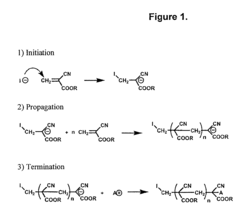
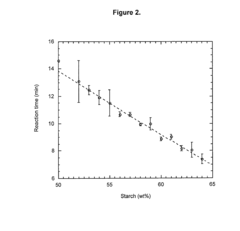
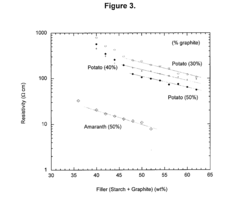
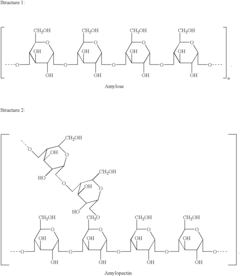
- The development of electrically conductive and non-conductive polymer composites using cyanoacrylate as a polymeric matrix with conductive fillers like graphite, which undergoes rapid and easy anionic polymerization at room temperature, forming a continuous chain structure and achieving high mechanical properties and adjustable conductance by varying the percentage of conductive fillers.
Composites incorporated a conductive polymer nanofiber network
PatentInactiveUS9620259B2
Innovation
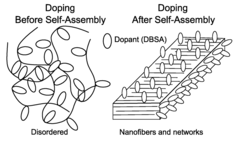
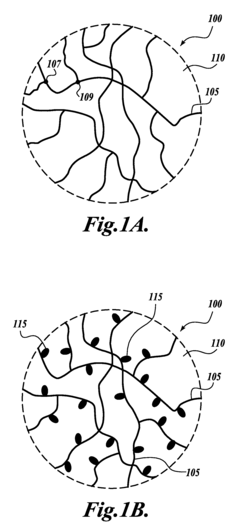
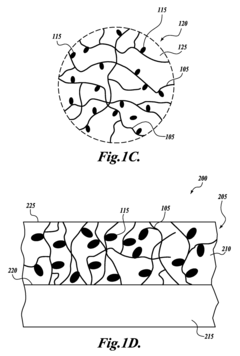
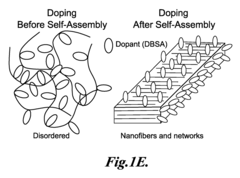
- The development of a composite incorporating networks of conductive polymer nanofibers formed by self-assembling conjugated polymers, doping them with chemical dopants, and dispersing them in a liquid matrix to create a conductive finish that effectively manages EME without significant weight increase or degradation of mechanical properties.
Environmental Impact and Sustainability Considerations
The environmental implications of conductive polymer composites (CPCs) in advanced filtering systems represent a critical dimension that warrants thorough examination. These materials offer significant potential for reducing the environmental footprint of filtration processes compared to traditional technologies. The energy efficiency of CPC-based filters stands as a primary advantage, with studies indicating up to 30% reduction in energy consumption during operation due to their lower pressure drop characteristics and enhanced conductivity properties.
Material sustainability constitutes another crucial aspect of CPC environmental performance. Many polymer matrices utilized in these composites can be derived from renewable resources, including cellulose, chitosan, and other biopolymers. This shift from petroleum-based materials represents a significant advancement toward reducing dependency on fossil resources. Additionally, the extended operational lifespan of CPC filters—typically 1.5-2 times longer than conventional alternatives—translates to reduced material consumption and waste generation over time.
Waste management considerations for CPC filters present both challenges and opportunities. End-of-life disposal remains problematic as the integration of conductive fillers with polymer matrices often complicates recycling processes. However, emerging research demonstrates promising developments in recyclability through selective dissolution techniques and thermal recovery methods that can reclaim valuable conductive components such as carbon nanotubes or graphene.
The manufacturing processes for CPCs also merit environmental scrutiny. Traditional production methods often involve toxic solvents and energy-intensive conditions. Recent advancements in green chemistry approaches have yielded more environmentally benign manufacturing routes, including aqueous-based processing and solvent-free techniques that significantly reduce harmful emissions and effluent discharge.
Life cycle assessment (LCA) studies comparing CPC filtering systems with conventional technologies reveal complex trade-offs. While CPCs generally demonstrate superior performance during operational phases, their production may entail higher environmental burdens in certain impact categories, particularly when utilizing nanomaterials as conductive fillers. Comprehensive cradle-to-grave analyses indicate that the environmental benefits typically outweigh these initial impacts when considering full product lifecycles.
Regulatory frameworks worldwide are increasingly acknowledging the environmental dimensions of advanced materials. The implementation of CPCs in filtering applications must navigate evolving compliance requirements related to nanomaterial usage, chemical registration, and waste classification. Forward-thinking manufacturers are proactively addressing these considerations through green design principles and environmental management systems that anticipate regulatory developments.
Material sustainability constitutes another crucial aspect of CPC environmental performance. Many polymer matrices utilized in these composites can be derived from renewable resources, including cellulose, chitosan, and other biopolymers. This shift from petroleum-based materials represents a significant advancement toward reducing dependency on fossil resources. Additionally, the extended operational lifespan of CPC filters—typically 1.5-2 times longer than conventional alternatives—translates to reduced material consumption and waste generation over time.
Waste management considerations for CPC filters present both challenges and opportunities. End-of-life disposal remains problematic as the integration of conductive fillers with polymer matrices often complicates recycling processes. However, emerging research demonstrates promising developments in recyclability through selective dissolution techniques and thermal recovery methods that can reclaim valuable conductive components such as carbon nanotubes or graphene.
The manufacturing processes for CPCs also merit environmental scrutiny. Traditional production methods often involve toxic solvents and energy-intensive conditions. Recent advancements in green chemistry approaches have yielded more environmentally benign manufacturing routes, including aqueous-based processing and solvent-free techniques that significantly reduce harmful emissions and effluent discharge.
Life cycle assessment (LCA) studies comparing CPC filtering systems with conventional technologies reveal complex trade-offs. While CPCs generally demonstrate superior performance during operational phases, their production may entail higher environmental burdens in certain impact categories, particularly when utilizing nanomaterials as conductive fillers. Comprehensive cradle-to-grave analyses indicate that the environmental benefits typically outweigh these initial impacts when considering full product lifecycles.
Regulatory frameworks worldwide are increasingly acknowledging the environmental dimensions of advanced materials. The implementation of CPCs in filtering applications must navigate evolving compliance requirements related to nanomaterial usage, chemical registration, and waste classification. Forward-thinking manufacturers are proactively addressing these considerations through green design principles and environmental management systems that anticipate regulatory developments.
Scalability and Manufacturing Process Optimization
The scalability of conductive polymer composite (CPC) manufacturing represents a critical factor in their commercial viability for advanced filtering systems. Current production methods face significant challenges when transitioning from laboratory to industrial scale. Batch-to-batch consistency remains problematic, with variations in electrical conductivity, mechanical properties, and filtration efficiency occurring during scale-up. These inconsistencies stem from difficulties in achieving uniform dispersion of conductive fillers throughout the polymer matrix at larger volumes.
Manufacturing process optimization requires a multi-faceted approach focusing on several key parameters. Temperature control during processing significantly impacts the final composite structure, with precise thermal management systems needed to maintain optimal conditions across larger production volumes. Similarly, mixing dynamics must be carefully calibrated to ensure homogeneous dispersion without damaging the conductive network structure. Recent innovations in high-shear mixing technologies have demonstrated promising results in maintaining dispersion quality at increased production scales.
Continuous manufacturing processes offer substantial advantages over traditional batch methods for CPC production. Extrusion-based techniques, particularly twin-screw extrusion with specialized screw configurations, have shown superior capability in maintaining consistent filler dispersion across production runs. Additionally, solution-based processing methods utilizing controlled solvent evaporation have emerged as viable alternatives for producing thin-film CPC filters with highly uniform properties.
Cost-efficiency considerations must balance material selection with processing complexity. While more expensive conductive fillers may offer superior performance, their economic viability depends on optimized processing that minimizes waste and maximizes yield. Recent developments in recycling and recovery systems for process waste have significantly improved the economic outlook for higher-end CPC materials in filtering applications.
Quality control systems represent another critical aspect of manufacturing optimization. In-line monitoring technologies utilizing spectroscopic methods have demonstrated effectiveness in real-time assessment of dispersion quality and electrical properties. These systems enable immediate process adjustments to maintain consistent product specifications. Machine learning algorithms integrated with these monitoring systems have shown promising results in predictive quality control, identifying potential issues before they manifest in the final product.
Energy efficiency improvements in CPC manufacturing processes have become increasingly important for both economic and environmental sustainability. Microwave-assisted processing techniques have demonstrated significant reductions in energy consumption while maintaining or even improving product quality. Similarly, optimized curing processes utilizing controlled atmosphere environments have reduced processing times while enhancing the performance characteristics of the resulting filtering materials.
Manufacturing process optimization requires a multi-faceted approach focusing on several key parameters. Temperature control during processing significantly impacts the final composite structure, with precise thermal management systems needed to maintain optimal conditions across larger production volumes. Similarly, mixing dynamics must be carefully calibrated to ensure homogeneous dispersion without damaging the conductive network structure. Recent innovations in high-shear mixing technologies have demonstrated promising results in maintaining dispersion quality at increased production scales.
Continuous manufacturing processes offer substantial advantages over traditional batch methods for CPC production. Extrusion-based techniques, particularly twin-screw extrusion with specialized screw configurations, have shown superior capability in maintaining consistent filler dispersion across production runs. Additionally, solution-based processing methods utilizing controlled solvent evaporation have emerged as viable alternatives for producing thin-film CPC filters with highly uniform properties.
Cost-efficiency considerations must balance material selection with processing complexity. While more expensive conductive fillers may offer superior performance, their economic viability depends on optimized processing that minimizes waste and maximizes yield. Recent developments in recycling and recovery systems for process waste have significantly improved the economic outlook for higher-end CPC materials in filtering applications.
Quality control systems represent another critical aspect of manufacturing optimization. In-line monitoring technologies utilizing spectroscopic methods have demonstrated effectiveness in real-time assessment of dispersion quality and electrical properties. These systems enable immediate process adjustments to maintain consistent product specifications. Machine learning algorithms integrated with these monitoring systems have shown promising results in predictive quality control, identifying potential issues before they manifest in the final product.
Energy efficiency improvements in CPC manufacturing processes have become increasingly important for both economic and environmental sustainability. Microwave-assisted processing techniques have demonstrated significant reductions in energy consumption while maintaining or even improving product quality. Similarly, optimized curing processes utilizing controlled atmosphere environments have reduced processing times while enhancing the performance characteristics of the resulting filtering materials.
Unlock deeper insights with PatSnap Eureka Quick Research — get a full tech report to explore trends and direct your research. Try now!
Generate Your Research Report Instantly with AI Agent
Supercharge your innovation with PatSnap Eureka AI Agent Platform!