

Contract Manufacturing Readiness For Anode-Free Solid-State
SEP 1, 20259 MIN READ
Generate Your Research Report Instantly with AI Agent
PatSnap Eureka helps you evaluate technical feasibility & market potential.
Anode-Free SSB Technology Background and Objectives
Solid-state batteries (SSBs) represent a significant evolution in energy storage technology, promising higher energy density, improved safety, and longer lifespan compared to conventional lithium-ion batteries. Within this domain, anode-free solid-state batteries have emerged as a particularly promising frontier, offering theoretical energy densities approaching the practical limits of lithium-based systems.
The development of anode-free SSBs can be traced back to early research in the 1970s on solid electrolytes, but significant progress has only materialized in the past decade. Traditional lithium-ion batteries utilize graphite anodes that store lithium ions during charging. In contrast, anode-free designs eliminate this dedicated structure, instead allowing lithium to plate directly onto a current collector during charging, substantially increasing energy density by removing inactive materials.
The technological evolution trajectory shows accelerating development, with major breakthroughs in solid electrolyte materials occurring between 2010-2020. These advances have addressed critical challenges in ionic conductivity and electrochemical stability that previously limited practical applications. Recent innovations in manufacturing techniques have further propelled the field toward commercial viability.
The primary objective of anode-free SSB technology development is to achieve energy densities exceeding 400 Wh/kg and 1,000 Wh/L at the cell level, representing approximately a 50-80% improvement over current lithium-ion technologies. Secondary goals include extending cycle life beyond 1,000 full cycles, reducing charging times to under 15 minutes, and maintaining performance across a wider temperature range (-20°C to 60°C).
From a manufacturing perspective, the technology aims to leverage existing battery production infrastructure where possible, while developing specialized processes for solid electrolyte synthesis and integration. Cost targets for mass production are set at under $100/kWh by 2030, which would position anode-free SSBs competitively against both conventional lithium-ion batteries and emerging alternatives.
The transition from laboratory prototypes to contract manufacturing readiness represents a critical inflection point in the technology's development. Current efforts focus on scaling production processes, standardizing materials specifications, and establishing quality control protocols suitable for high-volume manufacturing environments. This transition necessitates solving challenges related to interface stability, uniform lithium plating, and solid electrolyte production at industrial scales.
Looking forward, the technology roadmap projects pilot production lines by 2023-2024, limited commercial applications in premium segments by 2025-2026, and mass-market adoption beginning around 2028-2030, contingent upon successful resolution of remaining technical and manufacturing challenges.
The development of anode-free SSBs can be traced back to early research in the 1970s on solid electrolytes, but significant progress has only materialized in the past decade. Traditional lithium-ion batteries utilize graphite anodes that store lithium ions during charging. In contrast, anode-free designs eliminate this dedicated structure, instead allowing lithium to plate directly onto a current collector during charging, substantially increasing energy density by removing inactive materials.
The technological evolution trajectory shows accelerating development, with major breakthroughs in solid electrolyte materials occurring between 2010-2020. These advances have addressed critical challenges in ionic conductivity and electrochemical stability that previously limited practical applications. Recent innovations in manufacturing techniques have further propelled the field toward commercial viability.
The primary objective of anode-free SSB technology development is to achieve energy densities exceeding 400 Wh/kg and 1,000 Wh/L at the cell level, representing approximately a 50-80% improvement over current lithium-ion technologies. Secondary goals include extending cycle life beyond 1,000 full cycles, reducing charging times to under 15 minutes, and maintaining performance across a wider temperature range (-20°C to 60°C).
From a manufacturing perspective, the technology aims to leverage existing battery production infrastructure where possible, while developing specialized processes for solid electrolyte synthesis and integration. Cost targets for mass production are set at under $100/kWh by 2030, which would position anode-free SSBs competitively against both conventional lithium-ion batteries and emerging alternatives.
The transition from laboratory prototypes to contract manufacturing readiness represents a critical inflection point in the technology's development. Current efforts focus on scaling production processes, standardizing materials specifications, and establishing quality control protocols suitable for high-volume manufacturing environments. This transition necessitates solving challenges related to interface stability, uniform lithium plating, and solid electrolyte production at industrial scales.
Looking forward, the technology roadmap projects pilot production lines by 2023-2024, limited commercial applications in premium segments by 2025-2026, and mass-market adoption beginning around 2028-2030, contingent upon successful resolution of remaining technical and manufacturing challenges.
Market Demand Analysis for Next-Generation Battery Solutions
The global battery market is experiencing unprecedented growth driven by the rapid expansion of electric vehicles (EVs), renewable energy storage systems, and portable electronics. Current projections indicate the EV battery market alone will reach $127 billion by 2027, with a compound annual growth rate exceeding 18%. This acceleration creates substantial demand for next-generation battery technologies that overcome the limitations of conventional lithium-ion batteries.
Anode-free solid-state batteries represent a revolutionary advancement in energy storage technology, addressing critical market needs for higher energy density, improved safety, and faster charging capabilities. Industry analysis reveals that automotive manufacturers are particularly eager to adopt these batteries, as they potentially offer 80-100% higher energy density compared to conventional lithium-ion batteries, translating to significantly extended driving ranges for EVs.
Safety concerns with traditional lithium-ion batteries continue to drive market demand for alternatives. Recent high-profile thermal runaway incidents have heightened consumer awareness and regulatory scrutiny. Solid-state technology eliminates flammable liquid electrolytes, substantially reducing fire risks and addressing a major barrier to wider EV adoption among safety-conscious consumers.
The fast-charging capability of anode-free solid-state batteries aligns perfectly with consumer expectations for reduced charging times. Market surveys indicate that 65% of potential EV buyers consider charging time a critical factor in their purchasing decisions. The ability to achieve 80% charge in under 15 minutes would significantly accelerate market adoption rates.
Beyond automotive applications, the stationary energy storage sector presents substantial growth opportunities for solid-state battery technology. Grid-scale storage installations are projected to triple by 2030, driven by renewable energy integration requirements and grid stabilization needs. The enhanced safety profile and longer cycle life of solid-state batteries make them particularly attractive for these applications.
Consumer electronics manufacturers are also expressing strong interest in anode-free solid-state technology. The potential for batteries that are simultaneously smaller, more powerful, and safer creates opportunities for innovative product designs across smartphones, laptops, wearables, and emerging IoT devices. Market research indicates consumers are willing to pay premium prices for devices offering significantly longer battery life.
Supply chain considerations are increasingly influencing battery technology adoption. Recent geopolitical tensions and pandemic-related disruptions have highlighted vulnerabilities in traditional battery supply chains. Anode-free designs potentially reduce dependency on certain critical materials, offering manufacturers greater supply security and potentially lower production costs once manufacturing processes are optimized at scale.
Anode-free solid-state batteries represent a revolutionary advancement in energy storage technology, addressing critical market needs for higher energy density, improved safety, and faster charging capabilities. Industry analysis reveals that automotive manufacturers are particularly eager to adopt these batteries, as they potentially offer 80-100% higher energy density compared to conventional lithium-ion batteries, translating to significantly extended driving ranges for EVs.
Safety concerns with traditional lithium-ion batteries continue to drive market demand for alternatives. Recent high-profile thermal runaway incidents have heightened consumer awareness and regulatory scrutiny. Solid-state technology eliminates flammable liquid electrolytes, substantially reducing fire risks and addressing a major barrier to wider EV adoption among safety-conscious consumers.
The fast-charging capability of anode-free solid-state batteries aligns perfectly with consumer expectations for reduced charging times. Market surveys indicate that 65% of potential EV buyers consider charging time a critical factor in their purchasing decisions. The ability to achieve 80% charge in under 15 minutes would significantly accelerate market adoption rates.
Beyond automotive applications, the stationary energy storage sector presents substantial growth opportunities for solid-state battery technology. Grid-scale storage installations are projected to triple by 2030, driven by renewable energy integration requirements and grid stabilization needs. The enhanced safety profile and longer cycle life of solid-state batteries make them particularly attractive for these applications.
Consumer electronics manufacturers are also expressing strong interest in anode-free solid-state technology. The potential for batteries that are simultaneously smaller, more powerful, and safer creates opportunities for innovative product designs across smartphones, laptops, wearables, and emerging IoT devices. Market research indicates consumers are willing to pay premium prices for devices offering significantly longer battery life.
Supply chain considerations are increasingly influencing battery technology adoption. Recent geopolitical tensions and pandemic-related disruptions have highlighted vulnerabilities in traditional battery supply chains. Anode-free designs potentially reduce dependency on certain critical materials, offering manufacturers greater supply security and potentially lower production costs once manufacturing processes are optimized at scale.
Current State and Manufacturing Challenges of Anode-Free SSBs
Anode-free solid-state batteries (SSBs) represent a promising frontier in energy storage technology, offering theoretical energy densities up to 500 Wh/kg compared to conventional lithium-ion batteries' 250-300 Wh/kg. Currently, several research institutions and companies have demonstrated functional anode-free SSB prototypes at laboratory scale, with cycle lives reaching 200-300 cycles under controlled conditions. However, the transition from laboratory to commercial manufacturing presents significant challenges.
The manufacturing landscape for anode-free SSBs remains predominantly in the pre-commercial phase. Most production is limited to small-scale pilot lines producing cells in the 1-5 Ah range, with annual production capacities typically below 1 MWh. These pilot facilities primarily serve research and development purposes rather than commercial production. The technology readiness level (TRL) for anode-free SSBs generally falls between 4-6, indicating validation in laboratory and relevant environments but not yet in operational settings.
A primary manufacturing challenge involves the solid electrolyte layer production and integration. Current processes struggle with achieving uniform thickness (target: 20-50 μm) and defect-free layers at scale. The solid electrolyte materials themselves present processing difficulties due to their sensitivity to moisture and air, requiring specialized dry room or inert atmosphere manufacturing environments with dew points below -40°C.
Interface engineering between the cathode and solid electrolyte represents another significant hurdle. Manufacturing processes must ensure intimate contact between these components to minimize interfacial resistance. Current approaches include high-temperature sintering and pressure application during assembly, which are difficult to implement in high-throughput production lines.
The absence of a pre-deposited anode creates unique manufacturing challenges related to lithium metal plating during the first charge. Contract manufacturers lack standardized protocols for the initial formation cycles that are critical for establishing stable lithium deposition patterns. Additionally, quality control methods for detecting potential dendrite nucleation sites in solid electrolytes remain underdeveloped.
Equipment availability presents another obstacle, as existing battery manufacturing equipment requires significant modification to handle solid-state components. The mechanical properties of solid electrolytes differ substantially from liquid electrolyte-soaked separators, necessitating new handling and assembly approaches. Current contract manufacturers typically lack the specialized equipment needed for solid electrolyte processing, layer stacking, and high-pressure cell assembly.
Scalability issues are further compounded by material supply constraints. High-purity solid electrolyte materials are produced in limited quantities, with global production capacity estimated at less than 100 tons annually. This supply limitation restricts the ability of contract manufacturers to scale production beyond pilot quantities, creating a significant barrier to commercial readiness.
The manufacturing landscape for anode-free SSBs remains predominantly in the pre-commercial phase. Most production is limited to small-scale pilot lines producing cells in the 1-5 Ah range, with annual production capacities typically below 1 MWh. These pilot facilities primarily serve research and development purposes rather than commercial production. The technology readiness level (TRL) for anode-free SSBs generally falls between 4-6, indicating validation in laboratory and relevant environments but not yet in operational settings.
A primary manufacturing challenge involves the solid electrolyte layer production and integration. Current processes struggle with achieving uniform thickness (target: 20-50 μm) and defect-free layers at scale. The solid electrolyte materials themselves present processing difficulties due to their sensitivity to moisture and air, requiring specialized dry room or inert atmosphere manufacturing environments with dew points below -40°C.
Interface engineering between the cathode and solid electrolyte represents another significant hurdle. Manufacturing processes must ensure intimate contact between these components to minimize interfacial resistance. Current approaches include high-temperature sintering and pressure application during assembly, which are difficult to implement in high-throughput production lines.
The absence of a pre-deposited anode creates unique manufacturing challenges related to lithium metal plating during the first charge. Contract manufacturers lack standardized protocols for the initial formation cycles that are critical for establishing stable lithium deposition patterns. Additionally, quality control methods for detecting potential dendrite nucleation sites in solid electrolytes remain underdeveloped.
Equipment availability presents another obstacle, as existing battery manufacturing equipment requires significant modification to handle solid-state components. The mechanical properties of solid electrolytes differ substantially from liquid electrolyte-soaked separators, necessitating new handling and assembly approaches. Current contract manufacturers typically lack the specialized equipment needed for solid electrolyte processing, layer stacking, and high-pressure cell assembly.
Scalability issues are further compounded by material supply constraints. High-purity solid electrolyte materials are produced in limited quantities, with global production capacity estimated at less than 100 tons annually. This supply limitation restricts the ability of contract manufacturers to scale production beyond pilot quantities, creating a significant barrier to commercial readiness.
Current Manufacturing Approaches for Anode-Free SSBs
01 Solid electrolyte materials and manufacturing processes
Various solid electrolyte materials and their manufacturing processes are critical for anode-free solid-state batteries. These include ceramic, polymer, and composite electrolytes that offer high ionic conductivity while maintaining mechanical stability. Advanced manufacturing techniques such as tape casting, roll-to-roll processing, and sintering methods are employed to produce these electrolytes with consistent quality and performance characteristics. The selection and processing of these materials directly impact battery performance, safety, and manufacturing scalability.- Manufacturing processes for anode-free solid-state batteries: Various manufacturing processes have been developed for anode-free solid-state batteries to enhance production efficiency and scalability. These processes include specialized assembly techniques, electrode fabrication methods, and integration of solid electrolytes. Advanced manufacturing approaches focus on maintaining interface integrity during battery assembly and ensuring uniform electrolyte distribution. These manufacturing processes are critical for transitioning anode-free solid-state battery technology from laboratory scale to commercial production.
- Solid electrolyte materials and fabrication techniques: The development of suitable solid electrolyte materials and their fabrication techniques is essential for anode-free solid-state batteries. These materials must exhibit high ionic conductivity, good mechanical properties, and compatibility with cathode materials. Fabrication techniques include thin-film deposition, sintering processes, and composite formation methods. The optimization of these materials and techniques directly impacts the performance, safety, and manufacturing readiness of anode-free solid-state batteries.
- Interface engineering and stability solutions: Interface engineering is crucial for anode-free solid-state batteries to ensure stable operation and long cycle life. This involves developing solutions to address challenges at the electrolyte-electrode interfaces, including mechanical stress management, chemical stability enhancement, and reduction of interfacial resistance. Various coating technologies, buffer layers, and surface modification techniques have been developed to improve interface stability during manufacturing and operation of these batteries.
- Lithium metal handling and deposition control: Effective lithium metal handling and deposition control are critical aspects of anode-free solid-state battery manufacturing. Since these batteries form the lithium anode in-situ during the first charge, precise control of lithium deposition is essential to prevent dendrite formation and ensure uniform metal distribution. Manufacturing processes include specialized techniques for lithium source preparation, controlled lithium transport mechanisms, and strategies to manage volume changes during cycling.
- Scalable production and quality control methods: Scalable production and quality control methods are being developed to enable commercial manufacturing of anode-free solid-state batteries. These include automated assembly processes, in-line quality monitoring systems, and standardized testing protocols. Advanced techniques such as roll-to-roll processing, high-throughput screening, and non-destructive testing are being implemented to ensure consistent battery performance and reliability while increasing production capacity to meet market demands.
02 Lithium metal interface engineering
Interface engineering between lithium metal and solid electrolytes is crucial for anode-free solid-state battery performance. This involves developing specialized coatings, interlayers, and surface treatments to improve contact and reduce interfacial resistance. Techniques include atomic layer deposition, plasma treatment, and application of artificial SEI layers. These approaches help mitigate dendrite formation, enhance cycling stability, and improve the overall electrochemical performance of anode-free solid-state batteries while extending their operational lifetime.Expand Specific Solutions03 Cathode design and integration strategies
Cathode design and integration are essential for anode-free solid-state batteries, focusing on high-capacity cathode materials compatible with solid electrolytes. This includes developing composite cathodes with optimized active material loading, conductive additives, and binders to ensure efficient electron and ion transport. Manufacturing techniques such as slurry casting, electrodeposition, and pressure-assisted sintering are employed to create cathodes with strong interfacial contact to solid electrolytes, minimizing resistance and enhancing overall battery performance.Expand Specific Solutions04 Scale-up and mass production technologies
Scale-up and mass production technologies for anode-free solid-state batteries focus on transitioning from laboratory-scale processes to industrial manufacturing. This includes developing continuous production methods, automated assembly lines, and quality control systems specific to solid-state battery architecture. Key challenges addressed include maintaining uniform layer thickness, ensuring consistent interfacial contact between components, and developing specialized equipment for handling sensitive materials. These technologies aim to reduce production costs while maintaining high quality and performance standards.Expand Specific Solutions05 Testing and validation protocols for manufacturing readiness
Testing and validation protocols are critical for assessing the manufacturing readiness of anode-free solid-state batteries. These include accelerated aging tests, thermal cycling, mechanical stress testing, and quality control procedures specific to solid-state architecture. Non-destructive evaluation techniques such as ultrasonic inspection, X-ray tomography, and impedance spectroscopy are employed to detect defects and ensure consistent performance. These protocols help establish manufacturing readiness levels, identify process bottlenecks, and validate the reliability and safety of anode-free solid-state batteries for commercial deployment.Expand Specific Solutions
Key Industry Players and Manufacturing Partners Analysis
The anode-free solid-state battery market is currently in an early commercialization phase, with significant growth potential driven by electric vehicle adoption and energy storage demands. Market size is projected to expand rapidly as major automotive manufacturers like Toyota, Hyundai, GM, and Kia accelerate integration plans. Technologically, the field shows varying maturity levels across companies. Leaders include established battery manufacturers like LG Energy Solution, Samsung Electronics, and Panasonic Holdings, who are advancing contract manufacturing readiness through strategic partnerships. Research institutions (Fraunhofer-Gesellschaft, KERI, ETRI) and specialized startups (Solid Power, Nextech Batteries) are developing innovative manufacturing processes. The ecosystem is strengthened by materials suppliers like Corning and Murata Manufacturing, who are addressing scale-up challenges for commercial viability.
LG Energy Solution Ltd.
Technical Solution: LG Energy Solution has developed a hybrid manufacturing approach for anode-free solid-state batteries that combines aspects of conventional lithium-ion production with specialized solid electrolyte processing. Their technology utilizes a proprietary composite electrolyte system incorporating both polymer and ceramic components to balance mechanical flexibility with ionic conductivity. LG's manufacturing process employs a modified roll-to-roll technique with specialized coating equipment capable of precisely controlling layer thickness and uniformity at high production speeds. The company has demonstrated prototype cells achieving energy densities of 350-400 Wh/kg with cycle life exceeding 800 cycles. Their approach includes innovative dry room technologies specifically designed for handling moisture-sensitive solid electrolyte materials at scale. LG has invested in automated assembly systems that maintain precise alignment and pressure control during cell stacking and packaging, critical factors for solid-state battery performance. The company has established partnerships with automotive OEMs including General Motors and Stellantis to accelerate commercialization, with plans to begin mass production by 2026.
Strengths: Extensive experience in high-volume battery manufacturing; hybrid electrolyte approach offers balanced performance and processability. Weaknesses: Composite electrolytes may present interface stability challenges over long-term cycling; achieving consistent quality across large production volumes remains technically demanding.
Toyota Motor Corp.
Technical Solution: Toyota has pioneered a sulfide-based solid electrolyte system for anode-free solid-state batteries with over 1,000 patents in this field. Their manufacturing approach focuses on scalable production methods compatible with automotive quality requirements. Toyota's process utilizes cold sintering techniques that operate at temperatures below 200°C, significantly reducing energy requirements compared to oxide-based systems requiring 800-1000°C processing. The company has developed specialized coating technologies to create stable interfaces between the solid electrolyte and cathode materials, addressing a key challenge in solid-state battery performance. Toyota has demonstrated prototype cells achieving energy densities of 400-450 Wh/kg and fast-charging capabilities of 80% in under 15 minutes. Their manufacturing strategy includes a gradual transition from hybrid electrolyte systems (combining solid and liquid components) to fully solid-state designs, allowing for incremental implementation of manufacturing processes. Toyota has announced plans to introduce solid-state batteries in hybrid vehicles by 2025 before expanding to full electric vehicles.
Strengths: Extensive intellectual property portfolio in solid-state technology; cold sintering approach reduces manufacturing energy requirements and costs. Weaknesses: Sulfide electrolytes are sensitive to moisture and air exposure, requiring specialized handling equipment; achieving consistent quality at automotive scale remains challenging.
Critical Patents and Technical Innovations in SSB Manufacturing
Anode-free solid-state battery and method of battery fabrication
PatentActiveUS11824159B2
Innovation
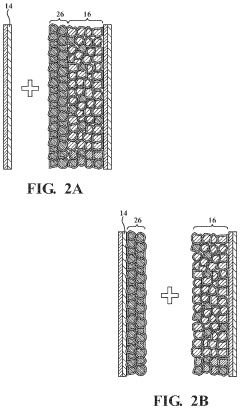
- An anode-free solid-state battery design that uses a cathode layer with transient anode elements, a bare current collector, and a gelled solid-state electrolyte layer to facilitate ionic conduction, eliminating the need for a permanent anode and simplifying the battery structure.



Anode interlayer for all-solid-state batteries and method of manufacturing the all-solid-state batteries
PatentWO2023023476A1
Innovation
- An anode interlayer is introduced between the anode current collector and the solid electrolyte, which is denser than the electrolyte, allowing uniform lithium deposition between the interlayer and the current collector, preventing contact with the electrolyte and maintaining layer stability, thereby enhancing energy density and preventing cell expansion.


Supply Chain Considerations for Scale-up Production
The scale-up production of anode-free solid-state batteries presents significant supply chain challenges that must be addressed to achieve commercial viability. Raw material sourcing emerges as a primary concern, particularly for critical components such as lithium metal, solid electrolytes, and specialized cathode materials. The limited global production capacity for high-purity lithium metal suitable for battery applications creates potential bottlenecks, while the novel solid electrolyte materials often require specialized processing techniques not widely available in existing manufacturing ecosystems.
Equipment and tooling requirements for anode-free solid-state battery production differ substantially from those used in conventional lithium-ion manufacturing. The handling of lithium metal and solid electrolytes demands specialized machinery operating in controlled environments with extremely low moisture levels. Currently, few contract manufacturers possess this specialized equipment, creating a significant barrier to rapid scale-up.
Supplier qualification represents another critical challenge in the supply chain. The nascent nature of solid-state battery technology means that supplier networks are underdeveloped compared to traditional battery manufacturing. Establishing reliable quality control protocols and certification processes for new materials suppliers will require substantial investment and time, potentially delaying production timelines.
Inventory management strategies must be reconsidered for anode-free solid-state batteries due to the reactive nature of lithium metal and the sensitivity of solid electrolytes to environmental conditions. Just-in-time manufacturing approaches may prove challenging, necessitating more robust storage solutions and potentially increasing working capital requirements for manufacturers.
Geographic considerations also impact supply chain resilience. Current solid electrolyte material production is concentrated in specific regions, creating potential vulnerabilities to geopolitical disruptions. Developing diversified sourcing strategies and considering regional manufacturing hubs could mitigate these risks while potentially reducing transportation costs and carbon footprint.
Cost modeling across the supply chain reveals that material costs currently dominate the production economics of anode-free solid-state batteries. As production scales, opportunities for cost reduction through process optimization and economies of scale will emerge, but initial manufacturing runs will likely face significant cost premiums compared to conventional lithium-ion batteries. Strategic partnerships with material suppliers and equipment manufacturers could help distribute development costs and accelerate the learning curve.
Equipment and tooling requirements for anode-free solid-state battery production differ substantially from those used in conventional lithium-ion manufacturing. The handling of lithium metal and solid electrolytes demands specialized machinery operating in controlled environments with extremely low moisture levels. Currently, few contract manufacturers possess this specialized equipment, creating a significant barrier to rapid scale-up.
Supplier qualification represents another critical challenge in the supply chain. The nascent nature of solid-state battery technology means that supplier networks are underdeveloped compared to traditional battery manufacturing. Establishing reliable quality control protocols and certification processes for new materials suppliers will require substantial investment and time, potentially delaying production timelines.
Inventory management strategies must be reconsidered for anode-free solid-state batteries due to the reactive nature of lithium metal and the sensitivity of solid electrolytes to environmental conditions. Just-in-time manufacturing approaches may prove challenging, necessitating more robust storage solutions and potentially increasing working capital requirements for manufacturers.
Geographic considerations also impact supply chain resilience. Current solid electrolyte material production is concentrated in specific regions, creating potential vulnerabilities to geopolitical disruptions. Developing diversified sourcing strategies and considering regional manufacturing hubs could mitigate these risks while potentially reducing transportation costs and carbon footprint.
Cost modeling across the supply chain reveals that material costs currently dominate the production economics of anode-free solid-state batteries. As production scales, opportunities for cost reduction through process optimization and economies of scale will emerge, but initial manufacturing runs will likely face significant cost premiums compared to conventional lithium-ion batteries. Strategic partnerships with material suppliers and equipment manufacturers could help distribute development costs and accelerate the learning curve.
Cost Analysis and Economic Viability Assessment
The economic viability of anode-free solid-state batteries (AFSSBs) represents a critical factor in determining their commercial feasibility for contract manufacturing. Current cost analyses indicate that AFSSBs have a potential cost advantage over conventional lithium-ion batteries in the long term, primarily due to the elimination of anode materials and simplified cell architecture. However, initial capital expenditure requirements remain significantly higher than traditional battery manufacturing facilities.
Manufacturing cost breakdowns reveal that solid electrolyte materials constitute approximately 35-40% of the total cell cost for AFSSBs, compared to 15-20% for electrolytes in conventional batteries. This cost differential is expected to decrease as production scales increase and manufacturing processes mature. Industry projections suggest that economies of scale could reduce solid electrolyte costs by 60-70% over the next five years, substantially improving the economic proposition.
Contract manufacturing readiness assessment indicates that the current cost structure presents challenges for immediate large-scale production. The specialized equipment required for solid-state battery manufacturing, particularly for electrolyte synthesis and cell assembly under controlled atmospheric conditions, demands investments 2.5-3 times higher than conventional lithium-ion battery production lines. These capital costs create significant barriers to entry for contract manufacturers without substantial financial backing.
Return on investment calculations demonstrate that contract manufacturing of AFSSBs could become economically viable when production volumes exceed 500 MWh annually, with payback periods estimated at 4-6 years under current market conditions. This timeline could be accelerated through strategic partnerships with automotive OEMs willing to commit to long-term supply agreements, effectively reducing financial risk for contract manufacturers.
Sensitivity analysis of key cost drivers reveals that solid electrolyte material costs and production yields have the most significant impact on economic viability. A 20% reduction in electrolyte costs or a 15% improvement in production yields could improve gross margins by approximately 8-10 percentage points, potentially transforming the business case for contract manufacturing. Additionally, government incentives for clean energy manufacturing could further enhance economic viability through tax credits, grants, or low-interest financing options.
The economic assessment must also consider the total cost of ownership benefits that AFSSBs offer to end users, including longer cycle life, improved safety, and potentially reduced battery management system complexity. These advantages may justify premium pricing strategies that could improve margins for contract manufacturers, particularly in high-value applications such as aerospace, premium electric vehicles, and grid storage systems.
Manufacturing cost breakdowns reveal that solid electrolyte materials constitute approximately 35-40% of the total cell cost for AFSSBs, compared to 15-20% for electrolytes in conventional batteries. This cost differential is expected to decrease as production scales increase and manufacturing processes mature. Industry projections suggest that economies of scale could reduce solid electrolyte costs by 60-70% over the next five years, substantially improving the economic proposition.
Contract manufacturing readiness assessment indicates that the current cost structure presents challenges for immediate large-scale production. The specialized equipment required for solid-state battery manufacturing, particularly for electrolyte synthesis and cell assembly under controlled atmospheric conditions, demands investments 2.5-3 times higher than conventional lithium-ion battery production lines. These capital costs create significant barriers to entry for contract manufacturers without substantial financial backing.
Return on investment calculations demonstrate that contract manufacturing of AFSSBs could become economically viable when production volumes exceed 500 MWh annually, with payback periods estimated at 4-6 years under current market conditions. This timeline could be accelerated through strategic partnerships with automotive OEMs willing to commit to long-term supply agreements, effectively reducing financial risk for contract manufacturers.
Sensitivity analysis of key cost drivers reveals that solid electrolyte material costs and production yields have the most significant impact on economic viability. A 20% reduction in electrolyte costs or a 15% improvement in production yields could improve gross margins by approximately 8-10 percentage points, potentially transforming the business case for contract manufacturing. Additionally, government incentives for clean energy manufacturing could further enhance economic viability through tax credits, grants, or low-interest financing options.
The economic assessment must also consider the total cost of ownership benefits that AFSSBs offer to end users, including longer cycle life, improved safety, and potentially reduced battery management system complexity. These advantages may justify premium pricing strategies that could improve margins for contract manufacturers, particularly in high-value applications such as aerospace, premium electric vehicles, and grid storage systems.
Unlock deeper insights with PatSnap Eureka Quick Research — get a full tech report to explore trends and direct your research. Try now!
Generate Your Research Report Instantly with AI Agent
Supercharge your innovation with PatSnap Eureka AI Agent Platform!