

Anode-Free Solid-State Mechanical Compliance Layers
SEP 1, 20259 MIN READ
Generate Your Research Report Instantly with AI Agent
PatSnap Eureka helps you evaluate technical feasibility & market potential.
Anode-Free Battery Technology Background and Objectives
The evolution of battery technology has witnessed significant advancements over the past decades, with lithium-ion batteries dominating the market since their commercial introduction in the early 1990s. However, conventional lithium-ion batteries face inherent limitations in energy density, safety, and longevity. Anode-free battery technology represents a revolutionary approach that eliminates the traditional graphite or silicon anode, potentially doubling energy density while reducing weight and manufacturing costs.
Anode-free batteries utilize metallic lithium that forms in situ during the initial charging process, directly on the current collector. This configuration maximizes the active material utilization and eliminates the "dead weight" of pre-lithiated anodes. The theoretical energy density of anode-free cells exceeds 500 Wh/kg, compared to approximately 250-300 Wh/kg for conventional lithium-ion batteries, making them particularly attractive for electric vehicles and portable electronics.
The integration of solid-state electrolytes with anode-free designs addresses critical safety concerns associated with liquid electrolytes, such as flammability and leakage risks. However, a significant challenge in this integration is the mechanical interface between the in situ formed lithium metal and the solid electrolyte. During cycling, lithium deposition and stripping cause volumetric changes that can create mechanical stress, leading to interface delamination and increased impedance.
Mechanical compliance layers (MCLs) emerge as a crucial technological component to accommodate these volumetric changes. These layers serve as buffer zones that maintain intimate contact between the lithium metal and solid electrolyte throughout cycling. The development of effective MCLs requires materials with specific mechanical properties, ionic conductivity, and chemical stability against lithium metal.
The primary objectives of research on anode-free solid-state mechanical compliance layers include: developing materials with optimal elasticity and plasticity to accommodate volume changes; ensuring high ionic conductivity to minimize interfacial resistance; achieving chemical and electrochemical stability against lithium metal; and designing manufacturing processes compatible with large-scale production.
Historical attempts at addressing mechanical interface issues have included polymer interlayers, composite materials, and engineered interfaces. Recent breakthroughs in material science, particularly in the field of soft matter physics and polymer chemistry, have opened new avenues for MCL development. The convergence of computational modeling, advanced characterization techniques, and high-throughput experimentation has accelerated progress in this field.
The successful development of effective MCLs would enable the commercialization of anode-free solid-state batteries with energy densities exceeding 500 Wh/kg, cycle life beyond 1000 cycles, and enhanced safety profiles. This technology could revolutionize energy storage across multiple sectors, from transportation to grid storage, supporting global efforts toward electrification and decarbonization.
Anode-free batteries utilize metallic lithium that forms in situ during the initial charging process, directly on the current collector. This configuration maximizes the active material utilization and eliminates the "dead weight" of pre-lithiated anodes. The theoretical energy density of anode-free cells exceeds 500 Wh/kg, compared to approximately 250-300 Wh/kg for conventional lithium-ion batteries, making them particularly attractive for electric vehicles and portable electronics.
The integration of solid-state electrolytes with anode-free designs addresses critical safety concerns associated with liquid electrolytes, such as flammability and leakage risks. However, a significant challenge in this integration is the mechanical interface between the in situ formed lithium metal and the solid electrolyte. During cycling, lithium deposition and stripping cause volumetric changes that can create mechanical stress, leading to interface delamination and increased impedance.
Mechanical compliance layers (MCLs) emerge as a crucial technological component to accommodate these volumetric changes. These layers serve as buffer zones that maintain intimate contact between the lithium metal and solid electrolyte throughout cycling. The development of effective MCLs requires materials with specific mechanical properties, ionic conductivity, and chemical stability against lithium metal.
The primary objectives of research on anode-free solid-state mechanical compliance layers include: developing materials with optimal elasticity and plasticity to accommodate volume changes; ensuring high ionic conductivity to minimize interfacial resistance; achieving chemical and electrochemical stability against lithium metal; and designing manufacturing processes compatible with large-scale production.
Historical attempts at addressing mechanical interface issues have included polymer interlayers, composite materials, and engineered interfaces. Recent breakthroughs in material science, particularly in the field of soft matter physics and polymer chemistry, have opened new avenues for MCL development. The convergence of computational modeling, advanced characterization techniques, and high-throughput experimentation has accelerated progress in this field.
The successful development of effective MCLs would enable the commercialization of anode-free solid-state batteries with energy densities exceeding 500 Wh/kg, cycle life beyond 1000 cycles, and enhanced safety profiles. This technology could revolutionize energy storage across multiple sectors, from transportation to grid storage, supporting global efforts toward electrification and decarbonization.
Market Analysis for Next-Generation Solid-State Batteries
The global market for solid-state batteries is experiencing unprecedented growth, driven by increasing demand for safer, higher energy density power solutions across multiple industries. Current projections indicate the solid-state battery market will reach approximately $8 billion by 2026, with a compound annual growth rate exceeding 34% between 2021 and 2026. This remarkable growth trajectory is primarily fueled by automotive applications, which represent nearly 60% of the total market value.
The electric vehicle (EV) sector presents the most significant market opportunity for next-generation solid-state batteries incorporating anode-free mechanical compliance layers. Major automotive manufacturers including Toyota, Volkswagen, and BMW have announced substantial investments totaling over $13.5 billion in solid-state battery technology development. The primary market drivers include stringent emissions regulations worldwide, consumer demand for longer-range EVs, and safety concerns with conventional lithium-ion batteries.
Consumer electronics represents the second-largest market segment, accounting for approximately 25% of potential solid-state battery applications. Manufacturers seek higher energy density solutions that enable thinner devices with longer operating times between charges. The premium smartphone and wearable technology segments demonstrate particular willingness to adopt advanced battery technologies, with consumers showing 70% higher purchase intent for devices offering significantly improved battery performance.
Aerospace and defense applications, while smaller in volume, offer premium pricing opportunities for solid-state batteries with mechanical compliance layers. This sector values the enhanced safety profile and operational reliability under extreme conditions, with specialized applications commanding price premiums up to five times higher than consumer-grade equivalents.
Geographically, Asia-Pacific dominates solid-state battery market development, with Japan and South Korea leading in patent filings related to mechanical compliance layer technologies. North America follows closely, with significant research initiatives at national laboratories and universities focusing specifically on anode-free designs. Europe shows strong market potential driven by automotive industry demand and supportive regulatory frameworks promoting battery manufacturing.
Market barriers include high production costs, with current solid-state batteries costing approximately three times more than conventional lithium-ion batteries. Manufacturing scalability remains challenging, particularly for technologies incorporating specialized mechanical compliance layers. However, industry analysts project production costs will decrease by 45% by 2025 as manufacturing processes mature and economies of scale are realized.
Customer adoption hinges on demonstrating performance advantages that justify premium pricing. Market research indicates commercial viability requires energy density improvements of at least 30% over conventional batteries, cycle life exceeding 1,000 charges, and fast-charging capabilities supporting 80% capacity in under 15 minutes.
The electric vehicle (EV) sector presents the most significant market opportunity for next-generation solid-state batteries incorporating anode-free mechanical compliance layers. Major automotive manufacturers including Toyota, Volkswagen, and BMW have announced substantial investments totaling over $13.5 billion in solid-state battery technology development. The primary market drivers include stringent emissions regulations worldwide, consumer demand for longer-range EVs, and safety concerns with conventional lithium-ion batteries.
Consumer electronics represents the second-largest market segment, accounting for approximately 25% of potential solid-state battery applications. Manufacturers seek higher energy density solutions that enable thinner devices with longer operating times between charges. The premium smartphone and wearable technology segments demonstrate particular willingness to adopt advanced battery technologies, with consumers showing 70% higher purchase intent for devices offering significantly improved battery performance.
Aerospace and defense applications, while smaller in volume, offer premium pricing opportunities for solid-state batteries with mechanical compliance layers. This sector values the enhanced safety profile and operational reliability under extreme conditions, with specialized applications commanding price premiums up to five times higher than consumer-grade equivalents.
Geographically, Asia-Pacific dominates solid-state battery market development, with Japan and South Korea leading in patent filings related to mechanical compliance layer technologies. North America follows closely, with significant research initiatives at national laboratories and universities focusing specifically on anode-free designs. Europe shows strong market potential driven by automotive industry demand and supportive regulatory frameworks promoting battery manufacturing.
Market barriers include high production costs, with current solid-state batteries costing approximately three times more than conventional lithium-ion batteries. Manufacturing scalability remains challenging, particularly for technologies incorporating specialized mechanical compliance layers. However, industry analysts project production costs will decrease by 45% by 2025 as manufacturing processes mature and economies of scale are realized.
Customer adoption hinges on demonstrating performance advantages that justify premium pricing. Market research indicates commercial viability requires energy density improvements of at least 30% over conventional batteries, cycle life exceeding 1,000 charges, and fast-charging capabilities supporting 80% capacity in under 15 minutes.
Technical Challenges in Mechanical Compliance Layers
The development of anode-free solid-state batteries represents a significant advancement in energy storage technology, yet the mechanical compliance layer presents several critical technical challenges. The interface between solid electrolytes and lithium metal anodes experiences substantial volume changes during cycling, creating mechanical stresses that can lead to interface delamination and battery failure.
One primary challenge is achieving optimal mechanical properties in compliance layers. These materials must simultaneously demonstrate sufficient elasticity to accommodate volume changes while maintaining adequate mechanical strength to prevent fracture. Current materials often excel in one property at the expense of the other, creating a fundamental design trade-off that limits performance.
Interfacial stability presents another significant hurdle. The compliance layer must maintain stable contact with both the solid electrolyte and the in-situ formed lithium metal during repeated cycling. Chemical compatibility issues often arise as lithium can react with components in the compliance layer, gradually degrading its mechanical properties and increasing interfacial resistance over time.
Ion transport across the compliance layer introduces additional complexity. The layer must facilitate efficient lithium-ion transport while preventing dendrite formation. Achieving high ionic conductivity without compromising mechanical properties remains difficult, as materials with excellent mechanical compliance often exhibit poor ionic conductivity and vice versa.
Manufacturing scalability poses substantial challenges for compliance layer implementation. Current laboratory-scale fabrication methods often involve complex processes that are difficult to scale for mass production. Techniques such as atomic layer deposition provide excellent control but are time-consuming and expensive for large-scale manufacturing.
Durability under extreme conditions represents another critical challenge. Compliance layers must maintain their properties across wide temperature ranges and withstand thousands of charge-discharge cycles. Many promising materials show rapid degradation under real-world operating conditions, limiting their practical application.
The integration of compliance layers with other battery components introduces additional engineering challenges. Ensuring uniform deposition and consistent thickness across large-format batteries remains problematic. Even minor variations in compliance layer properties can lead to localized stress concentrations and premature failure.
Analytical characterization of these interfaces presents significant technical difficulties. Real-time observation of interfacial phenomena during battery operation requires advanced in-situ techniques that are still being developed. This knowledge gap hinders the systematic optimization of compliance layer properties based on mechanistic understanding.
One primary challenge is achieving optimal mechanical properties in compliance layers. These materials must simultaneously demonstrate sufficient elasticity to accommodate volume changes while maintaining adequate mechanical strength to prevent fracture. Current materials often excel in one property at the expense of the other, creating a fundamental design trade-off that limits performance.
Interfacial stability presents another significant hurdle. The compliance layer must maintain stable contact with both the solid electrolyte and the in-situ formed lithium metal during repeated cycling. Chemical compatibility issues often arise as lithium can react with components in the compliance layer, gradually degrading its mechanical properties and increasing interfacial resistance over time.
Ion transport across the compliance layer introduces additional complexity. The layer must facilitate efficient lithium-ion transport while preventing dendrite formation. Achieving high ionic conductivity without compromising mechanical properties remains difficult, as materials with excellent mechanical compliance often exhibit poor ionic conductivity and vice versa.
Manufacturing scalability poses substantial challenges for compliance layer implementation. Current laboratory-scale fabrication methods often involve complex processes that are difficult to scale for mass production. Techniques such as atomic layer deposition provide excellent control but are time-consuming and expensive for large-scale manufacturing.
Durability under extreme conditions represents another critical challenge. Compliance layers must maintain their properties across wide temperature ranges and withstand thousands of charge-discharge cycles. Many promising materials show rapid degradation under real-world operating conditions, limiting their practical application.
The integration of compliance layers with other battery components introduces additional engineering challenges. Ensuring uniform deposition and consistent thickness across large-format batteries remains problematic. Even minor variations in compliance layer properties can lead to localized stress concentrations and premature failure.
Analytical characterization of these interfaces presents significant technical difficulties. Real-time observation of interfacial phenomena during battery operation requires advanced in-situ techniques that are still being developed. This knowledge gap hinders the systematic optimization of compliance layer properties based on mechanistic understanding.
Current Mechanical Compliance Layer Solutions
01 Anode-free solid-state battery designs with mechanical compliance layers
Anode-free solid-state batteries incorporate specialized mechanical compliance layers to accommodate volume changes during cycling. These designs eliminate the traditional anode structure, instead allowing lithium to plate directly onto a current collector during charging. The mechanical compliance layers help maintain interfacial contact between components, reduce mechanical stress, and improve cycling stability while enhancing energy density by removing the need for excess lithium in the anode.- Anode-free solid-state battery designs with mechanical compliance layers: Anode-free solid-state batteries incorporate specialized mechanical compliance layers to accommodate volume changes during cycling. These designs eliminate the traditional anode structure, instead allowing lithium to plate directly onto a current collector during charging. The mechanical compliance layers help maintain interfacial contact between components, reduce mechanical stress, and improve cycling stability by accommodating the dimensional changes that occur during lithium plating and stripping processes.
- Materials for mechanical compliance layers in solid-state batteries: Various materials are employed as mechanical compliance layers in solid-state battery systems to enhance performance and durability. These materials include polymeric composites, elastomeric substrates, and specialized coatings that provide the necessary flexibility while maintaining ionic conductivity. The selection of appropriate materials for these layers is critical for managing interfacial stress, preventing dendrite formation, and ensuring consistent electrical contact throughout battery cycling.
- Manufacturing techniques for compliance layers in battery systems: Advanced manufacturing techniques are employed to create effective mechanical compliance layers in battery systems. These methods include specialized coating processes, controlled deposition techniques, and innovative assembly approaches that ensure optimal interface formation between battery components. The manufacturing processes focus on creating uniform layers with consistent mechanical properties to enhance battery performance and longevity while maintaining scalability for commercial production.
- Testing and characterization methods for mechanical compliance in batteries: Various testing and characterization methods are employed to evaluate the effectiveness of mechanical compliance layers in battery systems. These include mechanical stress testing, electrochemical impedance spectroscopy, in-situ monitoring techniques, and accelerated aging tests. These methods help quantify the performance of compliance layers under different operating conditions and provide insights for optimizing their design and implementation in anode-free solid-state battery configurations.
- Integration of compliance layers with battery management systems: The integration of mechanical compliance layers with battery management systems enables enhanced monitoring and control of battery performance. This approach combines physical design elements with electronic monitoring to optimize battery operation, predict failure modes, and extend service life. Advanced sensors and control algorithms work in conjunction with the mechanical compliance layers to maintain optimal pressure distribution, temperature management, and overall system stability in anode-free solid-state battery configurations.
02 Materials for mechanical compliance layers in solid-state batteries
Various materials are employed as mechanical compliance layers in solid-state batteries to improve performance and durability. These materials include polymers, gels, and composite structures that can deform elastically under stress while maintaining ionic conductivity. The selection of appropriate materials for these layers is critical for accommodating volume changes during battery cycling, preventing delamination, and ensuring consistent electrical contact between battery components.Expand Specific Solutions03 Manufacturing techniques for compliance layers in battery systems
Specialized manufacturing techniques are employed to create effective mechanical compliance layers in battery systems. These methods include controlled deposition processes, lamination techniques, and precision coating approaches that ensure uniform layer thickness and proper integration with adjacent battery components. Advanced manufacturing processes help optimize the mechanical properties of these layers while maintaining necessary electrochemical characteristics for battery operation.Expand Specific Solutions04 Interface engineering for solid-state battery components
Interface engineering plays a crucial role in solid-state battery performance, particularly in systems with mechanical compliance layers. This involves designing and optimizing the interfaces between different battery components to minimize resistance, prevent unwanted reactions, and maintain structural integrity during cycling. Techniques include surface modification, gradient structures, and specialized coatings that improve adhesion and ion transport across component boundaries.Expand Specific Solutions05 Performance evaluation and testing methodologies for anode-free batteries
Specialized testing methodologies are developed to evaluate the performance of anode-free solid-state batteries with mechanical compliance layers. These include accelerated aging tests, mechanical stress simulations, and electrochemical characterization techniques that assess cycle life, rate capability, and failure mechanisms. Advanced analytical tools help quantify the effectiveness of compliance layers in maintaining battery performance under various operating conditions and mechanical stresses.Expand Specific Solutions
Leading Companies and Research Institutions in Solid-State Batteries
The anode-free solid-state mechanical compliance layer technology market is currently in an early growth phase, characterized by intensive R&D activities across automotive and electronics sectors. The global market is projected to expand significantly as solid-state battery technology matures, driven by demands for higher energy density and safety in electric vehicles. Major automotive players like Hyundai, Kia, GM, and Mercedes-Benz are actively developing this technology alongside specialized battery manufacturers including LG Energy Solution, Samsung SDI, and Murata Manufacturing. Research institutions such as Georgia Tech, Northwestern University, and Chinese Academy of Sciences are contributing fundamental innovations. Technical challenges remain in interface stability and manufacturing scalability, with companies like TeraWatt Technology and Honeycomb Battery focusing on commercial viability through novel material approaches.
LG Energy Solution Ltd.
Technical Solution: LG Energy Solution has developed a proprietary mechanical compliance layer (MCL) technology for anode-free solid-state batteries that addresses the critical interface issues between solid electrolytes and electrodes. Their approach utilizes a composite interlayer consisting of elastomeric polymers infused with ceramic fillers that maintains intimate contact during volume changes. The MCL technology employs a gradient structure with varying mechanical properties from the electrolyte to the current collector side, allowing for effective stress dissipation during cycling. LG's research demonstrates that their MCL can accommodate volume changes of up to 300% while maintaining ionic conductivity above 10^-4 S/cm at room temperature. Their implementation includes a specialized coating process that ensures uniform deposition of the compliance layer with controlled thickness between 5-20 μm, optimized for different cell designs.
Strengths: Superior mechanical flexibility that accommodates large volume changes while maintaining ionic conductivity; scalable manufacturing process compatible with existing production lines. Weaknesses: The polymer components may limit high-temperature operation; potential long-term stability issues under extreme cycling conditions.
Samsung SDI Co., Ltd.
Technical Solution: Samsung SDI has pioneered an advanced mechanical compliance layer system specifically designed for anode-free solid-state batteries. Their technology utilizes a multi-functional interlayer composed of a polymer-ceramic composite with gradient porosity that effectively manages the mechanical stresses during lithium plating and stripping cycles. The compliance layer incorporates nano-engineered structures with controlled elasticity (Young's modulus ranging from 0.5-5 GPa) that maintain intimate contact between the solid electrolyte and the current collector. Samsung's approach includes a proprietary surface treatment of the current collector that enhances lithium nucleation and distribution, preventing dendrite formation. Their research shows that this MCL system enables stable cycling with over 85% capacity retention after 500 cycles at 1C rate, while operating at pressures below 5 MPa - significantly lower than conventional solid-state systems requiring 10-20 MPa.
Strengths: Excellent mechanical stability with minimal external pressure requirements; superior cycle life performance; effective dendrite suppression. Weaknesses: Complex manufacturing process with multiple specialized materials; potential cost implications for commercial scaling.
Key Patents and Innovations in Interface Engineering
Anode-free solid-state battery and method of battery fabrication
PatentActiveUS11824159B2
Innovation
- An anode-free solid-state battery design that uses a cathode layer with transient anode elements, a bare current collector, and a gelled solid-state electrolyte layer to facilitate ionic conduction, eliminating the need for a permanent anode and simplifying the battery structure.

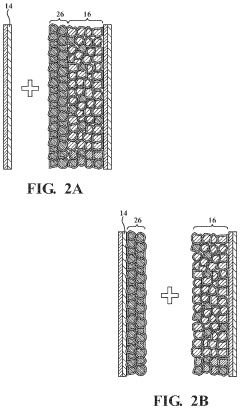


Anode composite layer for a solid-state battery of an at least partially electrically operated motor vehicle, and solid-state battery
PatentWO2024121208A1
Innovation
- An anode composite layer with eutectic metal alloys is introduced, placed between the solid electrolyte and current collector, which reduces chemical reactions and enables reversible lithium deposition by forming alloys with lithium, thereby improving cycle performance and safety.


Materials Science Advancements for Compliance Layers
Recent advancements in materials science have significantly propelled the development of mechanical compliance layers for anode-free solid-state batteries. These specialized interfacial components serve as critical elements that accommodate volume changes during battery cycling while maintaining excellent ionic conductivity. The evolution of these materials has been marked by a transition from traditional polymeric materials to advanced composite structures with engineered properties.
Nano-structured materials have emerged as promising candidates for compliance layers, offering superior mechanical flexibility while maintaining structural integrity. Carbon-based materials, including graphene derivatives and carbon nanotubes, demonstrate exceptional elasticity and conductivity properties when incorporated into compliance layer formulations. These materials can withstand significant strain without compromising their electronic transport capabilities, making them ideal for battery interfaces subject to mechanical stress.
Polymer-ceramic composites represent another breakthrough in compliance layer technology. By combining the flexibility of polymers with the ionic conductivity and mechanical stability of ceramics, researchers have developed hybrid materials that effectively bridge the gap between solid electrolytes and electrode materials. These composites typically incorporate nanoscale ceramic fillers within a polymer matrix, creating pathways for ion transport while maintaining mechanical compliance.
Self-healing materials constitute a revolutionary approach to compliance layer design. These materials contain microencapsulated healing agents or dynamic chemical bonds that can repair mechanical damage autonomously. When microcracks form during battery cycling, these self-healing mechanisms activate to restore interfacial contact, significantly extending battery lifespan and performance stability. Recent research has demonstrated compliance layers with up to 85% recovery of mechanical properties after damage events.
Surface modification techniques have also advanced considerably, enabling precise engineering of interfacial properties. Atomic layer deposition and molecular layer deposition allow for nanometer-scale control over compliance layer composition and structure. These techniques facilitate the creation of gradient interfaces that gradually transition between the properties of adjacent battery components, minimizing mechanical stress concentrations.
Biomimetic approaches have inspired novel compliance layer designs based on natural structures with exceptional mechanical properties. Materials mimicking the hierarchical organization of nacre or spider silk demonstrate remarkable combinations of strength and flexibility. These bio-inspired structures typically feature ordered arrangements of hard and soft phases that work synergistically to distribute mechanical stress while maintaining functional properties.
Nano-structured materials have emerged as promising candidates for compliance layers, offering superior mechanical flexibility while maintaining structural integrity. Carbon-based materials, including graphene derivatives and carbon nanotubes, demonstrate exceptional elasticity and conductivity properties when incorporated into compliance layer formulations. These materials can withstand significant strain without compromising their electronic transport capabilities, making them ideal for battery interfaces subject to mechanical stress.
Polymer-ceramic composites represent another breakthrough in compliance layer technology. By combining the flexibility of polymers with the ionic conductivity and mechanical stability of ceramics, researchers have developed hybrid materials that effectively bridge the gap between solid electrolytes and electrode materials. These composites typically incorporate nanoscale ceramic fillers within a polymer matrix, creating pathways for ion transport while maintaining mechanical compliance.
Self-healing materials constitute a revolutionary approach to compliance layer design. These materials contain microencapsulated healing agents or dynamic chemical bonds that can repair mechanical damage autonomously. When microcracks form during battery cycling, these self-healing mechanisms activate to restore interfacial contact, significantly extending battery lifespan and performance stability. Recent research has demonstrated compliance layers with up to 85% recovery of mechanical properties after damage events.
Surface modification techniques have also advanced considerably, enabling precise engineering of interfacial properties. Atomic layer deposition and molecular layer deposition allow for nanometer-scale control over compliance layer composition and structure. These techniques facilitate the creation of gradient interfaces that gradually transition between the properties of adjacent battery components, minimizing mechanical stress concentrations.
Biomimetic approaches have inspired novel compliance layer designs based on natural structures with exceptional mechanical properties. Materials mimicking the hierarchical organization of nacre or spider silk demonstrate remarkable combinations of strength and flexibility. These bio-inspired structures typically feature ordered arrangements of hard and soft phases that work synergistically to distribute mechanical stress while maintaining functional properties.
Safety and Performance Benchmarking Methodologies
The development of standardized safety and performance benchmarking methodologies is critical for advancing anode-free solid-state batteries with mechanical compliance layers. Current evaluation frameworks remain fragmented across research institutions, making direct comparisons between different compliance layer solutions challenging and potentially misleading.
Mechanical integrity testing represents a fundamental benchmarking requirement, focusing on the compliance layer's ability to accommodate volume changes during cycling. Standardized protocols should include controlled compression testing, in-situ strain measurements during cycling, and accelerated stress testing to simulate long-term operational conditions. These tests must be conducted under uniform temperature and pressure conditions to ensure reproducibility.
Electrochemical performance benchmarking necessitates comprehensive protocols measuring interfacial resistance, rate capability, and cycling stability. The unique nature of anode-free configurations requires specialized testing parameters, including first-cycle lithium plating efficiency and dendrite nucleation thresholds. Industry consensus is emerging around testing at various C-rates (0.1C to 2C) and extended cycling (>500 cycles) to properly evaluate compliance layer functionality.
Safety evaluation methodologies must address the specific failure modes of anode-free systems with compliance layers. Thermal runaway testing, nail penetration tests, and overcharge/overdischarge protocols need modification to account for the altered failure mechanisms in these novel battery architectures. Particularly important is the development of standardized testing for mechanical abuse tolerance, as compliance layers fundamentally alter the mechanical response characteristics of the battery.
Comparative benchmarking frameworks must establish baseline performance metrics against which new compliance layer technologies can be evaluated. This includes direct comparison with conventional liquid electrolyte systems, traditional solid-state batteries without compliance layers, and commercial lithium-ion batteries. Such frameworks should incorporate normalized metrics accounting for differences in active material loading and cell design.
Accelerated aging protocols represent another critical benchmarking need, as the long-term stability of compliance layers remains largely unproven. Calendar aging under various temperature conditions, combined with periodic performance testing, provides insights into degradation mechanisms specific to these interfaces. Industry standards are gradually converging toward 1000-hour testing protocols at elevated temperatures (45-60°C) to simulate years of operational life.
Mechanical integrity testing represents a fundamental benchmarking requirement, focusing on the compliance layer's ability to accommodate volume changes during cycling. Standardized protocols should include controlled compression testing, in-situ strain measurements during cycling, and accelerated stress testing to simulate long-term operational conditions. These tests must be conducted under uniform temperature and pressure conditions to ensure reproducibility.
Electrochemical performance benchmarking necessitates comprehensive protocols measuring interfacial resistance, rate capability, and cycling stability. The unique nature of anode-free configurations requires specialized testing parameters, including first-cycle lithium plating efficiency and dendrite nucleation thresholds. Industry consensus is emerging around testing at various C-rates (0.1C to 2C) and extended cycling (>500 cycles) to properly evaluate compliance layer functionality.
Safety evaluation methodologies must address the specific failure modes of anode-free systems with compliance layers. Thermal runaway testing, nail penetration tests, and overcharge/overdischarge protocols need modification to account for the altered failure mechanisms in these novel battery architectures. Particularly important is the development of standardized testing for mechanical abuse tolerance, as compliance layers fundamentally alter the mechanical response characteristics of the battery.
Comparative benchmarking frameworks must establish baseline performance metrics against which new compliance layer technologies can be evaluated. This includes direct comparison with conventional liquid electrolyte systems, traditional solid-state batteries without compliance layers, and commercial lithium-ion batteries. Such frameworks should incorporate normalized metrics accounting for differences in active material loading and cell design.
Accelerated aging protocols represent another critical benchmarking need, as the long-term stability of compliance layers remains largely unproven. Calendar aging under various temperature conditions, combined with periodic performance testing, provides insights into degradation mechanisms specific to these interfaces. Industry standards are gradually converging toward 1000-hour testing protocols at elevated temperatures (45-60°C) to simulate years of operational life.
Unlock deeper insights with PatSnap Eureka Quick Research — get a full tech report to explore trends and direct your research. Try now!
Generate Your Research Report Instantly with AI Agent
Supercharge your innovation with PatSnap Eureka AI Agent Platform!