

Critical Considerations for PNP Transistor Schematic Design
JUL 28, 20259 MIN READ
Generate Your Research Report Instantly with AI Agent
PatSnap Eureka helps you evaluate technical feasibility & market potential.
PNP Transistor Fundamentals and Design Objectives
PNP transistors have been a fundamental component in electronic circuit design since their inception in the mid-20th century. These devices, characterized by their ability to control current flow using a small input signal, have played a crucial role in the development of modern electronics. The evolution of PNP transistor technology has been marked by continuous improvements in performance, efficiency, and miniaturization.
The primary objective in PNP transistor schematic design is to achieve optimal performance while addressing key considerations such as power consumption, thermal management, and signal integrity. Designers aim to maximize the transistor's gain, minimize noise, and ensure stable operation across a wide range of operating conditions. Additionally, there is a growing emphasis on reducing the overall footprint of transistor-based circuits to meet the demands of increasingly compact electronic devices.
One of the critical trends in PNP transistor development is the push towards higher frequency operation. As electronic systems continue to demand faster processing speeds and increased bandwidth, transistor designs must evolve to support these requirements. This has led to innovations in materials science and fabrication techniques, resulting in PNP transistors capable of operating at frequencies well into the gigahertz range.
Another significant trend is the focus on power efficiency. With the proliferation of battery-powered devices and the growing concern for energy conservation, designers are constantly seeking ways to reduce power consumption in transistor circuits. This has driven research into low-voltage and low-power PNP transistor designs, as well as the development of advanced biasing techniques to optimize power usage.
The integration of PNP transistors with other semiconductor technologies has also become a key area of development. As mixed-signal circuits become more prevalent, there is a need for PNP transistors that can seamlessly interface with digital components and operate effectively in hybrid analog-digital environments. This has led to the creation of specialized PNP transistor designs optimized for specific applications, such as high-speed switching or precision analog processing.
Looking ahead, the future of PNP transistor technology is likely to be shaped by emerging fields such as quantum computing and neuromorphic engineering. These cutting-edge areas of research may lead to novel transistor architectures that push the boundaries of current semiconductor technology, potentially revolutionizing the way we approach electronic circuit design.
The primary objective in PNP transistor schematic design is to achieve optimal performance while addressing key considerations such as power consumption, thermal management, and signal integrity. Designers aim to maximize the transistor's gain, minimize noise, and ensure stable operation across a wide range of operating conditions. Additionally, there is a growing emphasis on reducing the overall footprint of transistor-based circuits to meet the demands of increasingly compact electronic devices.
One of the critical trends in PNP transistor development is the push towards higher frequency operation. As electronic systems continue to demand faster processing speeds and increased bandwidth, transistor designs must evolve to support these requirements. This has led to innovations in materials science and fabrication techniques, resulting in PNP transistors capable of operating at frequencies well into the gigahertz range.
Another significant trend is the focus on power efficiency. With the proliferation of battery-powered devices and the growing concern for energy conservation, designers are constantly seeking ways to reduce power consumption in transistor circuits. This has driven research into low-voltage and low-power PNP transistor designs, as well as the development of advanced biasing techniques to optimize power usage.
The integration of PNP transistors with other semiconductor technologies has also become a key area of development. As mixed-signal circuits become more prevalent, there is a need for PNP transistors that can seamlessly interface with digital components and operate effectively in hybrid analog-digital environments. This has led to the creation of specialized PNP transistor designs optimized for specific applications, such as high-speed switching or precision analog processing.
Looking ahead, the future of PNP transistor technology is likely to be shaped by emerging fields such as quantum computing and neuromorphic engineering. These cutting-edge areas of research may lead to novel transistor architectures that push the boundaries of current semiconductor technology, potentially revolutionizing the way we approach electronic circuit design.
Market Demand for PNP Transistor Applications
The market demand for PNP transistor applications has been steadily growing across various industries, driven by the increasing need for efficient power management and signal processing in electronic devices. The global semiconductor market, which includes transistors, is projected to reach $726 billion by 2027, with a significant portion attributed to discrete semiconductor components like PNP transistors.
In the consumer electronics sector, PNP transistors play a crucial role in power management circuits for smartphones, tablets, and laptops. The rapid proliferation of these devices, coupled with the trend towards more energy-efficient designs, has led to a surge in demand for high-performance PNP transistors. This segment of the market is expected to grow at a compound annual growth rate (CAGR) of 6.8% from 2022 to 2027.
The automotive industry represents another significant market for PNP transistors, particularly in electric and hybrid vehicles. These transistors are essential components in battery management systems, motor controllers, and various sensor interfaces. With the global electric vehicle market projected to expand at a CAGR of 22.5% from 2022 to 2030, the demand for PNP transistors in this sector is poised for substantial growth.
Industrial automation and control systems also contribute to the increasing market demand for PNP transistors. These components are widely used in programmable logic controllers (PLCs), motor drives, and sensor interfaces. The industrial automation market is expected to reach $306 billion by 2027, with a CAGR of 8.9% from 2022 to 2027, indicating a strong potential for PNP transistor applications in this sector.
The telecommunications industry, particularly with the ongoing rollout of 5G networks, presents another significant market opportunity for PNP transistors. These components are crucial in the design of power amplifiers, switches, and other RF circuits used in base stations and mobile devices. The global 5G infrastructure market is projected to grow at a CAGR of 49.8% from 2022 to 2030, driving the demand for high-performance PNP transistors.
In the medical electronics sector, PNP transistors find applications in various diagnostic and therapeutic devices, such as patient monitoring systems, imaging equipment, and portable medical devices. The medical electronics market is expected to reach $195 billion by 2027, growing at a CAGR of 6.4% from 2022 to 2027, indicating a steady demand for PNP transistors in this field.
The emerging Internet of Things (IoT) ecosystem also contributes to the market demand for PNP transistors. These components are essential in the design of low-power sensor nodes, wearable devices, and smart home appliances. The global IoT market is projected to grow at a CAGR of 26.4% from 2022 to 2027, presenting significant opportunities for PNP transistor applications in compact, energy-efficient designs.
In the consumer electronics sector, PNP transistors play a crucial role in power management circuits for smartphones, tablets, and laptops. The rapid proliferation of these devices, coupled with the trend towards more energy-efficient designs, has led to a surge in demand for high-performance PNP transistors. This segment of the market is expected to grow at a compound annual growth rate (CAGR) of 6.8% from 2022 to 2027.
The automotive industry represents another significant market for PNP transistors, particularly in electric and hybrid vehicles. These transistors are essential components in battery management systems, motor controllers, and various sensor interfaces. With the global electric vehicle market projected to expand at a CAGR of 22.5% from 2022 to 2030, the demand for PNP transistors in this sector is poised for substantial growth.
Industrial automation and control systems also contribute to the increasing market demand for PNP transistors. These components are widely used in programmable logic controllers (PLCs), motor drives, and sensor interfaces. The industrial automation market is expected to reach $306 billion by 2027, with a CAGR of 8.9% from 2022 to 2027, indicating a strong potential for PNP transistor applications in this sector.
The telecommunications industry, particularly with the ongoing rollout of 5G networks, presents another significant market opportunity for PNP transistors. These components are crucial in the design of power amplifiers, switches, and other RF circuits used in base stations and mobile devices. The global 5G infrastructure market is projected to grow at a CAGR of 49.8% from 2022 to 2030, driving the demand for high-performance PNP transistors.
In the medical electronics sector, PNP transistors find applications in various diagnostic and therapeutic devices, such as patient monitoring systems, imaging equipment, and portable medical devices. The medical electronics market is expected to reach $195 billion by 2027, growing at a CAGR of 6.4% from 2022 to 2027, indicating a steady demand for PNP transistors in this field.
The emerging Internet of Things (IoT) ecosystem also contributes to the market demand for PNP transistors. These components are essential in the design of low-power sensor nodes, wearable devices, and smart home appliances. The global IoT market is projected to grow at a CAGR of 26.4% from 2022 to 2027, presenting significant opportunities for PNP transistor applications in compact, energy-efficient designs.
Current Challenges in PNP Transistor Design
PNP transistor design faces several critical challenges in today's semiconductor industry. One of the primary issues is the inherent slower switching speed compared to NPN transistors. This limitation arises from the lower mobility of holes, which are the majority carriers in PNP devices. As a result, designers must carefully consider trade-offs between speed and other performance parameters when incorporating PNP transistors into high-frequency circuits.
Another significant challenge is the management of parasitic capacitances, particularly the base-collector capacitance. This capacitance can lead to unwanted feedback and potential instability in amplifier circuits. Minimizing these parasitic effects requires meticulous layout techniques and often involves compromises in other design aspects, such as current gain or breakdown voltage.
The issue of thermal management also presents a considerable hurdle in PNP transistor design. PNP devices tend to generate more heat than their NPN counterparts due to their lower current gain and higher on-resistance. This thermal concern becomes especially critical in high-power applications or densely packed integrated circuits, where heat dissipation can significantly impact overall performance and reliability.
Furthermore, achieving high current gain (β) in PNP transistors remains a persistent challenge. The lower hole mobility not only affects switching speed but also results in generally lower current gains compared to NPN transistors. This limitation often necessitates more complex circuit designs to achieve the desired amplification or switching characteristics.
The voltage breakdown characteristics of PNP transistors also pose design challenges. The reverse breakdown voltage of the base-emitter junction is typically lower in PNP devices, which can restrict the operating voltage range and complicate circuit protection strategies. Designers must carefully consider these voltage limitations when developing high-voltage or power management circuits.
Additionally, the process variations in PNP transistor manufacturing can lead to inconsistencies in device characteristics. These variations can affect parameters such as current gain, threshold voltage, and leakage currents, making it challenging to design robust circuits that perform consistently across different manufacturing batches or environmental conditions.
Lastly, the integration of PNP transistors in modern CMOS processes presents its own set of challenges. While vertical PNP transistors are relatively easy to implement, lateral PNP devices, which are often preferred for their better frequency response, require more complex fabrication steps. This complexity can increase manufacturing costs and potentially impact yield, especially in advanced process nodes.
Another significant challenge is the management of parasitic capacitances, particularly the base-collector capacitance. This capacitance can lead to unwanted feedback and potential instability in amplifier circuits. Minimizing these parasitic effects requires meticulous layout techniques and often involves compromises in other design aspects, such as current gain or breakdown voltage.
The issue of thermal management also presents a considerable hurdle in PNP transistor design. PNP devices tend to generate more heat than their NPN counterparts due to their lower current gain and higher on-resistance. This thermal concern becomes especially critical in high-power applications or densely packed integrated circuits, where heat dissipation can significantly impact overall performance and reliability.
Furthermore, achieving high current gain (β) in PNP transistors remains a persistent challenge. The lower hole mobility not only affects switching speed but also results in generally lower current gains compared to NPN transistors. This limitation often necessitates more complex circuit designs to achieve the desired amplification or switching characteristics.
The voltage breakdown characteristics of PNP transistors also pose design challenges. The reverse breakdown voltage of the base-emitter junction is typically lower in PNP devices, which can restrict the operating voltage range and complicate circuit protection strategies. Designers must carefully consider these voltage limitations when developing high-voltage or power management circuits.
Additionally, the process variations in PNP transistor manufacturing can lead to inconsistencies in device characteristics. These variations can affect parameters such as current gain, threshold voltage, and leakage currents, making it challenging to design robust circuits that perform consistently across different manufacturing batches or environmental conditions.
Lastly, the integration of PNP transistors in modern CMOS processes presents its own set of challenges. While vertical PNP transistors are relatively easy to implement, lateral PNP devices, which are often preferred for their better frequency response, require more complex fabrication steps. This complexity can increase manufacturing costs and potentially impact yield, especially in advanced process nodes.
Existing PNP Transistor Schematic Solutions
01 Schematic design tools for PNP transistors
Various software tools and platforms are available for designing PNP transistor schematics. These tools often include features for circuit simulation, component placement, and automated routing. They help engineers create accurate and efficient designs for PNP transistor circuits.- Schematic design and layout optimization: This involves creating and optimizing the schematic design for PNP transistors, focusing on efficient layout techniques and component placement to improve overall circuit performance. The process includes considering factors such as signal integrity, power distribution, and thermal management to ensure optimal transistor operation.
- Automated design and verification tools: Utilizing automated design and verification tools to streamline the PNP transistor schematic design process. These tools can help in creating, simulating, and validating transistor designs, reducing errors and improving efficiency in the design workflow.
- Circuit simulation and analysis: Implementing circuit simulation and analysis techniques to evaluate the performance of PNP transistor designs. This includes using various simulation models and tools to predict transistor behavior, analyze circuit characteristics, and optimize design parameters for improved functionality.
- Design rule checking and verification: Applying design rule checking and verification processes to ensure that PNP transistor schematics meet specified design constraints and manufacturing requirements. This involves using automated tools to detect and correct potential issues in the schematic design before fabrication.
- Integration with larger circuit designs: Incorporating PNP transistor schematics into larger circuit designs and systems. This includes considering the interaction between the transistor and other components, optimizing signal paths, and ensuring proper integration with surrounding circuitry to achieve desired overall system performance.
02 Optimization techniques for PNP transistor layouts
Advanced optimization techniques are employed to improve the performance and efficiency of PNP transistor layouts. These methods may involve automated algorithms for component placement, routing optimization, and parasitic reduction to enhance the overall circuit design.Expand Specific Solutions03 Integration of PNP transistors in complex circuits
Methods for integrating PNP transistors into larger, more complex circuits are crucial for modern electronic designs. This involves considerations for signal integrity, power distribution, and thermal management to ensure optimal performance of the PNP transistors within the overall system.Expand Specific Solutions04 Verification and testing of PNP transistor designs
Robust verification and testing procedures are essential for ensuring the reliability and functionality of PNP transistor designs. This includes simulation-based testing, design rule checks, and automated verification processes to identify and resolve potential issues before fabrication.Expand Specific Solutions05 Advanced modeling techniques for PNP transistors
Sophisticated modeling techniques are used to accurately represent PNP transistor behavior in schematic designs. These models account for various physical phenomena and parasitic effects, enabling more precise simulations and better prediction of circuit performance.Expand Specific Solutions
Key Players in PNP Transistor Manufacturing
The PNP transistor schematic design market is in a mature stage, with established players dominating the industry. The global market size for transistors, including PNP types, is substantial, driven by increasing demand in consumer electronics, automotive, and industrial applications. Technologically, PNP transistor design is well-established, but ongoing innovations focus on improving efficiency and miniaturization. Key players like Infineon Technologies, Texas Instruments, and GlobalFoundries lead in advanced semiconductor manufacturing, while companies such as IBM and Siemens contribute significant research and development. Emerging players from China, including Shanghai Huahong Grace and SMIC, are rapidly advancing their capabilities, intensifying global competition in this critical semiconductor segment.
Infineon Technologies AG
Technical Solution: Infineon Technologies AG has developed advanced PNP transistor designs optimized for high-frequency applications. Their approach involves using SiGe (Silicon-Germanium) technology to enhance the performance of PNP transistors. The company's PNP transistors feature a vertical structure with a thin base region, allowing for faster switching speeds and higher current gain. Infineon has also implemented advanced doping profiles and emitter scaling techniques to improve the transistor's frequency response and reduce parasitic capacitances[1][3]. Their designs incorporate self-aligned emitter-base structures to minimize base resistance and improve high-frequency performance. Additionally, Infineon has developed proprietary isolation techniques to reduce substrate coupling and enhance overall circuit performance in mixed-signal applications[2].
Strengths: Superior high-frequency performance, reduced parasitic capacitances, and improved current gain. Weaknesses: Potentially higher manufacturing costs due to advanced process technologies and more complex fabrication steps.
International Business Machines Corp.
Technical Solution: IBM has made significant advancements in PNP transistor design, particularly focusing on improving power efficiency and reducing noise in analog and mixed-signal circuits. Their approach involves using a combination of silicon-on-insulator (SOI) technology and advanced lithography techniques to create ultra-thin body PNP transistors. IBM's design incorporates a fully depleted channel region, which helps to minimize short-channel effects and improve overall device performance. The company has also developed innovative strain engineering techniques to enhance hole mobility in the PNP structure, leading to improved current drive capabilities[4]. Furthermore, IBM has implemented advanced contact engineering methods to reduce parasitic resistances and optimize the transistor's frequency response[5]. Their PNP transistor designs also feature carefully optimized doping profiles to balance between high current gain and breakdown voltage requirements.
Strengths: Excellent power efficiency, reduced noise in analog circuits, and improved scalability. Weaknesses: Potentially higher initial production costs and complexity in integrating with existing semiconductor processes.
Core Innovations in PNP Transistor Design
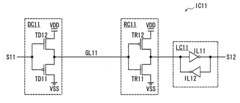
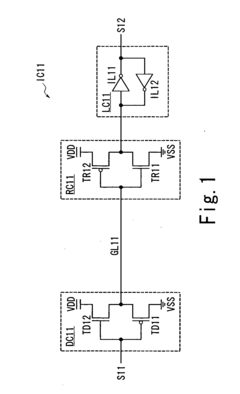
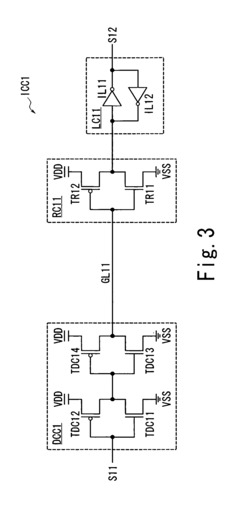
Semiconductor integrated circuit
PatentInactiveUS20070170954A1
Innovation
- Incorporating a driver circuit with p-type and n-type transistors to reduce signal amplitude, specifically connecting transistors to low and high power supply lines, and using transistors with gates receiving input signals to manage signal transmission across signal lines, thereby reducing power consumption.

High output current buffer
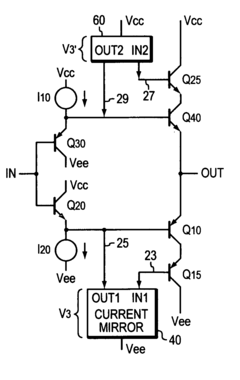
PatentInactiveUS20070159255A1
Innovation
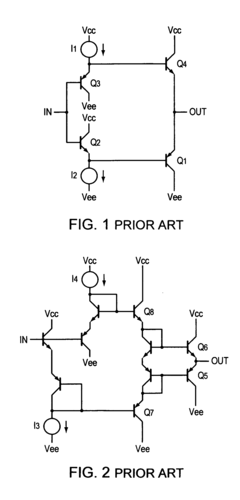
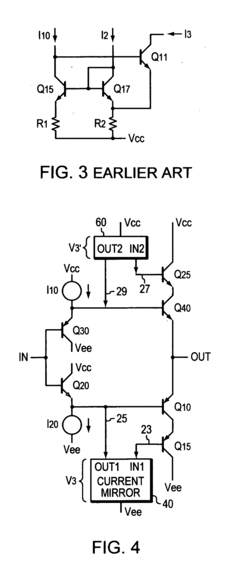
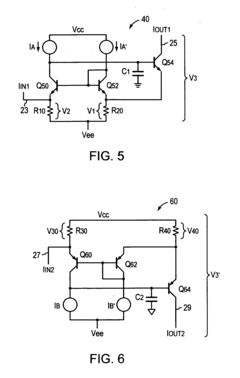
- The proposed solution involves a bipolar transistor configuration with a current mirror approach, where the emitter of a second transistor is coupled to the collector of the first transistor, and a feedback loop is formed with additional transistors to reduce quiescent power dissipation while maintaining high output current and dynamic range, using a configuration similar to U.S. Pat. No. 4,574,233 but with distinct differences.
Thermal Management in PNP Transistor Circuits
Thermal management is a critical aspect of PNP transistor circuit design, particularly in high-power applications where excessive heat generation can significantly impact performance and reliability. Effective thermal management strategies are essential to maintain optimal operating temperatures and prevent thermal runaway, which can lead to device failure or reduced lifespan.
One of the primary considerations in thermal management for PNP transistor circuits is the selection of appropriate heat sinking methods. Heat sinks are designed to dissipate excess heat generated by the transistor, typically through conduction and convection. The choice of heat sink material, size, and design depends on factors such as the power dissipation of the transistor, ambient temperature, and available space within the circuit enclosure.
Thermal resistance is a key parameter in heat sink selection, representing the ability of the heat sink to transfer heat from the transistor to the surrounding environment. Lower thermal resistance values indicate better heat dissipation capabilities. Engineers must carefully calculate the total thermal resistance of the system, including the junction-to-case, case-to-heat sink, and heat sink-to-ambient thermal resistances, to ensure adequate cooling.
In addition to heat sinks, thermal interface materials (TIMs) play a crucial role in enhancing heat transfer between the transistor and the heat sink. These materials, such as thermal greases, pads, or adhesives, fill microscopic air gaps and improve thermal conductivity. The selection of an appropriate TIM depends on factors like thermal conductivity, ease of application, and long-term reliability.
Active cooling methods, such as forced-air cooling or liquid cooling systems, may be necessary for high-power PNP transistor circuits. Forced-air cooling typically involves the use of fans or blowers to increase air circulation and enhance convective heat transfer. Liquid cooling systems, while more complex, offer superior heat dissipation capabilities for extremely high-power applications.
Thermal simulation and modeling tools are invaluable in the design process, allowing engineers to predict and optimize thermal performance before physical prototyping. These tools can help identify potential hot spots, evaluate different cooling strategies, and optimize component placement for improved thermal management.
Circuit board layout and design also play a significant role in thermal management. Proper component spacing, the use of thermal vias, and strategic placement of heat-generating components can help distribute heat more evenly across the board and improve overall thermal performance.
Implementing temperature monitoring and protection circuits is another important aspect of thermal management in PNP transistor circuits. These circuits can detect excessive temperatures and trigger protective measures, such as reducing power output or shutting down the circuit entirely, to prevent thermal damage.
One of the primary considerations in thermal management for PNP transistor circuits is the selection of appropriate heat sinking methods. Heat sinks are designed to dissipate excess heat generated by the transistor, typically through conduction and convection. The choice of heat sink material, size, and design depends on factors such as the power dissipation of the transistor, ambient temperature, and available space within the circuit enclosure.
Thermal resistance is a key parameter in heat sink selection, representing the ability of the heat sink to transfer heat from the transistor to the surrounding environment. Lower thermal resistance values indicate better heat dissipation capabilities. Engineers must carefully calculate the total thermal resistance of the system, including the junction-to-case, case-to-heat sink, and heat sink-to-ambient thermal resistances, to ensure adequate cooling.
In addition to heat sinks, thermal interface materials (TIMs) play a crucial role in enhancing heat transfer between the transistor and the heat sink. These materials, such as thermal greases, pads, or adhesives, fill microscopic air gaps and improve thermal conductivity. The selection of an appropriate TIM depends on factors like thermal conductivity, ease of application, and long-term reliability.
Active cooling methods, such as forced-air cooling or liquid cooling systems, may be necessary for high-power PNP transistor circuits. Forced-air cooling typically involves the use of fans or blowers to increase air circulation and enhance convective heat transfer. Liquid cooling systems, while more complex, offer superior heat dissipation capabilities for extremely high-power applications.
Thermal simulation and modeling tools are invaluable in the design process, allowing engineers to predict and optimize thermal performance before physical prototyping. These tools can help identify potential hot spots, evaluate different cooling strategies, and optimize component placement for improved thermal management.
Circuit board layout and design also play a significant role in thermal management. Proper component spacing, the use of thermal vias, and strategic placement of heat-generating components can help distribute heat more evenly across the board and improve overall thermal performance.
Implementing temperature monitoring and protection circuits is another important aspect of thermal management in PNP transistor circuits. These circuits can detect excessive temperatures and trigger protective measures, such as reducing power output or shutting down the circuit entirely, to prevent thermal damage.
Reliability and Lifespan Considerations
Reliability and lifespan considerations are crucial aspects in the design of PNP transistor schematics, as they directly impact the overall performance and longevity of electronic systems. When designing circuits incorporating PNP transistors, engineers must carefully evaluate and address several key factors to ensure optimal reliability and extended operational life.
One primary consideration is the thermal management of PNP transistors. As these devices generate heat during operation, proper thermal design is essential to prevent premature failure and maintain consistent performance over time. This involves selecting appropriate heat sinks, implementing effective cooling mechanisms, and ensuring adequate thermal dissipation pathways. Engineers must also consider the ambient temperature conditions in which the circuit will operate, as extreme temperatures can significantly affect transistor behavior and lifespan.
Another critical factor is the selection of high-quality components and materials. Using reliable PNP transistors from reputable manufacturers can greatly enhance the overall reliability of the circuit. Additionally, choosing components with appropriate voltage and current ratings, as well as considering their tolerance to environmental factors such as humidity and vibration, is essential for ensuring long-term stability and performance.
Proper biasing and operating point selection are vital for maximizing the lifespan of PNP transistors. Designers must carefully calculate and implement bias circuits that maintain the transistor within its safe operating area (SOA) under all expected operating conditions. This includes considering variations in temperature, supply voltage, and load conditions that may occur during the circuit's lifetime.
Protection mechanisms play a crucial role in enhancing reliability and extending the lifespan of PNP transistor circuits. Implementing safeguards against overvoltage, overcurrent, and reverse polarity can prevent catastrophic failures and protect the transistors from damage due to unexpected operating conditions or external factors. This may involve the use of voltage regulators, current-limiting resistors, and protective diodes in the circuit design.
Careful consideration of the circuit's layout and PCB design is also essential for reliability and lifespan optimization. Proper component placement, trace routing, and ground plane design can minimize parasitic effects, reduce electromagnetic interference, and improve overall circuit stability. Additionally, implementing robust soldering techniques and using high-quality PCB materials can enhance the physical durability and longevity of the circuit.
Regular maintenance and monitoring strategies should be incorporated into the design philosophy to ensure long-term reliability. This may include implementing self-diagnostic features, temperature monitoring, and periodic performance checks to detect and address potential issues before they lead to failure. Designing for easy maintenance and component replacement can also contribute to extended system lifespan and improved reliability over time.
One primary consideration is the thermal management of PNP transistors. As these devices generate heat during operation, proper thermal design is essential to prevent premature failure and maintain consistent performance over time. This involves selecting appropriate heat sinks, implementing effective cooling mechanisms, and ensuring adequate thermal dissipation pathways. Engineers must also consider the ambient temperature conditions in which the circuit will operate, as extreme temperatures can significantly affect transistor behavior and lifespan.
Another critical factor is the selection of high-quality components and materials. Using reliable PNP transistors from reputable manufacturers can greatly enhance the overall reliability of the circuit. Additionally, choosing components with appropriate voltage and current ratings, as well as considering their tolerance to environmental factors such as humidity and vibration, is essential for ensuring long-term stability and performance.
Proper biasing and operating point selection are vital for maximizing the lifespan of PNP transistors. Designers must carefully calculate and implement bias circuits that maintain the transistor within its safe operating area (SOA) under all expected operating conditions. This includes considering variations in temperature, supply voltage, and load conditions that may occur during the circuit's lifetime.
Protection mechanisms play a crucial role in enhancing reliability and extending the lifespan of PNP transistor circuits. Implementing safeguards against overvoltage, overcurrent, and reverse polarity can prevent catastrophic failures and protect the transistors from damage due to unexpected operating conditions or external factors. This may involve the use of voltage regulators, current-limiting resistors, and protective diodes in the circuit design.
Careful consideration of the circuit's layout and PCB design is also essential for reliability and lifespan optimization. Proper component placement, trace routing, and ground plane design can minimize parasitic effects, reduce electromagnetic interference, and improve overall circuit stability. Additionally, implementing robust soldering techniques and using high-quality PCB materials can enhance the physical durability and longevity of the circuit.
Regular maintenance and monitoring strategies should be incorporated into the design philosophy to ensure long-term reliability. This may include implementing self-diagnostic features, temperature monitoring, and periodic performance checks to detect and address potential issues before they lead to failure. Designing for easy maintenance and component replacement can also contribute to extended system lifespan and improved reliability over time.
Unlock deeper insights with PatSnap Eureka Quick Research — get a full tech report to explore trends and direct your research. Try now!
Generate Your Research Report Instantly with AI Agent
Supercharge your innovation with PatSnap Eureka AI Agent Platform!