
Enhancing Brain-Computer Interface Algorithms for Dynamic Context Recognition
MAR 5, 20269 MIN READ
Generate Your Research Report Instantly with AI Agent
Patsnap Eureka helps you evaluate technical feasibility & market potential.
BCI Dynamic Context Recognition Background and Objectives
Brain-Computer Interface technology has undergone remarkable evolution since its inception in the 1970s, transitioning from basic signal detection experiments to sophisticated systems capable of translating neural activity into actionable commands. The field has progressed through distinct phases, beginning with invasive electrode-based recordings, advancing to non-invasive EEG systems, and now incorporating advanced machine learning algorithms for signal processing and interpretation.
The contemporary BCI landscape faces a critical challenge in dynamic context recognition, where traditional static algorithms struggle to adapt to the continuously changing nature of human cognitive states and environmental conditions. Current systems often operate under controlled laboratory conditions with limited contextual variability, creating a significant gap between research achievements and real-world applications.
Dynamic context recognition represents the next evolutionary leap in BCI technology, addressing the fundamental limitation of context-agnostic signal processing. This advancement seeks to develop algorithms that can intelligently adapt to varying user states, environmental factors, task demands, and temporal changes in neural patterns. The technology aims to create more robust and reliable BCI systems that maintain performance consistency across diverse operational scenarios.
The primary objective centers on developing adaptive algorithms capable of real-time context assessment and system reconfiguration. These algorithms must demonstrate proficiency in recognizing contextual shifts such as changes in user attention levels, emotional states, fatigue conditions, and task complexity variations. The system should automatically adjust its processing parameters, feature extraction methods, and classification thresholds to maintain optimal performance.
Secondary objectives include establishing standardized metrics for context recognition accuracy, developing computational frameworks that balance processing speed with recognition precision, and creating user-centric adaptation mechanisms that learn individual neural patterns over time. The technology must also address scalability concerns, ensuring that enhanced algorithms can operate efficiently across different BCI hardware platforms and application domains.
The ultimate goal involves bridging the gap between laboratory-controlled BCI systems and practical real-world applications, enabling seamless integration of brain-computer interfaces into daily life scenarios where contextual variability is inherent and unpredictable.
The contemporary BCI landscape faces a critical challenge in dynamic context recognition, where traditional static algorithms struggle to adapt to the continuously changing nature of human cognitive states and environmental conditions. Current systems often operate under controlled laboratory conditions with limited contextual variability, creating a significant gap between research achievements and real-world applications.
Dynamic context recognition represents the next evolutionary leap in BCI technology, addressing the fundamental limitation of context-agnostic signal processing. This advancement seeks to develop algorithms that can intelligently adapt to varying user states, environmental factors, task demands, and temporal changes in neural patterns. The technology aims to create more robust and reliable BCI systems that maintain performance consistency across diverse operational scenarios.
The primary objective centers on developing adaptive algorithms capable of real-time context assessment and system reconfiguration. These algorithms must demonstrate proficiency in recognizing contextual shifts such as changes in user attention levels, emotional states, fatigue conditions, and task complexity variations. The system should automatically adjust its processing parameters, feature extraction methods, and classification thresholds to maintain optimal performance.
Secondary objectives include establishing standardized metrics for context recognition accuracy, developing computational frameworks that balance processing speed with recognition precision, and creating user-centric adaptation mechanisms that learn individual neural patterns over time. The technology must also address scalability concerns, ensuring that enhanced algorithms can operate efficiently across different BCI hardware platforms and application domains.
The ultimate goal involves bridging the gap between laboratory-controlled BCI systems and practical real-world applications, enabling seamless integration of brain-computer interfaces into daily life scenarios where contextual variability is inherent and unpredictable.
Market Demand for Adaptive BCI Systems
The global brain-computer interface market is experiencing unprecedented growth driven by increasing demand for adaptive systems capable of dynamic context recognition. Healthcare applications represent the largest segment, with neurological rehabilitation centers and hospitals seeking BCI solutions that can adapt to patients' changing cognitive states and environmental conditions. Stroke rehabilitation programs particularly require systems that can recognize and respond to varying levels of patient engagement, fatigue, and recovery progress throughout therapy sessions.
Assistive technology markets demonstrate substantial demand for context-aware BCI systems among individuals with motor disabilities. Users require interfaces that can distinguish between intentional commands and involuntary neural signals while adapting to different daily activities, emotional states, and environmental settings. The aging population worldwide further amplifies this demand as more individuals seek independence through advanced neural interface technologies.
Gaming and entertainment industries are emerging as significant market drivers, with consumers demanding immersive experiences that respond intelligently to their cognitive and emotional states. Virtual reality platforms increasingly integrate adaptive BCI systems to enhance user engagement by recognizing attention levels, stress responses, and preference patterns in real-time.
Military and defense sectors present growing opportunities for adaptive BCI applications in pilot training, soldier performance monitoring, and human-machine teaming scenarios. These applications require robust context recognition capabilities to function effectively across diverse operational environments and stress conditions.
Research institutions and academic centers constitute a critical market segment, driving demand for sophisticated BCI platforms capable of advancing neuroscience research. These organizations require systems that can adapt to various experimental protocols while maintaining high precision in dynamic research environments.
The enterprise market shows increasing interest in BCI-enabled productivity tools that can recognize cognitive workload, attention states, and decision-making processes. Knowledge workers and professionals in high-stakes environments seek adaptive interfaces that enhance performance while reducing mental fatigue.
Market growth is further accelerated by technological convergence with artificial intelligence, machine learning, and edge computing capabilities, enabling more sophisticated context recognition algorithms that can operate in real-world dynamic environments rather than controlled laboratory settings.
Assistive technology markets demonstrate substantial demand for context-aware BCI systems among individuals with motor disabilities. Users require interfaces that can distinguish between intentional commands and involuntary neural signals while adapting to different daily activities, emotional states, and environmental settings. The aging population worldwide further amplifies this demand as more individuals seek independence through advanced neural interface technologies.
Gaming and entertainment industries are emerging as significant market drivers, with consumers demanding immersive experiences that respond intelligently to their cognitive and emotional states. Virtual reality platforms increasingly integrate adaptive BCI systems to enhance user engagement by recognizing attention levels, stress responses, and preference patterns in real-time.
Military and defense sectors present growing opportunities for adaptive BCI applications in pilot training, soldier performance monitoring, and human-machine teaming scenarios. These applications require robust context recognition capabilities to function effectively across diverse operational environments and stress conditions.
Research institutions and academic centers constitute a critical market segment, driving demand for sophisticated BCI platforms capable of advancing neuroscience research. These organizations require systems that can adapt to various experimental protocols while maintaining high precision in dynamic research environments.
The enterprise market shows increasing interest in BCI-enabled productivity tools that can recognize cognitive workload, attention states, and decision-making processes. Knowledge workers and professionals in high-stakes environments seek adaptive interfaces that enhance performance while reducing mental fatigue.
Market growth is further accelerated by technological convergence with artificial intelligence, machine learning, and edge computing capabilities, enabling more sophisticated context recognition algorithms that can operate in real-world dynamic environments rather than controlled laboratory settings.
Current BCI Algorithm Limitations in Dynamic Environments
Current brain-computer interface algorithms face significant performance degradation when deployed in dynamic environments, primarily due to their reliance on static calibration procedures and fixed feature extraction methods. Traditional BCI systems are typically trained under controlled laboratory conditions with minimal environmental variations, resulting in algorithms that struggle to maintain accuracy when users encounter changing contexts, varying cognitive loads, or shifting attention states.
Signal non-stationarity represents one of the most persistent challenges in dynamic BCI applications. Neural signals naturally drift over time due to electrode impedance changes, user fatigue, and neuroplasticity effects. Conventional machine learning approaches assume stationary data distributions, making them inadequate for handling the temporal variations inherent in real-world BCI usage scenarios.
Artifact contamination becomes exponentially more problematic in dynamic environments compared to controlled settings. Eye movements, muscle contractions, and environmental electromagnetic interference create complex noise patterns that traditional filtering techniques cannot effectively address. Current algorithms often lack robust artifact rejection mechanisms that can distinguish between genuine neural signals and contamination sources in real-time applications.
Context switching poses another fundamental limitation for existing BCI systems. When users transition between different tasks or mental states, the underlying neural patterns change significantly. Current algorithms typically require extensive recalibration periods to adapt to new contexts, creating impractical delays and reducing system usability in dynamic scenarios.
Feature extraction methods employed in contemporary BCI systems demonstrate insufficient adaptability to environmental changes. Static feature sets that perform well in laboratory conditions often become irrelevant or misleading when applied to dynamic contexts. The inability to dynamically select and weight relevant features based on current environmental conditions severely limits algorithm performance.
Classification boundaries established during initial training phases prove inadequate for handling the expanded feature space encountered in dynamic environments. Traditional classifiers struggle with concept drift, where the relationship between input features and target classes evolves over time, leading to decreased accuracy and increased false positive rates.
Real-time processing constraints further compound these limitations, as current algorithms must balance computational efficiency with adaptation capabilities. The trade-off between processing speed and algorithmic sophistication often results in oversimplified models that cannot capture the complexity of dynamic neural patterns effectively.
Signal non-stationarity represents one of the most persistent challenges in dynamic BCI applications. Neural signals naturally drift over time due to electrode impedance changes, user fatigue, and neuroplasticity effects. Conventional machine learning approaches assume stationary data distributions, making them inadequate for handling the temporal variations inherent in real-world BCI usage scenarios.
Artifact contamination becomes exponentially more problematic in dynamic environments compared to controlled settings. Eye movements, muscle contractions, and environmental electromagnetic interference create complex noise patterns that traditional filtering techniques cannot effectively address. Current algorithms often lack robust artifact rejection mechanisms that can distinguish between genuine neural signals and contamination sources in real-time applications.
Context switching poses another fundamental limitation for existing BCI systems. When users transition between different tasks or mental states, the underlying neural patterns change significantly. Current algorithms typically require extensive recalibration periods to adapt to new contexts, creating impractical delays and reducing system usability in dynamic scenarios.
Feature extraction methods employed in contemporary BCI systems demonstrate insufficient adaptability to environmental changes. Static feature sets that perform well in laboratory conditions often become irrelevant or misleading when applied to dynamic contexts. The inability to dynamically select and weight relevant features based on current environmental conditions severely limits algorithm performance.
Classification boundaries established during initial training phases prove inadequate for handling the expanded feature space encountered in dynamic environments. Traditional classifiers struggle with concept drift, where the relationship between input features and target classes evolves over time, leading to decreased accuracy and increased false positive rates.
Real-time processing constraints further compound these limitations, as current algorithms must balance computational efficiency with adaptation capabilities. The trade-off between processing speed and algorithmic sophistication often results in oversimplified models that cannot capture the complexity of dynamic neural patterns effectively.
Existing Dynamic Context Recognition Solutions
01 Machine learning algorithms for brain signal classification
Advanced machine learning and deep learning algorithms are employed to classify and interpret brain signals in real-time. These algorithms process electroencephalogram (EEG) data and other neural signals to identify patterns corresponding to specific mental states, intentions, or commands. The classification methods enable accurate recognition of user intent by training models on large datasets of brain activity, improving the accuracy and responsiveness of brain-computer interfaces.- Machine learning algorithms for brain signal classification: Advanced machine learning and deep learning algorithms are employed to classify and interpret brain signals in real-time. These algorithms process electroencephalogram (EEG) data and other neural signals to identify patterns corresponding to specific mental states, intentions, or commands. The classification methods enable accurate recognition of user intent by training models on large datasets of brain activity, improving the reliability and responsiveness of brain-computer interface systems.
- Context-aware adaptive signal processing: Dynamic context recognition systems incorporate adaptive signal processing techniques that adjust to changing environmental conditions and user states. These systems monitor contextual factors such as user attention levels, task complexity, and environmental noise to optimize signal interpretation. The adaptive mechanisms ensure consistent performance across different scenarios by modifying filtering parameters, feature extraction methods, and classification thresholds based on detected context changes.
- Multi-modal sensor fusion for enhanced recognition: Integration of multiple sensor modalities improves the accuracy and robustness of context recognition in brain-computer interfaces. Systems combine neural signals with additional physiological data, motion sensors, and environmental information to create a comprehensive understanding of user context. The fusion of heterogeneous data sources through sophisticated algorithms enables more reliable interpretation of user intentions and reduces false positives in command recognition.
- Real-time feature extraction and dimensionality reduction: Efficient feature extraction techniques are critical for processing high-dimensional brain signal data in real-time applications. These methods identify relevant characteristics from raw neural data while reducing computational complexity through dimensionality reduction algorithms. The extracted features capture essential information about brain states and user intentions, enabling faster processing and lower latency in brain-computer interface systems while maintaining high recognition accuracy.
- Personalized calibration and user adaptation: Personalized calibration procedures and continuous adaptation mechanisms account for inter-individual variability in brain signals and changing user characteristics over time. These systems employ transfer learning and online learning techniques to customize recognition models for individual users, reducing setup time and improving long-term performance. The adaptation algorithms continuously refine their parameters based on user feedback and performance metrics, ensuring sustained accuracy as users become more proficient with the interface.
02 Context-aware adaptive signal processing
Dynamic context recognition systems adapt signal processing parameters based on the user's current environmental and cognitive context. These systems monitor contextual factors such as user attention level, task complexity, and environmental conditions to adjust algorithm sensitivity and feature extraction methods. The adaptive approach ensures optimal performance across varying usage scenarios and reduces false positives in command recognition.Expand Specific Solutions03 Multi-modal sensor fusion for enhanced recognition
Integration of multiple sensor modalities improves the robustness of context recognition in brain-computer interfaces. By combining brain signals with other physiological measurements, motion data, and environmental sensors, the system achieves more comprehensive understanding of user state and intent. Fusion algorithms process heterogeneous data streams to create a unified representation that enhances recognition accuracy and reduces ambiguity in interpretation.Expand Specific Solutions04 Real-time feature extraction and dimensionality reduction
Efficient feature extraction techniques process high-dimensional brain signal data in real-time to identify relevant patterns for context recognition. These methods employ signal decomposition, time-frequency analysis, and statistical feature computation to extract discriminative characteristics from raw neural data. Dimensionality reduction algorithms compress the feature space while preserving critical information, enabling faster processing and improved classification performance in resource-constrained applications.Expand Specific Solutions05 Personalized calibration and user adaptation
Personalized calibration procedures and continuous adaptation mechanisms account for inter-individual variability in brain signals and changing user characteristics over time. These systems implement user-specific training protocols to establish baseline patterns and continuously update recognition models based on user feedback and performance metrics. Adaptive algorithms adjust to neuroplasticity effects and daily variations in signal quality, maintaining consistent interface performance across extended usage periods.Expand Specific Solutions
Leading BCI Companies and Research Institutions
The brain-computer interface (BCI) industry for dynamic context recognition is in an emerging growth phase, with the market experiencing rapid expansion driven by advances in AI and neural signal processing. The sector demonstrates significant heterogeneity in technological maturity across different players. Technology giants like Google, IBM, Microsoft, and Apple possess advanced AI capabilities but are in early-stage BCI development. Specialized companies such as Neurable, SmartStent, and Specs France represent mature BCI technology with focused applications. Academic institutions including Columbia University, Tianjin University, and Zhejiang University contribute foundational research, while research organizations like HRL Laboratories and Battelle Memorial Institute bridge academic discoveries with practical implementations. The competitive landscape shows a convergence of established tech corporations, innovative startups, and research institutions, indicating strong market potential but varied technological readiness levels across participants.
International Business Machines Corp.
Technical Solution: IBM has developed Watson-powered BCI algorithms that leverage artificial intelligence for enhanced dynamic context recognition. Their approach combines deep learning neural networks with cognitive computing capabilities to process and interpret brain signals in varying contexts. The system utilizes IBM's quantum computing research to handle complex pattern recognition tasks and can adapt to different user states and environmental conditions. Their algorithms incorporate natural language processing elements to better understand user intent and context, making them suitable for assistive technologies and human-computer interaction applications.
Strengths: Strong AI and quantum computing foundation with extensive research resources. Weaknesses: Less specialized focus on BCI compared to dedicated neurotechnology companies.
Google LLC
Technical Solution: Google has developed TensorFlow-based BCI algorithms that utilize advanced machine learning techniques for dynamic context recognition. Their approach incorporates attention mechanisms and transformer architectures to process temporal neural data sequences. The system can adapt to changing contexts by employing transfer learning and few-shot learning techniques, allowing rapid adaptation to new environments or user states. Google's algorithms leverage their expertise in natural language processing and computer vision to create multimodal BCI systems that can interpret neural signals alongside other contextual inputs such as visual and auditory information.
Strengths: Cutting-edge AI research capabilities and vast computational resources. Weaknesses: BCI is not a core business focus, potentially limiting dedicated development resources.
Core Algorithm Innovations for Adaptive BCI
Contextualized decoding for brain computer interface systems
PatentPendingUS20250138635A1
Innovation
- A method that utilizes contextual information to dynamically select the appropriate decoding algorithm for neural signals, processed by a computer processor, to enhance interaction between the user and external devices, thereby improving ease of use and user autonomy.


Brain-computer target reading method based on dynamic graph representation network and system thereof
PatentPendingUS20250181161A1
Innovation
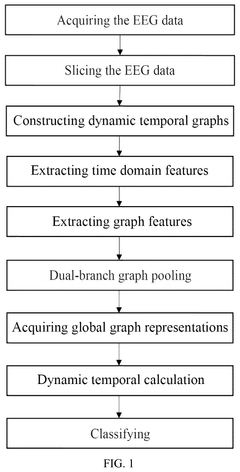
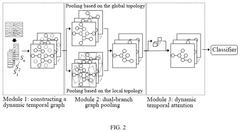
- A brain-computer target reading method using a dynamic graph representation network, which includes a dynamic temporal graph constructing module, a dual-branch graph pooling module, and a dynamic temporal attention module to capture time-varying connectivity and extract task-related features from EEG signals.
Privacy and Security in Neural Data Processing
Privacy and security concerns in neural data processing represent critical challenges that must be addressed as brain-computer interface technologies advance toward dynamic context recognition applications. Neural signals contain highly sensitive biometric information that can reveal not only intended commands but also emotional states, cognitive patterns, and potentially private thoughts, making robust protection mechanisms essential for widespread adoption.
The inherent vulnerability of neural data stems from its rich information content and the difficulty of anonymizing brainwave patterns. Unlike traditional biometric data, neural signals are continuous, high-dimensional, and contain temporal dependencies that make standard privacy-preserving techniques insufficient. Current encryption methods face significant challenges when applied to real-time BCI systems, as the computational overhead can introduce latency that compromises system responsiveness and user experience.
Data transmission security poses another critical concern, particularly for wireless BCI systems that rely on radio frequency communication between implanted devices and external processors. The wireless nature of these communications creates potential attack vectors for eavesdropping, signal injection, and man-in-the-middle attacks. Ensuring secure communication channels while maintaining the low-latency requirements necessary for effective brain-computer interaction requires sophisticated cryptographic protocols specifically designed for neural interface applications.
Storage and processing of neural data present additional security challenges, especially when leveraging cloud-based machine learning platforms for algorithm training and optimization. The sensitive nature of brain data necessitates strict access controls, audit trails, and secure multi-party computation techniques that allow for collaborative research while preserving individual privacy. Federated learning approaches show promise for enabling distributed algorithm development without centralizing sensitive neural datasets.
Regulatory frameworks for neural data protection remain underdeveloped, creating uncertainty around compliance requirements and liability issues. The intersection of medical device regulations, data protection laws, and emerging neurotechnology governance creates a complex landscape that developers must navigate while ensuring user privacy rights are preserved throughout the entire data lifecycle from acquisition to analysis and storage.
The inherent vulnerability of neural data stems from its rich information content and the difficulty of anonymizing brainwave patterns. Unlike traditional biometric data, neural signals are continuous, high-dimensional, and contain temporal dependencies that make standard privacy-preserving techniques insufficient. Current encryption methods face significant challenges when applied to real-time BCI systems, as the computational overhead can introduce latency that compromises system responsiveness and user experience.
Data transmission security poses another critical concern, particularly for wireless BCI systems that rely on radio frequency communication between implanted devices and external processors. The wireless nature of these communications creates potential attack vectors for eavesdropping, signal injection, and man-in-the-middle attacks. Ensuring secure communication channels while maintaining the low-latency requirements necessary for effective brain-computer interaction requires sophisticated cryptographic protocols specifically designed for neural interface applications.
Storage and processing of neural data present additional security challenges, especially when leveraging cloud-based machine learning platforms for algorithm training and optimization. The sensitive nature of brain data necessitates strict access controls, audit trails, and secure multi-party computation techniques that allow for collaborative research while preserving individual privacy. Federated learning approaches show promise for enabling distributed algorithm development without centralizing sensitive neural datasets.
Regulatory frameworks for neural data protection remain underdeveloped, creating uncertainty around compliance requirements and liability issues. The intersection of medical device regulations, data protection laws, and emerging neurotechnology governance creates a complex landscape that developers must navigate while ensuring user privacy rights are preserved throughout the entire data lifecycle from acquisition to analysis and storage.
Ethical Framework for Advanced BCI Applications
The development of advanced brain-computer interface algorithms for dynamic context recognition necessitates a comprehensive ethical framework to address the profound implications of direct neural access and interpretation. As BCI technology evolves to decode complex cognitive states and environmental contexts, fundamental questions arise regarding mental privacy, cognitive autonomy, and the boundaries of technological intervention in human consciousness.
Privacy concerns represent the most immediate ethical challenge in advanced BCI applications. Unlike traditional data collection methods, BCIs access neural signals that may reveal intimate thoughts, emotions, and intentions beyond the user's conscious awareness. The ability to recognize dynamic contexts through brain activity patterns raises questions about what constitutes truly private mental space and whether individuals can maintain cognitive sanctuary in an increasingly connected world.
Informed consent becomes particularly complex when dealing with BCI systems capable of context recognition. Users may not fully comprehend the extent of information that can be extracted from their neural patterns, especially as algorithms become more sophisticated in interpreting subconscious responses to environmental stimuli. The dynamic nature of context recognition means that consent frameworks must account for evolving capabilities and unexpected insights derived from neural data analysis.
The principle of cognitive liberty emerges as a cornerstone of BCI ethics, encompassing the right to mental autonomy and freedom from unwanted neural monitoring or manipulation. Advanced context recognition algorithms could potentially influence decision-making processes or create dependencies that compromise genuine free will. Establishing boundaries between therapeutic assistance and cognitive enhancement becomes crucial as these systems grow more capable of interpreting and responding to mental states.
Data governance and algorithmic transparency present additional ethical dimensions. The proprietary nature of advanced BCI algorithms often conflicts with the need for accountability and user understanding. Establishing standards for algorithmic auditing, bias detection, and performance validation becomes essential to ensure fair and equitable treatment across diverse user populations and contextual scenarios.
Finally, the societal implications of widespread BCI adoption require careful consideration of equity, access, and potential discrimination. As context recognition capabilities advance, ensuring that these technologies do not exacerbate existing inequalities or create new forms of cognitive stratification becomes paramount for responsible development and deployment.
Privacy concerns represent the most immediate ethical challenge in advanced BCI applications. Unlike traditional data collection methods, BCIs access neural signals that may reveal intimate thoughts, emotions, and intentions beyond the user's conscious awareness. The ability to recognize dynamic contexts through brain activity patterns raises questions about what constitutes truly private mental space and whether individuals can maintain cognitive sanctuary in an increasingly connected world.
Informed consent becomes particularly complex when dealing with BCI systems capable of context recognition. Users may not fully comprehend the extent of information that can be extracted from their neural patterns, especially as algorithms become more sophisticated in interpreting subconscious responses to environmental stimuli. The dynamic nature of context recognition means that consent frameworks must account for evolving capabilities and unexpected insights derived from neural data analysis.
The principle of cognitive liberty emerges as a cornerstone of BCI ethics, encompassing the right to mental autonomy and freedom from unwanted neural monitoring or manipulation. Advanced context recognition algorithms could potentially influence decision-making processes or create dependencies that compromise genuine free will. Establishing boundaries between therapeutic assistance and cognitive enhancement becomes crucial as these systems grow more capable of interpreting and responding to mental states.
Data governance and algorithmic transparency present additional ethical dimensions. The proprietary nature of advanced BCI algorithms often conflicts with the need for accountability and user understanding. Establishing standards for algorithmic auditing, bias detection, and performance validation becomes essential to ensure fair and equitable treatment across diverse user populations and contextual scenarios.
Finally, the societal implications of widespread BCI adoption require careful consideration of equity, access, and potential discrimination. As context recognition capabilities advance, ensuring that these technologies do not exacerbate existing inequalities or create new forms of cognitive stratification becomes paramount for responsible development and deployment.
Unlock deeper insights with Patsnap Eureka Quick Research — get a full tech report to explore trends and direct your research. Try now!
Generate Your Research Report Instantly with AI Agent
Supercharge your innovation with Patsnap Eureka AI Agent Platform!