
Optimizing Brain-Computer Interface Control Functions in Mixed Reality
MAR 5, 20269 MIN READ
Generate Your Research Report Instantly with AI Agent
Patsnap Eureka helps you evaluate technical feasibility & market potential.
BCI-MR Integration Background and Technical Objectives
Brain-Computer Interface (BCI) technology has evolved significantly since its inception in the 1970s, transitioning from basic signal detection experiments to sophisticated neural control systems. The foundational work by Jacques Vidal established the conceptual framework for direct brain-to-computer communication, while subsequent decades witnessed remarkable advances in signal processing algorithms, electrode technologies, and machine learning applications. Modern BCI systems now demonstrate capabilities ranging from cursor control to robotic limb manipulation, establishing a robust technological foundation for integration with emerging computing paradigms.
Mixed Reality (MR) represents the convergence of physical and digital worlds, creating immersive environments where virtual objects coexist and interact with real-world elements in real-time. This technology has matured rapidly, driven by advances in spatial computing, computer vision, and display technologies. The evolution from early augmented reality concepts to today's sophisticated MR platforms has opened unprecedented opportunities for intuitive human-computer interaction, particularly in applications requiring seamless integration of digital content with physical environments.
The convergence of BCI and MR technologies represents a paradigm shift in human-computer interaction, promising to eliminate traditional input barriers and enable direct neural control of mixed reality environments. This integration addresses fundamental limitations in current MR systems, where users rely on gesture recognition, voice commands, or handheld controllers that can introduce latency and reduce immersion. By leveraging neural signals, BCI-MR systems can potentially achieve more intuitive, responsive, and personalized interaction modalities.
The primary technical objective centers on developing robust neural signal processing algorithms capable of real-time interpretation and translation of brain activity into precise MR control commands. This requires advancing signal acquisition techniques, improving noise reduction methodologies, and implementing adaptive machine learning models that can accommodate individual neural patterns and environmental variations.
Secondary objectives include establishing seamless integration protocols between BCI hardware and MR software platforms, ensuring minimal latency in the neural-to-digital translation pipeline, and developing standardized interfaces that support interoperability across different BCI and MR systems. Additionally, the integration must address user safety, comfort, and long-term usability while maintaining high fidelity in both neural signal interpretation and mixed reality rendering.
The ultimate goal involves creating a unified BCI-MR ecosystem that enables natural, intuitive control of mixed reality environments through thought alone, potentially revolutionizing applications in healthcare, education, entertainment, and professional training while establishing new benchmarks for human-computer symbiosis.
Mixed Reality (MR) represents the convergence of physical and digital worlds, creating immersive environments where virtual objects coexist and interact with real-world elements in real-time. This technology has matured rapidly, driven by advances in spatial computing, computer vision, and display technologies. The evolution from early augmented reality concepts to today's sophisticated MR platforms has opened unprecedented opportunities for intuitive human-computer interaction, particularly in applications requiring seamless integration of digital content with physical environments.
The convergence of BCI and MR technologies represents a paradigm shift in human-computer interaction, promising to eliminate traditional input barriers and enable direct neural control of mixed reality environments. This integration addresses fundamental limitations in current MR systems, where users rely on gesture recognition, voice commands, or handheld controllers that can introduce latency and reduce immersion. By leveraging neural signals, BCI-MR systems can potentially achieve more intuitive, responsive, and personalized interaction modalities.
The primary technical objective centers on developing robust neural signal processing algorithms capable of real-time interpretation and translation of brain activity into precise MR control commands. This requires advancing signal acquisition techniques, improving noise reduction methodologies, and implementing adaptive machine learning models that can accommodate individual neural patterns and environmental variations.
Secondary objectives include establishing seamless integration protocols between BCI hardware and MR software platforms, ensuring minimal latency in the neural-to-digital translation pipeline, and developing standardized interfaces that support interoperability across different BCI and MR systems. Additionally, the integration must address user safety, comfort, and long-term usability while maintaining high fidelity in both neural signal interpretation and mixed reality rendering.
The ultimate goal involves creating a unified BCI-MR ecosystem that enables natural, intuitive control of mixed reality environments through thought alone, potentially revolutionizing applications in healthcare, education, entertainment, and professional training while establishing new benchmarks for human-computer symbiosis.
Market Demand for BCI-Enhanced Mixed Reality Applications
The convergence of brain-computer interface technology and mixed reality represents a transformative frontier with substantial market potential across multiple sectors. Healthcare applications demonstrate the most immediate and compelling demand, particularly in neurorehabilitation and assistive technologies. Medical institutions increasingly seek BCI-enhanced mixed reality solutions for stroke recovery, spinal cord injury rehabilitation, and cognitive therapy programs. These applications enable patients to control virtual environments through neural signals, facilitating more engaging and effective therapeutic interventions.
The gaming and entertainment industry exhibits strong appetite for immersive BCI-MR experiences that transcend traditional input methods. Major gaming companies are exploring neural control mechanisms that allow players to manipulate virtual objects, navigate environments, and interact with digital content through thought alone. This demand stems from the pursuit of unprecedented immersion levels and the potential to create entirely new gaming paradigms that were previously impossible with conventional controllers.
Enterprise and industrial sectors present significant opportunities for BCI-enhanced mixed reality applications in training and operational environments. Manufacturing companies seek solutions that enable hands-free control of complex machinery and virtual training simulations. Aerospace and defense organizations require advanced human-machine interfaces for mission-critical operations where traditional input methods may be impractical or insufficient.
Educational institutions and research facilities drive demand for BCI-MR systems that facilitate advanced learning experiences and scientific visualization. These applications enable students and researchers to manipulate complex three-dimensional models and data sets through neural commands, enhancing comprehension and analytical capabilities in fields ranging from molecular biology to architectural design.
The accessibility market represents a crucial demand driver, with organizations serving individuals with physical disabilities seeking BCI-enhanced mixed reality solutions for communication, environmental control, and social interaction. These applications address fundamental quality-of-life improvements and independence for users with limited mobility or traditional interface capabilities.
Current market barriers include high implementation costs, technical complexity, and regulatory considerations, particularly in healthcare applications. However, growing investment in neurotechnology research and declining hardware costs are gradually reducing these obstacles, indicating expanding market accessibility and adoption potential across diverse application domains.
The gaming and entertainment industry exhibits strong appetite for immersive BCI-MR experiences that transcend traditional input methods. Major gaming companies are exploring neural control mechanisms that allow players to manipulate virtual objects, navigate environments, and interact with digital content through thought alone. This demand stems from the pursuit of unprecedented immersion levels and the potential to create entirely new gaming paradigms that were previously impossible with conventional controllers.
Enterprise and industrial sectors present significant opportunities for BCI-enhanced mixed reality applications in training and operational environments. Manufacturing companies seek solutions that enable hands-free control of complex machinery and virtual training simulations. Aerospace and defense organizations require advanced human-machine interfaces for mission-critical operations where traditional input methods may be impractical or insufficient.
Educational institutions and research facilities drive demand for BCI-MR systems that facilitate advanced learning experiences and scientific visualization. These applications enable students and researchers to manipulate complex three-dimensional models and data sets through neural commands, enhancing comprehension and analytical capabilities in fields ranging from molecular biology to architectural design.
The accessibility market represents a crucial demand driver, with organizations serving individuals with physical disabilities seeking BCI-enhanced mixed reality solutions for communication, environmental control, and social interaction. These applications address fundamental quality-of-life improvements and independence for users with limited mobility or traditional interface capabilities.
Current market barriers include high implementation costs, technical complexity, and regulatory considerations, particularly in healthcare applications. However, growing investment in neurotechnology research and declining hardware costs are gradually reducing these obstacles, indicating expanding market accessibility and adoption potential across diverse application domains.
Current BCI Control Limitations in Mixed Reality Environments
Brain-computer interfaces in mixed reality environments face significant technical constraints that limit their practical implementation and user experience quality. Current BCI systems struggle with signal acquisition accuracy when users are engaged in complex mixed reality tasks, as the cognitive load from processing both real and virtual stimuli creates interference patterns that degrade neural signal clarity. The temporal resolution of existing BCI technologies often fails to match the real-time demands of mixed reality applications, resulting in noticeable delays between user intent and system response.
Signal processing algorithms currently employed in BCI systems demonstrate inadequate performance when handling the multi-modal sensory inputs characteristic of mixed reality environments. The simultaneous processing of visual, auditory, and haptic feedback creates neural noise that existing filtering techniques cannot effectively eliminate. This limitation becomes particularly pronounced during complex interaction scenarios where users must manipulate multiple virtual objects while maintaining awareness of their physical surroundings.
Hardware integration presents another critical bottleneck, as current BCI devices lack the portability and wireless capabilities necessary for seamless mixed reality experiences. Most systems require extensive calibration procedures that interrupt the immersive experience, while electrode placement and maintenance issues create practical barriers to extended use. The power consumption of high-resolution neural recording equipment conflicts with the mobility requirements of mixed reality applications.
Control precision remains fundamentally limited by the current understanding of neural signal interpretation. Existing BCI systems typically support only basic command sets, such as binary selections or simple directional inputs, which prove insufficient for the complex manipulation tasks required in mixed reality environments. The inability to decode fine motor intentions or complex cognitive states restricts users to rudimentary interaction patterns that fail to leverage the full potential of mixed reality interfaces.
Environmental factors further compound these limitations, as electromagnetic interference from mixed reality hardware can corrupt neural signals, while head-mounted displays and tracking systems create physical constraints that affect electrode positioning and signal quality. These technical barriers collectively prevent BCI-controlled mixed reality systems from achieving the responsiveness and reliability necessary for practical deployment in professional or consumer applications.
Signal processing algorithms currently employed in BCI systems demonstrate inadequate performance when handling the multi-modal sensory inputs characteristic of mixed reality environments. The simultaneous processing of visual, auditory, and haptic feedback creates neural noise that existing filtering techniques cannot effectively eliminate. This limitation becomes particularly pronounced during complex interaction scenarios where users must manipulate multiple virtual objects while maintaining awareness of their physical surroundings.
Hardware integration presents another critical bottleneck, as current BCI devices lack the portability and wireless capabilities necessary for seamless mixed reality experiences. Most systems require extensive calibration procedures that interrupt the immersive experience, while electrode placement and maintenance issues create practical barriers to extended use. The power consumption of high-resolution neural recording equipment conflicts with the mobility requirements of mixed reality applications.
Control precision remains fundamentally limited by the current understanding of neural signal interpretation. Existing BCI systems typically support only basic command sets, such as binary selections or simple directional inputs, which prove insufficient for the complex manipulation tasks required in mixed reality environments. The inability to decode fine motor intentions or complex cognitive states restricts users to rudimentary interaction patterns that fail to leverage the full potential of mixed reality interfaces.
Environmental factors further compound these limitations, as electromagnetic interference from mixed reality hardware can corrupt neural signals, while head-mounted displays and tracking systems create physical constraints that affect electrode positioning and signal quality. These technical barriers collectively prevent BCI-controlled mixed reality systems from achieving the responsiveness and reliability necessary for practical deployment in professional or consumer applications.
Existing BCI Control Optimization Solutions for MR
01 Signal processing and feature extraction for brain-computer interfaces
Brain-computer interface systems employ various signal processing techniques to extract meaningful features from brain signals such as EEG, ECoG, or neural recordings. These methods include filtering, artifact removal, frequency domain analysis, and pattern recognition algorithms to identify user intentions. Advanced machine learning and deep learning approaches are utilized to improve the accuracy of signal interpretation and classification, enabling more reliable control commands.- Signal processing and feature extraction for brain-computer interfaces: Brain-computer interface systems employ advanced signal processing techniques to extract meaningful features from neural signals. These methods include filtering, artifact removal, and pattern recognition algorithms to identify specific brain activity patterns. The processed signals are then translated into control commands for various applications. Machine learning and deep learning approaches are utilized to improve the accuracy and reliability of signal interpretation, enabling more precise control functions.
- Motor imagery and movement intention detection: Brain-computer interfaces can detect motor imagery and movement intentions by analyzing specific brain wave patterns associated with imagined or intended movements. This technology enables users to control external devices through thought alone, without physical movement. The system identifies characteristic neural signatures corresponding to different motor commands, such as left or right hand movement, walking, or grasping. These detected intentions are then mapped to specific control functions for assistive devices, prosthetics, or computer interfaces.
- Attention and cognitive state monitoring: Brain-computer interface systems can monitor user attention levels and cognitive states by analyzing brain activity patterns. These systems detect variations in mental workload, focus, fatigue, and alertness through electroencephalography or other neural recording methods. The monitored cognitive states can be used to adapt interface behavior, provide feedback to users, or trigger alerts when attention drops below safe levels. Applications include driver monitoring systems, educational tools, and productivity enhancement platforms.
- Multi-modal control integration and hybrid interfaces: Advanced brain-computer interfaces integrate multiple control modalities to enhance functionality and user experience. These hybrid systems combine brain signals with other input methods such as eye tracking, voice commands, or gesture recognition. The integration allows for more robust and flexible control schemes, reducing the limitations of single-modality systems. Multi-modal approaches improve control accuracy, expand the range of available commands, and provide redundancy in case of signal degradation in one modality.
- Adaptive learning and personalized calibration systems: Brain-computer interfaces employ adaptive learning algorithms to personalize control functions for individual users. These systems continuously learn from user interactions and adjust parameters to optimize performance over time. Calibration procedures are streamlined through automated processes that adapt to individual neural patterns and preferences. The adaptive mechanisms account for variations in brain signals across sessions and compensate for changes in user state or environmental conditions, ensuring consistent and reliable control functionality.
02 Device control and command execution systems
Brain-computer interfaces enable users to control external devices through decoded neural signals. These systems translate brain activity into specific commands for operating computers, prosthetic limbs, wheelchairs, communication devices, or smart home systems. The control mechanisms include discrete command selection, continuous control paradigms, and hybrid approaches that combine multiple input modalities to enhance user interaction and system responsiveness.Expand Specific Solutions03 Feedback and adaptation mechanisms
Brain-computer interface systems incorporate feedback mechanisms to provide users with real-time information about their control performance. These systems employ visual, auditory, or haptic feedback to facilitate user learning and improve control accuracy. Adaptive algorithms continuously adjust system parameters based on user performance and changing brain signal characteristics, enabling personalized calibration and long-term stability of the interface.Expand Specific Solutions04 Multi-modal integration and hybrid control approaches
Advanced brain-computer interfaces combine multiple signal sources or control modalities to enhance functionality and reliability. These hybrid systems may integrate brain signals with eye tracking, muscle activity, voice commands, or other physiological signals. Multi-modal approaches provide redundancy, increase the number of available control commands, and improve overall system performance by leveraging complementary information from different sources.Expand Specific Solutions05 Clinical and assistive applications
Brain-computer interfaces are designed for various clinical and assistive applications to help individuals with motor disabilities or neurological conditions. These systems enable communication for locked-in patients, provide motor restoration through neuroprosthetics, support rehabilitation therapy, and assist with daily living activities. The implementations focus on user safety, reliability, and practical usability in real-world environments, with considerations for long-term use and minimal maintenance requirements.Expand Specific Solutions
Key Players in BCI and Mixed Reality Industry
The brain-computer interface (BCI) control functions in mixed reality represent an emerging technological frontier currently in the early development stage, with significant market potential estimated to reach billions as AR/VR adoption accelerates. The competitive landscape spans diverse players from tech giants like Microsoft, Meta Platforms Technologies, Apple, and Google who leverage extensive mixed reality platforms, to specialized BCI companies such as MindPortal and Cognixion developing targeted neural interface solutions. Technology maturity varies considerably across participants, with established corporations like Toshiba and HRL Laboratories contributing hardware expertise, while academic institutions including Johns Hopkins University, Zhejiang University, and Beijing Institute of Technology drive fundamental research breakthroughs. The field demonstrates fragmented development with no dominant standard, creating opportunities for innovative solutions that effectively integrate neural signal processing with immersive computing environments.
Microsoft Technology Licensing LLC
Technical Solution: Microsoft has developed HoloLens mixed reality platform with integrated brain-computer interface capabilities for enhanced user control. Their approach combines spatial computing with neural signal processing to enable hands-free interaction in mixed reality environments. The system utilizes machine learning algorithms to interpret EEG signals and translate them into actionable commands within the HoloLens interface. Microsoft's solution focuses on reducing cognitive load by implementing adaptive filtering techniques that learn user-specific neural patterns over time. The platform supports multi-modal input combining traditional gesture controls with BCI signals, allowing for seamless transitions between control methods. Their research emphasizes real-time signal processing with latency under 100ms to maintain immersive experience quality.
Strengths: Established mixed reality ecosystem, strong enterprise partnerships, robust cloud computing infrastructure for signal processing. Weaknesses: Limited consumer market penetration, high hardware costs, dependency on external EEG equipment for full BCI functionality.
Meta Platforms Technologies LLC
Technical Solution: Meta has invested heavily in neural interface research through their Reality Labs division, developing non-invasive BCI solutions for AR/VR control. Their approach focuses on electromyography (EMG) wristbands that detect neural signals sent to hand muscles, enabling users to control virtual objects through subtle finger movements and gestures. The system employs advanced machine learning models to decode motor intentions from neural signals, allowing for precise manipulation of virtual environments. Meta's solution emphasizes user privacy by processing neural data locally on device rather than in cloud systems. Their research includes adaptive algorithms that continuously learn and improve recognition accuracy based on individual user patterns. The platform integrates seamlessly with their Quest VR headsets and future AR glasses, providing a unified control experience across mixed reality applications.
Strengths: Large user base for testing and feedback, significant R&D investment, integration with existing VR/AR ecosystem. Weaknesses: Privacy concerns around neural data collection, early-stage technology with limited commercial availability, focus primarily on wrist-based EMG rather than direct brain signals.
Core Patents in BCI-MR Control Function Innovation
Multi-controlled-object brain control method fusing brain-computer interface and mixed reality interaction
PatentInactiveCN118244897A
Innovation
- Integrating brain-computer interface and mixed reality interaction technology, by adding virtual flashing function keys and control instructions in the actual environment, using SSVEP-BCI combined with mixed reality technology to increase the number of controllable devices and the number of output instructions, and realize the control of smart home devices Flexible brain control.


Systems and methods that involve BCI (brain computer interface), extended reality and/or eye-tracking devices, detect mind/brain activity, generate and/or process saliency maps, eye-tracking information and/or various control(s) or instructions, implement mind-based selection of UI elements and/or perform other features and functionality
PatentPendingUS20250004558A1
Innovation
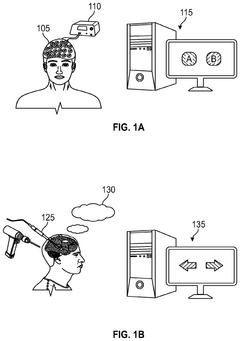
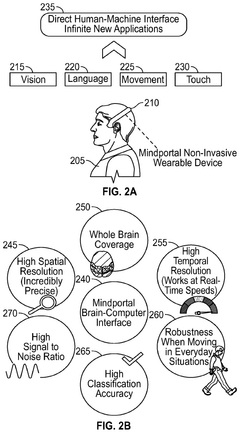
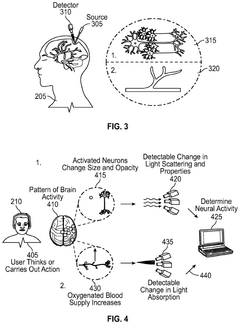
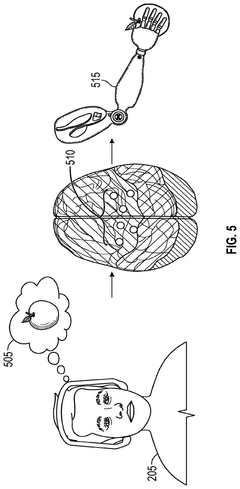
- A non-invasive brain-computer interface system that uses optical-based brain signal acquisition and decoding modalities, enabling high-resolution data collection and decoding of neural activities associated with thoughts, including visual attention and intended actions, through the use of wearable optodes that detect neuronal and haemodynamic changes, allowing for precise brain signal processing and interaction with UI elements in mixed reality environments.
Privacy and Safety Regulations for Neural Interface Devices
The integration of brain-computer interfaces with mixed reality environments presents unprecedented challenges in privacy protection and safety regulation. Neural interface devices operating in mixed reality contexts collect vast amounts of sensitive neurological data while simultaneously processing environmental and behavioral information, creating complex regulatory landscapes that existing frameworks struggle to address comprehensively.
Current privacy regulations for neural interfaces primarily focus on traditional medical device standards, but mixed reality applications extend beyond therapeutic uses into consumer, entertainment, and professional domains. The European Union's Medical Device Regulation (MDR) and FDA guidelines provide foundational safety requirements, yet they inadequately address the unique privacy concerns arising from continuous neural signal monitoring in immersive environments. The challenge intensifies when considering that mixed reality BCIs can potentially access not only intended control signals but also inadvertent neural patterns revealing thoughts, emotions, and cognitive states.
Data sovereignty emerges as a critical regulatory concern, particularly regarding cross-border data transfers and cloud processing requirements inherent in mixed reality systems. Neural data classification varies significantly across jurisdictions, with some treating it as highly sensitive biometric information while others apply standard medical data protections. This inconsistency creates compliance challenges for global BCI-MR platform developers and raises questions about user consent mechanisms when neural data processing occurs across multiple regulatory domains.
Safety regulations must address both direct neural interface risks and mixed reality-specific hazards. Traditional BCI safety focuses on biocompatibility and signal integrity, but mixed reality integration introduces additional concerns including sensory overload, spatial disorientation, and potential manipulation of perceived reality through neural feedback loops. Regulatory bodies are developing new assessment criteria that evaluate the psychological and cognitive safety implications of prolonged neural-mixed reality interaction.
Emerging regulatory frameworks emphasize user agency and transparent data governance. The proposed Neural Rights legislation in several countries aims to establish fundamental protections for mental privacy and cognitive liberty. These regulations mandate explicit consent for neural data collection, require real-time user control over data processing, and establish strict limitations on neural pattern analysis beyond immediate interface control functions.
International standardization efforts through ISO and IEEE are developing comprehensive guidelines for neural interface privacy and safety in immersive environments. These standards address technical requirements for data encryption, anonymization protocols, and fail-safe mechanisms that protect users when neural-mixed reality systems encounter unexpected conditions or potential security breaches.
Current privacy regulations for neural interfaces primarily focus on traditional medical device standards, but mixed reality applications extend beyond therapeutic uses into consumer, entertainment, and professional domains. The European Union's Medical Device Regulation (MDR) and FDA guidelines provide foundational safety requirements, yet they inadequately address the unique privacy concerns arising from continuous neural signal monitoring in immersive environments. The challenge intensifies when considering that mixed reality BCIs can potentially access not only intended control signals but also inadvertent neural patterns revealing thoughts, emotions, and cognitive states.
Data sovereignty emerges as a critical regulatory concern, particularly regarding cross-border data transfers and cloud processing requirements inherent in mixed reality systems. Neural data classification varies significantly across jurisdictions, with some treating it as highly sensitive biometric information while others apply standard medical data protections. This inconsistency creates compliance challenges for global BCI-MR platform developers and raises questions about user consent mechanisms when neural data processing occurs across multiple regulatory domains.
Safety regulations must address both direct neural interface risks and mixed reality-specific hazards. Traditional BCI safety focuses on biocompatibility and signal integrity, but mixed reality integration introduces additional concerns including sensory overload, spatial disorientation, and potential manipulation of perceived reality through neural feedback loops. Regulatory bodies are developing new assessment criteria that evaluate the psychological and cognitive safety implications of prolonged neural-mixed reality interaction.
Emerging regulatory frameworks emphasize user agency and transparent data governance. The proposed Neural Rights legislation in several countries aims to establish fundamental protections for mental privacy and cognitive liberty. These regulations mandate explicit consent for neural data collection, require real-time user control over data processing, and establish strict limitations on neural pattern analysis beyond immediate interface control functions.
International standardization efforts through ISO and IEEE are developing comprehensive guidelines for neural interface privacy and safety in immersive environments. These standards address technical requirements for data encryption, anonymization protocols, and fail-safe mechanisms that protect users when neural-mixed reality systems encounter unexpected conditions or potential security breaches.
Ethical Framework for Brain Data in Mixed Reality
The integration of brain-computer interfaces with mixed reality environments necessitates a comprehensive ethical framework to govern the collection, processing, and utilization of neural data. This framework must address the unprecedented challenges posed by the intimate nature of brain signals and their potential for revealing users' cognitive states, intentions, and personal information in immersive digital environments.
Privacy protection represents the cornerstone of ethical brain data management in mixed reality systems. Neural signals contain highly sensitive information about users' thoughts, emotions, and mental processes, requiring robust encryption protocols and data anonymization techniques. The framework must establish strict guidelines for data minimization, ensuring that only necessary neural information is collected for specific control functions while preventing unauthorized access to broader cognitive patterns.
Informed consent mechanisms must be redesigned to address the complexity of brain data collection in mixed reality contexts. Users need comprehensive understanding of what neural information is being captured, how it will be processed, and the potential implications for their privacy. The consent process should include clear explanations of data retention periods, sharing policies, and users' rights to data deletion or modification.
Data ownership and control rights present unique challenges in brain-computer interface applications. The framework must clearly define whether users retain ownership of their neural patterns and establish mechanisms for users to control how their brain data is utilized. This includes provisions for data portability, allowing users to transfer their neural profiles between different mixed reality platforms while maintaining control over their cognitive information.
Algorithmic transparency and accountability are essential components of the ethical framework. Users should have access to information about how their brain signals are interpreted and translated into mixed reality control commands. The framework must address potential biases in neural signal processing algorithms and establish procedures for auditing and correcting discriminatory outcomes that might affect certain user groups.
Long-term implications of brain data storage and analysis require careful consideration within the ethical framework. Neural patterns may reveal information about cognitive decline, mental health conditions, or neurological disorders, raising questions about data use for purposes beyond mixed reality control. The framework must establish boundaries for secondary use of brain data and protect users from potential discrimination based on their neural characteristics.
Privacy protection represents the cornerstone of ethical brain data management in mixed reality systems. Neural signals contain highly sensitive information about users' thoughts, emotions, and mental processes, requiring robust encryption protocols and data anonymization techniques. The framework must establish strict guidelines for data minimization, ensuring that only necessary neural information is collected for specific control functions while preventing unauthorized access to broader cognitive patterns.
Informed consent mechanisms must be redesigned to address the complexity of brain data collection in mixed reality contexts. Users need comprehensive understanding of what neural information is being captured, how it will be processed, and the potential implications for their privacy. The consent process should include clear explanations of data retention periods, sharing policies, and users' rights to data deletion or modification.
Data ownership and control rights present unique challenges in brain-computer interface applications. The framework must clearly define whether users retain ownership of their neural patterns and establish mechanisms for users to control how their brain data is utilized. This includes provisions for data portability, allowing users to transfer their neural profiles between different mixed reality platforms while maintaining control over their cognitive information.
Algorithmic transparency and accountability are essential components of the ethical framework. Users should have access to information about how their brain signals are interpreted and translated into mixed reality control commands. The framework must address potential biases in neural signal processing algorithms and establish procedures for auditing and correcting discriminatory outcomes that might affect certain user groups.
Long-term implications of brain data storage and analysis require careful consideration within the ethical framework. Neural patterns may reveal information about cognitive decline, mental health conditions, or neurological disorders, raising questions about data use for purposes beyond mixed reality control. The framework must establish boundaries for secondary use of brain data and protect users from potential discrimination based on their neural characteristics.
Unlock deeper insights with Patsnap Eureka Quick Research — get a full tech report to explore trends and direct your research. Try now!
Generate Your Research Report Instantly with AI Agent
Supercharge your innovation with Patsnap Eureka AI Agent Platform!