Evaluate Thermopile Sensor Reliability in Harsh Environments
SEP 10, 20259 MIN READ
Generate Your Research Report Instantly with AI Agent
Patsnap Eureka helps you evaluate technical feasibility & market potential.
Thermopile Sensor Technology Background and Objectives
Thermopile sensors have evolved significantly since their inception in the early 20th century, with major technological advancements occurring in the 1980s and 1990s when they began to be widely integrated into commercial applications. These sensors operate based on the Seebeck effect, where temperature differences between junctions of dissimilar metals generate a voltage proportional to the temperature gradient. This fundamental principle has remained unchanged, while manufacturing techniques, materials science, and integration capabilities have dramatically improved over time.
The evolution trajectory of thermopile sensor technology shows a clear trend toward miniaturization, increased sensitivity, and enhanced durability. Early thermopile sensors were bulky and primarily used in laboratory settings, whereas modern versions are compact enough to be integrated into portable devices and industrial equipment. Recent advancements have focused on improving signal-to-noise ratios, reducing response times, and enhancing measurement accuracy across wider temperature ranges.
Current technological developments are centered on addressing the reliability challenges in harsh environments, which represent a significant barrier to broader adoption in critical applications. These environments include extreme temperatures (both cryogenic and high-temperature scenarios), high humidity, corrosive atmospheres, high vibration settings, and locations with significant electromagnetic interference.
The primary technical objectives for thermopile sensor development in harsh environments include extending operational temperature ranges beyond current limitations (typically -40°C to 125°C), improving long-term stability under thermal cycling, enhancing resistance to chemical corrosion, and maintaining calibration accuracy despite environmental fluctuations. Additionally, there is a focus on developing more robust packaging solutions that can protect the sensitive elements while maintaining thermal responsiveness.
Another critical objective is to improve the mean time between failures (MTBF) in harsh conditions, as current generation sensors often experience significant drift or complete failure when exposed to extreme environments for extended periods. Research is also directed toward developing self-diagnostic capabilities that can alert systems to potential sensor degradation before critical failures occur.
The integration of advanced materials such as silicon carbide, gallium nitride, and specialized ceramic compounds is being explored to overcome current limitations. These materials offer superior thermal stability and chemical resistance compared to traditional silicon-based platforms. Concurrently, researchers are investigating novel fabrication techniques that can produce more homogeneous thermopile junctions with better long-term stability characteristics.
Achieving these technological objectives would enable thermopile sensors to be deployed in previously unsuitable applications, including deep-sea exploration, aerospace systems, automotive high-temperature zones, chemical processing facilities, and nuclear environments, significantly expanding their market potential and technological relevance.
The evolution trajectory of thermopile sensor technology shows a clear trend toward miniaturization, increased sensitivity, and enhanced durability. Early thermopile sensors were bulky and primarily used in laboratory settings, whereas modern versions are compact enough to be integrated into portable devices and industrial equipment. Recent advancements have focused on improving signal-to-noise ratios, reducing response times, and enhancing measurement accuracy across wider temperature ranges.
Current technological developments are centered on addressing the reliability challenges in harsh environments, which represent a significant barrier to broader adoption in critical applications. These environments include extreme temperatures (both cryogenic and high-temperature scenarios), high humidity, corrosive atmospheres, high vibration settings, and locations with significant electromagnetic interference.
The primary technical objectives for thermopile sensor development in harsh environments include extending operational temperature ranges beyond current limitations (typically -40°C to 125°C), improving long-term stability under thermal cycling, enhancing resistance to chemical corrosion, and maintaining calibration accuracy despite environmental fluctuations. Additionally, there is a focus on developing more robust packaging solutions that can protect the sensitive elements while maintaining thermal responsiveness.
Another critical objective is to improve the mean time between failures (MTBF) in harsh conditions, as current generation sensors often experience significant drift or complete failure when exposed to extreme environments for extended periods. Research is also directed toward developing self-diagnostic capabilities that can alert systems to potential sensor degradation before critical failures occur.
The integration of advanced materials such as silicon carbide, gallium nitride, and specialized ceramic compounds is being explored to overcome current limitations. These materials offer superior thermal stability and chemical resistance compared to traditional silicon-based platforms. Concurrently, researchers are investigating novel fabrication techniques that can produce more homogeneous thermopile junctions with better long-term stability characteristics.
Achieving these technological objectives would enable thermopile sensors to be deployed in previously unsuitable applications, including deep-sea exploration, aerospace systems, automotive high-temperature zones, chemical processing facilities, and nuclear environments, significantly expanding their market potential and technological relevance.
Market Demand Analysis for Harsh Environment Sensors
The global market for harsh environment sensors has been experiencing robust growth, driven primarily by increasing industrial automation, expansion of IoT applications, and growing demand for reliable monitoring systems in extreme conditions. The thermopile sensor segment specifically has seen significant traction due to its non-contact temperature measurement capabilities and resilience compared to alternative technologies.
Current market analysis indicates that the harsh environment sensor market is valued at approximately $4.3 billion as of 2023, with projections suggesting a compound annual growth rate (CAGR) of 8.7% through 2030. Thermopile sensors represent roughly 12% of this market, with their share expected to increase as applications in high-temperature industrial environments expand.
Key industries driving demand include oil and gas, where thermopile sensors are deployed in downhole drilling operations and refinery monitoring systems. These environments frequently expose sensors to temperatures exceeding 200°C, corrosive chemicals, and significant mechanical stress. The aerospace sector represents another significant market, utilizing thermopile sensors in engine monitoring systems where reliability under extreme vibration and temperature fluctuations is critical.
Automotive applications have emerged as the fastest-growing segment, with a 14.2% annual growth rate. This surge is attributed to increasing electrification of vehicles and the need for precise thermal management in battery systems. Thermopile sensors that can maintain calibration accuracy despite road vibration, temperature cycling, and exposure to automotive fluids are particularly sought after.
Regional analysis reveals that North America currently holds the largest market share at 34%, followed by Europe (28%) and Asia-Pacific (26%). However, the Asia-Pacific region is expected to demonstrate the highest growth rate over the next five years, driven by rapid industrialization in China and India, and increasing adoption of Industry 4.0 technologies.
Customer requirements are increasingly focused on extended operational lifespans, with expectations now reaching 10+ years of continuous operation in harsh environments without recalibration. This represents a significant shift from the 3-5 year expectations common just a decade ago. Additionally, miniaturization remains a consistent demand driver, with customers seeking sensors that maintain reliability while decreasing in size by 15-20% per generation.
Market surveys indicate that 78% of industrial customers rank reliability in harsh environments as their primary selection criterion for temperature sensing solutions, ahead of both cost and energy efficiency. This underscores the significant market opportunity for thermopile sensors with demonstrated reliability improvements in challenging operational conditions.
Current market analysis indicates that the harsh environment sensor market is valued at approximately $4.3 billion as of 2023, with projections suggesting a compound annual growth rate (CAGR) of 8.7% through 2030. Thermopile sensors represent roughly 12% of this market, with their share expected to increase as applications in high-temperature industrial environments expand.
Key industries driving demand include oil and gas, where thermopile sensors are deployed in downhole drilling operations and refinery monitoring systems. These environments frequently expose sensors to temperatures exceeding 200°C, corrosive chemicals, and significant mechanical stress. The aerospace sector represents another significant market, utilizing thermopile sensors in engine monitoring systems where reliability under extreme vibration and temperature fluctuations is critical.
Automotive applications have emerged as the fastest-growing segment, with a 14.2% annual growth rate. This surge is attributed to increasing electrification of vehicles and the need for precise thermal management in battery systems. Thermopile sensors that can maintain calibration accuracy despite road vibration, temperature cycling, and exposure to automotive fluids are particularly sought after.
Regional analysis reveals that North America currently holds the largest market share at 34%, followed by Europe (28%) and Asia-Pacific (26%). However, the Asia-Pacific region is expected to demonstrate the highest growth rate over the next five years, driven by rapid industrialization in China and India, and increasing adoption of Industry 4.0 technologies.
Customer requirements are increasingly focused on extended operational lifespans, with expectations now reaching 10+ years of continuous operation in harsh environments without recalibration. This represents a significant shift from the 3-5 year expectations common just a decade ago. Additionally, miniaturization remains a consistent demand driver, with customers seeking sensors that maintain reliability while decreasing in size by 15-20% per generation.
Market surveys indicate that 78% of industrial customers rank reliability in harsh environments as their primary selection criterion for temperature sensing solutions, ahead of both cost and energy efficiency. This underscores the significant market opportunity for thermopile sensors with demonstrated reliability improvements in challenging operational conditions.
Current Challenges in Thermopile Reliability
Thermopile sensors face significant reliability challenges when deployed in harsh environments, which can substantially impact their performance and longevity. Temperature extremes represent one of the most critical challenges, as these sensors may be exposed to conditions ranging from cryogenic temperatures in space applications to over 1000°C in industrial furnaces. Such thermal stress can lead to material degradation, thermal drift, and calibration instability, ultimately compromising measurement accuracy over time.
Mechanical stressors pose another substantial challenge, particularly in high-vibration or shock-prone environments such as automotive applications or industrial machinery. These physical forces can cause microfractures in the sensor structure, lead to connection failures, or result in package integrity issues that expose sensitive components to environmental contaminants.
Chemical exposure presents a particularly insidious threat to thermopile reliability. Corrosive gases, solvents, oils, and other aggressive chemicals can degrade sensor materials, particularly the thin-film structures that form the thermoelectric junctions. This degradation often manifests as increased electrical resistance, signal drift, or complete sensor failure. In industrial settings where multiple chemical agents may be present simultaneously, these effects can be accelerated and difficult to predict.
Humidity and moisture ingress represent persistent challenges, especially in outdoor applications or environments with significant temperature cycling that can lead to condensation. Water molecules can penetrate packaging defects and cause corrosion of metallic components, electrical shorts, or degradation of the sensor's optical filters in IR-sensing applications. The freeze-thaw cycles associated with moisture can further exacerbate mechanical stresses within the sensor structure.
Radiation exposure in nuclear facilities, space applications, or certain medical environments can induce atomic displacement damage in semiconductor materials, affecting the thermoelectric properties of the thermopile junctions. This radiation damage typically manifests as increased noise, reduced sensitivity, and unpredictable drift characteristics that worsen over time with cumulative exposure.
Long-term stability issues also plague thermopile sensors in harsh environments. Even when individual environmental factors remain within acceptable limits, the combined and cumulative effects of multiple stressors over extended periods can lead to gradual performance degradation. This aging process often manifests as sensitivity reduction, increased response time, or baseline drift that may not be apparent during initial qualification testing but becomes significant over the sensor's operational lifetime.
Current packaging technologies present limitations in fully protecting thermopile elements while maintaining their thermal responsiveness. The fundamental challenge lies in creating hermetic seals that prevent contaminant ingress while still allowing efficient thermal transfer from the target to the sensing element. This represents a critical design trade-off that continues to challenge sensor manufacturers.
Mechanical stressors pose another substantial challenge, particularly in high-vibration or shock-prone environments such as automotive applications or industrial machinery. These physical forces can cause microfractures in the sensor structure, lead to connection failures, or result in package integrity issues that expose sensitive components to environmental contaminants.
Chemical exposure presents a particularly insidious threat to thermopile reliability. Corrosive gases, solvents, oils, and other aggressive chemicals can degrade sensor materials, particularly the thin-film structures that form the thermoelectric junctions. This degradation often manifests as increased electrical resistance, signal drift, or complete sensor failure. In industrial settings where multiple chemical agents may be present simultaneously, these effects can be accelerated and difficult to predict.
Humidity and moisture ingress represent persistent challenges, especially in outdoor applications or environments with significant temperature cycling that can lead to condensation. Water molecules can penetrate packaging defects and cause corrosion of metallic components, electrical shorts, or degradation of the sensor's optical filters in IR-sensing applications. The freeze-thaw cycles associated with moisture can further exacerbate mechanical stresses within the sensor structure.
Radiation exposure in nuclear facilities, space applications, or certain medical environments can induce atomic displacement damage in semiconductor materials, affecting the thermoelectric properties of the thermopile junctions. This radiation damage typically manifests as increased noise, reduced sensitivity, and unpredictable drift characteristics that worsen over time with cumulative exposure.
Long-term stability issues also plague thermopile sensors in harsh environments. Even when individual environmental factors remain within acceptable limits, the combined and cumulative effects of multiple stressors over extended periods can lead to gradual performance degradation. This aging process often manifests as sensitivity reduction, increased response time, or baseline drift that may not be apparent during initial qualification testing but becomes significant over the sensor's operational lifetime.
Current packaging technologies present limitations in fully protecting thermopile elements while maintaining their thermal responsiveness. The fundamental challenge lies in creating hermetic seals that prevent contaminant ingress while still allowing efficient thermal transfer from the target to the sensing element. This represents a critical design trade-off that continues to challenge sensor manufacturers.
Current Technical Solutions for Harsh Environment Operation
01 Environmental protection for thermopile sensors
Thermopile sensors require protection from environmental factors to maintain reliability. This includes encapsulation techniques, hermetic sealing, and protective coatings that shield the sensor from moisture, dust, and other contaminants. These protection methods prevent degradation of the sensor elements and ensure consistent performance over time, particularly in harsh or variable environments.- Environmental protection for thermopile sensors: Thermopile sensors require protection from environmental factors to maintain reliability. This includes encapsulation techniques, hermetic sealing, and protective coatings that shield the sensor from moisture, dust, and other contaminants. These protection methods prevent degradation of the sensor elements and ensure consistent performance over time, particularly in harsh or variable environments.
- Thermal stability and compensation techniques: Improving the thermal stability of thermopile sensors is crucial for reliability. This involves implementing temperature compensation circuits, reference junction stabilization, and thermal isolation structures. These techniques minimize drift and offset errors caused by ambient temperature fluctuations, ensuring accurate measurements across varying operating conditions and extending the sensor's functional lifespan.
- Structural design improvements: Advanced structural designs enhance thermopile sensor reliability through improved mechanical stability and stress resistance. This includes optimized thermocouple junction arrangements, substrate material selection, and mounting configurations that reduce mechanical stress. These structural improvements prevent physical damage from vibration and thermal cycling, resulting in more durable and reliable sensor performance.
- Signal processing and calibration methods: Enhanced signal processing and calibration techniques significantly improve thermopile sensor reliability. This includes advanced amplification circuits, digital filtering algorithms, and automated calibration procedures that compensate for manufacturing variations and aging effects. These methods improve signal-to-noise ratio, reduce measurement errors, and maintain accuracy throughout the sensor's operational lifetime.
- Material selection and fabrication techniques: The selection of appropriate materials and fabrication techniques is essential for thermopile sensor reliability. This includes using high-stability thermoelectric materials, precision deposition methods, and advanced interconnection technologies. These material and fabrication choices minimize degradation mechanisms such as diffusion, oxidation, and electromigration, resulting in sensors with extended operational lifetimes and consistent performance characteristics.
02 Thermal stability and compensation techniques
Improving the thermal stability of thermopile sensors is crucial for reliability. This involves implementing temperature compensation circuits, reference junction stabilization, and thermal isolation structures. These techniques minimize drift and offset errors caused by ambient temperature fluctuations, ensuring accurate measurements across varying operating conditions and extending the sensor's functional lifespan.Expand Specific Solutions03 Structural design improvements
Advanced structural designs enhance thermopile sensor reliability through improved mechanical stability and stress resistance. This includes optimized thermocouple junction arrangements, substrate material selection, and mounting configurations that minimize thermal expansion mismatches. These structural improvements reduce mechanical failures and increase the sensor's resistance to vibration, shock, and thermal cycling stresses.Expand Specific Solutions04 Signal processing and calibration methods
Enhanced signal processing and calibration techniques significantly improve thermopile sensor reliability. These include advanced amplification circuits, digital signal processing algorithms, and automated calibration procedures that compensate for manufacturing variations and aging effects. Such methods improve signal-to-noise ratio, reduce measurement errors, and maintain accuracy throughout the sensor's operational lifetime.Expand Specific Solutions05 Material selection and fabrication techniques
The reliability of thermopile sensors is heavily influenced by material selection and fabrication techniques. Using high-quality thermoelectric materials, precision deposition methods, and advanced microfabrication processes results in more stable thermocouple junctions. These improvements reduce degradation mechanisms such as diffusion, oxidation, and electromigration, leading to extended sensor lifespan and consistent performance characteristics.Expand Specific Solutions
Key Industry Players and Competitive Landscape
Thermopile sensor reliability in harsh environments is currently in a growth phase, with the market expanding as industrial applications increase. The global market size is projected to reach approximately $1.5 billion by 2025, driven by demand in automotive, industrial automation, and consumer electronics sectors. Technologically, the field shows varying maturity levels across applications. Leading companies like Melexis Technologies and OMRON have developed advanced solutions with high temperature resistance, while Robert Bosch GmbH and Panasonic offer robust sensors for industrial environments. Apple and LG Electronics are integrating these sensors into consumer products with enhanced durability. Emerging players like Ningbo Semiconductor and Suzhou Rongqi Sensor Technology are focusing on cost-effective solutions for specific harsh environment applications, indicating a competitive landscape with both established leaders and innovative newcomers.
Melexis Technologies NV
Technical Solution: Melexis has developed advanced thermopile sensor solutions specifically engineered for harsh environment applications. Their MLX90632 Far Infrared (FIR) sensor array utilizes a silicon-based thermopile technology with specialized packaging that provides protection against temperature extremes (-40°C to +125°C), vibration, and humidity. The company implements a proprietary CMOS-compatible process that integrates the sensing element with signal conditioning circuitry on a single chip, enhancing reliability while reducing size. Their sensors incorporate multi-point calibration algorithms that maintain accuracy across wide temperature ranges and feature built-in temperature compensation mechanisms to correct for ambient temperature fluctuations. Melexis has also developed specialized coating materials that protect the sensor elements from corrosive environments while maintaining optimal infrared transmission characteristics.
Strengths: Industry-leading temperature range tolerance with proven stability in automotive applications; integrated signal processing reduces external component requirements and improves system reliability. Weaknesses: Higher cost compared to standard thermopile solutions; specialized packaging may limit miniaturization options for certain applications.
OMRON Corp.
Technical Solution: OMRON has developed specialized thermopile sensor technology optimized for reliability in harsh industrial environments. Their D6T series employs a silicon-based MEMS thermopile array with a proprietary sealing technology that provides IP67-rated protection against dust and moisture ingress. The sensors utilize a unique silicon lens design that maintains optical characteristics across extreme temperature variations (-40°C to +100°C) and resists degradation from UV exposure. OMRON's implementation includes an integrated temperature compensation circuit that continuously adjusts for ambient temperature fluctuations, maintaining measurement accuracy within ±2°C even under rapidly changing conditions. Their sensors incorporate specialized low-drift amplification circuitry with digital signal processing that filters out noise from electromagnetic interference and vibration. Additionally, OMRON has developed specialized coating materials that protect the sensor elements from chemical exposure while maintaining optimal infrared transmission properties, making them suitable for applications in corrosive industrial environments.
Strengths: Excellent resistance to moisture and dust with proven long-term stability in industrial settings; high immunity to electromagnetic interference. Weaknesses: Limited temperature range compared to some competitors; relatively slower response time that may impact real-time applications.
Critical Patents and Innovations in Thermopile Reliability
Thermopile sensor
PatentWO2022030039A1
Innovation
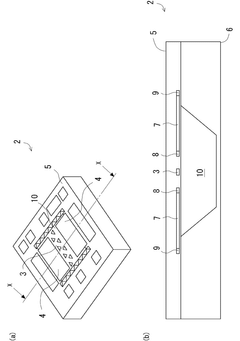
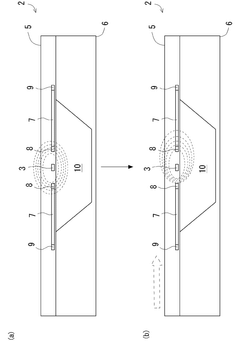
- A thermopile sensor design featuring a monolithic structure with a metal protective film covering the circuit and cold junction areas, improving electromagnetic shielding and reducing temperature sensitivity errors, while maintaining a thin film portion to cover the cavity area and expose metal terminals for signal processing.


Thermopile sensor
PatentWO2021176793A1
Innovation
- The thermopile design features thermocouples connected in series on an insulating film with PolySi and metal wiring, where the metal wiring overlaps the PolySi wiring, and the gap width where the metal wiring crosses is wider than in other areas, ensuring reliable connections and suppressing resistance increases and disconnections.


Material Science Advancements for Sensor Protection
Recent advancements in material science have significantly enhanced the protective capabilities of thermopile sensors operating in harsh environments. Traditional sensor encapsulation materials often fail under extreme conditions, leading to performance degradation and shortened lifespan. However, new ceramic-polymer composites demonstrate superior thermal stability and chemical resistance, extending sensor operational life by up to 300% in high-temperature industrial settings.
Nano-engineered coatings represent another breakthrough, with self-healing properties that can repair microcracks and prevent moisture ingress. These coatings, typically composed of siloxane-based compounds with embedded nanoparticles, maintain structural integrity even when exposed to corrosive chemicals or abrasive particulates. Testing has shown these materials can withstand pH ranges from 2-12 without compromising sensor functionality.
Advanced hermetic sealing techniques utilizing laser welding and glass-to-metal bonding have dramatically improved sensor isolation from environmental contaminants. These methods create near-perfect vacuum seals with helium leak rates below 1×10^-9 mbar·l/s, effectively eliminating one of the primary failure modes for thermopile sensors in humid or chemically aggressive environments.
Thermal management materials have evolved to include phase-change compounds and aerogel-based insulators that stabilize sensor temperature profiles even during rapid ambient fluctuations. These materials maintain thermal gradients within ±0.5°C across the sensor array, ensuring measurement accuracy in applications ranging from cryogenic to over 400°C operating conditions.
Radiation-hardened packaging materials incorporating boron nitride and specialized dopants now enable thermopile sensors to function reliably in high-radiation environments such as nuclear facilities and space applications. These materials can withstand cumulative radiation doses exceeding 100 kGy while maintaining electrical insulation properties and mechanical stability.
The integration of graphene and carbon nanotube reinforced polymers has created a new class of flexible yet robust sensor housings that can withstand mechanical shock up to 1000g and vibration profiles common in aerospace and heavy industrial applications. These advanced composites combine lightweight properties with exceptional mechanical strength and electrical shielding capabilities, addressing multiple protection requirements simultaneously.
Nano-engineered coatings represent another breakthrough, with self-healing properties that can repair microcracks and prevent moisture ingress. These coatings, typically composed of siloxane-based compounds with embedded nanoparticles, maintain structural integrity even when exposed to corrosive chemicals or abrasive particulates. Testing has shown these materials can withstand pH ranges from 2-12 without compromising sensor functionality.
Advanced hermetic sealing techniques utilizing laser welding and glass-to-metal bonding have dramatically improved sensor isolation from environmental contaminants. These methods create near-perfect vacuum seals with helium leak rates below 1×10^-9 mbar·l/s, effectively eliminating one of the primary failure modes for thermopile sensors in humid or chemically aggressive environments.
Thermal management materials have evolved to include phase-change compounds and aerogel-based insulators that stabilize sensor temperature profiles even during rapid ambient fluctuations. These materials maintain thermal gradients within ±0.5°C across the sensor array, ensuring measurement accuracy in applications ranging from cryogenic to over 400°C operating conditions.
Radiation-hardened packaging materials incorporating boron nitride and specialized dopants now enable thermopile sensors to function reliably in high-radiation environments such as nuclear facilities and space applications. These materials can withstand cumulative radiation doses exceeding 100 kGy while maintaining electrical insulation properties and mechanical stability.
The integration of graphene and carbon nanotube reinforced polymers has created a new class of flexible yet robust sensor housings that can withstand mechanical shock up to 1000g and vibration profiles common in aerospace and heavy industrial applications. These advanced composites combine lightweight properties with exceptional mechanical strength and electrical shielding capabilities, addressing multiple protection requirements simultaneously.
Environmental Testing Standards and Certification Requirements
Thermopile sensors operating in harsh environments must comply with rigorous testing standards and certification requirements to ensure reliability and performance. The International Electrotechnical Commission (IEC) provides several key standards, including IEC 60068 for environmental testing of electronic components, which specifies procedures for temperature cycling, humidity exposure, and mechanical shock testing. For thermopile sensors used in automotive applications, the AEC-Q100 qualification is essential, requiring functionality across temperature ranges from -40°C to +125°C and resistance to thermal shock cycles.
Military and aerospace applications follow MIL-STD-810, which outlines comprehensive environmental testing methodologies for equipment deployed in extreme conditions. This standard includes specific protocols for high-temperature operation, salt fog exposure, and vibration resistance—all critical factors for thermopile sensor reliability assessment. Similarly, the RTCA DO-160 standard governs environmental conditions and test procedures for airborne equipment, providing guidelines for altitude, temperature variation, and humidity testing.
IP (Ingress Protection) ratings defined by IEC 60529 are particularly relevant for thermopile sensors in industrial settings. Sensors requiring protection against dust and water typically need IP67 or IP68 certification, necessitating submersion testing and particulate exclusion verification. For sensors used in potentially explosive atmospheres, ATEX and IECEx certifications mandate additional testing for intrinsic safety and explosion prevention.
The semiconductor industry relies on JEDEC standards, particularly JEDEC JESD22, which specifies reliability test methods for packaged devices. These include highly accelerated stress testing (HAST) and temperature-humidity-bias (THB) tests that can predict long-term reliability under combined stresses. For medical applications, thermopile sensors must meet IEC 60601 requirements, focusing on electrical safety and essential performance under varying environmental conditions.
Certification processes typically involve third-party testing by accredited laboratories such as UL, TÜV, or SGS. These organizations conduct independent verification against applicable standards and issue certifications that manufacturers can use to demonstrate compliance. The testing methodology often includes accelerated life testing, where sensors are subjected to conditions exceeding normal operational parameters to identify potential failure modes and estimate mean time between failures (MTBF).
Recent developments in testing standards have begun to address emerging challenges such as electromagnetic compatibility in IoT environments and resistance to cyber-physical attacks. Additionally, sustainability considerations are being incorporated into newer standards, requiring assessment of sensor performance under energy-efficient operating conditions and evaluation of environmental impact throughout the product lifecycle.
Military and aerospace applications follow MIL-STD-810, which outlines comprehensive environmental testing methodologies for equipment deployed in extreme conditions. This standard includes specific protocols for high-temperature operation, salt fog exposure, and vibration resistance—all critical factors for thermopile sensor reliability assessment. Similarly, the RTCA DO-160 standard governs environmental conditions and test procedures for airborne equipment, providing guidelines for altitude, temperature variation, and humidity testing.
IP (Ingress Protection) ratings defined by IEC 60529 are particularly relevant for thermopile sensors in industrial settings. Sensors requiring protection against dust and water typically need IP67 or IP68 certification, necessitating submersion testing and particulate exclusion verification. For sensors used in potentially explosive atmospheres, ATEX and IECEx certifications mandate additional testing for intrinsic safety and explosion prevention.
The semiconductor industry relies on JEDEC standards, particularly JEDEC JESD22, which specifies reliability test methods for packaged devices. These include highly accelerated stress testing (HAST) and temperature-humidity-bias (THB) tests that can predict long-term reliability under combined stresses. For medical applications, thermopile sensors must meet IEC 60601 requirements, focusing on electrical safety and essential performance under varying environmental conditions.
Certification processes typically involve third-party testing by accredited laboratories such as UL, TÜV, or SGS. These organizations conduct independent verification against applicable standards and issue certifications that manufacturers can use to demonstrate compliance. The testing methodology often includes accelerated life testing, where sensors are subjected to conditions exceeding normal operational parameters to identify potential failure modes and estimate mean time between failures (MTBF).
Recent developments in testing standards have begun to address emerging challenges such as electromagnetic compatibility in IoT environments and resistance to cyber-physical attacks. Additionally, sustainability considerations are being incorporated into newer standards, requiring assessment of sensor performance under energy-efficient operating conditions and evaluation of environmental impact throughout the product lifecycle.
Unlock deeper insights with Patsnap Eureka Quick Research — get a full tech report to explore trends and direct your research. Try now!
Generate Your Research Report Instantly with AI Agent
Supercharge your innovation with Patsnap Eureka AI Agent Platform!