
Evaluating Brain-Computer Interface Utilization in Smart City Projects
MAR 5, 202610 MIN READ
Generate Your Research Report Instantly with AI Agent
Patsnap Eureka helps you evaluate technical feasibility & market potential.
BCI Technology Background and Smart City Integration Goals
Brain-Computer Interface technology represents a revolutionary paradigm in human-machine interaction, enabling direct communication pathways between the brain and external devices through the detection and interpretation of neural signals. The foundational principles of BCI systems emerged from decades of neuroscience research, beginning with early experiments in the 1970s that demonstrated the possibility of recording neural activity and translating it into control signals for external devices.
The evolution of BCI technology has progressed through distinct phases, from invasive electrode-based systems requiring surgical implantation to non-invasive approaches utilizing electroencephalography, functional near-infrared spectroscopy, and advanced neuroimaging techniques. Contemporary BCI systems have achieved remarkable milestones in signal processing accuracy, real-time response capabilities, and user adaptability, making them increasingly viable for practical applications beyond medical rehabilitation.
Smart city initiatives represent the convergence of digital technologies, data analytics, and urban infrastructure to create more efficient, sustainable, and livable urban environments. The integration of BCI technology into smart city frameworks presents unprecedented opportunities to enhance citizen engagement, accessibility, and personalized urban services through direct neural interface capabilities.
The primary integration goals for BCI technology within smart city projects encompass several strategic objectives. Enhanced accessibility represents a fundamental goal, where BCI systems can provide individuals with mobility or communication impairments seamless access to urban services, transportation systems, and digital infrastructure through thought-based control mechanisms. This integration aims to eliminate traditional barriers and create truly inclusive urban environments.
Personalized urban experience delivery constitutes another critical objective, leveraging BCI technology to understand individual preferences, cognitive states, and needs in real-time. Smart city systems equipped with BCI capabilities can dynamically adjust environmental parameters, recommend services, and optimize resource allocation based on direct neural feedback from citizens.
Emergency response optimization represents a vital integration goal, where BCI technology can enable rapid distress signal detection, unconscious state monitoring, and immediate emergency service activation through neural pattern recognition. This capability could revolutionize urban safety protocols and emergency medical response systems.
The convergence of BCI technology with smart city infrastructure also aims to establish new paradigms for human-urban environment interaction, where citizens can directly interface with city systems, provide feedback on urban planning initiatives, and participate in collective decision-making processes through neural consensus mechanisms. These integration goals collectively envision a future where urban environments become extensions of human cognitive capabilities, creating symbiotic relationships between citizens and their technological urban ecosystems.
The evolution of BCI technology has progressed through distinct phases, from invasive electrode-based systems requiring surgical implantation to non-invasive approaches utilizing electroencephalography, functional near-infrared spectroscopy, and advanced neuroimaging techniques. Contemporary BCI systems have achieved remarkable milestones in signal processing accuracy, real-time response capabilities, and user adaptability, making them increasingly viable for practical applications beyond medical rehabilitation.
Smart city initiatives represent the convergence of digital technologies, data analytics, and urban infrastructure to create more efficient, sustainable, and livable urban environments. The integration of BCI technology into smart city frameworks presents unprecedented opportunities to enhance citizen engagement, accessibility, and personalized urban services through direct neural interface capabilities.
The primary integration goals for BCI technology within smart city projects encompass several strategic objectives. Enhanced accessibility represents a fundamental goal, where BCI systems can provide individuals with mobility or communication impairments seamless access to urban services, transportation systems, and digital infrastructure through thought-based control mechanisms. This integration aims to eliminate traditional barriers and create truly inclusive urban environments.
Personalized urban experience delivery constitutes another critical objective, leveraging BCI technology to understand individual preferences, cognitive states, and needs in real-time. Smart city systems equipped with BCI capabilities can dynamically adjust environmental parameters, recommend services, and optimize resource allocation based on direct neural feedback from citizens.
Emergency response optimization represents a vital integration goal, where BCI technology can enable rapid distress signal detection, unconscious state monitoring, and immediate emergency service activation through neural pattern recognition. This capability could revolutionize urban safety protocols and emergency medical response systems.
The convergence of BCI technology with smart city infrastructure also aims to establish new paradigms for human-urban environment interaction, where citizens can directly interface with city systems, provide feedback on urban planning initiatives, and participate in collective decision-making processes through neural consensus mechanisms. These integration goals collectively envision a future where urban environments become extensions of human cognitive capabilities, creating symbiotic relationships between citizens and their technological urban ecosystems.
Market Demand for BCI-Enabled Smart City Solutions
The integration of brain-computer interface technology into smart city infrastructure represents an emerging market segment with significant growth potential across multiple urban application domains. Current market demand is primarily driven by the need for more intuitive and accessible human-machine interaction systems in urban environments, particularly for individuals with mobility limitations or disabilities who require enhanced accessibility solutions.
Healthcare and assistive technology sectors demonstrate the strongest immediate demand for BCI-enabled smart city solutions. Urban healthcare systems are increasingly seeking technologies that can provide seamless patient monitoring, emergency response capabilities, and rehabilitation support through neural interface systems. Smart hospitals and medical facilities within urban environments are exploring BCI applications for patient care management and medical device control.
Transportation infrastructure presents another significant demand driver, with urban mobility systems requiring more sophisticated user interaction methods. Public transportation authorities are investigating BCI applications for hands-free ticketing systems, navigation assistance for visually impaired users, and enhanced accessibility features in smart transit networks. The growing emphasis on inclusive urban design is accelerating interest in neural interface solutions for transportation accessibility.
Smart building and infrastructure management sectors are experiencing rising demand for BCI-enabled control systems. Building automation companies are exploring neural interface technologies for environmental control, security access, and facility management applications. The potential for thought-controlled building systems appeals to both commercial real estate developers and municipal facility managers seeking innovative user experience solutions.
Public safety and emergency response services represent an emerging demand segment for BCI applications in smart cities. Emergency response teams are evaluating neural interface technologies for hands-free communication systems, situational awareness enhancement, and rapid response coordination. The ability to maintain communication and control capabilities in high-stress emergency situations drives interest in BCI solutions among urban safety organizations.
The market demand is further supported by increasing government initiatives promoting digital inclusion and accessibility in urban environments. Municipal authorities are allocating resources toward technologies that can improve quality of life for citizens with disabilities, creating procurement opportunities for BCI-enabled smart city solutions. This regulatory and policy support is establishing a foundation for sustained market growth in neural interface applications for urban infrastructure.
Healthcare and assistive technology sectors demonstrate the strongest immediate demand for BCI-enabled smart city solutions. Urban healthcare systems are increasingly seeking technologies that can provide seamless patient monitoring, emergency response capabilities, and rehabilitation support through neural interface systems. Smart hospitals and medical facilities within urban environments are exploring BCI applications for patient care management and medical device control.
Transportation infrastructure presents another significant demand driver, with urban mobility systems requiring more sophisticated user interaction methods. Public transportation authorities are investigating BCI applications for hands-free ticketing systems, navigation assistance for visually impaired users, and enhanced accessibility features in smart transit networks. The growing emphasis on inclusive urban design is accelerating interest in neural interface solutions for transportation accessibility.
Smart building and infrastructure management sectors are experiencing rising demand for BCI-enabled control systems. Building automation companies are exploring neural interface technologies for environmental control, security access, and facility management applications. The potential for thought-controlled building systems appeals to both commercial real estate developers and municipal facility managers seeking innovative user experience solutions.
Public safety and emergency response services represent an emerging demand segment for BCI applications in smart cities. Emergency response teams are evaluating neural interface technologies for hands-free communication systems, situational awareness enhancement, and rapid response coordination. The ability to maintain communication and control capabilities in high-stress emergency situations drives interest in BCI solutions among urban safety organizations.
The market demand is further supported by increasing government initiatives promoting digital inclusion and accessibility in urban environments. Municipal authorities are allocating resources toward technologies that can improve quality of life for citizens with disabilities, creating procurement opportunities for BCI-enabled smart city solutions. This regulatory and policy support is establishing a foundation for sustained market growth in neural interface applications for urban infrastructure.
Current BCI Development Status and Urban Implementation Challenges
Brain-Computer Interface technology has reached a pivotal stage in its development trajectory, with significant advances in neural signal acquisition, processing algorithms, and real-time interpretation capabilities. Current BCI systems demonstrate varying levels of maturity across different application domains, ranging from medical rehabilitation devices with established clinical validation to emerging consumer-grade interfaces still undergoing refinement. The technology landscape encompasses invasive, semi-invasive, and non-invasive approaches, each presenting distinct advantages and limitations for urban deployment scenarios.
The integration of BCI technology into smart city infrastructure faces substantial technical barriers that extend beyond traditional laboratory environments. Signal quality degradation in urban electromagnetic environments poses a critical challenge, as metropolitan areas generate significant interference from wireless networks, electrical systems, and industrial equipment. This electromagnetic noise can severely compromise the fidelity of neural signal acquisition, particularly for non-invasive EEG-based systems that rely on detecting microvolt-level brain activity.
Scalability represents another fundamental obstacle in urban BCI implementation. Current systems typically support individual or small-group interactions, but smart city applications demand simultaneous processing of neural inputs from potentially thousands of users across distributed locations. The computational infrastructure required for real-time neural signal processing at this scale necessitates substantial advances in edge computing architectures and cloud-based neural processing platforms.
Privacy and security concerns create additional implementation barriers unique to urban environments. Unlike controlled clinical settings, smart city BCI applications must operate within complex regulatory frameworks while protecting sensitive neural data from potential cyber threats. The permanent nature of neural signatures raises unprecedented questions about biometric data protection and long-term privacy implications that current cybersecurity frameworks are not equipped to address.
Standardization challenges further complicate urban BCI deployment. The absence of unified protocols for neural signal interpretation, device interoperability, and data exchange formats creates fragmentation across different BCI platforms. This lack of standardization becomes particularly problematic in smart city contexts where multiple vendors and technologies must seamlessly integrate within existing urban infrastructure systems.
User acceptance and training requirements present significant social implementation challenges. Urban BCI applications must accommodate diverse populations with varying technological literacy levels, physical capabilities, and cultural attitudes toward brain-computer interaction. The learning curve associated with effective BCI operation, combined with potential user discomfort regarding neural monitoring, creates barriers to widespread adoption in public urban environments.
Current pilot projects in select metropolitan areas reveal promising developments alongside persistent challenges. Limited-scale implementations in transportation hubs and public facilities demonstrate feasibility for specific use cases, while highlighting the substantial infrastructure investments required for broader deployment across comprehensive smart city networks.
The integration of BCI technology into smart city infrastructure faces substantial technical barriers that extend beyond traditional laboratory environments. Signal quality degradation in urban electromagnetic environments poses a critical challenge, as metropolitan areas generate significant interference from wireless networks, electrical systems, and industrial equipment. This electromagnetic noise can severely compromise the fidelity of neural signal acquisition, particularly for non-invasive EEG-based systems that rely on detecting microvolt-level brain activity.
Scalability represents another fundamental obstacle in urban BCI implementation. Current systems typically support individual or small-group interactions, but smart city applications demand simultaneous processing of neural inputs from potentially thousands of users across distributed locations. The computational infrastructure required for real-time neural signal processing at this scale necessitates substantial advances in edge computing architectures and cloud-based neural processing platforms.
Privacy and security concerns create additional implementation barriers unique to urban environments. Unlike controlled clinical settings, smart city BCI applications must operate within complex regulatory frameworks while protecting sensitive neural data from potential cyber threats. The permanent nature of neural signatures raises unprecedented questions about biometric data protection and long-term privacy implications that current cybersecurity frameworks are not equipped to address.
Standardization challenges further complicate urban BCI deployment. The absence of unified protocols for neural signal interpretation, device interoperability, and data exchange formats creates fragmentation across different BCI platforms. This lack of standardization becomes particularly problematic in smart city contexts where multiple vendors and technologies must seamlessly integrate within existing urban infrastructure systems.
User acceptance and training requirements present significant social implementation challenges. Urban BCI applications must accommodate diverse populations with varying technological literacy levels, physical capabilities, and cultural attitudes toward brain-computer interaction. The learning curve associated with effective BCI operation, combined with potential user discomfort regarding neural monitoring, creates barriers to widespread adoption in public urban environments.
Current pilot projects in select metropolitan areas reveal promising developments alongside persistent challenges. Limited-scale implementations in transportation hubs and public facilities demonstrate feasibility for specific use cases, while highlighting the substantial infrastructure investments required for broader deployment across comprehensive smart city networks.
Existing BCI Applications in Urban Infrastructure
01 Signal processing and feature extraction methods for brain-computer interfaces
Advanced signal processing techniques are employed to extract meaningful features from brain signals captured by BCI systems. These methods involve filtering, amplification, and transformation of raw neural data to identify patterns associated with specific mental states or intentions. Machine learning algorithms and neural networks are often integrated to improve the accuracy of signal interpretation and reduce noise interference.- Signal processing and feature extraction methods for brain-computer interfaces: Advanced signal processing techniques are employed to extract meaningful features from brain signals captured by BCI systems. These methods involve filtering, noise reduction, and pattern recognition algorithms to improve the accuracy of brain signal interpretation. Machine learning and deep learning approaches are utilized to classify different brain states and intentions, enabling more reliable control of external devices through thought alone.
- Hardware design and electrode configuration for brain signal acquisition: The physical design of BCI systems includes specialized electrode arrays and sensor configurations optimized for capturing brain signals with high fidelity. These designs focus on improving signal quality, reducing interference, and enhancing user comfort during extended use. Innovations include flexible electrode materials, wireless transmission capabilities, and miniaturized components that make BCI systems more practical for everyday applications.
- Application of brain-computer interfaces in medical rehabilitation and assistive technology: BCI technology is applied to help patients with motor disabilities regain control and independence through neural prosthetics and rehabilitation systems. These applications enable individuals with paralysis or neuromuscular disorders to control wheelchairs, robotic limbs, or communication devices using brain signals. The technology also supports cognitive rehabilitation and provides new therapeutic approaches for stroke recovery and neurological conditions.
- Integration of brain-computer interfaces with virtual reality and augmented reality systems: BCI systems are combined with immersive technologies to create enhanced user experiences and novel interaction paradigms. This integration allows users to control virtual environments, gaming applications, and training simulations through neural commands. The combination enables more intuitive human-computer interaction and opens new possibilities for entertainment, education, and professional training applications.
- Wireless and portable brain-computer interface systems: Development of compact, wireless BCI devices that enable mobile and practical applications outside laboratory settings. These systems incorporate battery-powered operation, wireless data transmission, and lightweight designs that allow users to move freely while maintaining brain signal monitoring capabilities. The portability aspect makes BCI technology more accessible for daily use in home environments, workplaces, and clinical settings.
02 Hardware design and electrode configuration for brain signal acquisition
The physical components of BCI systems include specialized electrodes and sensors designed to capture brain activity with high precision. These hardware solutions focus on optimizing electrode placement, improving signal quality, and ensuring user comfort during extended use. Innovations include non-invasive electrode arrays, wireless transmission systems, and miniaturized components that enhance portability and usability.Expand Specific Solutions03 Application of brain-computer interfaces in medical rehabilitation and assistive technology
BCI technology is utilized to assist patients with motor disabilities or neurological conditions by enabling direct communication between the brain and external devices. These applications include controlling prosthetic limbs, wheelchairs, and communication aids through thought alone. The systems are designed to restore lost functionality and improve quality of life for individuals with paralysis, stroke, or other impairments.Expand Specific Solutions04 Integration of brain-computer interfaces with virtual reality and gaming systems
BCI systems are being integrated with virtual reality platforms and gaming applications to create immersive experiences controlled by neural activity. These implementations allow users to interact with digital environments using mental commands, enhancing engagement and providing new forms of entertainment. The technology also has potential applications in training simulations and cognitive assessment tools.Expand Specific Solutions05 Calibration and adaptation mechanisms for personalized brain-computer interface performance
Personalization techniques are developed to adapt BCI systems to individual users' unique brain signal patterns and cognitive characteristics. These mechanisms involve calibration procedures that learn from user-specific data to optimize system responsiveness and accuracy over time. Adaptive algorithms continuously adjust parameters to maintain performance despite variations in signal quality or user mental state.Expand Specific Solutions
Key Players in BCI and Smart City Technology Sectors
The brain-computer interface (BCI) market for smart city applications is in its nascent stage, representing an emerging frontier with significant growth potential. The market remains relatively small but shows promising expansion as urbanization demands innovative human-machine interaction solutions. Technology maturity varies considerably across players, with established companies like MindPortal, Inc. and Neurable, Inc. leading commercial development of non-invasive BCI systems, while Koninklijke Philips NV leverages healthcare expertise for urban wellness applications. Academic institutions including Tsinghua University, University of Washington, and Sorbonne Université drive fundamental research advancement. Research organizations like Centre National de la Recherche Scientifique and Advanced Telecommunications Research Institute International contribute theoretical foundations. Corporate giants IBM and Toyota Motor Europe explore integration possibilities within smart infrastructure frameworks. The competitive landscape reflects a hybrid ecosystem where specialized BCI startups, healthcare technology leaders, automotive manufacturers, and academic research institutions collaborate to overcome technical challenges and establish practical applications for urban environments.
Koninklijke Philips NV
Technical Solution: Philips leverages its extensive healthcare technology expertise to develop brain-computer interface solutions for smart city health monitoring applications. Their approach integrates advanced neuroimaging technologies with IoT infrastructure to create comprehensive brain health monitoring systems for urban populations. The company's BCI technology utilizes high-resolution EEG combined with their proprietary HealthSuite digital platform to monitor cognitive load, stress levels, and mental fatigue in real-time across city environments. This data can be used to optimize urban planning, workplace environments, and public health initiatives. Philips' solution incorporates machine learning algorithms that can predict mental health trends and provide early warning systems for cognitive decline in aging populations. Their technology is designed to integrate seamlessly with existing healthcare infrastructure and smart city management systems, providing valuable insights for urban planners and healthcare providers.
Strengths: Strong healthcare industry expertise, robust data analytics platform, regulatory compliance experience. Weaknesses: Higher cost implementation, primarily focused on healthcare applications rather than broader smart city integration.
Neurable, Inc.
Technical Solution: Neurable develops non-invasive brain-computer interface technology specifically designed for everyday use in smart environments. Their flagship approach utilizes dry EEG electrodes integrated into wearable devices like headphones and AR/VR headsets, enabling seamless brain-computer interaction without the need for conductive gels or clinical setup. The company's proprietary machine learning algorithms can decode user intent from neural signals in real-time, allowing for hands-free control of smart city infrastructure such as traffic management systems, public transportation interfaces, and building automation. Their technology focuses on detecting specific neural patterns associated with attention, focus, and decision-making, which can be translated into actionable commands for urban IoT devices. Neurable's solution is particularly suited for integration with existing smart city platforms due to its wireless connectivity and cloud-based processing capabilities.
Strengths: User-friendly wearable design, real-time processing capabilities, strong commercial viability. Weaknesses: Limited signal quality compared to invasive methods, requires user training for optimal performance.
Core BCI Patents for Smart City Applications
Systems and methods that involve BCI (brain computer interface), extended reality and/or eye-tracking devices, detect mind/brain activity, generate and/or process saliency maps, eye-tracking information and/or various control(s) or instructions, implement mind-based selection of UI elements and/or perform other features and functionality
PatentPendingUS20250004558A1
Innovation
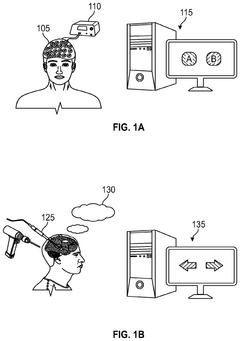
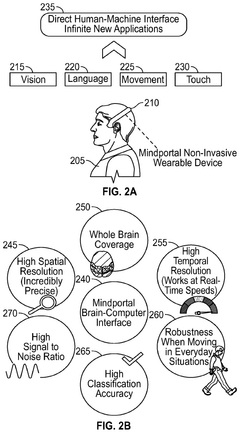
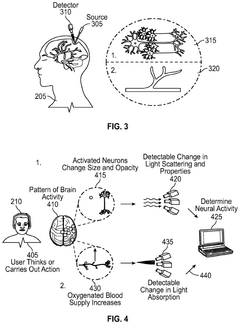
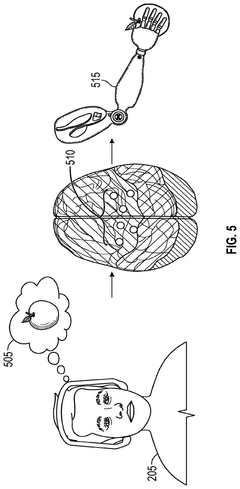
- A non-invasive brain-computer interface system that uses optical-based brain signal acquisition and decoding modalities, enabling high-resolution data collection and decoding of neural activities associated with thoughts, including visual attention and intended actions, through the use of wearable optodes that detect neuronal and haemodynamic changes, allowing for precise brain signal processing and interaction with UI elements in mixed reality environments.
Systems and methods for processing data involving aspects of brain computer interface (BCI), virtual environment and/or other features associated with activity and/or state of a user's mind, brain and/or other interactions with the environment
PatentWO2024192445A1
Innovation
- The development of non-invasive brain-computer interface systems using high-density diffuse optical tomography (HD-DOT) and other optical systems for direct continuous speech decoding, enabling semantic level decoding and leveraging generative artificial intelligence to reconstruct text from brain data, allowing for natural and efficient user interactions.


Privacy and Data Protection Regulations for BCI Systems
The integration of Brain-Computer Interface (BCI) systems within smart city infrastructures presents unprecedented challenges for privacy and data protection frameworks. Neural data represents the most intimate form of personal information, containing direct recordings of brain activity that could potentially reveal thoughts, emotions, intentions, and cognitive states. Current privacy regulations, including GDPR in Europe and various national data protection laws, were not specifically designed to address the unique characteristics of neural data, creating significant regulatory gaps that must be addressed before widespread BCI deployment in urban environments.
The classification of neural data under existing privacy frameworks remains ambiguous and varies across jurisdictions. While some regulators treat BCI data as sensitive biometric information requiring enhanced protection, others categorize it alongside general health data. This inconsistency creates compliance challenges for smart city operators implementing BCI systems across multiple regions. The European Union's GDPR provides the most comprehensive framework, classifying neural data as special category personal data requiring explicit consent and additional safeguards, yet specific guidelines for BCI applications remain underdeveloped.
Consent mechanisms for BCI systems in smart cities require fundamental reconceptualization beyond traditional opt-in models. The continuous and often subconscious nature of neural data collection makes informed consent particularly complex. Users may not fully comprehend the implications of sharing brain signals, especially when data collection occurs passively through ambient BCI sensors integrated into urban infrastructure. Dynamic consent models that allow real-time adjustment of data sharing preferences are emerging as potential solutions, though technical implementation remains challenging.
Data minimization principles face unique obstacles in BCI applications where the full value of neural signals may not be immediately apparent. Smart city BCI systems often require extensive data collection to achieve meaningful insights about urban behavior patterns, traffic flow optimization, or public safety monitoring. Balancing these operational needs with privacy-by-design principles requires sophisticated data processing techniques that can extract necessary insights while minimizing personal data exposure.
Cross-border data transfer regulations significantly impact BCI system architecture in internationally connected smart cities. Neural data's sensitive nature often restricts international transfers, requiring local data processing and storage infrastructure. This creates technical and economic challenges for global smart city technology providers who must adapt their systems to comply with varying national requirements while maintaining system interoperability and performance standards.
Emerging regulatory frameworks specifically addressing neurotechnology are beginning to appear in several jurisdictions. Chile's constitutional amendment protecting mental integrity and cognitive liberty represents a pioneering approach, while the European Union is developing specific guidelines for neurotechnology applications. These evolving regulations will likely establish new standards for BCI data governance, requiring smart city operators to implement adaptive compliance systems capable of responding to changing regulatory landscapes.
The classification of neural data under existing privacy frameworks remains ambiguous and varies across jurisdictions. While some regulators treat BCI data as sensitive biometric information requiring enhanced protection, others categorize it alongside general health data. This inconsistency creates compliance challenges for smart city operators implementing BCI systems across multiple regions. The European Union's GDPR provides the most comprehensive framework, classifying neural data as special category personal data requiring explicit consent and additional safeguards, yet specific guidelines for BCI applications remain underdeveloped.
Consent mechanisms for BCI systems in smart cities require fundamental reconceptualization beyond traditional opt-in models. The continuous and often subconscious nature of neural data collection makes informed consent particularly complex. Users may not fully comprehend the implications of sharing brain signals, especially when data collection occurs passively through ambient BCI sensors integrated into urban infrastructure. Dynamic consent models that allow real-time adjustment of data sharing preferences are emerging as potential solutions, though technical implementation remains challenging.
Data minimization principles face unique obstacles in BCI applications where the full value of neural signals may not be immediately apparent. Smart city BCI systems often require extensive data collection to achieve meaningful insights about urban behavior patterns, traffic flow optimization, or public safety monitoring. Balancing these operational needs with privacy-by-design principles requires sophisticated data processing techniques that can extract necessary insights while minimizing personal data exposure.
Cross-border data transfer regulations significantly impact BCI system architecture in internationally connected smart cities. Neural data's sensitive nature often restricts international transfers, requiring local data processing and storage infrastructure. This creates technical and economic challenges for global smart city technology providers who must adapt their systems to comply with varying national requirements while maintaining system interoperability and performance standards.
Emerging regulatory frameworks specifically addressing neurotechnology are beginning to appear in several jurisdictions. Chile's constitutional amendment protecting mental integrity and cognitive liberty represents a pioneering approach, while the European Union is developing specific guidelines for neurotechnology applications. These evolving regulations will likely establish new standards for BCI data governance, requiring smart city operators to implement adaptive compliance systems capable of responding to changing regulatory landscapes.
Ethical Framework for Neural Data in Public Spaces
The deployment of brain-computer interfaces in smart city environments necessitates a comprehensive ethical framework to govern neural data collection, processing, and utilization in public spaces. This framework must address fundamental principles of privacy, consent, and data sovereignty while balancing technological innovation with citizen rights protection.
Informed consent represents the cornerstone of ethical neural data handling in public BCI implementations. Unlike traditional data collection methods, neural interfaces capture intimate cognitive and emotional states, requiring enhanced consent protocols that clearly communicate data types, processing purposes, and potential risks. Dynamic consent mechanisms should enable citizens to modify permissions in real-time as they navigate different public zones with varying BCI capabilities.
Privacy preservation in neural data systems demands multi-layered protection strategies. Differential privacy techniques can anonymize brainwave patterns while maintaining analytical utility for smart city optimization. Edge computing architectures should process sensitive neural signals locally, transmitting only aggregated insights to central systems. Temporal data retention policies must strictly limit neural data storage duration, with automatic deletion protocols preventing indefinite accumulation of cognitive profiles.
Data minimization principles require BCI systems to collect only neural information essential for specific smart city functions. Traffic optimization applications should access movement intention signals without capturing emotional states or personal thoughts. Environmental monitoring systems utilizing collective neural responses to air quality must implement strict data segregation to prevent cross-functional data correlation.
Algorithmic transparency and accountability mechanisms ensure neural data processing remains auditable and explainable. Citizens must understand how their brain signals influence smart city decisions, from traffic light timing to public space design modifications. Regular algorithmic audits should assess potential biases in neural pattern interpretation across diverse demographic groups.
Governance structures should establish independent oversight bodies comprising neuroscientists, ethicists, and citizen representatives to monitor BCI deployment compliance. These entities must possess authority to investigate privacy violations, mandate system modifications, and impose penalties for ethical breaches. International cooperation frameworks can harmonize neural data protection standards across interconnected smart city networks, ensuring consistent ethical treatment regardless of geographical boundaries.
Informed consent represents the cornerstone of ethical neural data handling in public BCI implementations. Unlike traditional data collection methods, neural interfaces capture intimate cognitive and emotional states, requiring enhanced consent protocols that clearly communicate data types, processing purposes, and potential risks. Dynamic consent mechanisms should enable citizens to modify permissions in real-time as they navigate different public zones with varying BCI capabilities.
Privacy preservation in neural data systems demands multi-layered protection strategies. Differential privacy techniques can anonymize brainwave patterns while maintaining analytical utility for smart city optimization. Edge computing architectures should process sensitive neural signals locally, transmitting only aggregated insights to central systems. Temporal data retention policies must strictly limit neural data storage duration, with automatic deletion protocols preventing indefinite accumulation of cognitive profiles.
Data minimization principles require BCI systems to collect only neural information essential for specific smart city functions. Traffic optimization applications should access movement intention signals without capturing emotional states or personal thoughts. Environmental monitoring systems utilizing collective neural responses to air quality must implement strict data segregation to prevent cross-functional data correlation.
Algorithmic transparency and accountability mechanisms ensure neural data processing remains auditable and explainable. Citizens must understand how their brain signals influence smart city decisions, from traffic light timing to public space design modifications. Regular algorithmic audits should assess potential biases in neural pattern interpretation across diverse demographic groups.
Governance structures should establish independent oversight bodies comprising neuroscientists, ethicists, and citizen representatives to monitor BCI deployment compliance. These entities must possess authority to investigate privacy violations, mandate system modifications, and impose penalties for ethical breaches. International cooperation frameworks can harmonize neural data protection standards across interconnected smart city networks, ensuring consistent ethical treatment regardless of geographical boundaries.
Unlock deeper insights with Patsnap Eureka Quick Research — get a full tech report to explore trends and direct your research. Try now!
Generate Your Research Report Instantly with AI Agent
Supercharge your innovation with Patsnap Eureka AI Agent Platform!