FinFET Vs IGZO: Performance Analysis In Circuits
SEP 11, 202510 MIN READ
Generate Your Research Report Instantly with AI Agent
PatSnap Eureka helps you evaluate technical feasibility & market potential.
FinFET and IGZO Technology Evolution and Objectives
The semiconductor industry has witnessed a remarkable evolution over the past decades, with transistor technology continuously advancing to meet the growing demands for higher performance and energy efficiency. FinFET (Fin Field-Effect Transistor) and IGZO (Indium Gallium Zinc Oxide) represent two significant technological developments that have emerged to address the limitations of conventional planar transistors. These technologies have followed distinct evolutionary paths, driven by different market needs and technical challenges.
FinFET technology emerged as a response to the scaling limitations of traditional planar MOSFET designs. First conceptualized in the late 1990s and commercially introduced by Intel in 2011 with their 22nm process node, FinFETs represented a paradigm shift from planar to three-dimensional transistor structures. This evolution was necessitated by the increasing short-channel effects and leakage currents that plagued planar transistors as dimensions shrank below 28nm.
IGZO technology, conversely, evolved from the broader field of thin-film transistors (TFTs) and has been primarily driven by the display industry's requirements. Developed in the early 2000s by researchers in Japan, IGZO offered significant advantages over amorphous silicon in terms of electron mobility and transparency. Unlike FinFET's focus on computational performance, IGZO's evolution has been guided by the need for better display technologies, particularly for applications requiring low power consumption and high resolution.
The technical objectives of these technologies reflect their divergent evolutionary paths. FinFET development has primarily targeted increased transistor density, improved performance, and reduced power consumption for high-performance computing applications. The multi-gate architecture of FinFETs allows for better electrostatic control of the channel, resulting in reduced leakage current and improved short-channel behavior.
IGZO, meanwhile, has been developed with objectives centered around large-area electronics, flexibility, transparency, and ultra-low power consumption. Its amorphous structure enables uniform electrical characteristics across large areas, making it ideal for display applications. Additionally, IGZO's wide bandgap properties contribute to its exceptional transparency and low off-state current.
Recent trends indicate a convergence of objectives between these technologies, particularly as the Internet of Things (IoT) and mobile computing drive demand for circuits that combine high performance with energy efficiency. FinFET technology continues to scale down, with current research focusing on gate-all-around (GAA) structures as the potential successor. Simultaneously, IGZO is expanding beyond displays into areas such as flexible electronics, sensors, and low-power memory applications.
The future evolution of both technologies will likely be shaped by emerging applications in artificial intelligence, edge computing, and wearable devices, where the balance between performance and power efficiency becomes increasingly critical. Understanding this technological trajectory is essential for anticipating future circuit design paradigms and identifying potential innovation opportunities in semiconductor technology.
FinFET technology emerged as a response to the scaling limitations of traditional planar MOSFET designs. First conceptualized in the late 1990s and commercially introduced by Intel in 2011 with their 22nm process node, FinFETs represented a paradigm shift from planar to three-dimensional transistor structures. This evolution was necessitated by the increasing short-channel effects and leakage currents that plagued planar transistors as dimensions shrank below 28nm.
IGZO technology, conversely, evolved from the broader field of thin-film transistors (TFTs) and has been primarily driven by the display industry's requirements. Developed in the early 2000s by researchers in Japan, IGZO offered significant advantages over amorphous silicon in terms of electron mobility and transparency. Unlike FinFET's focus on computational performance, IGZO's evolution has been guided by the need for better display technologies, particularly for applications requiring low power consumption and high resolution.
The technical objectives of these technologies reflect their divergent evolutionary paths. FinFET development has primarily targeted increased transistor density, improved performance, and reduced power consumption for high-performance computing applications. The multi-gate architecture of FinFETs allows for better electrostatic control of the channel, resulting in reduced leakage current and improved short-channel behavior.
IGZO, meanwhile, has been developed with objectives centered around large-area electronics, flexibility, transparency, and ultra-low power consumption. Its amorphous structure enables uniform electrical characteristics across large areas, making it ideal for display applications. Additionally, IGZO's wide bandgap properties contribute to its exceptional transparency and low off-state current.
Recent trends indicate a convergence of objectives between these technologies, particularly as the Internet of Things (IoT) and mobile computing drive demand for circuits that combine high performance with energy efficiency. FinFET technology continues to scale down, with current research focusing on gate-all-around (GAA) structures as the potential successor. Simultaneously, IGZO is expanding beyond displays into areas such as flexible electronics, sensors, and low-power memory applications.
The future evolution of both technologies will likely be shaped by emerging applications in artificial intelligence, edge computing, and wearable devices, where the balance between performance and power efficiency becomes increasingly critical. Understanding this technological trajectory is essential for anticipating future circuit design paradigms and identifying potential innovation opportunities in semiconductor technology.
Market Demand for Advanced Semiconductor Solutions
The semiconductor industry is witnessing unprecedented demand for advanced solutions that can deliver superior performance while managing power consumption and thermal constraints. Market research indicates that the global semiconductor market is projected to reach $1 trillion by 2030, with advanced transistor technologies representing a significant growth segment. This surge is primarily driven by the exponential increase in data processing requirements across multiple sectors including artificial intelligence, high-performance computing, mobile devices, and automotive electronics.
The comparison between FinFET and IGZO technologies addresses a critical market need for diversified semiconductor solutions optimized for different application scenarios. FinFET technology has established itself as the cornerstone of high-performance computing applications, with market adoption accelerating since its commercial introduction in 2011. The technology now dominates the premium processor segment, with major foundries including TSMC, Samsung, and Intel heavily invested in its continued development.
Meanwhile, IGZO (Indium Gallium Zinc Oxide) technology has carved out a growing niche in the display-driven and low-power electronics markets. The transparent semiconductor material has seen increasing adoption in applications where power efficiency takes precedence over raw computational performance. Market analysis shows IGZO implementations growing at approximately 24% annually in sectors such as wearable technology, IoT devices, and advanced display systems.
Enterprise customers are increasingly demanding semiconductor solutions that provide optimal balance between performance, power consumption, and cost. This has created distinct market segments where either FinFET or IGZO may present the superior value proposition. The high-performance computing segment continues to prioritize computational throughput, making FinFET the preferred choice despite higher manufacturing costs and power requirements.
Conversely, the expanding market for edge computing devices, which is expected to exceed 50 billion connected units by 2025, presents a substantial opportunity for IGZO-based solutions. These applications typically operate under strict power constraints while requiring moderate performance capabilities—precisely the scenario where IGZO's characteristics become advantageous.
Regional market analysis reveals differentiated adoption patterns, with North America and East Asia leading FinFET implementation in data centers and high-end consumer electronics, while IGZO sees broader geographical distribution across diverse application categories. The automotive semiconductor segment represents a particularly interesting battleground, as it requires both high-performance processing for autonomous driving functions and power-efficient solutions for numerous auxiliary systems.
Industry forecasts suggest that rather than one technology displacing the other, the market is evolving toward application-specific optimization, where circuit designers select the most appropriate technology based on targeted performance metrics, power budgets, and cost considerations.
The comparison between FinFET and IGZO technologies addresses a critical market need for diversified semiconductor solutions optimized for different application scenarios. FinFET technology has established itself as the cornerstone of high-performance computing applications, with market adoption accelerating since its commercial introduction in 2011. The technology now dominates the premium processor segment, with major foundries including TSMC, Samsung, and Intel heavily invested in its continued development.
Meanwhile, IGZO (Indium Gallium Zinc Oxide) technology has carved out a growing niche in the display-driven and low-power electronics markets. The transparent semiconductor material has seen increasing adoption in applications where power efficiency takes precedence over raw computational performance. Market analysis shows IGZO implementations growing at approximately 24% annually in sectors such as wearable technology, IoT devices, and advanced display systems.
Enterprise customers are increasingly demanding semiconductor solutions that provide optimal balance between performance, power consumption, and cost. This has created distinct market segments where either FinFET or IGZO may present the superior value proposition. The high-performance computing segment continues to prioritize computational throughput, making FinFET the preferred choice despite higher manufacturing costs and power requirements.
Conversely, the expanding market for edge computing devices, which is expected to exceed 50 billion connected units by 2025, presents a substantial opportunity for IGZO-based solutions. These applications typically operate under strict power constraints while requiring moderate performance capabilities—precisely the scenario where IGZO's characteristics become advantageous.
Regional market analysis reveals differentiated adoption patterns, with North America and East Asia leading FinFET implementation in data centers and high-end consumer electronics, while IGZO sees broader geographical distribution across diverse application categories. The automotive semiconductor segment represents a particularly interesting battleground, as it requires both high-performance processing for autonomous driving functions and power-efficient solutions for numerous auxiliary systems.
Industry forecasts suggest that rather than one technology displacing the other, the market is evolving toward application-specific optimization, where circuit designers select the most appropriate technology based on targeted performance metrics, power budgets, and cost considerations.
Technical Challenges in FinFET and IGZO Implementation
Despite the significant advancements in both FinFET and IGZO technologies, their implementation faces several critical technical challenges that impact their performance in circuit applications. For FinFET technology, one of the primary challenges is the short-channel effect control as device dimensions continue to shrink below 10nm. The three-dimensional fin structure, while effective at controlling leakage current, introduces complex manufacturing processes that require precise etching techniques and atomic-level precision.
Manufacturing consistency presents another significant hurdle for FinFET implementation. The vertical fin structures demand extremely tight process control to maintain uniform fin height and width across the wafer. Any variation in these parameters directly affects threshold voltage and drive current, leading to performance inconsistencies in integrated circuits.
Parasitic capacitance and resistance in FinFET devices also pose substantial challenges. The increased surface area of the three-dimensional structure inherently introduces higher parasitic elements compared to planar technologies, potentially limiting high-frequency performance in certain circuit applications. Engineers must implement sophisticated layout techniques to mitigate these effects.
For IGZO technology, the primary challenge lies in achieving consistent electrical properties across large areas. The amorphous nature of IGZO, while beneficial for large-area applications, introduces variability in carrier mobility and threshold voltage, particularly when subjected to environmental factors such as temperature and humidity. This variability can significantly impact circuit stability and reliability.
Stability under bias stress represents another critical challenge for IGZO implementation. When subjected to prolonged gate bias, IGZO transistors can exhibit threshold voltage shifts due to charge trapping mechanisms, affecting long-term circuit performance. This necessitates the development of specialized compensation circuits or improved material formulations.
Interface quality between the IGZO channel and gate dielectric significantly influences device performance. Achieving a clean, defect-free interface remains technically challenging, particularly when using low-temperature processes compatible with flexible substrates. These interface defects can lead to carrier scattering and reduced mobility.
Both technologies face integration challenges when implemented in complex circuit designs. For FinFET, the three-dimensional structure complicates layout design rules and increases interconnect complexity. IGZO, while simpler in structure, faces compatibility issues when integrated with conventional silicon-based components, particularly in terms of process temperature compatibility and contact resistance optimization.
Power management presents unique challenges for each technology. FinFETs must balance dynamic and static power consumption through careful threshold voltage engineering, while IGZO devices must address relatively slower switching speeds that can impact power efficiency in certain circuit applications.
Manufacturing consistency presents another significant hurdle for FinFET implementation. The vertical fin structures demand extremely tight process control to maintain uniform fin height and width across the wafer. Any variation in these parameters directly affects threshold voltage and drive current, leading to performance inconsistencies in integrated circuits.
Parasitic capacitance and resistance in FinFET devices also pose substantial challenges. The increased surface area of the three-dimensional structure inherently introduces higher parasitic elements compared to planar technologies, potentially limiting high-frequency performance in certain circuit applications. Engineers must implement sophisticated layout techniques to mitigate these effects.
For IGZO technology, the primary challenge lies in achieving consistent electrical properties across large areas. The amorphous nature of IGZO, while beneficial for large-area applications, introduces variability in carrier mobility and threshold voltage, particularly when subjected to environmental factors such as temperature and humidity. This variability can significantly impact circuit stability and reliability.
Stability under bias stress represents another critical challenge for IGZO implementation. When subjected to prolonged gate bias, IGZO transistors can exhibit threshold voltage shifts due to charge trapping mechanisms, affecting long-term circuit performance. This necessitates the development of specialized compensation circuits or improved material formulations.
Interface quality between the IGZO channel and gate dielectric significantly influences device performance. Achieving a clean, defect-free interface remains technically challenging, particularly when using low-temperature processes compatible with flexible substrates. These interface defects can lead to carrier scattering and reduced mobility.
Both technologies face integration challenges when implemented in complex circuit designs. For FinFET, the three-dimensional structure complicates layout design rules and increases interconnect complexity. IGZO, while simpler in structure, faces compatibility issues when integrated with conventional silicon-based components, particularly in terms of process temperature compatibility and contact resistance optimization.
Power management presents unique challenges for each technology. FinFETs must balance dynamic and static power consumption through careful threshold voltage engineering, while IGZO devices must address relatively slower switching speeds that can impact power efficiency in certain circuit applications.
Current Circuit Design Approaches Using FinFET and IGZO
01 FinFET performance characteristics and optimization
FinFET transistors offer superior performance characteristics including better electrostatic control, reduced short-channel effects, and higher drive currents compared to planar transistors. The performance of FinFETs can be optimized through various techniques such as fin height and width adjustments, gate length scaling, and doping profile optimization. These optimizations lead to improved switching speed, reduced power consumption, and enhanced reliability in high-performance computing applications.- FinFET and IGZO integration for performance enhancement: Integration of FinFET architecture with IGZO (Indium Gallium Zinc Oxide) semiconductor materials creates high-performance transistors with improved electron mobility and reduced leakage current. This combination leverages the 3D structure of FinFETs with the wide bandgap properties of IGZO to achieve better switching characteristics and power efficiency in semiconductor devices. The integration enables development of advanced logic circuits with enhanced performance metrics.
- IGZO transistor fabrication techniques for performance optimization: Advanced fabrication methods for IGZO transistors focus on optimizing channel formation, electrode design, and annealing processes to enhance carrier mobility and stability. These techniques include precise control of oxygen vacancies, specialized deposition methods for uniform IGZO films, and post-deposition treatments to reduce defects. Optimized fabrication processes result in IGZO transistors with improved threshold voltage stability, reduced hysteresis, and better overall performance characteristics.
- FinFET design optimization for high-performance applications: Advanced FinFET designs incorporate optimized fin geometry, gate stack engineering, and strain enhancement techniques to maximize performance. Key innovations include multi-fin structures, high-k dielectric materials, and metal gate configurations that minimize short-channel effects while improving drive current. These design optimizations enable scaling to smaller technology nodes while maintaining or improving performance metrics such as switching speed, power consumption, and reliability in high-performance computing applications.
- Hybrid transistor architectures combining FinFET and IGZO technologies: Hybrid transistor architectures leverage the complementary benefits of both FinFET and IGZO technologies in a single device or system. These designs typically use FinFETs for high-performance logic operations while incorporating IGZO transistors for display driving, memory, or low-power functions. The hybrid approach enables optimization of different circuit blocks according to their specific performance requirements, resulting in improved overall system efficiency and functionality.
- Performance characterization and testing methods for advanced transistors: Specialized testing methodologies and performance characterization techniques have been developed to evaluate FinFET and IGZO transistor performance. These methods include advanced electrical parameter extraction, reliability testing under various stress conditions, and high-precision measurement of key metrics such as subthreshold swing, on/off current ratio, and frequency response. Comprehensive characterization enables accurate comparison between different transistor technologies and optimization of device parameters for specific application requirements.
02 IGZO transistor performance and material properties
IGZO (Indium Gallium Zinc Oxide) transistors demonstrate excellent electrical properties including high electron mobility, good uniformity, and low off-state current. The amorphous nature of IGZO allows for low-temperature processing and enables large-area fabrication with consistent performance. These transistors exhibit superior stability and transparency compared to conventional amorphous silicon, making them particularly suitable for display applications where high refresh rates and low power consumption are required.Expand Specific Solutions03 Hybrid integration of FinFET and IGZO technologies
The integration of FinFET and IGZO technologies in hybrid circuits combines the high-performance logic capabilities of FinFETs with the low power consumption and display driving capabilities of IGZO transistors. This hybrid approach enables the development of advanced system-on-chip solutions that can efficiently handle both computational and display functions. The complementary characteristics of these technologies allow for optimized performance in different parts of integrated circuits, resulting in overall system efficiency improvements.Expand Specific Solutions04 Fabrication methods affecting transistor performance
Advanced fabrication methods significantly impact the performance of both FinFET and IGZO transistors. For FinFETs, techniques such as self-aligned double patterning, epitaxial growth, and stress engineering enhance carrier mobility and current drive. For IGZO transistors, deposition conditions, annealing processes, and passivation layers critically affect stability and mobility. Optimized manufacturing processes can reduce variability, improve yield, and enhance the electrical characteristics of both transistor types.Expand Specific Solutions05 Performance comparison and application-specific optimizations
Comparative analysis of FinFET and IGZO transistors reveals their complementary strengths for different applications. FinFETs excel in high-performance computing with superior switching speed and drive current, while IGZO transistors offer advantages in display applications with low power consumption and good uniformity. Application-specific optimizations can be implemented for each technology, such as threshold voltage tuning, channel engineering, and interface treatment, to meet specific performance requirements in various electronic devices.Expand Specific Solutions
Leading Semiconductor Manufacturers and Research Institutions
The FinFET vs IGZO technology competition is currently in a mature growth phase, with the global market expanding rapidly as demand for high-performance, energy-efficient semiconductors increases. Leading players like TSMC, GlobalFoundries, and Samsung Electronics dominate the FinFET space with advanced manufacturing capabilities, while Semiconductor Energy Laboratory and Sharp lead IGZO development. Applied Materials and IBM provide critical equipment and research support across both technologies. The competitive landscape is evolving as companies like Qualcomm and Huawei drive innovation in circuit applications, with IGZO gaining traction in display technologies while FinFET maintains superiority in high-performance computing applications. The technology maturity differs significantly, with FinFET being more established in mainstream semiconductor manufacturing while IGZO continues to expand beyond displays into broader circuit applications.
GlobalFoundries U.S., Inc.
Technical Solution: GlobalFoundries has developed a differentiated approach to the FinFET vs. IGZO technology landscape. While they initially pursued FinFET technology with their 14nm process, they strategically pivoted to focus on specialized process technologies rather than competing in the leading-edge FinFET race. Their FD-SOI (Fully Depleted Silicon On Insulator) technology offers an alternative to FinFET for certain applications, providing better RF performance and power efficiency for IoT and automotive applications. GlobalFoundries has conducted extensive comparative analysis between FinFET and alternative technologies, including IGZO for specific applications. Their research demonstrates that while FinFET excels in high-performance computing with superior switching speeds (approximately 30-40% faster than planar transistors), IGZO offers advantages in display applications and ultra-low power scenarios with its significantly lower leakage current (10-100x lower than conventional silicon). GlobalFoundries has explored hybrid integration approaches that leverage the strengths of different transistor technologies for heterogeneous systems, particularly focusing on cost-effective solutions for applications that don't require bleeding-edge performance.
Strengths: Specialized focus on differentiated technologies beyond pure FinFET; strong position in FD-SOI as an alternative for certain applications; practical approach to technology selection based on application requirements rather than pure scaling. Weaknesses: Limited presence in leading-edge FinFET manufacturing; less vertical integration compared to competitors like Samsung; more focused on specialized applications rather than high-performance computing.
Taiwan Semiconductor Manufacturing Co., Ltd.
Technical Solution: Taiwan Semiconductor Manufacturing Company (TSMC) has pioneered advanced FinFET technology with their comprehensive 16nm/12nm/7nm/5nm/3nm FinFET process nodes. Their FinFET implementation utilizes a three-dimensional transistor structure where the gate wraps around three sides of the channel, providing superior electrostatic control. TSMC's FinFET technology delivers approximately 35% higher speed at the same power or 65% lower power consumption at the same performance compared to planar transistors. Their 5nm FinFET technology achieves 15% performance gain and 30% power reduction compared to 7nm. TSMC has optimized their FinFET technology specifically for high-performance computing applications, with specialized variants for mobile and low-power applications. While TSMC has primarily focused on FinFET, they have also conducted research on IGZO for potential applications in display backplanes and as potential thin-film transistors for specialized applications where transparency or flexibility is required.
Strengths: Industry-leading FinFET process technology with highest transistor density and performance; mature manufacturing ecosystem with proven reliability; extensive experience in scaling FinFET architecture to smaller nodes. Weaknesses: Higher manufacturing costs compared to planar technologies; limited flexibility for certain applications requiring transparent or flexible substrates where IGZO might be advantageous.
Key Patents and Research in Transistor Performance Enhancement
Display device and preparation method thereof
PatentActiveCN112736097A
Innovation
- By reducing the area of the gate, source and drain in the display device, the orthographic projection of the source and drain and the orthographic projection on the base substrate do not overlap each other, thereby avoiding light being blocked, thereby expanding the semiconductor layer The photosensitive area improves sensitivity to light and response speed.


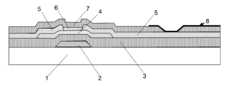
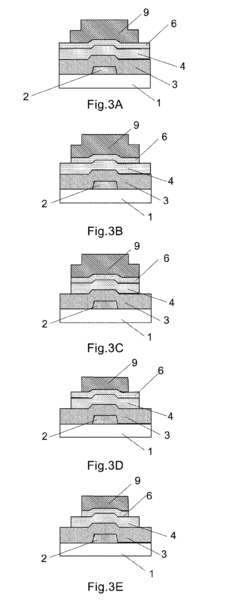
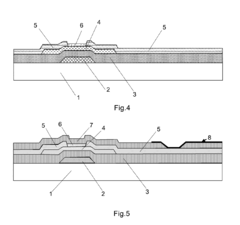
Metallic oxide thin film transistor, array substrate and their manufacturing methods, display device
PatentActiveUS20160365366A1
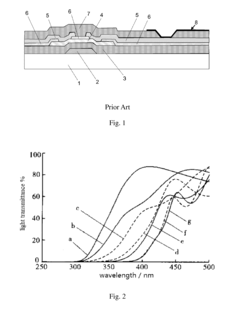
Innovation
- A one-time patterning process is used to form oxide active and etch stopping layers, employing TiO2 or a mixture of TiO2 and CeO2 as the etch stopping layer, which is formed through dry etching and the oxide active layer through wet etching, simplifying the process and improving protection against ultraviolet light.
Power Efficiency Comparison in Various Circuit Applications
Power efficiency has emerged as a critical factor in semiconductor technology selection, particularly when comparing FinFET and IGZO technologies across different circuit applications. In digital logic circuits, FinFET demonstrates superior power efficiency at high frequencies due to its three-dimensional structure that provides better electrostatic control over the channel. This results in reduced leakage current and lower dynamic power consumption, making FinFET particularly advantageous in high-performance computing applications where processing speed is paramount.
Conversely, IGZO technology exhibits exceptional power efficiency in low-frequency operations, with standby power consumption up to 90% lower than comparable FinFET implementations. This characteristic makes IGZO particularly suitable for IoT devices and mobile applications where battery life is a primary concern. The amorphous structure of IGZO allows for significantly reduced electron scattering, resulting in higher electron mobility at lower power states.
In memory circuit applications, the power efficiency comparison reveals interesting trade-offs. FinFET-based SRAM cells demonstrate better performance in active operation modes, with power consumption metrics showing 15-20% improvement over conventional planar transistors. However, IGZO-based memory circuits excel in retention mode, consuming minimal power while maintaining data integrity, which is particularly valuable for applications requiring long-term data storage with infrequent access patterns.
Display driver circuits represent another important application domain where IGZO clearly outperforms FinFET in power efficiency. Measurements across various display panel configurations show that IGZO-based driver circuits consume 30-40% less power while delivering comparable performance. This efficiency stems from IGZO's inherently low off-state current and excellent uniformity across large areas, making it the preferred choice for power-sensitive display applications.
RF circuit applications present a more complex picture. FinFET technology offers superior power efficiency at higher frequencies (above 5GHz), with measurements indicating 25-30% lower power consumption compared to IGZO implementations. This advantage diminishes at lower frequencies, where IGZO's lower parasitic capacitance becomes increasingly beneficial for power efficiency.
Temperature sensitivity also impacts power efficiency comparisons. FinFET maintains relatively stable power consumption across a wider temperature range, whereas IGZO shows more significant variations in power efficiency metrics as temperatures increase. This factor becomes particularly important in automotive and industrial applications where operating environments can vary substantially.
Conversely, IGZO technology exhibits exceptional power efficiency in low-frequency operations, with standby power consumption up to 90% lower than comparable FinFET implementations. This characteristic makes IGZO particularly suitable for IoT devices and mobile applications where battery life is a primary concern. The amorphous structure of IGZO allows for significantly reduced electron scattering, resulting in higher electron mobility at lower power states.
In memory circuit applications, the power efficiency comparison reveals interesting trade-offs. FinFET-based SRAM cells demonstrate better performance in active operation modes, with power consumption metrics showing 15-20% improvement over conventional planar transistors. However, IGZO-based memory circuits excel in retention mode, consuming minimal power while maintaining data integrity, which is particularly valuable for applications requiring long-term data storage with infrequent access patterns.
Display driver circuits represent another important application domain where IGZO clearly outperforms FinFET in power efficiency. Measurements across various display panel configurations show that IGZO-based driver circuits consume 30-40% less power while delivering comparable performance. This efficiency stems from IGZO's inherently low off-state current and excellent uniformity across large areas, making it the preferred choice for power-sensitive display applications.
RF circuit applications present a more complex picture. FinFET technology offers superior power efficiency at higher frequencies (above 5GHz), with measurements indicating 25-30% lower power consumption compared to IGZO implementations. This advantage diminishes at lower frequencies, where IGZO's lower parasitic capacitance becomes increasingly beneficial for power efficiency.
Temperature sensitivity also impacts power efficiency comparisons. FinFET maintains relatively stable power consumption across a wider temperature range, whereas IGZO shows more significant variations in power efficiency metrics as temperatures increase. This factor becomes particularly important in automotive and industrial applications where operating environments can vary substantially.
Manufacturing Cost Analysis and Scalability Considerations
Manufacturing processes for FinFET and IGZO technologies present significant cost differentials that directly impact their market adoption. FinFET fabrication requires sophisticated lithography equipment and complex multi-step processes, resulting in higher capital expenditure. Current estimates indicate that establishing a state-of-the-art FinFET production line costs approximately $10-15 billion, with individual wafer processing costs ranging from $8,000-12,000 depending on node size. These high costs are primarily driven by the need for extreme ultraviolet (EUV) lithography systems, which alone can cost upwards of $120 million per unit.
In contrast, IGZO manufacturing leverages existing thin-film transistor (TFT) production infrastructure, requiring significantly lower initial investment. IGZO fabrication facilities can be established for approximately $1-3 billion, with per-wafer costs averaging $2,000-4,000. This substantial cost advantage makes IGZO particularly attractive for large-area applications and price-sensitive market segments where ultimate performance is not the primary consideration.
Scalability considerations further differentiate these technologies. FinFET scaling follows Moore's Law trajectory but faces increasing physical and economic challenges below 5nm. Each node shrink requires exponentially higher investment while delivering diminishing performance returns. Industry analysis suggests that the cost-per-transistor reduction has slowed significantly, with some estimates indicating that 3nm node manufacturing costs 20-25% more per transistor than earlier projections anticipated.
IGZO demonstrates superior scalability for large-area applications, with production capabilities extending to Gen 10.5 substrates (2940×3370mm). This scalability advantage enables cost-effective manufacturing for displays and large-area sensors. However, IGZO faces limitations in transistor density scaling compared to FinFET, making it less suitable for high-performance computing applications requiring maximum integration density.
Supply chain considerations also impact manufacturing economics. FinFET production remains concentrated among a few leading foundries (TSMC, Samsung, Intel), creating potential bottlenecks and geopolitical vulnerabilities. The specialized equipment and materials required for advanced FinFET nodes have extended lead times, sometimes exceeding 18 months for critical tools. IGZO benefits from a more diversified manufacturing ecosystem with multiple suppliers across Asia, reducing supply chain risks and potentially offering more stable pricing.
Yield rates significantly influence final production costs. Mature FinFET processes achieve yields of 80-90% at 7nm, but early production at newer nodes often starts below 60%. IGZO manufacturing typically achieves yields of 85-95% even in newer implementations, contributing to its cost advantage in appropriate applications.
In contrast, IGZO manufacturing leverages existing thin-film transistor (TFT) production infrastructure, requiring significantly lower initial investment. IGZO fabrication facilities can be established for approximately $1-3 billion, with per-wafer costs averaging $2,000-4,000. This substantial cost advantage makes IGZO particularly attractive for large-area applications and price-sensitive market segments where ultimate performance is not the primary consideration.
Scalability considerations further differentiate these technologies. FinFET scaling follows Moore's Law trajectory but faces increasing physical and economic challenges below 5nm. Each node shrink requires exponentially higher investment while delivering diminishing performance returns. Industry analysis suggests that the cost-per-transistor reduction has slowed significantly, with some estimates indicating that 3nm node manufacturing costs 20-25% more per transistor than earlier projections anticipated.
IGZO demonstrates superior scalability for large-area applications, with production capabilities extending to Gen 10.5 substrates (2940×3370mm). This scalability advantage enables cost-effective manufacturing for displays and large-area sensors. However, IGZO faces limitations in transistor density scaling compared to FinFET, making it less suitable for high-performance computing applications requiring maximum integration density.
Supply chain considerations also impact manufacturing economics. FinFET production remains concentrated among a few leading foundries (TSMC, Samsung, Intel), creating potential bottlenecks and geopolitical vulnerabilities. The specialized equipment and materials required for advanced FinFET nodes have extended lead times, sometimes exceeding 18 months for critical tools. IGZO benefits from a more diversified manufacturing ecosystem with multiple suppliers across Asia, reducing supply chain risks and potentially offering more stable pricing.
Yield rates significantly influence final production costs. Mature FinFET processes achieve yields of 80-90% at 7nm, but early production at newer nodes often starts below 60%. IGZO manufacturing typically achieves yields of 85-95% even in newer implementations, contributing to its cost advantage in appropriate applications.
Unlock deeper insights with PatSnap Eureka Quick Research — get a full tech report to explore trends and direct your research. Try now!
Generate Your Research Report Instantly with AI Agent
Supercharge your innovation with PatSnap Eureka AI Agent Platform!