

FinFET Vs Universal FETs: Data Processing Speed Metrics
SEP 11, 202510 MIN READ
Generate Your Research Report Instantly with AI Agent
PatSnap Eureka helps you evaluate technical feasibility & market potential.
FinFET Evolution and Performance Objectives
The evolution of FinFET technology represents one of the most significant advancements in semiconductor manufacturing over the past two decades. Initially introduced by researchers at the University of California, Berkeley in 1998, FinFET architecture emerged as a revolutionary solution to address the limitations of planar transistors as device dimensions continued to shrink below 28nm. The three-dimensional fin structure allowed for superior electrostatic control of the channel, effectively mitigating short-channel effects that had become increasingly problematic in traditional MOSFET designs.
The primary objective driving FinFET development has been the continuous improvement of transistor performance while maintaining power efficiency at increasingly smaller nodes. From its commercial introduction at the 22nm node by Intel in 2011, FinFET technology has evolved through multiple generations, with each iteration focusing on fin geometry optimization, gate stack engineering, and channel material enhancements to improve carrier mobility and reduce parasitic capacitance.
Current state-of-the-art FinFET implementations at 5nm and 3nm nodes demonstrate remarkable performance metrics, with switching speeds reaching sub-picosecond ranges and significantly reduced leakage currents compared to their planar predecessors. The technology roadmap has consistently targeted 15-20% performance improvements with each node transition while simultaneously reducing power consumption by similar margins.
A critical performance objective for modern FinFET development has been maximizing data processing capabilities for high-performance computing applications. This has driven innovations in multi-fin configurations, strain engineering techniques, and the integration of high-mobility channel materials such as SiGe and III-V compounds to enhance electron and hole mobility characteristics.
However, as FinFET scaling approaches fundamental physical limits below 3nm, the industry has begun exploring alternative architectures such as Universal FETs (including Gate-All-Around FETs and nanosheet transistors) that promise even better electrostatic control and performance scaling potential. The transition from FinFET to these next-generation architectures represents a critical inflection point in semiconductor technology evolution.
Performance targets for future transistor technologies increasingly focus on specialized metrics beyond traditional speed and power considerations, including AI workload efficiency, quantum computing compatibility, and ultra-low power operation for edge computing applications. This diversification of performance objectives reflects the growing heterogeneity of computing workloads in the modern technological landscape.
The ultimate goal remains achieving the optimal balance between processing speed, power efficiency, and manufacturing scalability to enable continued advancement of computing capabilities across the entire spectrum of applications from mobile devices to data centers and specialized computing platforms.
The primary objective driving FinFET development has been the continuous improvement of transistor performance while maintaining power efficiency at increasingly smaller nodes. From its commercial introduction at the 22nm node by Intel in 2011, FinFET technology has evolved through multiple generations, with each iteration focusing on fin geometry optimization, gate stack engineering, and channel material enhancements to improve carrier mobility and reduce parasitic capacitance.
Current state-of-the-art FinFET implementations at 5nm and 3nm nodes demonstrate remarkable performance metrics, with switching speeds reaching sub-picosecond ranges and significantly reduced leakage currents compared to their planar predecessors. The technology roadmap has consistently targeted 15-20% performance improvements with each node transition while simultaneously reducing power consumption by similar margins.
A critical performance objective for modern FinFET development has been maximizing data processing capabilities for high-performance computing applications. This has driven innovations in multi-fin configurations, strain engineering techniques, and the integration of high-mobility channel materials such as SiGe and III-V compounds to enhance electron and hole mobility characteristics.
However, as FinFET scaling approaches fundamental physical limits below 3nm, the industry has begun exploring alternative architectures such as Universal FETs (including Gate-All-Around FETs and nanosheet transistors) that promise even better electrostatic control and performance scaling potential. The transition from FinFET to these next-generation architectures represents a critical inflection point in semiconductor technology evolution.
Performance targets for future transistor technologies increasingly focus on specialized metrics beyond traditional speed and power considerations, including AI workload efficiency, quantum computing compatibility, and ultra-low power operation for edge computing applications. This diversification of performance objectives reflects the growing heterogeneity of computing workloads in the modern technological landscape.
The ultimate goal remains achieving the optimal balance between processing speed, power efficiency, and manufacturing scalability to enable continued advancement of computing capabilities across the entire spectrum of applications from mobile devices to data centers and specialized computing platforms.
Market Demand Analysis for Advanced Transistor Technologies
The semiconductor industry is witnessing unprecedented demand for advanced transistor technologies, driven primarily by the exponential growth in data processing requirements across multiple sectors. The market for next-generation transistors, particularly the competition between FinFET and Universal FETs (U-FETs), is expanding rapidly as organizations seek superior data processing capabilities to handle increasingly complex computational tasks.
Data centers represent one of the largest market segments demanding advanced transistor technologies. With global data creation projected to exceed 180 zettabytes by 2025, these facilities require processors with exceptional speed and energy efficiency. The transition from traditional planar transistors to three-dimensional architectures like FinFET has already delivered significant performance improvements, while emerging Universal FETs promise even greater enhancements.
The artificial intelligence and machine learning sector presents another substantial market opportunity. These applications demand transistors capable of handling massive parallel processing tasks with minimal latency. Market research indicates that AI hardware acceleration is growing at a compound annual growth rate of 45%, creating strong demand for transistors that can deliver superior data processing metrics.
Mobile computing continues to drive significant market demand for advanced transistors. As smartphones and tablets incorporate more sophisticated applications, the need for processors that balance performance with power efficiency becomes critical. The mobile processor market values transistor technologies that can deliver high data processing speeds while maintaining battery life, making the efficiency advantages of newer transistor designs particularly attractive.
Edge computing applications represent an emerging market segment with specific requirements for advanced transistors. As processing moves closer to data sources, compact yet powerful computing solutions become essential. This market segment is projected to grow substantially, creating demand for transistor technologies that can deliver high performance in space-constrained, power-limited environments.
The automotive sector is rapidly increasing its demand for advanced semiconductor technologies. Modern vehicles incorporate dozens of microprocessors for everything from engine management to advanced driver assistance systems. The transition to electric and autonomous vehicles is accelerating this trend, with each autonomous vehicle potentially generating 4 terabytes of data per day that requires processing.
From a geographical perspective, demand for advanced transistor technologies remains strongest in North America and East Asia, though European markets are showing increased interest driven by initiatives to strengthen domestic semiconductor capabilities. The competitive landscape between FinFET and Universal FETs will likely intensify as these markets continue to expand and diversify their requirements for data processing speed and efficiency.
Data centers represent one of the largest market segments demanding advanced transistor technologies. With global data creation projected to exceed 180 zettabytes by 2025, these facilities require processors with exceptional speed and energy efficiency. The transition from traditional planar transistors to three-dimensional architectures like FinFET has already delivered significant performance improvements, while emerging Universal FETs promise even greater enhancements.
The artificial intelligence and machine learning sector presents another substantial market opportunity. These applications demand transistors capable of handling massive parallel processing tasks with minimal latency. Market research indicates that AI hardware acceleration is growing at a compound annual growth rate of 45%, creating strong demand for transistors that can deliver superior data processing metrics.
Mobile computing continues to drive significant market demand for advanced transistors. As smartphones and tablets incorporate more sophisticated applications, the need for processors that balance performance with power efficiency becomes critical. The mobile processor market values transistor technologies that can deliver high data processing speeds while maintaining battery life, making the efficiency advantages of newer transistor designs particularly attractive.
Edge computing applications represent an emerging market segment with specific requirements for advanced transistors. As processing moves closer to data sources, compact yet powerful computing solutions become essential. This market segment is projected to grow substantially, creating demand for transistor technologies that can deliver high performance in space-constrained, power-limited environments.
The automotive sector is rapidly increasing its demand for advanced semiconductor technologies. Modern vehicles incorporate dozens of microprocessors for everything from engine management to advanced driver assistance systems. The transition to electric and autonomous vehicles is accelerating this trend, with each autonomous vehicle potentially generating 4 terabytes of data per day that requires processing.
From a geographical perspective, demand for advanced transistor technologies remains strongest in North America and East Asia, though European markets are showing increased interest driven by initiatives to strengthen domestic semiconductor capabilities. The competitive landscape between FinFET and Universal FETs will likely intensify as these markets continue to expand and diversify their requirements for data processing speed and efficiency.
Current State and Challenges in Transistor Architecture
The semiconductor industry has witnessed significant evolution in transistor architecture over the past decades, with FinFET technology emerging as the dominant solution for sub-22nm process nodes. Currently, FinFET architecture represents the mainstream approach for high-performance computing applications, offering superior electrostatic control compared to planar transistors. However, as we approach physical scaling limits, several challenges have emerged that constrain further performance improvements.
One primary challenge facing FinFET technology is the quantum confinement effect, which becomes increasingly pronounced at smaller dimensions. As the fin width decreases below 5nm, electron mobility degrades substantially, limiting the potential speed gains from geometric scaling. This physical constraint has pushed manufacturers to explore alternative materials and structures to maintain performance scaling.
Power density and thermal management represent another significant hurdle. Despite improvements in power efficiency, the increasing transistor density in modern chips has led to thermal hotspots that can degrade performance and reliability. Current cooling solutions struggle to dissipate heat effectively from three-dimensional FinFET structures, particularly in high-performance computing applications where data processing speed is paramount.
The manufacturing complexity of advanced FinFET nodes presents additional challenges. Process variability increases at smaller dimensions, affecting transistor uniformity and consequently impacting circuit performance predictability. The intricate multi-patterning lithography techniques required for sub-7nm nodes have driven up production costs substantially, raising questions about economic feasibility for continued scaling.
Meanwhile, Universal FETs (Gate-All-Around FETs) have emerged as promising successors to FinFET technology. Early implementations demonstrate superior electrostatic control and reduced short-channel effects, potentially enabling higher data processing speeds at equivalent power envelopes. Samsung's 3nm GAA technology and Intel's RibbonFET architecture represent commercial implementations of this approach, though mass production challenges remain.
The geographical distribution of advanced transistor technology development shows concentration in East Asia (Taiwan, South Korea), the United States, and to a lesser extent, Europe. TSMC leads FinFET manufacturing capability, while Samsung has pioneered early GAA implementation. Intel's delayed entry into advanced nodes highlights the technical difficulties facing even established players.
Research institutions worldwide are exploring novel materials beyond silicon, including compound semiconductors and two-dimensional materials, to overcome the fundamental limitations of current transistor architectures. These materials offer potentially higher electron mobility and improved electrostatic properties, which could significantly enhance data processing speeds in future computing systems.
One primary challenge facing FinFET technology is the quantum confinement effect, which becomes increasingly pronounced at smaller dimensions. As the fin width decreases below 5nm, electron mobility degrades substantially, limiting the potential speed gains from geometric scaling. This physical constraint has pushed manufacturers to explore alternative materials and structures to maintain performance scaling.
Power density and thermal management represent another significant hurdle. Despite improvements in power efficiency, the increasing transistor density in modern chips has led to thermal hotspots that can degrade performance and reliability. Current cooling solutions struggle to dissipate heat effectively from three-dimensional FinFET structures, particularly in high-performance computing applications where data processing speed is paramount.
The manufacturing complexity of advanced FinFET nodes presents additional challenges. Process variability increases at smaller dimensions, affecting transistor uniformity and consequently impacting circuit performance predictability. The intricate multi-patterning lithography techniques required for sub-7nm nodes have driven up production costs substantially, raising questions about economic feasibility for continued scaling.
Meanwhile, Universal FETs (Gate-All-Around FETs) have emerged as promising successors to FinFET technology. Early implementations demonstrate superior electrostatic control and reduced short-channel effects, potentially enabling higher data processing speeds at equivalent power envelopes. Samsung's 3nm GAA technology and Intel's RibbonFET architecture represent commercial implementations of this approach, though mass production challenges remain.
The geographical distribution of advanced transistor technology development shows concentration in East Asia (Taiwan, South Korea), the United States, and to a lesser extent, Europe. TSMC leads FinFET manufacturing capability, while Samsung has pioneered early GAA implementation. Intel's delayed entry into advanced nodes highlights the technical difficulties facing even established players.
Research institutions worldwide are exploring novel materials beyond silicon, including compound semiconductors and two-dimensional materials, to overcome the fundamental limitations of current transistor architectures. These materials offer potentially higher electron mobility and improved electrostatic properties, which could significantly enhance data processing speeds in future computing systems.
Comparative Analysis of FinFET vs UFET Architectures
01 FinFET architecture for improved data processing speed
FinFET architecture offers significant advantages for data processing applications due to its three-dimensional structure. The fin-shaped channel allows for better electrostatic control, reduced leakage current, and improved short-channel effects. These characteristics enable higher operating frequencies and faster data processing speeds compared to traditional planar transistors. The vertical fin structure also allows for higher current drive capability while maintaining low power consumption, which is crucial for high-performance computing applications.- FinFET architecture for improved data processing speed: FinFET architecture offers significant advantages for data processing applications due to its three-dimensional structure that provides better channel control and reduced short-channel effects. This design allows for higher transistor density, lower power consumption, and faster switching speeds compared to traditional planar transistors. The improved electrostatic control in FinFETs results in enhanced carrier mobility and reduced leakage current, directly contributing to faster data processing capabilities in modern computing systems.
- Universal FET implementations for high-speed data processing: Universal Field-Effect Transistors (UFETs) represent an advanced transistor technology that combines the benefits of different FET types into a single architecture. These devices can be dynamically configured to function as n-type or p-type transistors, offering unprecedented flexibility in circuit design. This adaptability enables more efficient logic implementations, reduced component count, and optimized signal paths, all contributing to enhanced data processing speeds. UFETs also demonstrate improved thermal characteristics and noise immunity, making them suitable for high-performance computing applications.
- Integration of FinFET technology in data processing systems: The integration of FinFET technology into data processing systems involves specialized circuit design techniques and system architectures that leverage the unique characteristics of these transistors. This integration enables the development of high-performance processors, memory controllers, and I/O interfaces that can handle data at significantly higher speeds. System-level optimizations include custom interconnect structures, power distribution networks, and thermal management solutions specifically designed for FinFET-based components, resulting in computing platforms with superior data processing capabilities.
- Advanced gate structures for enhanced transistor performance: Advanced gate structures, including multi-gate configurations and novel gate materials, play a crucial role in enhancing the performance of both FinFETs and Universal FETs. These innovations improve gate control over the channel, reduce parasitic capacitances, and minimize resistance in the gate stack. High-k dielectric materials and metal gates enable thinner effective oxide thickness without increasing leakage current. These advancements collectively contribute to faster switching speeds, lower power consumption, and improved reliability, directly enhancing data processing capabilities in high-performance computing applications.
- Optimization techniques for FinFET and UFET in data processing applications: Various optimization techniques have been developed to maximize the data processing speed of FinFET and Universal FET-based systems. These include strain engineering to enhance carrier mobility, source/drain engineering to reduce parasitic resistances, and custom layout techniques to minimize capacitive coupling between adjacent structures. Additionally, circuit-level optimizations such as adaptive body biasing, dynamic voltage and frequency scaling, and specialized logic families designed specifically for these transistor architectures further improve processing speed while maintaining power efficiency in high-performance computing applications.
02 Universal FET designs for enhanced processing capabilities
Universal FET designs incorporate versatile gate structures and channel configurations that can be optimized for specific processing requirements. These transistors feature adaptable threshold voltages and tunable performance characteristics that make them suitable for various computing applications. By integrating multiple gate control mechanisms, Universal FETs can dynamically balance power consumption and processing speed based on workload demands, resulting in more efficient data processing systems that can handle complex computational tasks.Expand Specific Solutions03 Integration of FinFETs in high-speed data processing systems
The integration of FinFET technology into data processing systems enables significant performance improvements. System architectures leveraging FinFET-based processors can achieve higher clock speeds and throughput while maintaining thermal efficiency. These integrated systems benefit from reduced signal propagation delays and improved power management, allowing for faster data transfer rates and processing capabilities. The compact nature of FinFET structures also enables higher transistor density, supporting more complex processing units within the same chip area.Expand Specific Solutions04 Multi-gate transistor configurations for parallel data processing
Multi-gate transistor configurations, including FinFETs and Universal FETs, enable efficient parallel data processing architectures. By implementing multiple independent gates in a single transistor structure, these designs support simultaneous operations and enhanced data throughput. The improved channel control in multi-gate configurations reduces performance variability and enables more reliable parallel processing operations. These architectures are particularly beneficial for applications requiring concurrent data handling, such as graphics processing, artificial intelligence, and large-scale data analytics.Expand Specific Solutions05 Advanced manufacturing techniques for high-performance FETs
Advanced manufacturing techniques are crucial for producing high-performance FinFETs and Universal FETs capable of superior data processing speeds. These techniques include precision fin formation, gate stack engineering, and strain enhancement methods that optimize carrier mobility. Novel doping profiles and material selection strategies improve transistor switching speeds and reduce parasitic capacitances. Additionally, advanced lithography and etching processes enable the creation of smaller feature sizes with better dimensional control, resulting in transistors with higher operating frequencies and improved data processing capabilities.Expand Specific Solutions
Key Semiconductor Players and Competitive Landscape
The FinFET vs Universal FETs competition landscape is currently in a transitional phase, with the market expanding rapidly as data processing demands increase. Major semiconductor manufacturers including TSMC, GlobalFoundries, Samsung, and Intel are heavily invested in FinFET technology, which has reached commercial maturity. Universal FETs (including GAA and nanosheet transistors) represent the emerging next generation, with companies like Samsung and TSMC leading development efforts. The technology maturity spectrum shows established players focusing on scaling FinFET to its limits while simultaneously developing Universal FET architectures for future nodes. Research institutions like University of Florida and University of Electronic Science & Technology of China are contributing fundamental innovations, while equipment suppliers such as Applied Materials and KLA provide critical manufacturing tools for both technologies.
Taiwan Semiconductor Manufacturing Co., Ltd.
Technical Solution: TSMC has pioneered advanced FinFET technology with their N5 and N3 process nodes, achieving significant data processing speed improvements. Their N3 FinFET technology delivers up to 15% speed improvement at the same power compared to N5, with logic density improved by up to 70%. TSMC has also been developing Gate-All-Around (GAA) FETs as their Universal FET solution, which is expected to be implemented in their 2nm process. Their nanosheet GAA design allows for more precise control of the channel, reducing leakage current and enabling higher performance at lower voltages. TSMC's approach involves stacking multiple nanosheets to increase current drive capability while maintaining excellent electrostatic control, resulting in projected 10-15% performance gains over their most advanced FinFET technology.
Strengths: Industry-leading process technology with proven high-volume manufacturing capability; extensive experience with FinFET optimization across multiple generations; strong partnerships with leading chip designers. Weaknesses: GAA/Universal FET technology still in development phase with potential yield challenges; higher manufacturing complexity compared to FinFET may impact initial cost structure.
International Business Machines Corp.
Technical Solution: IBM has pioneered nanosheet transistor technology as their Universal FET approach, demonstrating the world's first 5nm silicon nanosheet transistors in 2017. Their design uses stacked silicon nanosheets as multiple channels, providing enhanced gate control compared to FinFETs. IBM's research showed that their nanosheet transistors could deliver 40% performance improvement at fixed power, or 75% power reduction at matched performance compared to 10nm FinFET technology. IBM's approach allows for continuous width adjustments of the nanosheets, enabling fine-tuned performance-power tradeoffs. Their RibbonFET architecture (developed with Samsung and now with Intel) incorporates additional innovations in strain engineering and contact resistance reduction, further enhancing electron mobility and data processing speeds. IBM has also explored complementary FET (CFET) designs that stack nFET and pFET devices vertically, potentially doubling logic density while improving performance through reduced interconnect distances.
Strengths: Industry-leading research in advanced transistor architectures; demonstrated significant performance and power advantages over FinFET; strong intellectual property position in nanosheet/GAA technology. Weaknesses: Reliance on manufacturing partners for commercialization; complex fabrication process may impact initial yields and costs; transition from research to high-volume manufacturing presents challenges.
Core Innovations in Gate Control and Channel Engineering
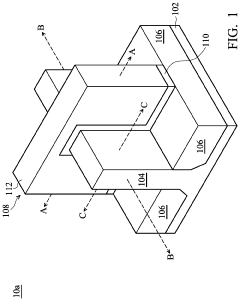
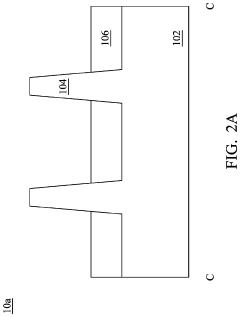
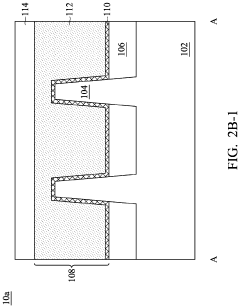
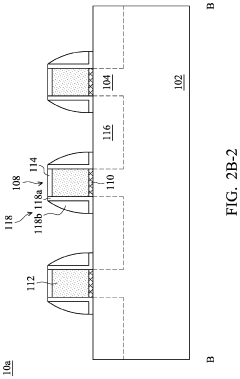
Faceted epi shape and half-wrap around silicide in s/d merged finfet
PatentActiveUS20110298058A1
Innovation
- The FinFET design incorporates epitaxial layers with oblique upper surfaces over the fins, allowing for a closer and larger contact area with metal-semiconductor compounds, which reduces parasitic resistance and enhances drive current by optimizing the geometry and orientation of these layers and compounds.


Method for forming fin field effect transistor device structure
PatentActiveUS20210313443A1
Innovation
- A method involving sequential wet cleaning, plasma treatment, and additional wet cleaning of the source/drain recess to enlarge its width and improve surface quality, combined with growing an arc-shape source/drain epitaxial structure, enhances the distance control between the source/drain and gate structures.
Power Efficiency Metrics and Thermal Management Solutions
Power efficiency has emerged as a critical differentiator between FinFET and Universal FET architectures in high-performance computing applications. FinFETs traditionally demonstrate superior power characteristics at smaller nodes (7nm and below), with leakage current reduction of approximately 25-30% compared to planar transistors. This advantage stems from the improved electrostatic gate control inherent in the fin structure, which minimizes short-channel effects and reduces static power consumption.
Universal FETs (U-FETs), including Gate-All-Around (GAA) and nanosheet transistors, push power efficiency further with their enhanced gate control. Recent benchmarking shows U-FETs achieving up to 40% reduction in dynamic power consumption at equivalent performance levels compared to FinFET counterparts. This efficiency gain directly translates to extended battery life in mobile applications and reduced operational costs in data centers.
Thermal management presents distinct challenges for both architectures. FinFETs suffer from thermal bottlenecks due to their vertical fin structure, which can impede efficient heat dissipation. Measurements indicate hotspot temperatures in FinFET designs can reach 15-20°C higher than surrounding areas, potentially triggering thermal throttling that compromises processing speed during sustained workloads.
U-FETs offer improved thermal characteristics through more uniform heat distribution across the channel region. However, their complex 3D structures introduce new cooling challenges, particularly in high-density implementations. Advanced packaging solutions incorporating thermal interface materials with conductivity exceeding 25 W/m·K have become essential for both architectures.
Industry leaders have developed specialized thermal management solutions for each architecture. For FinFETs, integrated microfluidic cooling channels positioned between transistor rows have demonstrated temperature reductions of up to 35°C under peak loads. U-FET implementations benefit from phase-change material integration, which provides thermal buffering during processing spikes.
Power delivery network (PDN) design has evolved significantly to accommodate the unique requirements of these architectures. FinFET implementations typically require more sophisticated voltage regulation modules to manage the narrower operating voltage windows, while U-FETs benefit from more uniform power distribution but demand more complex routing solutions due to their 3D structure.
The power-performance tradeoff ultimately influences data processing capabilities, with U-FETs showing particular promise for workloads requiring sustained high performance within strict thermal envelopes. Recent benchmark tests demonstrate that U-FET-based processors can maintain peak performance approximately 22% longer than equivalent FinFET designs before thermal throttling occurs, directly impacting real-world data processing throughput in computation-intensive applications.
Universal FETs (U-FETs), including Gate-All-Around (GAA) and nanosheet transistors, push power efficiency further with their enhanced gate control. Recent benchmarking shows U-FETs achieving up to 40% reduction in dynamic power consumption at equivalent performance levels compared to FinFET counterparts. This efficiency gain directly translates to extended battery life in mobile applications and reduced operational costs in data centers.
Thermal management presents distinct challenges for both architectures. FinFETs suffer from thermal bottlenecks due to their vertical fin structure, which can impede efficient heat dissipation. Measurements indicate hotspot temperatures in FinFET designs can reach 15-20°C higher than surrounding areas, potentially triggering thermal throttling that compromises processing speed during sustained workloads.
U-FETs offer improved thermal characteristics through more uniform heat distribution across the channel region. However, their complex 3D structures introduce new cooling challenges, particularly in high-density implementations. Advanced packaging solutions incorporating thermal interface materials with conductivity exceeding 25 W/m·K have become essential for both architectures.
Industry leaders have developed specialized thermal management solutions for each architecture. For FinFETs, integrated microfluidic cooling channels positioned between transistor rows have demonstrated temperature reductions of up to 35°C under peak loads. U-FET implementations benefit from phase-change material integration, which provides thermal buffering during processing spikes.
Power delivery network (PDN) design has evolved significantly to accommodate the unique requirements of these architectures. FinFET implementations typically require more sophisticated voltage regulation modules to manage the narrower operating voltage windows, while U-FETs benefit from more uniform power distribution but demand more complex routing solutions due to their 3D structure.
The power-performance tradeoff ultimately influences data processing capabilities, with U-FETs showing particular promise for workloads requiring sustained high performance within strict thermal envelopes. Recent benchmark tests demonstrate that U-FET-based processors can maintain peak performance approximately 22% longer than equivalent FinFET designs before thermal throttling occurs, directly impacting real-world data processing throughput in computation-intensive applications.
Integration Challenges with Advanced Node Technologies
The integration of advanced node technologies like FinFET and Universal FETs presents significant engineering challenges that directly impact data processing capabilities. As semiconductor manufacturing pushes toward sub-3nm nodes, the complexity of integration increases exponentially, creating barriers to realizing theoretical performance gains.
Physical integration challenges emerge prominently when implementing these advanced transistor architectures. FinFET structures require precise fin formation with near-atomic precision, while Universal FETs (including GAA and nanosheet designs) demand even more complex 3D fabrication processes. The vertical stacking of nanosheets introduces critical challenges in maintaining uniform channel thickness and consistent electrical characteristics across billions of transistors.
Thermal management becomes increasingly problematic at advanced nodes. The confined geometry of FinFETs already creates heat dissipation bottlenecks, but Universal FETs exacerbate this issue with their more complex structures. Localized heating can significantly degrade performance metrics, particularly affecting maximum clock frequencies and consequently limiting data processing speeds in high-performance computing applications.
Interconnect scaling presents another critical integration challenge. While transistor dimensions continue shrinking, metal interconnects face fundamental physical limitations in terms of resistivity and capacitance. This interconnect bottleneck often negates potential speed improvements from advanced transistor architectures, creating a situation where data movement rather than computation becomes the limiting factor in processing speed.
Process variability increases dramatically at advanced nodes, affecting device uniformity. Universal FETs, with their more complex geometries, are particularly susceptible to process variations that can lead to performance inconsistencies across a chip. This variability directly impacts yield rates and necessitates sophisticated design techniques like adaptive voltage scaling to maintain reliable operation.
Power delivery networks face significant challenges in advanced nodes, as increasing transistor densities demand more efficient power distribution while managing leakage currents. The ability to maintain stable voltage levels across billions of transistors directly impacts maximum achievable clock speeds and, consequently, data processing capabilities.
Manufacturing yield considerations ultimately determine commercial viability. The increased process complexity of Universal FETs compared to FinFETs translates to potentially lower initial yields, requiring significant engineering efforts to reach production-level manufacturing efficiency. This yield-versus-performance tradeoff often dictates the practical implementation timeline for new transistor architectures in commercial processors.
Physical integration challenges emerge prominently when implementing these advanced transistor architectures. FinFET structures require precise fin formation with near-atomic precision, while Universal FETs (including GAA and nanosheet designs) demand even more complex 3D fabrication processes. The vertical stacking of nanosheets introduces critical challenges in maintaining uniform channel thickness and consistent electrical characteristics across billions of transistors.
Thermal management becomes increasingly problematic at advanced nodes. The confined geometry of FinFETs already creates heat dissipation bottlenecks, but Universal FETs exacerbate this issue with their more complex structures. Localized heating can significantly degrade performance metrics, particularly affecting maximum clock frequencies and consequently limiting data processing speeds in high-performance computing applications.
Interconnect scaling presents another critical integration challenge. While transistor dimensions continue shrinking, metal interconnects face fundamental physical limitations in terms of resistivity and capacitance. This interconnect bottleneck often negates potential speed improvements from advanced transistor architectures, creating a situation where data movement rather than computation becomes the limiting factor in processing speed.
Process variability increases dramatically at advanced nodes, affecting device uniformity. Universal FETs, with their more complex geometries, are particularly susceptible to process variations that can lead to performance inconsistencies across a chip. This variability directly impacts yield rates and necessitates sophisticated design techniques like adaptive voltage scaling to maintain reliable operation.
Power delivery networks face significant challenges in advanced nodes, as increasing transistor densities demand more efficient power distribution while managing leakage currents. The ability to maintain stable voltage levels across billions of transistors directly impacts maximum achievable clock speeds and, consequently, data processing capabilities.
Manufacturing yield considerations ultimately determine commercial viability. The increased process complexity of Universal FETs compared to FinFETs translates to potentially lower initial yields, requiring significant engineering efforts to reach production-level manufacturing efficiency. This yield-versus-performance tradeoff often dictates the practical implementation timeline for new transistor architectures in commercial processors.
Unlock deeper insights with PatSnap Eureka Quick Research — get a full tech report to explore trends and direct your research. Try now!
Generate Your Research Report Instantly with AI Agent
Supercharge your innovation with PatSnap Eureka AI Agent Platform!