

Graphene Oxide's Potential in Quantum Computing Development
Graphene Oxide in QC: Background and Objectives
Graphene oxide has emerged as a promising material in the field of quantum computing, attracting significant attention from researchers and industry experts alike. This two-dimensional carbon-based material, derived from graphene, possesses unique properties that make it particularly suitable for quantum computing applications. The development of graphene oxide in quantum computing can be traced back to the early 2010s when scientists began exploring its potential in various technological domains.
The primary objective of incorporating graphene oxide into quantum computing is to overcome the limitations of traditional materials and enhance the performance of quantum systems. Researchers aim to leverage graphene oxide's exceptional electronic, optical, and mechanical properties to create more efficient and stable quantum bits (qubits), the fundamental building blocks of quantum computers. By utilizing graphene oxide, scientists hope to address key challenges in quantum computing, such as decoherence and scalability.
One of the main goals in this field is to develop graphene oxide-based quantum devices that can operate at room temperature, eliminating the need for complex and expensive cooling systems. This would significantly reduce the cost and complexity of quantum computers, making them more accessible for widespread adoption. Additionally, researchers are exploring ways to integrate graphene oxide into existing quantum computing architectures to improve their overall performance and reliability.
The evolution of graphene oxide in quantum computing is closely tied to advancements in material science and nanotechnology. As fabrication techniques and characterization methods have improved, scientists have gained a deeper understanding of graphene oxide's quantum properties and how to manipulate them effectively. This has led to the development of novel quantum devices, such as graphene oxide-based qubits and quantum sensors, which show great promise for future quantum technologies.
Another important objective in this field is to establish standardized production methods for high-quality graphene oxide suitable for quantum computing applications. Consistency and reproducibility in material properties are crucial for the development of reliable quantum devices. Researchers are working on optimizing synthesis techniques and developing quality control measures to ensure the production of graphene oxide with the desired characteristics for quantum computing.
As the field progresses, there is a growing focus on exploring the potential of graphene oxide in hybrid quantum systems. These systems combine different quantum technologies to leverage their respective strengths and mitigate their weaknesses. Graphene oxide's versatility makes it an ideal candidate for integration with other quantum platforms, potentially leading to more robust and efficient quantum computing solutions.
Market Demand for Quantum Computing Solutions
The quantum computing market is experiencing rapid growth and increasing demand for innovative solutions. As traditional computing approaches reach their physical limits, quantum computing offers the potential to solve complex problems that are currently intractable for classical computers. This has led to a surge in interest from various sectors, including finance, pharmaceuticals, logistics, and cybersecurity.
The global quantum computing market is projected to expand significantly in the coming years. Major technology companies, government agencies, and research institutions are investing heavily in quantum computing research and development. This investment is driven by the potential for quantum computers to revolutionize fields such as drug discovery, financial modeling, and cryptography.
In the financial sector, quantum computing solutions are highly sought after for their potential to optimize portfolio management, improve risk assessment, and enhance fraud detection. Banks and investment firms are exploring quantum algorithms to gain a competitive edge in high-frequency trading and complex financial simulations.
The pharmaceutical industry is another key driver of demand for quantum computing solutions. Drug discovery processes could be significantly accelerated by quantum simulations of molecular interactions, potentially reducing the time and cost of bringing new medications to market. This has become particularly relevant in light of recent global health challenges.
Logistics and supply chain management represent another area with growing demand for quantum computing solutions. Optimization problems in route planning, inventory management, and resource allocation could benefit greatly from quantum algorithms, leading to increased efficiency and cost savings for businesses.
Cybersecurity is a critical field where quantum computing is both a threat and an opportunity. While quantum computers pose a risk to current encryption methods, they also offer the potential for developing new, quantum-resistant cryptographic techniques. This dual nature is driving demand for quantum computing solutions in both offensive and defensive cybersecurity applications.
Government and defense sectors are also investing heavily in quantum computing research, recognizing its potential for national security applications and maintaining technological superiority. This includes areas such as secure communications, sensor technology, and data analysis for intelligence purposes.
As quantum computing hardware continues to advance, there is a growing need for quantum software development tools and platforms. This has created a new market segment focused on bridging the gap between quantum hardware and practical applications, with demand for quantum programming languages, simulators, and development environments on the rise.
Current Challenges in Graphene Oxide-based QC
Despite the promising potential of graphene oxide in quantum computing, several significant challenges currently hinder its full implementation and widespread adoption in this field. One of the primary obstacles is the precise control and manipulation of graphene oxide's electronic properties. While graphene oxide exhibits unique quantum mechanical behaviors, researchers struggle to consistently maintain and exploit these properties in practical quantum computing applications.
Another major challenge lies in the scalability of graphene oxide-based quantum computing systems. Current fabrication techniques for graphene oxide quantum devices are often limited in their ability to produce large-scale, uniform structures with the required quantum coherence. This limitation impedes the development of more complex and powerful quantum computing architectures necessary for practical applications.
The issue of decoherence presents a significant hurdle in graphene oxide-based quantum computing. Quantum states in graphene oxide are highly sensitive to environmental perturbations, leading to rapid loss of quantum information. Developing effective methods to protect and preserve quantum coherence in graphene oxide systems remains a critical challenge for researchers in the field.
Integration of graphene oxide with existing quantum computing technologies poses another substantial challenge. While graphene oxide shows promise as a quantum computing material, seamlessly incorporating it into current quantum computing frameworks and infrastructures requires overcoming significant technical and engineering obstacles.
The optimization of graphene oxide's electronic band structure for quantum computing applications is yet another area of difficulty. Researchers are still working to fine-tune the material's properties to achieve the ideal balance between conductivity and insulation required for efficient quantum operations.
Lastly, the challenge of reproducibility in graphene oxide-based quantum devices cannot be overlooked. Variations in material quality, processing techniques, and environmental conditions can lead to inconsistent performance across different devices, making it difficult to establish standardized protocols for graphene oxide quantum computing systems.
Addressing these challenges requires a multidisciplinary approach, combining advances in materials science, quantum physics, and engineering. As researchers continue to tackle these obstacles, the potential for graphene oxide to revolutionize quantum computing remains significant, driving ongoing efforts to overcome these current limitations.
Existing Graphene Oxide QC Implementations
01 Synthesis and production methods of graphene oxide
Various methods for synthesizing and producing graphene oxide are described, including chemical exfoliation, oxidation of graphite, and reduction processes. These techniques aim to create high-quality graphene oxide with controlled properties for different applications.- Synthesis and production methods of graphene oxide: Various methods for synthesizing and producing graphene oxide are described, including chemical exfoliation, oxidation of graphite, and reduction processes. These techniques aim to create high-quality graphene oxide with controlled properties for different applications.
- Applications of graphene oxide in electronics and energy storage: Graphene oxide is utilized in electronic devices and energy storage systems due to its unique electrical and thermal properties. It is incorporated into batteries, supercapacitors, and other electronic components to enhance performance and efficiency.
- Functionalization and modification of graphene oxide: Techniques for functionalizing and modifying graphene oxide are explored to tailor its properties for specific applications. This includes chemical treatments, doping, and surface modifications to enhance its performance in various fields such as composites, sensors, and biomedical applications.
- Graphene oxide-based composites and materials: The development of graphene oxide-based composites and materials is described, combining graphene oxide with polymers, metals, or other nanomaterials. These composites exhibit enhanced mechanical, thermal, and electrical properties for various industrial applications.
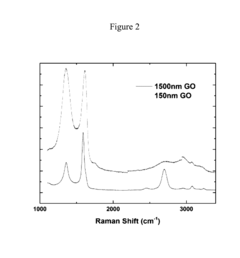
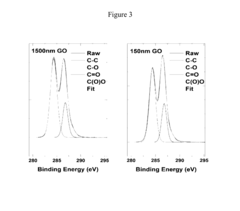
- Characterization and analysis techniques for graphene oxide: Various methods and techniques for characterizing and analyzing graphene oxide are presented. These include spectroscopic, microscopic, and other analytical tools to determine the structure, composition, and properties of graphene oxide materials.
02 Applications of graphene oxide in electronics and energy storage
Graphene oxide is utilized in electronic devices and energy storage systems due to its unique electrical and thermal properties. It is incorporated into batteries, supercapacitors, and other electronic components to enhance performance and efficiency.Expand Specific Solutions03 Functionalization and modification of graphene oxide
Techniques for functionalizing and modifying graphene oxide are explored to tailor its properties for specific applications. This includes chemical treatments, doping, and surface modifications to enhance its performance in various fields such as composites, sensors, and biomedical applications.Expand Specific Solutions04 Graphene oxide-based composites and materials
The development of graphene oxide-based composites and materials is described, focusing on enhancing mechanical, thermal, and electrical properties. These materials find applications in aerospace, automotive, and construction industries, among others.Expand Specific Solutions05 Characterization and analysis techniques for graphene oxide
Various methods and techniques for characterizing and analyzing graphene oxide are presented. These include spectroscopic, microscopic, and electrochemical techniques to determine the structure, composition, and properties of graphene oxide materials.Expand Specific Solutions
Key Players in Graphene Oxide QC Research
The development of graphene oxide in quantum computing is in its early stages, with significant potential for growth. The market size is expanding rapidly as research institutions and tech companies explore its applications. Technologically, it's still in the research phase, with varying levels of maturity across different applications. Leading institutions like Centre National de la Recherche Scientifique, Northwestern University, and Fudan University are at the forefront of research. Companies such as Zapata Computing, Inc. and Texas Instruments Incorporated are also investing in this field, indicating growing commercial interest. The competitive landscape is characterized by a mix of academic and industrial players, with collaboration between sectors driving innovation and progress.
Nanyang Technological University
William Marsh Rice University
Breakthrough Graphene Oxide QC Patents
- A multilayered composite thin film material is developed using a Layer-by-Layer (LbL) self-assembly technique, comprising a substrate with a positively charged surface, alternating bilayers of negatively charged metal nanocrystals (e.g., Ru, Rh, Os, Ir, Pd, Au, Ag, Pt) and positively charged graphene quantum dots, with each layer attached through electrostatic attraction, allowing for controlled assembly and enhanced interfacial contact.


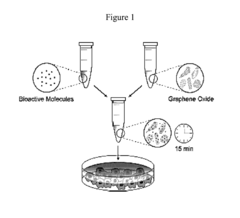
- A method involving unmodified graphene oxide in an aqueous medium with hydrophilic bioactive molecular components, where the two are co-incubated to allow binding and adsorption, enhancing cellular delivery through sedimentation and adsorption, with the option to conjugate with contrast agents for monitoring.
Environmental Impact of Graphene Oxide Production
The production of graphene oxide, while promising for quantum computing applications, raises significant environmental concerns that warrant careful consideration. The synthesis process typically involves the oxidation of graphite using strong oxidizing agents, such as potassium permanganate and sulfuric acid, which can lead to the generation of hazardous waste and potentially toxic byproducts.
One of the primary environmental issues associated with graphene oxide production is the release of chemical pollutants. The use of strong acids and oxidizing agents can result in the emission of harmful gases and the creation of acidic waste streams. These emissions, if not properly managed, can contribute to air and water pollution, potentially impacting local ecosystems and human health.
Water consumption is another critical environmental factor to consider. The production process often requires substantial amounts of water for washing and purification steps. This high water demand can strain local water resources, particularly in water-scarce regions, and may lead to competition with other essential water uses.
Energy consumption during graphene oxide synthesis is also a significant concern. The process typically involves high-temperature reactions and energy-intensive purification steps, contributing to increased carbon emissions if the energy source is not renewable. This aspect of production can have implications for climate change and overall environmental sustainability.
The disposal of waste materials generated during graphene oxide production presents additional challenges. Residual chemicals, unreacted materials, and byproducts must be handled and disposed of properly to prevent environmental contamination. Improper disposal can lead to soil and groundwater pollution, potentially affecting both terrestrial and aquatic ecosystems.
Furthermore, the potential release of graphene oxide nanoparticles into the environment during production or handling raises concerns about their long-term ecological impact. The unique properties of these nanoparticles, while beneficial for quantum computing applications, may have unforeseen effects on organisms and ecosystems if released into the environment.
To address these environmental challenges, research into more sustainable production methods is crucial. This includes exploring green synthesis techniques that use less harmful chemicals, developing closed-loop systems to minimize waste and water consumption, and implementing energy-efficient processes. Additionally, rigorous environmental impact assessments and the establishment of strict regulatory frameworks are essential to ensure responsible production practices.
Quantum Computing Standardization Efforts
Quantum computing standardization efforts are gaining momentum as the field rapidly evolves. Several international organizations and industry consortia are working to establish common frameworks, protocols, and benchmarks for quantum computing technologies. The IEEE Quantum Computing Standards Working Group is developing standards for quantum computing terminology, performance metrics, and system architectures. This initiative aims to create a unified language for describing quantum systems and their capabilities.
In parallel, the International Organization for Standardization (ISO) has formed a technical committee (ISO/IEC JTC 1/SC 42) focused on quantum computing standardization. Their work encompasses quantum algorithms, quantum hardware specifications, and quantum software development frameworks. These efforts are crucial for ensuring interoperability between different quantum computing platforms and facilitating the integration of quantum technologies into existing IT infrastructures.
The Quantum Economic Development Consortium (QED-C) is another key player in standardization efforts. This industry-led organization is collaborating with government agencies to develop standards for quantum computing hardware, software, and applications. Their work includes defining benchmarks for quantum processor performance and establishing guidelines for quantum-safe cryptography.
Academic institutions are also contributing to standardization efforts through research collaborations and open-source initiatives. The OpenQASM project, for instance, is developing a standard intermediate representation for quantum circuits, which is essential for creating portable quantum software across different hardware platforms.
As quantum computing moves closer to practical applications, standardization becomes increasingly critical. It enables fair comparisons between different quantum technologies, promotes innovation by providing clear targets for improvement, and facilitates the integration of quantum systems into existing computing infrastructures. These efforts are particularly relevant to the development of graphene oxide-based quantum computing technologies, as they provide a framework for evaluating and comparing the performance of these novel materials against other quantum computing platforms.
Standardization also plays a crucial role in attracting investment and fostering market growth in the quantum computing sector. By establishing clear benchmarks and performance metrics, investors and potential users can make informed decisions about quantum technologies. This is especially important for emerging materials like graphene oxide, as standardized metrics will allow for objective assessment of their potential in quantum computing applications.