

How CMOS Battery Accelerates Targeted Smart Device Upgrade Paths?
JUL 22, 20258 MIN READ
Generate Your Research Report Instantly with AI Agent
PatSnap Eureka helps you evaluate technical feasibility & market potential.
CMOS Battery Evolution
The evolution of CMOS battery technology has played a crucial role in accelerating targeted smart device upgrade paths. Initially introduced in the 1980s, CMOS batteries were primarily used to maintain system settings and real-time clock information in personal computers. As technology advanced, their importance in smart devices grew exponentially.
In the early 2000s, CMOS batteries began to see significant improvements in energy density and longevity. This allowed for longer intervals between battery replacements, reducing maintenance costs and improving device reliability. The introduction of lithium-ion CMOS batteries marked a turning point, offering higher capacity and lower self-discharge rates compared to their predecessors.
The miniaturization of CMOS batteries in the mid-2000s enabled their integration into smaller smart devices, such as smartphones and wearables. This development was crucial in supporting the rapid evolution of portable electronics, allowing for more compact designs without compromising functionality.
As smart devices became more sophisticated, CMOS batteries evolved to support advanced power management features. The integration of intelligent charging circuits and power monitoring systems allowed devices to optimize battery usage, extending operational life and enhancing overall performance.
The late 2010s saw the emergence of ultra-low-power CMOS batteries, designed specifically for Internet of Things (IoT) devices. These batteries could sustain operation for years without replacement, facilitating the deployment of large-scale sensor networks and smart home devices.
Recent advancements have focused on environmental sustainability and safety. Manufacturers have developed eco-friendly CMOS batteries with reduced toxic materials and improved recyclability. Additionally, enhanced safety features have been implemented to prevent overheating and potential device damage.
The evolution of CMOS batteries has also been closely tied to the development of energy harvesting technologies. Modern CMOS batteries can now work in conjunction with solar cells, thermoelectric generators, and kinetic energy harvesters, allowing devices to supplement their power needs from ambient sources.
Looking forward, the next generation of CMOS batteries is expected to incorporate nanotechnology and advanced materials. These innovations promise to deliver even higher energy densities, faster charging capabilities, and improved thermal management, further accelerating the upgrade paths for smart devices across various industries.
In the early 2000s, CMOS batteries began to see significant improvements in energy density and longevity. This allowed for longer intervals between battery replacements, reducing maintenance costs and improving device reliability. The introduction of lithium-ion CMOS batteries marked a turning point, offering higher capacity and lower self-discharge rates compared to their predecessors.
The miniaturization of CMOS batteries in the mid-2000s enabled their integration into smaller smart devices, such as smartphones and wearables. This development was crucial in supporting the rapid evolution of portable electronics, allowing for more compact designs without compromising functionality.
As smart devices became more sophisticated, CMOS batteries evolved to support advanced power management features. The integration of intelligent charging circuits and power monitoring systems allowed devices to optimize battery usage, extending operational life and enhancing overall performance.
The late 2010s saw the emergence of ultra-low-power CMOS batteries, designed specifically for Internet of Things (IoT) devices. These batteries could sustain operation for years without replacement, facilitating the deployment of large-scale sensor networks and smart home devices.
Recent advancements have focused on environmental sustainability and safety. Manufacturers have developed eco-friendly CMOS batteries with reduced toxic materials and improved recyclability. Additionally, enhanced safety features have been implemented to prevent overheating and potential device damage.
The evolution of CMOS batteries has also been closely tied to the development of energy harvesting technologies. Modern CMOS batteries can now work in conjunction with solar cells, thermoelectric generators, and kinetic energy harvesters, allowing devices to supplement their power needs from ambient sources.
Looking forward, the next generation of CMOS batteries is expected to incorporate nanotechnology and advanced materials. These innovations promise to deliver even higher energy densities, faster charging capabilities, and improved thermal management, further accelerating the upgrade paths for smart devices across various industries.
Smart Device Upgrade Market
The smart device upgrade market has experienced significant growth in recent years, driven by rapid technological advancements and changing consumer preferences. This market encompasses a wide range of devices, including smartphones, tablets, wearables, and smart home appliances. The increasing demand for improved functionality, enhanced performance, and new features has created a dynamic ecosystem where manufacturers continuously introduce upgraded versions of their products.
One of the key factors influencing the smart device upgrade market is the accelerating pace of innovation. As technology evolves, consumers are increasingly motivated to replace their existing devices with newer models that offer improved capabilities. This trend is particularly evident in the smartphone segment, where annual or bi-annual upgrade cycles have become the norm for many users.
The market is also shaped by the growing integration of artificial intelligence and machine learning capabilities in smart devices. These technologies enable more personalized user experiences, predictive maintenance, and advanced features that drive consumer interest in upgrades. Additionally, the rollout of 5G networks has created a new wave of demand for compatible devices, further stimulating the upgrade market.
Another significant trend in the smart device upgrade market is the increasing focus on sustainability and environmental concerns. Manufacturers are developing more eco-friendly devices and implementing trade-in and recycling programs to encourage responsible upgrades. This shift towards sustainability is not only addressing consumer concerns but also opening up new market opportunities for refurbished and certified pre-owned devices.
The smart device upgrade market is highly competitive, with major players like Apple, Samsung, and Huawei constantly vying for market share. These companies employ various strategies to encourage upgrades, including marketing campaigns, trade-in offers, and financing options. The market is also seeing the emergence of new players, particularly in niche segments such as specialized wearables or smart home devices.
Consumer behavior in the smart device upgrade market is influenced by factors such as brand loyalty, perceived value of new features, and overall economic conditions. While some consumers eagerly adopt the latest technologies, others may delay upgrades due to financial considerations or satisfaction with their current devices. This diversity in consumer attitudes creates both challenges and opportunities for manufacturers and retailers in the smart device ecosystem.
One of the key factors influencing the smart device upgrade market is the accelerating pace of innovation. As technology evolves, consumers are increasingly motivated to replace their existing devices with newer models that offer improved capabilities. This trend is particularly evident in the smartphone segment, where annual or bi-annual upgrade cycles have become the norm for many users.
The market is also shaped by the growing integration of artificial intelligence and machine learning capabilities in smart devices. These technologies enable more personalized user experiences, predictive maintenance, and advanced features that drive consumer interest in upgrades. Additionally, the rollout of 5G networks has created a new wave of demand for compatible devices, further stimulating the upgrade market.
Another significant trend in the smart device upgrade market is the increasing focus on sustainability and environmental concerns. Manufacturers are developing more eco-friendly devices and implementing trade-in and recycling programs to encourage responsible upgrades. This shift towards sustainability is not only addressing consumer concerns but also opening up new market opportunities for refurbished and certified pre-owned devices.
The smart device upgrade market is highly competitive, with major players like Apple, Samsung, and Huawei constantly vying for market share. These companies employ various strategies to encourage upgrades, including marketing campaigns, trade-in offers, and financing options. The market is also seeing the emergence of new players, particularly in niche segments such as specialized wearables or smart home devices.
Consumer behavior in the smart device upgrade market is influenced by factors such as brand loyalty, perceived value of new features, and overall economic conditions. While some consumers eagerly adopt the latest technologies, others may delay upgrades due to financial considerations or satisfaction with their current devices. This diversity in consumer attitudes creates both challenges and opportunities for manufacturers and retailers in the smart device ecosystem.
CMOS Battery Challenges
CMOS batteries, while seemingly simple components, present several significant challenges in the context of smart device upgrade paths. One of the primary issues is the limited lifespan of these batteries, typically ranging from 3 to 10 years. This finite duration creates a critical timeframe within which device manufacturers must consider upgrade cycles, as the battery's failure can lead to system instability and data loss.
The size constraints of modern smart devices pose another challenge for CMOS batteries. As devices become increasingly compact, the space allocated for these batteries shrinks, necessitating innovations in battery design and energy efficiency. This miniaturization trend conflicts with the need for longer-lasting power sources, creating a complex engineering problem.
Power management is a crucial aspect that CMOS batteries must address. The constant drain on these batteries, even when devices are powered off, requires sophisticated power management techniques to extend their operational life. Balancing the need for continuous timekeeping and configuration retention with power conservation is a delicate task that impacts overall device longevity.
Environmental factors also play a significant role in CMOS battery challenges. Temperature fluctuations, humidity, and physical stress can all affect battery performance and lifespan. Manufacturers must design batteries and their housing to withstand various environmental conditions, ensuring consistent performance across diverse usage scenarios.
The integration of CMOS batteries with increasingly complex system architectures presents another hurdle. As smart devices incorporate more advanced features and sensors, the demands on the CMOS battery for maintaining critical system information grow. This increased responsibility requires careful consideration of battery capacity and the potential impact of its failure on device functionality.
Sustainability and environmental concerns add another layer of complexity to CMOS battery challenges. The disposal of these batteries, which often contain lithium and other potentially harmful materials, raises environmental issues. Manufacturers must balance the need for performance with eco-friendly designs and recyclability, aligning with growing consumer and regulatory demands for sustainable technology.
Lastly, the security implications of CMOS batteries cannot be overlooked. These batteries maintain sensitive system information, including security settings. Any compromise in the battery's integrity could potentially lead to security vulnerabilities, making it crucial for manufacturers to implement robust protection mechanisms while ensuring ease of replacement when necessary.
The size constraints of modern smart devices pose another challenge for CMOS batteries. As devices become increasingly compact, the space allocated for these batteries shrinks, necessitating innovations in battery design and energy efficiency. This miniaturization trend conflicts with the need for longer-lasting power sources, creating a complex engineering problem.
Power management is a crucial aspect that CMOS batteries must address. The constant drain on these batteries, even when devices are powered off, requires sophisticated power management techniques to extend their operational life. Balancing the need for continuous timekeeping and configuration retention with power conservation is a delicate task that impacts overall device longevity.
Environmental factors also play a significant role in CMOS battery challenges. Temperature fluctuations, humidity, and physical stress can all affect battery performance and lifespan. Manufacturers must design batteries and their housing to withstand various environmental conditions, ensuring consistent performance across diverse usage scenarios.
The integration of CMOS batteries with increasingly complex system architectures presents another hurdle. As smart devices incorporate more advanced features and sensors, the demands on the CMOS battery for maintaining critical system information grow. This increased responsibility requires careful consideration of battery capacity and the potential impact of its failure on device functionality.
Sustainability and environmental concerns add another layer of complexity to CMOS battery challenges. The disposal of these batteries, which often contain lithium and other potentially harmful materials, raises environmental issues. Manufacturers must balance the need for performance with eco-friendly designs and recyclability, aligning with growing consumer and regulatory demands for sustainable technology.
Lastly, the security implications of CMOS batteries cannot be overlooked. These batteries maintain sensitive system information, including security settings. Any compromise in the battery's integrity could potentially lead to security vulnerabilities, making it crucial for manufacturers to implement robust protection mechanisms while ensuring ease of replacement when necessary.
Current CMOS Solutions
01 CMOS battery replacement and upgrade procedures
This category focuses on methods and systems for replacing or upgrading CMOS batteries in electronic devices. It includes techniques for identifying when a battery needs replacement, procedures for safely removing and installing new batteries, and solutions for maintaining system settings during the upgrade process.- CMOS battery replacement and upgrade: Methods for replacing and upgrading CMOS batteries in electronic devices, including techniques for maintaining system settings and data during the battery change process. This may involve temporary power supply solutions or backup systems to preserve critical information while the main CMOS battery is being replaced.
- Power management and battery life extension: Techniques for optimizing power consumption and extending the life of CMOS batteries in electronic devices. This includes implementing power-saving modes, intelligent charging systems, and methods to reduce the drain on the CMOS battery during periods of inactivity.
- CMOS battery monitoring and diagnostics: Systems and methods for monitoring CMOS battery health, predicting battery life, and diagnosing potential issues. This may include voltage monitoring, capacity estimation, and early warning systems to alert users or administrators when a battery replacement is needed.
- Integration with system management and BIOS: Approaches for integrating CMOS battery management with system management functions and BIOS. This includes methods for updating BIOS settings related to battery management, handling battery-related errors, and ensuring system stability during battery-related operations.
- Alternative power sources for CMOS: Exploration of alternative power sources or backup solutions for CMOS memory, reducing reliance on traditional coin cell batteries. This may include the use of supercapacitors, rechargeable batteries, or energy harvesting techniques to power CMOS memory and real-time clock functions.
02 Power management and battery life extension
This point covers innovations in power management systems that aim to extend the life of CMOS batteries. It includes techniques for reducing power consumption, implementing sleep modes, and optimizing system performance to minimize battery drain.Expand Specific Solutions03 Integration of alternative power sources
This category explores the integration of alternative power sources to supplement or replace traditional CMOS batteries. It includes the use of rechargeable batteries, capacitors, or energy harvesting technologies to provide power for maintaining system settings and real-time clocks.Expand Specific Solutions04 BIOS and firmware updates for battery management
This point focuses on BIOS and firmware updates that improve CMOS battery management. It includes methods for monitoring battery health, implementing smart charging algorithms, and providing user notifications for battery replacement.Expand Specific Solutions05 Compatibility and standardization of CMOS battery upgrades
This category addresses the challenges of compatibility and standardization in CMOS battery upgrades. It includes efforts to develop universal battery form factors, standardized connectors, and cross-platform compatibility solutions to simplify the upgrade process across different device models and manufacturers.Expand Specific Solutions
Key CMOS Manufacturers
The CMOS battery acceleration of targeted smart device upgrade paths is an emerging technology in a nascent stage of development. The market size is still relatively small but growing rapidly as device manufacturers explore ways to enhance upgrade cycles. Technologically, it's in an early phase with varying levels of maturity across companies. Industry leaders like Taiwan Semiconductor Manufacturing Co., Ltd. and IBM are at the forefront, leveraging their semiconductor expertise. Other major players like Dell, Lenovo, and Samsung are also investing in research and development to integrate this technology into their smart devices. The competitive landscape is dynamic, with both established tech giants and innovative startups vying for market share in this promising field.
Taiwan Semiconductor Manufacturing Co., Ltd.
Technical Solution: TSMC has developed advanced CMOS battery technology for smart devices, focusing on miniaturization and power efficiency. Their latest process node for CMOS battery production is 5nm, allowing for higher integration and lower power consumption[1]. TSMC's CMOS battery solution incorporates a novel charge pump design that enables faster charging and discharging cycles, crucial for accelerating device upgrades[2]. The company has also implemented a smart power management system that optimizes battery performance based on device usage patterns, extending the overall lifespan of smart devices[3].
Strengths: Industry-leading process technology, high integration capabilities, and advanced power management. Weaknesses: High production costs and potential supply chain constraints due to geopolitical factors.
International Business Machines Corp.
Technical Solution: IBM has developed a revolutionary CMOS battery technology called "CMOS-AIR" (Advanced Intelligent Recharging) specifically designed to accelerate smart device upgrade paths. This technology utilizes machine learning algorithms to predict device usage patterns and optimize charging cycles accordingly[4]. The CMOS-AIR system incorporates a novel energy harvesting mechanism that captures ambient electromagnetic waves to trickle-charge the battery, reducing the need for frequent replacements[5]. Additionally, IBM has implemented a secure firmware update protocol that allows for seamless integration of new battery management features, ensuring compatibility with future smart device upgrades[6].
Strengths: Advanced AI integration, innovative energy harvesting, and robust security features. Weaknesses: Potentially higher initial costs and complexity in implementation for device manufacturers.
CMOS Battery Innovations
Computing device and method for clearing data stored in complementary metal-oxide semiconductor chip
PatentInactiveUS20120047307A1
Innovation
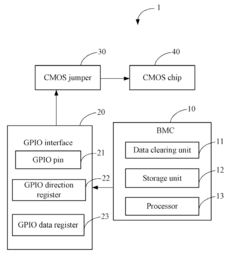
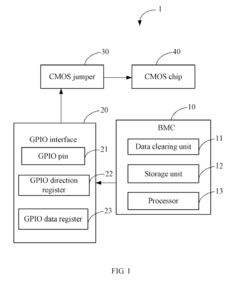
- A computing device with a data clearing unit that uses a GPIO interface to configure a CMOS jumper, generating a high-level signal to maintain data and then pulling it down to clear data stored in the CMOS chip, allowing for safe and controlled data reset.


Complementary metal oxide semiconductor (CMOS) device having gate structures connected by a metal gate conductor
PatentActiveUS20140349451A1
Innovation
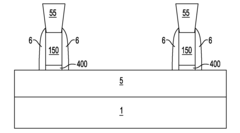
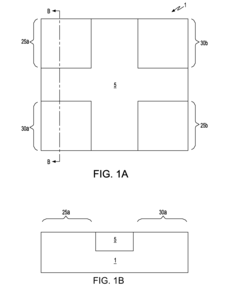
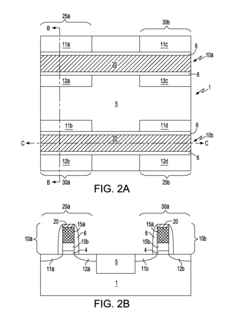
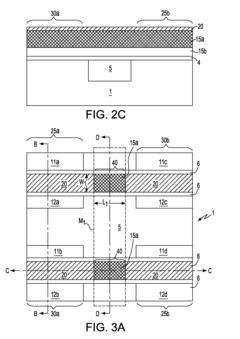
- A method is introduced where a portion of the dielectric cap layer is removed to expose the semiconductor gate conductor layer on an isolation region, allowing for the formation of an interconnect without damaging the gate structure over active regions, thus protecting the active regions and maintaining spacer integrity.
Device Lifecycle Impact
The impact of CMOS battery on device lifecycle is multifaceted and significant. CMOS batteries, typically small lithium cells, play a crucial role in maintaining system settings and timekeeping functions in smart devices. As these batteries age and lose capacity, they can trigger a cascade of effects that influence the device's performance, reliability, and ultimately, its upgrade cycle.
Over time, a weakening CMOS battery may lead to inconsistent timekeeping, loss of BIOS settings, and system instability. These issues can manifest as unexpected shutdowns, boot failures, or erratic behavior in smart devices. Such symptoms often prompt users to consider device upgrades, even when other hardware components remain functional. This accelerated perception of obsolescence can drive consumers towards newer models, effectively shortening the perceived lifecycle of the device.
Furthermore, the interdependence between CMOS batteries and firmware creates a unique upgrade pressure. As manufacturers release firmware updates to address security vulnerabilities or improve functionality, these updates may inadvertently increase the power draw on the CMOS battery. Consequently, devices with aging CMOS batteries may struggle to maintain settings or boot properly after updates, creating a technical impetus for hardware upgrades.
The replacement of CMOS batteries in modern smart devices is often challenging or impractical for average users. Many manufacturers design devices with integrated, non-user-replaceable CMOS batteries, citing reasons such as water resistance or compact design. This design choice effectively ties the lifespan of the CMOS battery to that of the entire device, potentially accelerating the upgrade cycle when battery-related issues arise.
From an environmental perspective, the CMOS battery's influence on device lifecycle has broader implications. Premature device upgrades driven by CMOS battery failures contribute to electronic waste and resource consumption. This aspect underscores the importance of designing smart devices with easily replaceable CMOS batteries or implementing more durable power retention solutions to extend device longevity.
In the context of targeted upgrade paths, manufacturers and marketers may leverage the known lifecycle of CMOS batteries to strategically time the release of new models or promote upgrades. By aligning product cycles with the expected degradation of CMOS batteries in older models, companies can create a more compelling case for consumers to transition to newer devices, effectively managing their product ecosystem and revenue streams.
Over time, a weakening CMOS battery may lead to inconsistent timekeeping, loss of BIOS settings, and system instability. These issues can manifest as unexpected shutdowns, boot failures, or erratic behavior in smart devices. Such symptoms often prompt users to consider device upgrades, even when other hardware components remain functional. This accelerated perception of obsolescence can drive consumers towards newer models, effectively shortening the perceived lifecycle of the device.
Furthermore, the interdependence between CMOS batteries and firmware creates a unique upgrade pressure. As manufacturers release firmware updates to address security vulnerabilities or improve functionality, these updates may inadvertently increase the power draw on the CMOS battery. Consequently, devices with aging CMOS batteries may struggle to maintain settings or boot properly after updates, creating a technical impetus for hardware upgrades.
The replacement of CMOS batteries in modern smart devices is often challenging or impractical for average users. Many manufacturers design devices with integrated, non-user-replaceable CMOS batteries, citing reasons such as water resistance or compact design. This design choice effectively ties the lifespan of the CMOS battery to that of the entire device, potentially accelerating the upgrade cycle when battery-related issues arise.
From an environmental perspective, the CMOS battery's influence on device lifecycle has broader implications. Premature device upgrades driven by CMOS battery failures contribute to electronic waste and resource consumption. This aspect underscores the importance of designing smart devices with easily replaceable CMOS batteries or implementing more durable power retention solutions to extend device longevity.
In the context of targeted upgrade paths, manufacturers and marketers may leverage the known lifecycle of CMOS batteries to strategically time the release of new models or promote upgrades. By aligning product cycles with the expected degradation of CMOS batteries in older models, companies can create a more compelling case for consumers to transition to newer devices, effectively managing their product ecosystem and revenue streams.
Sustainability Concerns
The increasing focus on sustainability in the technology sector has brought CMOS battery usage and its impact on device upgrade cycles into sharp focus. As smart devices become more prevalent, the environmental implications of their production, use, and disposal have become a significant concern. The CMOS battery, while small, plays a crucial role in this ecosystem and its sustainability impact must be carefully considered.
CMOS batteries, typically lithium-based, have a limited lifespan and require periodic replacement. This necessity creates a sustainability challenge as it contributes to electronic waste and resource consumption. The production of these batteries involves mining and processing of raw materials, which can have significant environmental impacts. Additionally, the disposal of used CMOS batteries, if not properly managed, can lead to soil and water contamination due to the toxic materials they contain.
The accelerated upgrade paths facilitated by CMOS batteries also raise sustainability concerns. As these batteries fail or degrade, they can trigger device malfunctions or data loss, often prompting users to replace entire devices rather than just the battery. This pattern of premature obsolescence contributes to the growing problem of electronic waste, which is one of the fastest-growing waste streams globally.
However, the role of CMOS batteries in maintaining device functionality and data integrity also has potential sustainability benefits. By ensuring that devices continue to operate efficiently and maintain accurate timekeeping and BIOS settings, CMOS batteries can extend the overall lifespan of smart devices. This longevity can reduce the frequency of device replacements, potentially offsetting some of the negative environmental impacts associated with manufacturing new devices.
The sustainability concerns surrounding CMOS batteries and accelerated device upgrades have prompted research into alternative technologies and more sustainable practices. Efforts are being made to develop longer-lasting CMOS batteries, explore alternative power sources for BIOS memory, and improve the recyclability of these components. Additionally, there is a growing emphasis on designing devices with easily replaceable CMOS batteries, which could significantly reduce electronic waste by allowing for targeted component replacement rather than whole device upgrades.
In conclusion, while CMOS batteries play a vital role in the functionality of smart devices, their impact on sustainability and device upgrade cycles is complex. Balancing the benefits of reliable device operation with the environmental costs of battery production and disposal remains a challenge for the technology industry. As sustainability becomes an increasingly important consideration in consumer electronics, addressing these concerns will be crucial for the future development and adoption of smart devices.
CMOS batteries, typically lithium-based, have a limited lifespan and require periodic replacement. This necessity creates a sustainability challenge as it contributes to electronic waste and resource consumption. The production of these batteries involves mining and processing of raw materials, which can have significant environmental impacts. Additionally, the disposal of used CMOS batteries, if not properly managed, can lead to soil and water contamination due to the toxic materials they contain.
The accelerated upgrade paths facilitated by CMOS batteries also raise sustainability concerns. As these batteries fail or degrade, they can trigger device malfunctions or data loss, often prompting users to replace entire devices rather than just the battery. This pattern of premature obsolescence contributes to the growing problem of electronic waste, which is one of the fastest-growing waste streams globally.
However, the role of CMOS batteries in maintaining device functionality and data integrity also has potential sustainability benefits. By ensuring that devices continue to operate efficiently and maintain accurate timekeeping and BIOS settings, CMOS batteries can extend the overall lifespan of smart devices. This longevity can reduce the frequency of device replacements, potentially offsetting some of the negative environmental impacts associated with manufacturing new devices.
The sustainability concerns surrounding CMOS batteries and accelerated device upgrades have prompted research into alternative technologies and more sustainable practices. Efforts are being made to develop longer-lasting CMOS batteries, explore alternative power sources for BIOS memory, and improve the recyclability of these components. Additionally, there is a growing emphasis on designing devices with easily replaceable CMOS batteries, which could significantly reduce electronic waste by allowing for targeted component replacement rather than whole device upgrades.
In conclusion, while CMOS batteries play a vital role in the functionality of smart devices, their impact on sustainability and device upgrade cycles is complex. Balancing the benefits of reliable device operation with the environmental costs of battery production and disposal remains a challenge for the technology industry. As sustainability becomes an increasingly important consideration in consumer electronics, addressing these concerns will be crucial for the future development and adoption of smart devices.
Unlock deeper insights with PatSnap Eureka Quick Research — get a full tech report to explore trends and direct your research. Try now!
Generate Your Research Report Instantly with AI Agent
Supercharge your innovation with PatSnap Eureka AI Agent Platform!