How to Enhance the Functionality of Spintronics in Cloud Computing
APR 16, 20269 MIN READ
Generate Your Research Report Instantly with AI Agent
PatSnap Eureka helps you evaluate technical feasibility & market potential.
Spintronics Cloud Computing Background and Objectives
Spintronics, an emerging field that exploits both the charge and spin properties of electrons, represents a paradigm shift from conventional electronics that relies solely on electron charge. This technology has evolved from fundamental quantum mechanical discoveries in the 1980s to practical applications in modern computing systems. The field gained significant momentum following the discovery of giant magnetoresistance (GMR) and tunnel magnetoresistance (TMR) effects, which laid the foundation for spin-based information processing and storage technologies.
The historical development of spintronics can be traced through several key milestones, beginning with the theoretical understanding of electron spin in quantum mechanics, progressing through the development of magnetic tunnel junctions, and culminating in contemporary applications such as magnetic random-access memory (MRAM) and spin-transfer torque devices. This evolutionary trajectory demonstrates a consistent trend toward miniaturization, increased energy efficiency, and enhanced computational capabilities.
Current technological trends indicate a convergence between spintronics and cloud computing infrastructure, driven by the exponential growth in data processing demands and the limitations of traditional silicon-based technologies. The integration of spintronic devices into cloud computing systems presents opportunities to address critical challenges including power consumption, processing speed, and data storage density. As cloud computing continues to expand globally, the need for more efficient hardware solutions becomes increasingly urgent.
The primary objective of enhancing spintronics functionality in cloud computing environments centers on developing next-generation computing architectures that can deliver superior performance while maintaining energy efficiency. This involves creating spintronic processors capable of handling complex computational tasks, implementing non-volatile memory systems that reduce power consumption during idle states, and establishing quantum-classical hybrid computing frameworks that leverage spin-based quantum bits for specific computational advantages.
Secondary objectives include achieving seamless integration of spintronic components with existing cloud infrastructure, developing scalable manufacturing processes for spintronic devices, and establishing industry standards for spin-based computing systems. These goals collectively aim to position spintronics as a cornerstone technology for future cloud computing platforms, enabling unprecedented computational capabilities while addressing sustainability concerns in large-scale data centers.
The historical development of spintronics can be traced through several key milestones, beginning with the theoretical understanding of electron spin in quantum mechanics, progressing through the development of magnetic tunnel junctions, and culminating in contemporary applications such as magnetic random-access memory (MRAM) and spin-transfer torque devices. This evolutionary trajectory demonstrates a consistent trend toward miniaturization, increased energy efficiency, and enhanced computational capabilities.
Current technological trends indicate a convergence between spintronics and cloud computing infrastructure, driven by the exponential growth in data processing demands and the limitations of traditional silicon-based technologies. The integration of spintronic devices into cloud computing systems presents opportunities to address critical challenges including power consumption, processing speed, and data storage density. As cloud computing continues to expand globally, the need for more efficient hardware solutions becomes increasingly urgent.
The primary objective of enhancing spintronics functionality in cloud computing environments centers on developing next-generation computing architectures that can deliver superior performance while maintaining energy efficiency. This involves creating spintronic processors capable of handling complex computational tasks, implementing non-volatile memory systems that reduce power consumption during idle states, and establishing quantum-classical hybrid computing frameworks that leverage spin-based quantum bits for specific computational advantages.
Secondary objectives include achieving seamless integration of spintronic components with existing cloud infrastructure, developing scalable manufacturing processes for spintronic devices, and establishing industry standards for spin-based computing systems. These goals collectively aim to position spintronics as a cornerstone technology for future cloud computing platforms, enabling unprecedented computational capabilities while addressing sustainability concerns in large-scale data centers.
Market Demand for Spintronic Cloud Solutions
The global cloud computing market continues to experience unprecedented growth, driven by digital transformation initiatives across industries and the increasing demand for scalable, energy-efficient computing solutions. Traditional silicon-based technologies are approaching their physical limits, creating substantial market opportunities for revolutionary alternatives like spintronic technologies that can address the growing computational demands while reducing power consumption.
Enterprise customers are increasingly seeking cloud solutions that can handle massive data processing workloads while maintaining cost-effectiveness and environmental sustainability. The exponential growth in artificial intelligence, machine learning, and big data analytics applications has created a pressing need for computing architectures that can deliver superior performance per watt. Spintronic cloud solutions present a compelling value proposition by offering non-volatile memory capabilities, ultra-low power consumption, and enhanced processing speeds that align perfectly with these market requirements.
Data centers, which consume approximately three percent of global electricity, face mounting pressure to reduce their environmental footprint while scaling capacity. Cloud service providers are actively pursuing technologies that can significantly lower operational costs through reduced energy consumption and cooling requirements. Spintronic devices, with their inherent ability to retain information without continuous power supply and operate at room temperature, address these critical pain points directly.
The market demand is particularly strong in sectors requiring real-time data processing and edge computing capabilities. Financial services, autonomous vehicles, Internet of Things applications, and telecommunications networks represent high-value market segments where spintronic cloud solutions can deliver transformative benefits. These industries require ultra-fast response times, reliable data storage, and continuous operation capabilities that traditional computing architectures struggle to provide efficiently.
Government initiatives promoting green technology adoption and carbon neutrality goals are creating additional market drivers for spintronic cloud solutions. Regulatory frameworks increasingly favor technologies that demonstrate measurable environmental benefits, positioning spintronics as a strategically advantageous choice for forward-thinking organizations seeking to align with sustainability mandates while achieving superior computational performance.
Enterprise customers are increasingly seeking cloud solutions that can handle massive data processing workloads while maintaining cost-effectiveness and environmental sustainability. The exponential growth in artificial intelligence, machine learning, and big data analytics applications has created a pressing need for computing architectures that can deliver superior performance per watt. Spintronic cloud solutions present a compelling value proposition by offering non-volatile memory capabilities, ultra-low power consumption, and enhanced processing speeds that align perfectly with these market requirements.
Data centers, which consume approximately three percent of global electricity, face mounting pressure to reduce their environmental footprint while scaling capacity. Cloud service providers are actively pursuing technologies that can significantly lower operational costs through reduced energy consumption and cooling requirements. Spintronic devices, with their inherent ability to retain information without continuous power supply and operate at room temperature, address these critical pain points directly.
The market demand is particularly strong in sectors requiring real-time data processing and edge computing capabilities. Financial services, autonomous vehicles, Internet of Things applications, and telecommunications networks represent high-value market segments where spintronic cloud solutions can deliver transformative benefits. These industries require ultra-fast response times, reliable data storage, and continuous operation capabilities that traditional computing architectures struggle to provide efficiently.
Government initiatives promoting green technology adoption and carbon neutrality goals are creating additional market drivers for spintronic cloud solutions. Regulatory frameworks increasingly favor technologies that demonstrate measurable environmental benefits, positioning spintronics as a strategically advantageous choice for forward-thinking organizations seeking to align with sustainability mandates while achieving superior computational performance.
Current Spintronic Integration Challenges in Cloud Systems
The integration of spintronic technologies into cloud computing systems faces significant architectural compatibility challenges. Traditional cloud infrastructures are built around conventional CMOS-based processors and memory systems, creating fundamental mismatches with spintronic devices that operate on different physical principles. Current data center architectures lack the specialized interfaces and control mechanisms required to effectively harness spin-based phenomena, necessitating substantial redesigns of existing hardware frameworks.
Power management represents another critical integration hurdle. While spintronics promises ultra-low power consumption through non-volatile magnetic states, current cloud systems struggle to optimize power delivery and thermal management for hybrid spintronic-electronic architectures. The coexistence of different power domains and the need for precise magnetic field control create complex power distribution challenges that existing infrastructure cannot adequately address.
Scalability concerns emerge prominently when attempting to deploy spintronic solutions across massive cloud environments. Current spintronic devices demonstrate excellent performance at laboratory scales but face significant challenges when scaled to the thousands of nodes typical in cloud data centers. Manufacturing variability, device-to-device consistency, and yield rates remain problematic for large-scale deployment, limiting the practical implementation of spintronic solutions in production cloud environments.
Interconnect and communication protocols present substantial integration barriers. Existing cloud systems rely on established networking standards and data transfer protocols optimized for conventional electronic systems. Spintronic devices require specialized signal conditioning, error correction mechanisms, and timing synchronization that are incompatible with current cloud communication infrastructures, creating bottlenecks in data flow and system coordination.
Software stack compatibility issues further complicate integration efforts. Current cloud operating systems, hypervisors, and management software lack native support for spintronic hardware abstractions. The absence of standardized APIs, device drivers, and resource management frameworks specifically designed for spintronic components creates significant barriers for cloud service providers attempting to incorporate these technologies into their existing software ecosystems.
Reliability and fault tolerance mechanisms designed for traditional cloud systems prove inadequate for spintronic integration. The unique failure modes of magnetic devices, sensitivity to external magnetic fields, and different aging characteristics require new approaches to system monitoring, predictive maintenance, and redundancy management that current cloud platforms do not provide.
Power management represents another critical integration hurdle. While spintronics promises ultra-low power consumption through non-volatile magnetic states, current cloud systems struggle to optimize power delivery and thermal management for hybrid spintronic-electronic architectures. The coexistence of different power domains and the need for precise magnetic field control create complex power distribution challenges that existing infrastructure cannot adequately address.
Scalability concerns emerge prominently when attempting to deploy spintronic solutions across massive cloud environments. Current spintronic devices demonstrate excellent performance at laboratory scales but face significant challenges when scaled to the thousands of nodes typical in cloud data centers. Manufacturing variability, device-to-device consistency, and yield rates remain problematic for large-scale deployment, limiting the practical implementation of spintronic solutions in production cloud environments.
Interconnect and communication protocols present substantial integration barriers. Existing cloud systems rely on established networking standards and data transfer protocols optimized for conventional electronic systems. Spintronic devices require specialized signal conditioning, error correction mechanisms, and timing synchronization that are incompatible with current cloud communication infrastructures, creating bottlenecks in data flow and system coordination.
Software stack compatibility issues further complicate integration efforts. Current cloud operating systems, hypervisors, and management software lack native support for spintronic hardware abstractions. The absence of standardized APIs, device drivers, and resource management frameworks specifically designed for spintronic components creates significant barriers for cloud service providers attempting to incorporate these technologies into their existing software ecosystems.
Reliability and fault tolerance mechanisms designed for traditional cloud systems prove inadequate for spintronic integration. The unique failure modes of magnetic devices, sensitivity to external magnetic fields, and different aging characteristics require new approaches to system monitoring, predictive maintenance, and redundancy management that current cloud platforms do not provide.
Existing Spintronic Enhancement Solutions for Cloud
01 Spin-orbit coupling materials and structures
Spintronics devices utilize materials with strong spin-orbit coupling effects to manipulate electron spin states. These materials enable efficient spin-charge conversion and spin current generation. The structures typically incorporate heavy metal layers, topological insulators, or transition metal compounds that exhibit significant spin-orbit interaction. Such materials form the foundation for various spintronic functionalities including spin Hall effect and Rashba effect based devices.- Spin-orbit coupling and spin Hall effect devices: Spintronic devices utilize spin-orbit coupling phenomena to manipulate electron spin states for information processing and storage. These devices exploit the spin Hall effect to generate and detect spin currents without the need for ferromagnetic materials. The technology enables efficient spin current generation through charge-to-spin conversion mechanisms, which can be applied in logic devices and memory applications. Advanced materials with strong spin-orbit coupling are employed to enhance device performance and reduce power consumption.
- Magnetic tunnel junctions and spin valves: Magnetic tunnel junctions serve as fundamental building blocks in spintronic devices, utilizing the tunneling magnetoresistance effect for data storage and sensing applications. These structures consist of ferromagnetic layers separated by thin insulating barriers, where the resistance depends on the relative magnetization orientation of the layers. The technology enables high-density memory devices with non-volatile characteristics and fast switching speeds. Optimization of barrier materials and interface properties is crucial for achieving high magnetoresistance ratios and thermal stability.
- Spin transfer torque and domain wall manipulation: Spin transfer torque mechanisms enable the manipulation of magnetic domain walls and magnetization switching through spin-polarized currents. This technology allows for current-driven magnetic switching without external magnetic fields, reducing power consumption and enabling scalable device architectures. Domain wall motion can be precisely controlled for racetrack memory and logic applications. The implementation involves optimizing current densities, material properties, and device geometries to achieve efficient and reliable operation.
- Topological insulators and quantum spin phenomena: Topological insulators exhibit unique surface states with spin-momentum locking properties that enable dissipationless spin transport for spintronic applications. These materials feature insulating bulk properties while maintaining conducting surface states protected by time-reversal symmetry. The technology leverages quantum spin Hall effects and topological protection mechanisms to create robust spintronic devices with reduced scattering and enhanced performance. Material engineering focuses on optimizing band structure and surface state properties for practical device implementation.
- Spintronic sensors and detection systems: Spintronic sensors utilize magnetoresistive effects and spin-dependent transport phenomena for high-sensitivity magnetic field detection and position sensing applications. These devices offer advantages in terms of sensitivity, power consumption, and integration density compared to conventional sensing technologies. Applications span from automotive sensors to biomedical detection systems and data storage read heads. Advanced sensor designs incorporate multi-layer structures and optimized magnetic configurations to enhance signal-to-noise ratios and operational stability.
02 Magnetic tunnel junctions and spin valves
Magnetic tunnel junctions serve as core components in spintronic devices, consisting of ferromagnetic layers separated by thin insulating barriers. These structures exploit tunneling magnetoresistance effects to achieve spin-dependent electron transport. The resistance of the junction varies significantly depending on the relative magnetization orientation of the magnetic layers, enabling memory and sensing applications. Advanced configurations include multi-layer stacks with optimized barrier materials for enhanced performance.Expand Specific Solutions03 Spin transfer torque mechanisms
Spin transfer torque technology enables the manipulation of magnetic states through spin-polarized currents rather than external magnetic fields. This mechanism allows for efficient switching of magnetization direction in nanoscale magnetic elements. The technology is particularly valuable for developing low-power, high-density memory devices and logic circuits. Implementation involves carefully designed current paths and magnetic layer configurations to optimize switching efficiency and reduce power consumption.Expand Specific Solutions04 Skyrmion-based spintronic devices
Skyrmions are topologically protected magnetic spin textures that can be utilized as information carriers in spintronic devices. These nanoscale magnetic whirls exhibit remarkable stability and can be manipulated with extremely low current densities. Devices based on skyrmions offer potential advantages in terms of energy efficiency and storage density. The technology involves specialized magnetic multilayer structures and materials that stabilize skyrmion formation and enable controlled movement.Expand Specific Solutions05 Spin wave and magnonic devices
Spin wave based devices utilize collective excitations of magnetic moments to process and transmit information without charge transport. Magnonic circuits can operate at high frequencies with low energy dissipation compared to conventional electronics. These devices exploit the wave nature of spin to perform logic operations, signal processing, and data transmission. Implementation requires careful design of magnetic waveguides, resonators, and coupling structures to control spin wave propagation and interference.Expand Specific Solutions
Key Players in Spintronics and Cloud Computing Industry
The spintronics in cloud computing field represents an emerging technology sector at the early development stage, with significant growth potential driven by the need for energy-efficient computing solutions. The market remains nascent but shows promise as cloud infrastructure demands increase exponentially. Technology maturity varies considerably across key players, with established semiconductor giants like Intel Corp., Taiwan Semiconductor Manufacturing Co., and IBM leading foundational research and development. Academic institutions including University of California, Harbin Institute of Technology, and Xidian University contribute crucial theoretical advances, while cloud infrastructure providers such as VMware, Microsoft Technology Licensing, and Oracle International Corp. focus on integration challenges. Chinese companies like ZTE Corp. and Alibaba demonstrate growing regional expertise, though overall commercial deployment remains limited, indicating the technology is still transitioning from laboratory research to practical applications.
Intel Corp.
Technical Solution: Intel has developed comprehensive spintronics solutions for cloud computing through their advanced magnetic memory technologies and spin-based processors. Their approach focuses on integrating spin-transfer torque magnetic random access memory (STT-MRAM) into cloud server architectures, providing non-volatile memory solutions that maintain data integrity during power failures. Intel's spintronics implementation includes spin-orbit coupling mechanisms for enhanced data processing efficiency and reduced energy consumption in large-scale cloud infrastructures. Their technology leverages magnetic tunnel junctions (MTJs) to create high-density storage arrays that can operate at cloud-scale with improved thermal stability and endurance compared to traditional semiconductor memory.
Strengths: Industry-leading manufacturing capabilities, extensive R&D resources, strong market presence in cloud infrastructure. Weaknesses: High development costs, complex integration challenges with existing architectures.
International Business Machines Corp.
Technical Solution: IBM has pioneered spintronics applications in cloud computing through their quantum-inspired spintronic processors and magnetic storage solutions. Their technology utilizes spin-based logic devices that can perform complex computational tasks while consuming significantly less power than conventional CMOS technology. IBM's approach incorporates spin wave propagation for data transmission within cloud server clusters, enabling faster inter-node communication and reduced latency. Their spintronics framework includes advanced error correction mechanisms specifically designed for cloud environments, ensuring data reliability across distributed computing systems. The company has also developed spin-based neuromorphic computing units that can handle AI workloads more efficiently in cloud platforms.
Strengths: Strong research foundation, proven track record in enterprise solutions, comprehensive patent portfolio. Weaknesses: Limited commercial deployment, high implementation complexity for existing cloud infrastructures.
Core Spintronic Patents for Cloud Functionality
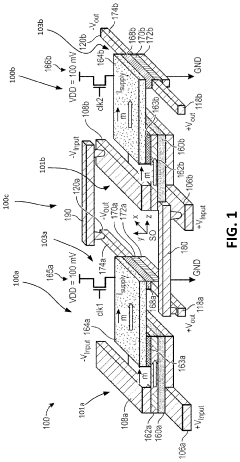
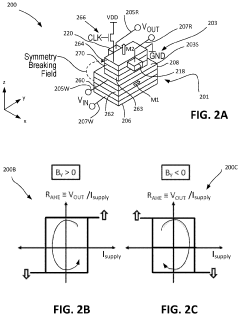
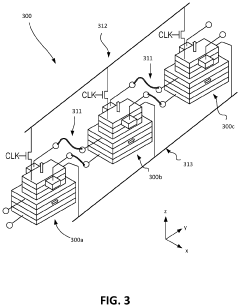
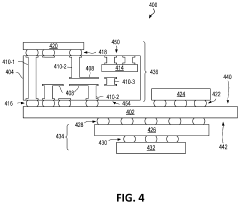
Magnetoelectric spin-orbit device with in-plane and perpendicular magnetic layers and method of manufacturing same
PatentActiveUS20230284538A1
Innovation
- The proposed solution involves using a perpendicular magnetic anisotropy (PMA) magnet in conjunction with the anomalous Hall effect to improve readout voltage and simplify manufacturing by employing a magnetoelectric spin-orbit (MESO) device with a ferroelectric material instead of ferromagnetic materials, allowing for easier integration and faster operation.
Energy Efficiency Standards for Spintronic Devices
The establishment of comprehensive energy efficiency standards for spintronic devices represents a critical foundation for their successful integration into cloud computing infrastructure. Current industry initiatives focus on developing standardized metrics that can accurately measure and compare the energy performance of spintronic components across different manufacturers and applications. These standards must address the unique characteristics of spin-based devices, including their non-volatile nature, ultra-low switching energy requirements, and temperature-dependent performance variations.
International standardization bodies are actively working to define power consumption benchmarks specifically tailored for spintronic memory and logic devices. The proposed standards encompass static power dissipation during idle states, dynamic power consumption during read/write operations, and standby power requirements for data retention. These metrics are particularly crucial for cloud computing environments where devices operate continuously across varying workload conditions.
The development of testing methodologies represents another essential component of energy efficiency standardization. Standardized test protocols must account for the operational frequency ranges, temperature coefficients, and endurance characteristics unique to spintronic devices. These protocols ensure consistent measurement approaches across different laboratory environments and enable reliable performance comparisons between competing technologies.
Compliance frameworks are being established to certify spintronic devices meeting specific energy efficiency thresholds. These frameworks incorporate tiered certification levels, allowing manufacturers to demonstrate varying degrees of energy optimization. The certification process includes rigorous testing procedures, documentation requirements, and periodic re-evaluation protocols to maintain standard compliance throughout the device lifecycle.
The integration of these standards with existing cloud computing energy management systems requires careful consideration of compatibility and scalability factors. Standards must accommodate the heterogeneous nature of cloud infrastructure while providing sufficient granularity for effective energy monitoring and optimization. This includes defining standardized interfaces for energy reporting and establishing protocols for real-time power management coordination between spintronic components and cloud orchestration systems.
International standardization bodies are actively working to define power consumption benchmarks specifically tailored for spintronic memory and logic devices. The proposed standards encompass static power dissipation during idle states, dynamic power consumption during read/write operations, and standby power requirements for data retention. These metrics are particularly crucial for cloud computing environments where devices operate continuously across varying workload conditions.
The development of testing methodologies represents another essential component of energy efficiency standardization. Standardized test protocols must account for the operational frequency ranges, temperature coefficients, and endurance characteristics unique to spintronic devices. These protocols ensure consistent measurement approaches across different laboratory environments and enable reliable performance comparisons between competing technologies.
Compliance frameworks are being established to certify spintronic devices meeting specific energy efficiency thresholds. These frameworks incorporate tiered certification levels, allowing manufacturers to demonstrate varying degrees of energy optimization. The certification process includes rigorous testing procedures, documentation requirements, and periodic re-evaluation protocols to maintain standard compliance throughout the device lifecycle.
The integration of these standards with existing cloud computing energy management systems requires careful consideration of compatibility and scalability factors. Standards must accommodate the heterogeneous nature of cloud infrastructure while providing sufficient granularity for effective energy monitoring and optimization. This includes defining standardized interfaces for energy reporting and establishing protocols for real-time power management coordination between spintronic components and cloud orchestration systems.
Quantum Computing Integration with Spintronic Systems
The convergence of quantum computing and spintronic systems represents a transformative frontier in computational architecture, particularly relevant for cloud computing applications. This integration leverages the quantum mechanical properties of electron spin alongside quantum computational principles to create hybrid systems that could revolutionize data processing capabilities in distributed computing environments.
Quantum-spintronic hybrid architectures utilize spin qubits as fundamental computational units, where electron spins in semiconductor quantum dots or defect centers serve as quantum information carriers. These systems benefit from the inherent coherence properties of spin states while maintaining compatibility with existing spintronic infrastructure. The integration enables quantum error correction through spin-based encoding schemes, where multiple physical spin qubits can represent a single logical qubit with enhanced stability.
Topological quantum computing approaches show particular promise when combined with spintronic systems. Majorana fermions, emerging in certain spintronic materials under specific conditions, provide naturally protected qubits that are inherently resistant to decoherence. This protection mechanism significantly reduces the overhead typically required for quantum error correction, making practical quantum-spintronic processors more feasible for cloud deployment.
The hybrid systems demonstrate unique advantages in quantum communication protocols essential for cloud computing networks. Spin-photon interfaces enable efficient quantum state transfer between distant processing nodes, facilitating distributed quantum computing across cloud infrastructure. These interfaces convert spin-encoded quantum information into photonic states suitable for fiber-optic transmission, maintaining quantum coherence over extended distances.
Implementation challenges include maintaining quantum coherence in spintronic devices operating at practical temperatures and integrating quantum control systems with classical spintronic components. Current research focuses on developing room-temperature spin qubits and creating seamless interfaces between quantum and classical processing elements within the same spintronic framework.
The integration pathway involves developing quantum-classical hybrid algorithms that leverage both quantum speedup for specific computational tasks and classical spintronic efficiency for data storage and retrieval operations, creating a synergistic approach to cloud computing enhancement.
Quantum-spintronic hybrid architectures utilize spin qubits as fundamental computational units, where electron spins in semiconductor quantum dots or defect centers serve as quantum information carriers. These systems benefit from the inherent coherence properties of spin states while maintaining compatibility with existing spintronic infrastructure. The integration enables quantum error correction through spin-based encoding schemes, where multiple physical spin qubits can represent a single logical qubit with enhanced stability.
Topological quantum computing approaches show particular promise when combined with spintronic systems. Majorana fermions, emerging in certain spintronic materials under specific conditions, provide naturally protected qubits that are inherently resistant to decoherence. This protection mechanism significantly reduces the overhead typically required for quantum error correction, making practical quantum-spintronic processors more feasible for cloud deployment.
The hybrid systems demonstrate unique advantages in quantum communication protocols essential for cloud computing networks. Spin-photon interfaces enable efficient quantum state transfer between distant processing nodes, facilitating distributed quantum computing across cloud infrastructure. These interfaces convert spin-encoded quantum information into photonic states suitable for fiber-optic transmission, maintaining quantum coherence over extended distances.
Implementation challenges include maintaining quantum coherence in spintronic devices operating at practical temperatures and integrating quantum control systems with classical spintronic components. Current research focuses on developing room-temperature spin qubits and creating seamless interfaces between quantum and classical processing elements within the same spintronic framework.
The integration pathway involves developing quantum-classical hybrid algorithms that leverage both quantum speedup for specific computational tasks and classical spintronic efficiency for data storage and retrieval operations, creating a synergistic approach to cloud computing enhancement.
Unlock deeper insights with PatSnap Eureka Quick Research — get a full tech report to explore trends and direct your research. Try now!
Generate Your Research Report Instantly with AI Agent
Supercharge your innovation with PatSnap Eureka AI Agent Platform!