
How to Improve Fault Tolerance in Solid-State Transformers
APR 20, 20269 MIN READ
Generate Your Research Report Instantly with AI Agent
Patsnap Eureka helps you evaluate technical feasibility & market potential.
SST Fault Tolerance Background and Objectives
Solid-State Transformers represent a paradigm shift from traditional electromagnetic transformers, emerging as critical components in modern power systems due to their enhanced controllability, reduced size, and improved efficiency. The evolution of SST technology has been driven by advances in wide bandgap semiconductors, particularly silicon carbide and gallium nitride devices, which enable higher switching frequencies and power densities. However, the increased complexity of SST systems, incorporating multiple power electronic stages and sophisticated control algorithms, has introduced new vulnerability points that traditional transformers do not face.
The fundamental challenge in SST fault tolerance stems from the inherent characteristics of power electronic systems. Unlike passive electromagnetic transformers that can withstand temporary overloads and fault conditions through their robust magnetic coupling, SSTs rely on active semiconductor switches that are susceptible to overcurrent, overvoltage, and thermal stress. The multi-stage architecture typical of SSTs, including AC-DC rectification, DC-DC isolation, and DC-AC inversion stages, creates multiple potential failure points where component degradation or sudden failures can cascade throughout the system.
Current fault tolerance limitations in SSTs manifest across several dimensions. Component-level vulnerabilities include semiconductor device failures due to thermal cycling, gate oxide degradation, and wire bond fatigue. System-level challenges encompass control system malfunctions, communication failures between distributed control units, and inadequate protection coordination between different stages. Additionally, the high-frequency operation of SSTs introduces electromagnetic interference issues that can compromise control signal integrity and sensor accuracy.
The primary objective of improving SST fault tolerance is to achieve reliability levels comparable to or exceeding conventional transformers while maintaining the operational advantages of solid-state technology. This involves developing comprehensive fault detection and diagnosis capabilities that can identify incipient failures before they propagate throughout the system. The goal extends to implementing graceful degradation strategies that allow continued operation under partial failure conditions, ensuring power system stability even when individual components or subsystems experience faults.
Strategic objectives include establishing standardized fault tolerance metrics and testing protocols specific to SST applications. The development of predictive maintenance algorithms leveraging machine learning and artificial intelligence techniques represents another crucial goal, enabling proactive component replacement and system optimization. Furthermore, the integration of advanced protection schemes that can rapidly isolate faulted sections while maintaining overall system functionality remains a primary target for enhancing SST reliability in critical power system applications.
The fundamental challenge in SST fault tolerance stems from the inherent characteristics of power electronic systems. Unlike passive electromagnetic transformers that can withstand temporary overloads and fault conditions through their robust magnetic coupling, SSTs rely on active semiconductor switches that are susceptible to overcurrent, overvoltage, and thermal stress. The multi-stage architecture typical of SSTs, including AC-DC rectification, DC-DC isolation, and DC-AC inversion stages, creates multiple potential failure points where component degradation or sudden failures can cascade throughout the system.
Current fault tolerance limitations in SSTs manifest across several dimensions. Component-level vulnerabilities include semiconductor device failures due to thermal cycling, gate oxide degradation, and wire bond fatigue. System-level challenges encompass control system malfunctions, communication failures between distributed control units, and inadequate protection coordination between different stages. Additionally, the high-frequency operation of SSTs introduces electromagnetic interference issues that can compromise control signal integrity and sensor accuracy.
The primary objective of improving SST fault tolerance is to achieve reliability levels comparable to or exceeding conventional transformers while maintaining the operational advantages of solid-state technology. This involves developing comprehensive fault detection and diagnosis capabilities that can identify incipient failures before they propagate throughout the system. The goal extends to implementing graceful degradation strategies that allow continued operation under partial failure conditions, ensuring power system stability even when individual components or subsystems experience faults.
Strategic objectives include establishing standardized fault tolerance metrics and testing protocols specific to SST applications. The development of predictive maintenance algorithms leveraging machine learning and artificial intelligence techniques represents another crucial goal, enabling proactive component replacement and system optimization. Furthermore, the integration of advanced protection schemes that can rapidly isolate faulted sections while maintaining overall system functionality remains a primary target for enhancing SST reliability in critical power system applications.
Market Demand for Reliable SST Systems
The global power electronics market is experiencing unprecedented growth driven by the increasing adoption of renewable energy systems, electric vehicles, and smart grid infrastructure. Solid-state transformers represent a critical enabling technology for these applications, where system reliability directly impacts operational efficiency and safety. The demand for fault-tolerant SST systems has intensified as utilities and industrial operators recognize the limitations of traditional electromagnetic transformers in modern power conversion applications.
Electric vehicle charging infrastructure presents one of the most significant market drivers for reliable SST technology. Fast-charging stations require power conversion systems that can operate continuously under varying load conditions while maintaining high efficiency and safety standards. The automotive industry's transition toward electrification has created substantial demand for SST systems that can withstand component failures without compromising charging operations or endangering users.
Renewable energy integration represents another major market segment driving SST reliability requirements. Solar and wind power installations require power conversion systems capable of handling intermittent generation patterns and grid disturbances. The increasing penetration of distributed energy resources has heightened the need for fault-tolerant SST systems that can maintain grid stability during component malfunctions or unexpected operating conditions.
Industrial applications, particularly in data centers and manufacturing facilities, demand SST systems with exceptional reliability characteristics. These environments require uninterrupted power supply with minimal downtime tolerance. The growing digitalization of industrial processes has amplified the economic impact of power system failures, creating strong market incentives for fault-tolerant SST technologies that can provide redundancy and graceful degradation capabilities.
The aerospace and defense sectors represent specialized but high-value market segments for reliable SST systems. These applications require power conversion systems that can operate in harsh environments while maintaining mission-critical functionality. The stringent reliability requirements in these sectors often drive technological innovations that subsequently benefit commercial applications.
Market research indicates that reliability concerns rank among the top three factors influencing SST procurement decisions across all application segments. End users consistently prioritize fault tolerance capabilities over marginal efficiency improvements, reflecting the high cost of system downtime and maintenance interventions. This market preference has encouraged manufacturers to invest heavily in developing advanced fault detection, isolation, and recovery mechanisms for SST systems.
Electric vehicle charging infrastructure presents one of the most significant market drivers for reliable SST technology. Fast-charging stations require power conversion systems that can operate continuously under varying load conditions while maintaining high efficiency and safety standards. The automotive industry's transition toward electrification has created substantial demand for SST systems that can withstand component failures without compromising charging operations or endangering users.
Renewable energy integration represents another major market segment driving SST reliability requirements. Solar and wind power installations require power conversion systems capable of handling intermittent generation patterns and grid disturbances. The increasing penetration of distributed energy resources has heightened the need for fault-tolerant SST systems that can maintain grid stability during component malfunctions or unexpected operating conditions.
Industrial applications, particularly in data centers and manufacturing facilities, demand SST systems with exceptional reliability characteristics. These environments require uninterrupted power supply with minimal downtime tolerance. The growing digitalization of industrial processes has amplified the economic impact of power system failures, creating strong market incentives for fault-tolerant SST technologies that can provide redundancy and graceful degradation capabilities.
The aerospace and defense sectors represent specialized but high-value market segments for reliable SST systems. These applications require power conversion systems that can operate in harsh environments while maintaining mission-critical functionality. The stringent reliability requirements in these sectors often drive technological innovations that subsequently benefit commercial applications.
Market research indicates that reliability concerns rank among the top three factors influencing SST procurement decisions across all application segments. End users consistently prioritize fault tolerance capabilities over marginal efficiency improvements, reflecting the high cost of system downtime and maintenance interventions. This market preference has encouraged manufacturers to invest heavily in developing advanced fault detection, isolation, and recovery mechanisms for SST systems.
Current SST Fault Tolerance Challenges
Solid-State Transformers face significant fault tolerance challenges that stem from their complex multi-stage architecture and reliance on power electronic components. Unlike conventional transformers that primarily fail due to insulation breakdown or thermal stress, SSTs are vulnerable to semiconductor device failures, control system malfunctions, and cascading fault propagation across multiple conversion stages.
Power semiconductor devices represent the most critical vulnerability in SST systems. Silicon carbide and gallium nitride devices, while offering superior performance characteristics, exhibit different failure modes compared to traditional silicon devices. These wide-bandgap semiconductors are susceptible to cosmic ray-induced single event effects, gate oxide degradation under high-frequency switching, and thermal cycling stress that can lead to wire bond failures and die attach degradation.
The multi-stage conversion topology inherent in SSTs creates additional fault propagation pathways. A failure in the primary-side AC-DC converter can propagate through the isolated DC-DC stage to the secondary-side DC-AC inverter, potentially causing system-wide shutdown. This cascading effect is particularly problematic in medium-voltage applications where SSTs interface with critical grid infrastructure.
Control system complexity introduces another layer of fault susceptibility. SSTs require sophisticated digital signal processors and real-time control algorithms to manage power flow, voltage regulation, and grid synchronization. Communication failures between control modules, sensor drift, and software bugs can compromise system reliability. The high-speed switching nature of SSTs demands precise timing control, making the system vulnerable to electromagnetic interference and control signal corruption.
Thermal management challenges compound fault tolerance issues in SST designs. The high power density achieved through advanced semiconductor devices generates significant heat flux that must be effectively dissipated. Inadequate thermal design can lead to junction temperature excursions, accelerated device aging, and eventual failure. The compact form factor requirements often conflict with optimal thermal management, creating design trade-offs that impact long-term reliability.
Grid integration faults present unique challenges for SST fault tolerance. Unlike conventional transformers that provide natural galvanic isolation, SSTs must actively maintain isolation through control algorithms. Grid disturbances, voltage sags, and harmonic distortion can overwhelm SST protection systems, particularly during transient conditions where rapid response is required to maintain system stability and prevent equipment damage.
Power semiconductor devices represent the most critical vulnerability in SST systems. Silicon carbide and gallium nitride devices, while offering superior performance characteristics, exhibit different failure modes compared to traditional silicon devices. These wide-bandgap semiconductors are susceptible to cosmic ray-induced single event effects, gate oxide degradation under high-frequency switching, and thermal cycling stress that can lead to wire bond failures and die attach degradation.
The multi-stage conversion topology inherent in SSTs creates additional fault propagation pathways. A failure in the primary-side AC-DC converter can propagate through the isolated DC-DC stage to the secondary-side DC-AC inverter, potentially causing system-wide shutdown. This cascading effect is particularly problematic in medium-voltage applications where SSTs interface with critical grid infrastructure.
Control system complexity introduces another layer of fault susceptibility. SSTs require sophisticated digital signal processors and real-time control algorithms to manage power flow, voltage regulation, and grid synchronization. Communication failures between control modules, sensor drift, and software bugs can compromise system reliability. The high-speed switching nature of SSTs demands precise timing control, making the system vulnerable to electromagnetic interference and control signal corruption.
Thermal management challenges compound fault tolerance issues in SST designs. The high power density achieved through advanced semiconductor devices generates significant heat flux that must be effectively dissipated. Inadequate thermal design can lead to junction temperature excursions, accelerated device aging, and eventual failure. The compact form factor requirements often conflict with optimal thermal management, creating design trade-offs that impact long-term reliability.
Grid integration faults present unique challenges for SST fault tolerance. Unlike conventional transformers that provide natural galvanic isolation, SSTs must actively maintain isolation through control algorithms. Grid disturbances, voltage sags, and harmonic distortion can overwhelm SST protection systems, particularly during transient conditions where rapid response is required to maintain system stability and prevent equipment damage.
Existing SST Fault Tolerance Solutions
01 Redundant module configuration for fault tolerance
Solid-state transformers can be designed with redundant power modules or converter stages to maintain operation during component failures. This architecture allows the system to continue functioning even when one or more modules fail, by redistributing power through remaining healthy modules. The redundancy can be implemented at various levels including input stages, intermediate DC links, or output stages, ensuring continuous power delivery and improved reliability.- Redundant module configuration for fault tolerance: Solid-state transformers can be designed with redundant power modules or converter stages to maintain operation during component failures. This architecture allows the system to continue functioning even when one or more modules fail, by redistributing power through remaining healthy modules. The redundancy can be implemented at various levels including input stages, intermediate DC links, or output stages, ensuring continuous power delivery and improved reliability.
- Fault detection and isolation mechanisms: Advanced monitoring and diagnostic systems are integrated into solid-state transformers to detect faults in real-time. These systems employ various sensing techniques to identify abnormal operating conditions, component degradation, or failures. Once detected, the faulty components or modules can be isolated from the system while maintaining overall operation, preventing fault propagation and enabling continued service.
- Reconfigurable topology and control strategies: Solid-state transformers utilize reconfigurable circuit topologies and adaptive control algorithms to maintain functionality during fault conditions. The system can dynamically adjust its configuration and control parameters to compensate for failed components. This includes switching between different operating modes, adjusting power flow paths, and modifying modulation strategies to ensure stable operation under degraded conditions.
- Protection circuits and bypass mechanisms: Dedicated protection circuits and bypass mechanisms are incorporated to handle fault scenarios in solid-state transformers. These include fast-acting switches, fuses, and bypass paths that can quickly isolate faulty sections while providing alternative current paths. The protection system responds rapidly to overcurrent, overvoltage, or thermal events, preventing damage to healthy components and maintaining system integrity.
- Multi-level converter architectures for enhanced reliability: Multi-level converter topologies are employed in solid-state transformers to improve fault tolerance through distributed power processing. These architectures divide voltage and current stresses across multiple switching devices and capacitors, reducing the impact of individual component failures. The modular nature allows for graceful degradation, where the system can continue operating at reduced capacity even with failed cells or levels.
02 Fault detection and isolation mechanisms
Advanced monitoring and diagnostic systems are integrated into solid-state transformers to detect faults in real-time. These systems employ various sensing techniques to identify abnormal operating conditions, component degradation, or failures. Once a fault is detected, isolation mechanisms can disconnect the faulty section while maintaining overall system operation. This approach minimizes downtime and prevents fault propagation to healthy components.Expand Specific Solutions03 Bypass and reconfiguration strategies
Fault-tolerant solid-state transformers incorporate bypass circuits and reconfiguration capabilities that allow the system to route power around failed components. When a fault occurs, control algorithms automatically reconfigure the power flow path to maintain operation. This may involve switching between parallel paths, activating backup circuits, or adjusting the topology to compensate for the loss of specific components, thereby ensuring continuous service.Expand Specific Solutions04 Multi-level converter topologies for enhanced reliability
Multi-level converter architectures are employed in solid-state transformers to improve fault tolerance through distributed power processing. These topologies divide voltage and current stresses across multiple switching devices and capacitors, reducing the impact of individual component failures. The modular nature of multi-level converters allows for graceful degradation, where the system can continue operating at reduced capacity even with failed cells or levels.Expand Specific Solutions05 Protection circuits and current limiting techniques
Integrated protection mechanisms are essential for fault tolerance in solid-state transformers, including overcurrent protection, overvoltage protection, and thermal management systems. These circuits rapidly respond to fault conditions by limiting current flow, clamping voltages, or activating cooling systems to prevent damage to semiconductor devices. Advanced protection schemes can distinguish between temporary disturbances and permanent faults, enabling appropriate responses that maintain system integrity.Expand Specific Solutions
Key Players in SST and Power Electronics Industry
The solid-state transformer (SST) fault tolerance improvement field represents an emerging technology sector in the early-to-mid development stage, driven by increasing demand for smart grid infrastructure and renewable energy integration. The market demonstrates significant growth potential as utilities modernize aging power systems. Technology maturity varies considerably across players, with established power electronics companies like Delta Electronics, Renesas Electronics, and Infineon Technologies leading in semiconductor solutions and control systems. State Grid Corp. of China and regional power companies drive deployment through large-scale infrastructure projects. Research institutions including Shanghai Jiao Tong University, Zhejiang University, and China Electric Power Research Institute contribute fundamental research on fault detection algorithms and redundancy architectures. While Huawei Digital Power Technologies and Fujitsu advance digital integration capabilities, the competitive landscape shows fragmentation between hardware manufacturers, software developers, and system integrators, indicating the technology's transitional phase toward commercial maturity.
State Grid Corp. of China
Technical Solution: State Grid Corporation of China has developed comprehensive fault tolerance strategies for solid-state transformers through extensive research and practical implementation in their power grid infrastructure. Their approach emphasizes system-level redundancy with multiple transformer units operating in parallel configuration, allowing for seamless load transfer during equipment failures. The company has implemented advanced monitoring and control systems that utilize big data analytics and machine learning algorithms to predict potential failures and automatically reconfigure the grid topology to maintain power supply continuity. Their fault tolerance solution includes distributed energy storage systems that can provide backup power during transformer failures, sophisticated protection relay systems with adaptive settings, and remote monitoring capabilities that enable rapid response to fault conditions. State Grid's approach also incorporates standardized maintenance procedures and spare part management systems to minimize downtime during repairs.
Strengths: Extensive practical implementation experience, comprehensive system-level approach, strong grid integration capabilities. Weaknesses: Focus primarily on utility-scale applications, slower adoption of latest semiconductor technologies compared to specialized manufacturers.
Renesas Electronics Corp.
Technical Solution: Renesas Electronics focuses on semiconductor-level fault tolerance for solid-state transformers through advanced microcontroller and power management IC solutions. Their approach emphasizes built-in self-test capabilities, error correction codes, and redundant processing units within their semiconductor devices. The company has developed specialized fault-tolerant microcontrollers with dual-core architecture and lockstep operation for critical control functions in SSTs. Their solution includes advanced gate driver ICs with integrated protection features, real-time fault detection algorithms, and fail-safe operating modes. Renesas implements hardware-based safety mechanisms including watchdog timers, voltage monitoring circuits, and temperature protection systems that can automatically shut down or reconfigure the system during fault conditions while maintaining essential functions.
Strengths: Hardware-level fault tolerance, automotive-grade reliability standards, excellent semiconductor integration. Weaknesses: Limited system-level solutions, requires additional external components for complete fault tolerance implementation.
Core Innovations in SST Fault Detection Methods
Fault-tolerant method for open-circuit fault of switch of dual-active bridge type solid-state transformer based on direct current injection
PatentPendingCN120880163A
Innovation
- By analyzing the DC bias current, transformer current, and magnetic flux under an open-circuit fault in the DAB module, DC current is injected and the phase shift ratio is adjusted to compensate for the fault DC bias current, eliminate overcurrent and transformer saturation problems, and maintain the power transfer capability of the faulty DAB module.


Coordinated fault-tolerant control method
PatentPendingEP4485776A1
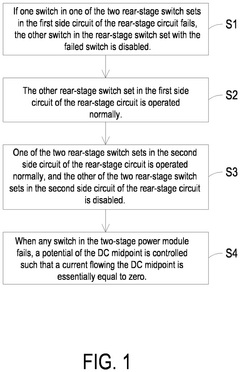
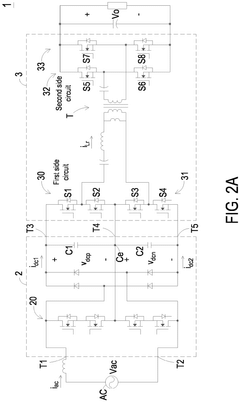
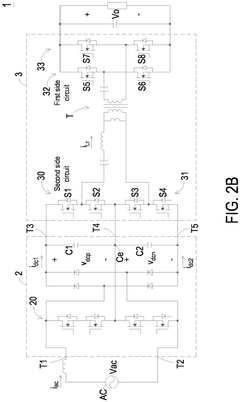
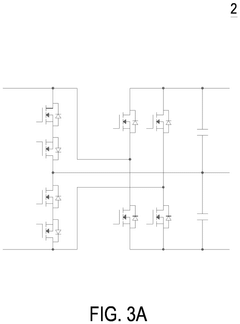
Innovation
- A coordinated fault-tolerant control method for two-stage power modules that disables the faulty switch and operates complementary switches to maintain normal operation without adding redundant components, ensuring balanced DC midpoint voltage.
Grid Integration Standards for SST Systems
Grid integration standards for solid-state transformer systems represent a critical framework that directly impacts fault tolerance capabilities and operational reliability. Current international standards including IEEE 1547, IEC 61850, and emerging IEEE 2030.10 establish fundamental requirements for distributed energy resource interconnection, communication protocols, and grid interface specifications that SST systems must comply with to ensure seamless integration.
The IEEE 1547 standard series provides comprehensive guidelines for interconnection requirements, including voltage and frequency ride-through capabilities, power quality specifications, and islanding detection protocols. These standards mandate specific fault response behaviors that SST systems must demonstrate, including low voltage ride-through (LVRT) and high voltage ride-through (HVRT) capabilities during grid disturbances. Compliance with these requirements necessitates robust fault detection and mitigation mechanisms within SST designs.
IEC 61850 communication standards play a pivotal role in enabling coordinated fault management across grid-connected SST installations. The standard defines generic object-oriented substation event (GOOSE) messaging and manufacturing message specification (MMS) protocols that facilitate real-time fault information exchange between SST systems and grid operators. This standardized communication framework enables distributed fault tolerance strategies and coordinated protection schemes.
Emerging grid codes specifically addressing power electronic-based systems are establishing more stringent requirements for fault current contribution, harmonic distortion limits, and dynamic grid support functions. These evolving standards require SST systems to provide synthetic inertia, frequency regulation, and voltage support services during both normal and fault conditions, demanding enhanced fault tolerance capabilities.
Regional variations in grid integration standards present additional complexity for SST deployment. European Network Codes, North American reliability standards, and Asian grid codes each impose distinct technical requirements that influence SST fault tolerance design considerations. Harmonization efforts are ongoing to establish globally consistent standards that promote interoperability while maintaining regional grid stability requirements.
Future standardization initiatives are focusing on cybersecurity requirements, advanced grid services, and resilience metrics that will further shape SST fault tolerance specifications and implementation strategies.
The IEEE 1547 standard series provides comprehensive guidelines for interconnection requirements, including voltage and frequency ride-through capabilities, power quality specifications, and islanding detection protocols. These standards mandate specific fault response behaviors that SST systems must demonstrate, including low voltage ride-through (LVRT) and high voltage ride-through (HVRT) capabilities during grid disturbances. Compliance with these requirements necessitates robust fault detection and mitigation mechanisms within SST designs.
IEC 61850 communication standards play a pivotal role in enabling coordinated fault management across grid-connected SST installations. The standard defines generic object-oriented substation event (GOOSE) messaging and manufacturing message specification (MMS) protocols that facilitate real-time fault information exchange between SST systems and grid operators. This standardized communication framework enables distributed fault tolerance strategies and coordinated protection schemes.
Emerging grid codes specifically addressing power electronic-based systems are establishing more stringent requirements for fault current contribution, harmonic distortion limits, and dynamic grid support functions. These evolving standards require SST systems to provide synthetic inertia, frequency regulation, and voltage support services during both normal and fault conditions, demanding enhanced fault tolerance capabilities.
Regional variations in grid integration standards present additional complexity for SST deployment. European Network Codes, North American reliability standards, and Asian grid codes each impose distinct technical requirements that influence SST fault tolerance design considerations. Harmonization efforts are ongoing to establish globally consistent standards that promote interoperability while maintaining regional grid stability requirements.
Future standardization initiatives are focusing on cybersecurity requirements, advanced grid services, and resilience metrics that will further shape SST fault tolerance specifications and implementation strategies.
Safety Certification Requirements for SST Deployment
The deployment of solid-state transformers in critical power infrastructure requires adherence to stringent safety certification standards that vary across different regions and applications. International standards such as IEC 61850 for power system communication, IEC 62040 for uninterruptible power systems, and IEEE 1547 for distributed energy resources provide foundational frameworks for SST safety requirements. These standards emphasize electrical safety, electromagnetic compatibility, and operational reliability under various fault conditions.
Certification bodies including UL, CSA, TÜV, and IEC evaluate SST systems against comprehensive safety criteria. The certification process typically involves extensive testing of insulation systems, thermal management capabilities, and fault response mechanisms. Particular attention is given to high-frequency switching components and their potential impact on grid stability and personnel safety. Testing protocols must validate the SST's ability to maintain safe operation during semiconductor failures, control system malfunctions, and external grid disturbances.
Regional regulatory frameworks impose additional requirements that manufacturers must navigate. In North America, IEEE C57.12.00 and C57.12.01 standards govern transformer safety requirements, while European markets require compliance with EN 50588 for medium voltage switchgear and controlgear. Asian markets, particularly China and Japan, have developed specific standards for power electronic transformers that address unique grid characteristics and operational environments.
The certification timeline for SST deployment typically spans 18-24 months, involving multiple testing phases including type testing, routine testing, and field validation. Pre-compliance testing during development phases can significantly reduce certification risks and accelerate market entry. Manufacturers must demonstrate compliance with safety integrity levels (SIL) appropriate for their target applications, with critical infrastructure deployments often requiring SIL 2 or SIL 3 certification.
Emerging certification challenges include cybersecurity requirements for digitally-controlled SSTs and interoperability standards for smart grid integration. The evolving nature of SST technology necessitates close collaboration between manufacturers and certification bodies to establish appropriate testing methodologies and safety benchmarks that adequately address the unique characteristics of solid-state power conversion systems.
Certification bodies including UL, CSA, TÜV, and IEC evaluate SST systems against comprehensive safety criteria. The certification process typically involves extensive testing of insulation systems, thermal management capabilities, and fault response mechanisms. Particular attention is given to high-frequency switching components and their potential impact on grid stability and personnel safety. Testing protocols must validate the SST's ability to maintain safe operation during semiconductor failures, control system malfunctions, and external grid disturbances.
Regional regulatory frameworks impose additional requirements that manufacturers must navigate. In North America, IEEE C57.12.00 and C57.12.01 standards govern transformer safety requirements, while European markets require compliance with EN 50588 for medium voltage switchgear and controlgear. Asian markets, particularly China and Japan, have developed specific standards for power electronic transformers that address unique grid characteristics and operational environments.
The certification timeline for SST deployment typically spans 18-24 months, involving multiple testing phases including type testing, routine testing, and field validation. Pre-compliance testing during development phases can significantly reduce certification risks and accelerate market entry. Manufacturers must demonstrate compliance with safety integrity levels (SIL) appropriate for their target applications, with critical infrastructure deployments often requiring SIL 2 or SIL 3 certification.
Emerging certification challenges include cybersecurity requirements for digitally-controlled SSTs and interoperability standards for smart grid integration. The evolving nature of SST technology necessitates close collaboration between manufacturers and certification bodies to establish appropriate testing methodologies and safety benchmarks that adequately address the unique characteristics of solid-state power conversion systems.
Unlock deeper insights with Patsnap Eureka Quick Research — get a full tech report to explore trends and direct your research. Try now!
Generate Your Research Report Instantly with AI Agent
Supercharge your innovation with Patsnap Eureka AI Agent Platform!