
How to Maximize Solid-State Transformer Energy Conversion
APR 20, 20269 MIN READ
Generate Your Research Report Instantly with AI Agent
Patsnap Eureka helps you evaluate technical feasibility & market potential.
SST Energy Conversion Background and Efficiency Targets
Solid-State Transformers represent a paradigm shift from traditional electromagnetic transformers, emerging as critical components in modern power systems. Unlike conventional transformers that rely solely on magnetic coupling, SSTs integrate power electronics, advanced control systems, and high-frequency switching technologies to achieve superior performance characteristics. This technology evolution stems from the increasing demand for efficient, compact, and intelligent power conversion solutions in applications ranging from smart grids to electric vehicle charging infrastructure.
The development trajectory of SST technology has been driven by advances in wide-bandgap semiconductors, particularly Silicon Carbide (SiC) and Gallium Nitride (GaN) devices. These materials enable higher switching frequencies, reduced switching losses, and improved thermal performance compared to traditional silicon-based components. The integration of digital control systems has further enhanced SST capabilities, enabling real-time optimization of power conversion processes and adaptive response to varying load conditions.
Current efficiency targets for SST systems typically range from 95% to 98% across various power ratings and applications. High-power utility-scale SSTs target efficiency levels exceeding 97%, while medium-voltage distribution applications aim for 96-98% efficiency. These targets represent significant improvements over conventional transformers, which typically achieve 95-97% efficiency but lack the advanced functionalities that SSTs provide.
The efficiency optimization challenge in SSTs involves multiple loss mechanisms including conduction losses in semiconductor devices, switching losses during power conversion transitions, magnetic losses in high-frequency transformers, and auxiliary power consumption for control systems. Each of these loss components requires specific mitigation strategies and represents opportunities for technological advancement.
Industry benchmarks continue to evolve as manufacturers push the boundaries of power electronics technology. Leading SST implementations have demonstrated laboratory efficiencies approaching 99% under optimal conditions, though commercial products typically achieve 96-98% efficiency across their operating range. The gap between laboratory achievements and commercial implementations highlights the ongoing challenges in translating research breakthroughs into practical, cost-effective solutions.
Future efficiency targets are increasingly ambitious, with next-generation SST systems targeting 99%+ efficiency through advanced topologies, improved semiconductor technologies, and sophisticated control algorithms. These targets align with global energy efficiency initiatives and the growing emphasis on reducing power system losses to support sustainable energy infrastructure development.
The development trajectory of SST technology has been driven by advances in wide-bandgap semiconductors, particularly Silicon Carbide (SiC) and Gallium Nitride (GaN) devices. These materials enable higher switching frequencies, reduced switching losses, and improved thermal performance compared to traditional silicon-based components. The integration of digital control systems has further enhanced SST capabilities, enabling real-time optimization of power conversion processes and adaptive response to varying load conditions.
Current efficiency targets for SST systems typically range from 95% to 98% across various power ratings and applications. High-power utility-scale SSTs target efficiency levels exceeding 97%, while medium-voltage distribution applications aim for 96-98% efficiency. These targets represent significant improvements over conventional transformers, which typically achieve 95-97% efficiency but lack the advanced functionalities that SSTs provide.
The efficiency optimization challenge in SSTs involves multiple loss mechanisms including conduction losses in semiconductor devices, switching losses during power conversion transitions, magnetic losses in high-frequency transformers, and auxiliary power consumption for control systems. Each of these loss components requires specific mitigation strategies and represents opportunities for technological advancement.
Industry benchmarks continue to evolve as manufacturers push the boundaries of power electronics technology. Leading SST implementations have demonstrated laboratory efficiencies approaching 99% under optimal conditions, though commercial products typically achieve 96-98% efficiency across their operating range. The gap between laboratory achievements and commercial implementations highlights the ongoing challenges in translating research breakthroughs into practical, cost-effective solutions.
Future efficiency targets are increasingly ambitious, with next-generation SST systems targeting 99%+ efficiency through advanced topologies, improved semiconductor technologies, and sophisticated control algorithms. These targets align with global energy efficiency initiatives and the growing emphasis on reducing power system losses to support sustainable energy infrastructure development.
Market Demand for High-Efficiency SST Applications
The global energy landscape is experiencing unprecedented transformation, driving substantial demand for high-efficiency solid-state transformer applications across multiple sectors. Traditional electromagnetic transformers, while reliable, face inherent limitations in efficiency, size, and controllability that no longer meet the requirements of modern power systems. This gap has created significant market opportunities for SST technologies that can deliver superior energy conversion performance.
Smart grid infrastructure represents one of the most promising markets for high-efficiency SSTs. Utility companies worldwide are investing heavily in grid modernization initiatives that require advanced power conversion systems capable of bidirectional power flow, real-time voltage regulation, and seamless integration of renewable energy sources. The ability of SSTs to provide galvanic isolation while maintaining high conversion efficiency makes them particularly attractive for distribution-level applications where space constraints and efficiency requirements are critical.
The renewable energy sector presents another substantial market driver for SST adoption. Solar photovoltaic installations, wind farms, and energy storage systems require sophisticated power conditioning equipment that can handle variable input conditions while maximizing energy harvest. High-efficiency SSTs offer superior performance compared to conventional solutions by providing better power quality, reduced harmonic distortion, and enhanced grid compatibility. The growing emphasis on maximizing return on investment for renewable energy projects has intensified demand for power conversion systems that minimize energy losses.
Electric vehicle charging infrastructure development has emerged as a rapidly expanding market segment for SST applications. Fast-charging stations require compact, efficient power conversion systems that can handle high power levels while maintaining grid stability. SSTs provide advantages in terms of power density, thermal management, and controllability that are essential for next-generation charging infrastructure. The automotive industry's transition toward electrification continues to drive demand for more efficient charging solutions.
Industrial applications represent a mature but evolving market for high-efficiency SST technology. Manufacturing facilities, data centers, and process industries are increasingly focused on energy efficiency improvements to reduce operational costs and meet sustainability targets. SSTs offer potential for significant efficiency gains in motor drives, power supplies, and industrial heating applications where traditional transformers currently dominate.
The telecommunications and data center sectors are experiencing growing demand for compact, efficient power conversion solutions. As data processing requirements continue to expand, the need for power systems that minimize energy consumption while maintaining high reliability has become paramount. SSTs provide advantages in terms of power density and efficiency that align well with the space and energy constraints typical of these applications.
Market adoption of high-efficiency SST technology faces certain challenges including higher initial costs compared to conventional transformers and the need for specialized maintenance expertise. However, the total cost of ownership advantages, including reduced energy losses, smaller footprint requirements, and enhanced functionality, are driving increasing acceptance across target market segments.
Smart grid infrastructure represents one of the most promising markets for high-efficiency SSTs. Utility companies worldwide are investing heavily in grid modernization initiatives that require advanced power conversion systems capable of bidirectional power flow, real-time voltage regulation, and seamless integration of renewable energy sources. The ability of SSTs to provide galvanic isolation while maintaining high conversion efficiency makes them particularly attractive for distribution-level applications where space constraints and efficiency requirements are critical.
The renewable energy sector presents another substantial market driver for SST adoption. Solar photovoltaic installations, wind farms, and energy storage systems require sophisticated power conditioning equipment that can handle variable input conditions while maximizing energy harvest. High-efficiency SSTs offer superior performance compared to conventional solutions by providing better power quality, reduced harmonic distortion, and enhanced grid compatibility. The growing emphasis on maximizing return on investment for renewable energy projects has intensified demand for power conversion systems that minimize energy losses.
Electric vehicle charging infrastructure development has emerged as a rapidly expanding market segment for SST applications. Fast-charging stations require compact, efficient power conversion systems that can handle high power levels while maintaining grid stability. SSTs provide advantages in terms of power density, thermal management, and controllability that are essential for next-generation charging infrastructure. The automotive industry's transition toward electrification continues to drive demand for more efficient charging solutions.
Industrial applications represent a mature but evolving market for high-efficiency SST technology. Manufacturing facilities, data centers, and process industries are increasingly focused on energy efficiency improvements to reduce operational costs and meet sustainability targets. SSTs offer potential for significant efficiency gains in motor drives, power supplies, and industrial heating applications where traditional transformers currently dominate.
The telecommunications and data center sectors are experiencing growing demand for compact, efficient power conversion solutions. As data processing requirements continue to expand, the need for power systems that minimize energy consumption while maintaining high reliability has become paramount. SSTs provide advantages in terms of power density and efficiency that align well with the space and energy constraints typical of these applications.
Market adoption of high-efficiency SST technology faces certain challenges including higher initial costs compared to conventional transformers and the need for specialized maintenance expertise. However, the total cost of ownership advantages, including reduced energy losses, smaller footprint requirements, and enhanced functionality, are driving increasing acceptance across target market segments.
Current SST Performance Limitations and Technical Challenges
Solid-state transformers face significant performance limitations that constrain their energy conversion efficiency and widespread adoption. The primary challenge lies in semiconductor device losses, which occur across switching, conduction, and reverse recovery phases. Silicon-based power devices, while mature, exhibit inherent voltage and frequency limitations that restrict operational efficiency, particularly at higher power densities required for grid-scale applications.
Thermal management represents another critical bottleneck in SST performance. High-frequency switching operations generate substantial heat concentrations within compact device packages, leading to junction temperature rises that degrade semiconductor performance and reliability. Current cooling solutions struggle to maintain optimal operating temperatures while preserving the size and weight advantages that SSTs offer over conventional transformers.
Magnetic core losses present additional constraints on energy conversion efficiency. At elevated switching frequencies necessary for size reduction, core materials experience increased hysteresis and eddy current losses. Traditional ferrite and silicon steel cores demonstrate limited performance at frequencies above 20 kHz, while advanced materials like amorphous and nanocrystalline alloys introduce cost and manufacturing complexity challenges.
Control system complexity significantly impacts overall SST performance. Multi-stage conversion architectures require sophisticated control algorithms to maintain voltage regulation, power factor correction, and harmonic mitigation simultaneously. Real-time coordination between input rectification, DC-DC isolation, and output inversion stages demands high-speed digital signal processing capabilities that increase system cost and potential failure points.
Electromagnetic interference and power quality issues emerge as frequency-dependent challenges. Higher switching frequencies, while enabling smaller magnetic components, generate broader EMI spectrums that require extensive filtering solutions. These filters add parasitic elements that reduce overall system efficiency and complicate impedance matching across the conversion chain.
Voltage stress distribution across series-connected devices poses reliability concerns, particularly in medium and high-voltage applications. Device parameter variations and dynamic switching behaviors create uneven voltage sharing that can lead to premature failures. Current voltage balancing techniques introduce additional circuit complexity and power losses that offset potential efficiency gains.
Manufacturing tolerances and component aging effects further limit SST performance optimization. Variations in semiconductor characteristics, magnetic properties, and passive component values create system-level performance deviations that are difficult to predict and compensate for during operation, ultimately constraining the achievable energy conversion efficiency improvements.
Thermal management represents another critical bottleneck in SST performance. High-frequency switching operations generate substantial heat concentrations within compact device packages, leading to junction temperature rises that degrade semiconductor performance and reliability. Current cooling solutions struggle to maintain optimal operating temperatures while preserving the size and weight advantages that SSTs offer over conventional transformers.
Magnetic core losses present additional constraints on energy conversion efficiency. At elevated switching frequencies necessary for size reduction, core materials experience increased hysteresis and eddy current losses. Traditional ferrite and silicon steel cores demonstrate limited performance at frequencies above 20 kHz, while advanced materials like amorphous and nanocrystalline alloys introduce cost and manufacturing complexity challenges.
Control system complexity significantly impacts overall SST performance. Multi-stage conversion architectures require sophisticated control algorithms to maintain voltage regulation, power factor correction, and harmonic mitigation simultaneously. Real-time coordination between input rectification, DC-DC isolation, and output inversion stages demands high-speed digital signal processing capabilities that increase system cost and potential failure points.
Electromagnetic interference and power quality issues emerge as frequency-dependent challenges. Higher switching frequencies, while enabling smaller magnetic components, generate broader EMI spectrums that require extensive filtering solutions. These filters add parasitic elements that reduce overall system efficiency and complicate impedance matching across the conversion chain.
Voltage stress distribution across series-connected devices poses reliability concerns, particularly in medium and high-voltage applications. Device parameter variations and dynamic switching behaviors create uneven voltage sharing that can lead to premature failures. Current voltage balancing techniques introduce additional circuit complexity and power losses that offset potential efficiency gains.
Manufacturing tolerances and component aging effects further limit SST performance optimization. Variations in semiconductor characteristics, magnetic properties, and passive component values create system-level performance deviations that are difficult to predict and compensate for during operation, ultimately constraining the achievable energy conversion efficiency improvements.
Existing Solutions for SST Energy Conversion Optimization
01 Multi-stage power conversion topology for solid-state transformers
Solid-state transformers utilize multi-stage power conversion architectures to achieve efficient energy conversion. These topologies typically include AC-DC rectification, DC-DC conversion with high-frequency isolation, and DC-AC inversion stages. The multi-stage approach enables voltage transformation, galvanic isolation, and power quality improvement while maintaining high efficiency across different operating conditions.- Multi-stage power conversion topology for solid-state transformers: Solid-state transformers employ multi-stage power conversion architectures to achieve efficient energy conversion. These topologies typically include AC-DC rectification, DC-DC conversion with high-frequency isolation, and DC-AC inversion stages. The multi-stage approach enables voltage transformation, galvanic isolation, and power quality improvement while maintaining high efficiency across wide operating ranges. Advanced control strategies coordinate the operation of multiple conversion stages to optimize overall system performance.
- High-frequency transformer design and magnetic integration: The core component of solid-state transformers utilizes high-frequency magnetic transformers operating at frequencies significantly higher than traditional line frequency. This enables substantial reduction in transformer size and weight while maintaining power handling capability. Advanced magnetic core materials, optimized winding configurations, and thermal management techniques are employed to minimize losses and improve power density. Magnetic integration techniques combine multiple magnetic components into unified structures to further enhance compactness and efficiency.
- Modular and cascaded converter architectures: Modular multilevel converter topologies enable scalable solid-state transformer designs for medium and high voltage applications. These architectures utilize cascaded power electronic modules that can be connected in series or parallel to achieve desired voltage and power ratings. The modular approach provides redundancy, fault tolerance, and simplified maintenance. Each module operates independently with distributed control, allowing for improved reliability and flexible system configuration to meet various application requirements.
- Advanced control and power management strategies: Sophisticated control algorithms manage the complex operation of solid-state transformers to ensure stable and efficient energy conversion. These strategies include voltage and current regulation, power factor correction, harmonic mitigation, and grid synchronization. Real-time monitoring and adaptive control techniques respond to varying load conditions and grid disturbances. Digital signal processors and microcontrollers implement advanced control schemes such as model predictive control, sliding mode control, and artificial intelligence-based optimization to maximize performance.
- Wide bandgap semiconductor devices and switching techniques: Solid-state transformers leverage wide bandgap semiconductor devices such as silicon carbide and gallium nitride to achieve superior switching performance and efficiency. These devices enable higher switching frequencies, reduced conduction and switching losses, and operation at elevated temperatures compared to traditional silicon devices. Advanced switching techniques including soft-switching, zero-voltage switching, and optimized gate drive circuits minimize electromagnetic interference and improve overall system efficiency. The integration of these devices enables compact designs with enhanced power density.
02 High-frequency transformer design and magnetic core optimization
The core component of solid-state transformers involves high-frequency magnetic transformers that enable compact design and efficient energy transfer. Advanced magnetic core materials and optimized winding configurations are employed to minimize losses and improve power density. The high-frequency operation allows for significant size and weight reduction compared to traditional line-frequency transformers while maintaining isolation and voltage transformation capabilities.Expand Specific Solutions03 Power semiconductor switching devices and control strategies
Solid-state transformers employ advanced power semiconductor devices such as IGBTs, MOSFETs, or wide-bandgap devices for switching operations. Sophisticated control algorithms including pulse-width modulation, phase-shift control, and resonant switching techniques are implemented to optimize conversion efficiency, reduce switching losses, and manage thermal performance. These control strategies enable precise regulation of output voltage and current while ensuring system stability.Expand Specific Solutions04 Bidirectional power flow and grid integration capabilities
Modern solid-state transformer designs incorporate bidirectional power conversion capabilities to support energy storage integration and distributed generation systems. These systems can manage power flow in both directions, enabling applications in smart grids, renewable energy integration, and vehicle-to-grid technologies. The bidirectional functionality includes active and reactive power control, voltage regulation, and grid synchronization features.Expand Specific Solutions05 Modular and scalable architecture for medium to high voltage applications
Solid-state transformers employ modular cascaded converter architectures to achieve medium and high voltage operation. The modular design allows for scalability, redundancy, and improved fault tolerance. Multiple converter modules are connected in series or parallel configurations to handle higher voltage and power levels, with each module operating independently to enhance system reliability and facilitate maintenance.Expand Specific Solutions
Key Players in SST and Power Electronics Industry
The solid-state transformer energy conversion market is in its early commercialization stage, transitioning from research and development to practical deployment. The market shows significant growth potential driven by increasing demand for efficient power conversion in renewable energy integration, electric vehicle charging, and smart grid applications. Technology maturity varies considerably across market players, with established industrial giants like ABB Ltd., Siemens Gamesa, and Hitachi Energy leading in advanced power electronics and grid integration solutions. Delta Electronics and Huawei Digital Power Technologies demonstrate strong capabilities in digital power management and energy conversion systems. Meanwhile, academic institutions including Shanghai Jiao Tong University, Zhejiang University, and Nanyang Technological University contribute fundamental research in semiconductor materials and control algorithms. Emerging companies like Koolbridge Energy and specialized firms such as Chengdu Monolithic Power Systems focus on niche applications and component-level innovations, indicating a competitive landscape where traditional power equipment manufacturers compete alongside technology-focused startups and research institutions.
Huawei Digital Power Technologies Co Ltd
Technical Solution: Huawei Digital Power develops advanced solid-state transformer solutions utilizing wide bandgap semiconductors like SiC and GaN to achieve higher switching frequencies and reduced losses. Their SST systems incorporate intelligent control algorithms with real-time optimization capabilities, enabling dynamic voltage regulation and power factor correction. The company's approach focuses on modular multilevel converter topologies with distributed control architecture, achieving power conversion efficiency exceeding 97% while maintaining galvanic isolation through high-frequency transformers operating at 20-50kHz frequency range.
Strengths: Advanced semiconductor integration, intelligent control systems, high efficiency rates. Weaknesses: Higher initial costs, complex thermal management requirements.
ABB Ltd.
Technical Solution: ABB's solid-state transformer technology leverages cascaded H-bridge multilevel converters combined with medium-frequency transformers to maximize energy conversion efficiency. Their SST solutions employ advanced magnetic materials and optimized winding configurations to minimize core losses while maintaining high power density. The system integrates predictive maintenance algorithms and grid-interactive capabilities, enabling bidirectional power flow management and reactive power compensation. ABB's approach includes fault-tolerant design with redundant switching modules, ensuring continuous operation even during component failures, achieving overall system efficiency above 96% across varying load conditions.
Strengths: Proven industrial experience, fault-tolerant design, comprehensive grid integration. Weaknesses: Conservative innovation approach, higher maintenance complexity.
Core Innovations in SST Efficiency Enhancement Patents
Solid state transformer controller
PatentActiveUS20230402936A1
Innovation
- A decoupled control system for SSTs, comprising a stored energy controller, power flow controller, and energy balancing controllers, each configured to operate independently to manage energy within capacitors, eliminate voltage ripples, and regulate power flow without requiring voltage balancing or power sharing mechanisms, allowing for separate deployment of stages and reduced hardware requirements.
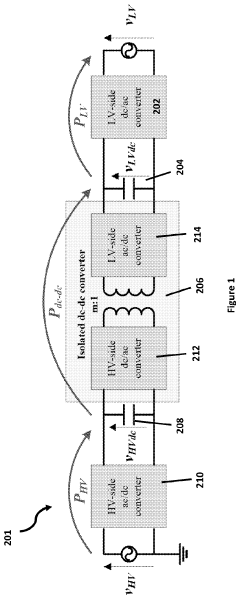
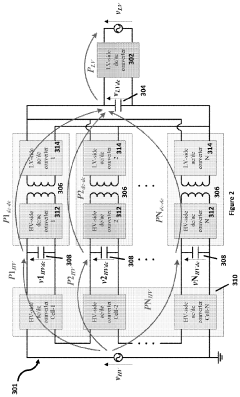
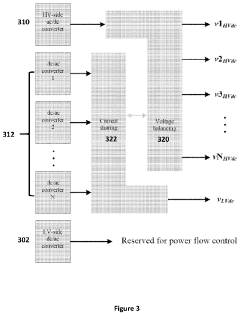
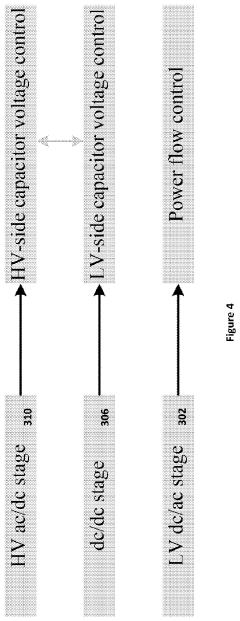
Photovoltaic solid-state transformer, photovoltaic inverter system and bidirectional high-voltage converter
PatentActiveUS11088655B2
Innovation
- A photovoltaic solid-state transformer is designed with multiple single-phase modules and a filter, utilizing high-efficiency DC/DC converters and cascade DC/AC modules, achieving efficiencies greater than 98.5% by incorporating high-frequency transformers and various rectifying and filtering modules, and including a controller and communication module for control and monitoring.


Grid Integration Standards for SST Deployment
The successful deployment of solid-state transformers in electrical grids requires adherence to comprehensive integration standards that ensure operational safety, reliability, and interoperability. Current grid integration frameworks are primarily governed by IEEE standards, particularly IEEE 1547 for distributed energy resources and IEEE C57 series for transformer specifications, though these require significant adaptation for SST applications.
Power quality standards represent a critical aspect of SST grid integration, with requirements typically specifying total harmonic distortion levels below 5% for voltage and 8% for current under normal operating conditions. SSTs must demonstrate compliance with voltage regulation capabilities within ±5% of nominal values and frequency stability within ±0.1 Hz during steady-state operations. These specifications ensure that SST deployment does not compromise existing grid power quality metrics.
Communication protocol standards are essential for enabling smart grid functionality inherent in SST systems. The IEC 61850 standard provides the foundational framework for substation automation and communication, while DNP3 and Modbus protocols facilitate data exchange between SSTs and grid management systems. These protocols enable real-time monitoring, control, and coordination of SST operations within broader grid management strategies.
Safety and protection standards mandate specific requirements for fault detection, isolation, and system recovery capabilities. SSTs must incorporate advanced protection schemes including overcurrent, overvoltage, and thermal protection systems with response times typically under 2 milliseconds for critical faults. Ground fault protection and arc fault detection capabilities are mandatory for ensuring personnel safety and equipment protection.
Cybersecurity standards have become increasingly important as SSTs introduce digital interfaces and communication capabilities to traditional power infrastructure. Compliance with NERC CIP standards and IEC 62351 security protocols is essential for protecting against cyber threats that could compromise grid stability or enable unauthorized access to critical infrastructure systems.
Testing and certification procedures require comprehensive validation of SST performance under various grid conditions, including voltage sags, frequency variations, and harmonic distortion scenarios. Type testing protocols must demonstrate SST capability to maintain stable operation during grid disturbances while providing required power quality and protection functions throughout the specified operational envelope.
Power quality standards represent a critical aspect of SST grid integration, with requirements typically specifying total harmonic distortion levels below 5% for voltage and 8% for current under normal operating conditions. SSTs must demonstrate compliance with voltage regulation capabilities within ±5% of nominal values and frequency stability within ±0.1 Hz during steady-state operations. These specifications ensure that SST deployment does not compromise existing grid power quality metrics.
Communication protocol standards are essential for enabling smart grid functionality inherent in SST systems. The IEC 61850 standard provides the foundational framework for substation automation and communication, while DNP3 and Modbus protocols facilitate data exchange between SSTs and grid management systems. These protocols enable real-time monitoring, control, and coordination of SST operations within broader grid management strategies.
Safety and protection standards mandate specific requirements for fault detection, isolation, and system recovery capabilities. SSTs must incorporate advanced protection schemes including overcurrent, overvoltage, and thermal protection systems with response times typically under 2 milliseconds for critical faults. Ground fault protection and arc fault detection capabilities are mandatory for ensuring personnel safety and equipment protection.
Cybersecurity standards have become increasingly important as SSTs introduce digital interfaces and communication capabilities to traditional power infrastructure. Compliance with NERC CIP standards and IEC 62351 security protocols is essential for protecting against cyber threats that could compromise grid stability or enable unauthorized access to critical infrastructure systems.
Testing and certification procedures require comprehensive validation of SST performance under various grid conditions, including voltage sags, frequency variations, and harmonic distortion scenarios. Type testing protocols must demonstrate SST capability to maintain stable operation during grid disturbances while providing required power quality and protection functions throughout the specified operational envelope.
Thermal Management Strategies for SST Systems
Thermal management represents one of the most critical challenges in solid-state transformer systems, directly impacting energy conversion efficiency, component reliability, and overall system performance. The high power density and switching frequencies inherent in SST designs generate substantial heat loads that must be effectively dissipated to maintain optimal operating conditions and prevent thermal-induced failures.
Active cooling strategies have emerged as the predominant approach for high-power SST applications. Forced air cooling systems utilize strategically positioned fans and heat sinks to enhance convective heat transfer, while liquid cooling solutions employ coolant circulation through dedicated channels or cold plates attached to critical components. Advanced liquid cooling implementations include immersion cooling and spray cooling techniques, which offer superior heat removal capabilities for ultra-high power density configurations.
Passive thermal management techniques focus on optimizing heat conduction and natural convection pathways. Heat sink design optimization involves selecting appropriate fin geometries, materials with high thermal conductivity such as aluminum or copper alloys, and surface treatments to maximize heat dissipation area. Thermal interface materials play a crucial role in minimizing thermal resistance between semiconductor devices and heat sinks, with phase change materials and thermal pads providing enhanced thermal coupling.
Component-level thermal design strategies encompass intelligent layout planning and thermal isolation techniques. Power semiconductor placement considers thermal coupling effects and hot spot formation, while thermal vias and copper pours in printed circuit boards facilitate efficient heat spreading. Advanced packaging technologies, including direct bonded copper substrates and embedded cooling channels, enable improved thermal performance at the device level.
Hybrid thermal management approaches combine multiple cooling mechanisms to achieve optimal thermal performance across varying operating conditions. These systems integrate active and passive elements with intelligent control algorithms that adjust cooling capacity based on real-time thermal monitoring and load conditions, ensuring maximum energy conversion efficiency while maintaining component temperatures within safe operating limits.
Active cooling strategies have emerged as the predominant approach for high-power SST applications. Forced air cooling systems utilize strategically positioned fans and heat sinks to enhance convective heat transfer, while liquid cooling solutions employ coolant circulation through dedicated channels or cold plates attached to critical components. Advanced liquid cooling implementations include immersion cooling and spray cooling techniques, which offer superior heat removal capabilities for ultra-high power density configurations.
Passive thermal management techniques focus on optimizing heat conduction and natural convection pathways. Heat sink design optimization involves selecting appropriate fin geometries, materials with high thermal conductivity such as aluminum or copper alloys, and surface treatments to maximize heat dissipation area. Thermal interface materials play a crucial role in minimizing thermal resistance between semiconductor devices and heat sinks, with phase change materials and thermal pads providing enhanced thermal coupling.
Component-level thermal design strategies encompass intelligent layout planning and thermal isolation techniques. Power semiconductor placement considers thermal coupling effects and hot spot formation, while thermal vias and copper pours in printed circuit boards facilitate efficient heat spreading. Advanced packaging technologies, including direct bonded copper substrates and embedded cooling channels, enable improved thermal performance at the device level.
Hybrid thermal management approaches combine multiple cooling mechanisms to achieve optimal thermal performance across varying operating conditions. These systems integrate active and passive elements with intelligent control algorithms that adjust cooling capacity based on real-time thermal monitoring and load conditions, ensuring maximum energy conversion efficiency while maintaining component temperatures within safe operating limits.
Unlock deeper insights with Patsnap Eureka Quick Research — get a full tech report to explore trends and direct your research. Try now!
Generate Your Research Report Instantly with AI Agent
Supercharge your innovation with Patsnap Eureka AI Agent Platform!