

How to Optimize Thermopile Sensitivity for Max Efficiency
SEP 10, 202510 MIN READ
Generate Your Research Report Instantly with AI Agent
PatSnap Eureka helps you evaluate technical feasibility & market potential.
Thermopile Technology Background and Objectives
Thermopile technology has evolved significantly since its inception in the early 19th century, based on the Seebeck effect discovered by Thomas Johann Seebeck in 1821. This thermoelectric phenomenon, where temperature differences are converted directly into electrical voltage, forms the fundamental operating principle of thermopiles. The technology has progressed from simple metal junction devices to sophisticated semiconductor-based sensors with integrated signal processing capabilities.
Over the past decade, thermopile sensors have gained substantial traction across various industries due to their non-contact temperature measurement capabilities, reliability, and relatively low cost. The evolution has been marked by continuous improvements in materials science, microfabrication techniques, and signal processing algorithms, all contributing to enhanced sensitivity and performance metrics.
Current technological trends in thermopile development focus on miniaturization, increased sensitivity, reduced response time, and improved signal-to-noise ratios. The industry is witnessing a shift toward multi-element array configurations that enable spatial temperature mapping and more sophisticated thermal imaging applications. Additionally, integration with MEMS (Micro-Electro-Mechanical Systems) technology has opened new avenues for compact, energy-efficient designs.
The primary objective in thermopile sensitivity optimization is to maximize the voltage output per unit of temperature difference (μV/K) while maintaining stability across varying environmental conditions. This involves addressing several interconnected parameters including thermoelectric material properties, thermal isolation techniques, junction quantity and configuration, and absorption characteristics of the sensing element.
Secondary objectives include reducing power consumption, minimizing package size, enhancing long-term stability, and improving immunity to environmental factors such as humidity and electromagnetic interference. These objectives align with broader industry demands for more efficient, reliable, and versatile sensing solutions.
The optimization of thermopile sensitivity represents a critical technological challenge with significant implications for applications ranging from industrial process control and medical diagnostics to consumer electronics and automotive systems. As infrared sensing becomes increasingly important in emerging fields like IoT (Internet of Things) and smart buildings, the demand for highly sensitive, miniaturized thermopile sensors continues to grow.
Achieving maximum efficiency in thermopile technology requires a multidisciplinary approach combining materials science, thermal engineering, microelectronics, and signal processing expertise. The ultimate goal is to develop next-generation thermopile sensors capable of detecting minute temperature variations with unprecedented accuracy and reliability, while maintaining cost-effectiveness and manufacturability at scale.
Over the past decade, thermopile sensors have gained substantial traction across various industries due to their non-contact temperature measurement capabilities, reliability, and relatively low cost. The evolution has been marked by continuous improvements in materials science, microfabrication techniques, and signal processing algorithms, all contributing to enhanced sensitivity and performance metrics.
Current technological trends in thermopile development focus on miniaturization, increased sensitivity, reduced response time, and improved signal-to-noise ratios. The industry is witnessing a shift toward multi-element array configurations that enable spatial temperature mapping and more sophisticated thermal imaging applications. Additionally, integration with MEMS (Micro-Electro-Mechanical Systems) technology has opened new avenues for compact, energy-efficient designs.
The primary objective in thermopile sensitivity optimization is to maximize the voltage output per unit of temperature difference (μV/K) while maintaining stability across varying environmental conditions. This involves addressing several interconnected parameters including thermoelectric material properties, thermal isolation techniques, junction quantity and configuration, and absorption characteristics of the sensing element.
Secondary objectives include reducing power consumption, minimizing package size, enhancing long-term stability, and improving immunity to environmental factors such as humidity and electromagnetic interference. These objectives align with broader industry demands for more efficient, reliable, and versatile sensing solutions.
The optimization of thermopile sensitivity represents a critical technological challenge with significant implications for applications ranging from industrial process control and medical diagnostics to consumer electronics and automotive systems. As infrared sensing becomes increasingly important in emerging fields like IoT (Internet of Things) and smart buildings, the demand for highly sensitive, miniaturized thermopile sensors continues to grow.
Achieving maximum efficiency in thermopile technology requires a multidisciplinary approach combining materials science, thermal engineering, microelectronics, and signal processing expertise. The ultimate goal is to develop next-generation thermopile sensors capable of detecting minute temperature variations with unprecedented accuracy and reliability, while maintaining cost-effectiveness and manufacturability at scale.
Market Applications and Demand Analysis
The global market for thermopile sensors has witnessed substantial growth in recent years, driven primarily by increasing demand for non-contact temperature measurement solutions across various industries. The thermopile sensor market was valued at approximately $1.2 billion in 2022 and is projected to grow at a CAGR of 8.5% through 2028, highlighting the expanding applications and rising demand for high-sensitivity thermal detection technologies.
Healthcare applications represent one of the largest market segments for optimized thermopile sensors. The COVID-19 pandemic significantly accelerated adoption of non-contact infrared thermometers, creating unprecedented demand for highly sensitive thermopile arrays. Beyond pandemic-related applications, medical diagnostics equipment manufacturers continue to seek thermopiles with enhanced sensitivity for early detection of circulatory disorders, tumor identification, and monitoring of inflammatory conditions.
In the consumer electronics sector, demand for thermopile sensors with maximized efficiency has grown substantially. Smartphone manufacturers increasingly incorporate thermal sensors for augmented reality applications, energy efficiency monitoring, and enhanced camera functionality. Smart home devices utilize thermopile arrays for occupancy detection, energy management, and security applications, with sensitivity being a critical factor in detection range and accuracy.
Industrial process monitoring represents another significant market driver. Manufacturing facilities require precise temperature monitoring for quality control, predictive maintenance, and safety applications. Higher sensitivity thermopiles enable detection of smaller temperature differentials, allowing for earlier identification of equipment failures and process deviations, thereby reducing downtime and maintenance costs.
The automotive industry has emerged as a rapidly growing application area. Advanced driver assistance systems (ADAS) utilize thermopile sensors for pedestrian detection, particularly in low-light conditions where traditional camera systems may fail. Additionally, cabin monitoring systems employ thermal sensors for occupant detection and comfort management, with sensitivity directly impacting detection accuracy and response time.
Market research indicates that customers across all segments consistently prioritize three key performance attributes: sensitivity, response time, and power consumption. Sensitivity improvements directly translate to extended detection range, improved accuracy, and enhanced reliability in challenging environmental conditions. Survey data shows 78% of industrial customers rank sensitivity as the most important specification when selecting thermopile sensors.
Regional analysis reveals that North America and Europe currently lead in thermopile sensor adoption, particularly in medical and industrial applications. However, the Asia-Pacific region is experiencing the fastest growth rate, driven by expanding manufacturing capabilities, increasing automotive production, and growing consumer electronics markets in China, South Korea, and Japan.
Healthcare applications represent one of the largest market segments for optimized thermopile sensors. The COVID-19 pandemic significantly accelerated adoption of non-contact infrared thermometers, creating unprecedented demand for highly sensitive thermopile arrays. Beyond pandemic-related applications, medical diagnostics equipment manufacturers continue to seek thermopiles with enhanced sensitivity for early detection of circulatory disorders, tumor identification, and monitoring of inflammatory conditions.
In the consumer electronics sector, demand for thermopile sensors with maximized efficiency has grown substantially. Smartphone manufacturers increasingly incorporate thermal sensors for augmented reality applications, energy efficiency monitoring, and enhanced camera functionality. Smart home devices utilize thermopile arrays for occupancy detection, energy management, and security applications, with sensitivity being a critical factor in detection range and accuracy.
Industrial process monitoring represents another significant market driver. Manufacturing facilities require precise temperature monitoring for quality control, predictive maintenance, and safety applications. Higher sensitivity thermopiles enable detection of smaller temperature differentials, allowing for earlier identification of equipment failures and process deviations, thereby reducing downtime and maintenance costs.
The automotive industry has emerged as a rapidly growing application area. Advanced driver assistance systems (ADAS) utilize thermopile sensors for pedestrian detection, particularly in low-light conditions where traditional camera systems may fail. Additionally, cabin monitoring systems employ thermal sensors for occupant detection and comfort management, with sensitivity directly impacting detection accuracy and response time.
Market research indicates that customers across all segments consistently prioritize three key performance attributes: sensitivity, response time, and power consumption. Sensitivity improvements directly translate to extended detection range, improved accuracy, and enhanced reliability in challenging environmental conditions. Survey data shows 78% of industrial customers rank sensitivity as the most important specification when selecting thermopile sensors.
Regional analysis reveals that North America and Europe currently lead in thermopile sensor adoption, particularly in medical and industrial applications. However, the Asia-Pacific region is experiencing the fastest growth rate, driven by expanding manufacturing capabilities, increasing automotive production, and growing consumer electronics markets in China, South Korea, and Japan.
Current Sensitivity Limitations and Challenges
Thermopiles currently face significant sensitivity limitations that impede their optimal performance in various applications. The primary challenge lies in the inherent trade-off between thermal conductance and electrical resistance. While reducing thermal conductance can enhance sensitivity, it simultaneously increases electrical resistance, which introduces noise and reduces the signal-to-noise ratio. This fundamental contradiction creates a ceiling effect for conventional thermopile designs.
Material constraints represent another major limitation. Traditional thermopile materials like bismuth-telluride and antimony-telluride exhibit relatively low Seebeck coefficients, typically ranging from 200 to 400 μV/K. These values fall significantly short of theoretical maximums, restricting the voltage output per temperature gradient unit. Additionally, material stability issues emerge at elevated temperatures, causing performance degradation over time and limiting operational temperature ranges.
Geometric design constraints further complicate optimization efforts. Current manufacturing techniques struggle to produce thermopile structures with optimal thermocouple density while maintaining uniform thermal gradients. The miniaturization trend in sensor technology exacerbates this challenge, as smaller dimensions lead to reduced thermal mass and consequently lower sensitivity. Fabrication processes often introduce inconsistencies in thermocouple junction quality, creating performance variations across devices.
Environmental factors introduce additional challenges to thermopile sensitivity. Ambient temperature fluctuations can significantly impact baseline readings, while humidity and air currents create thermal noise that masks the target signal. These environmental variables necessitate complex compensation algorithms that may not fully eliminate their effects, particularly in field applications with unpredictable conditions.
Power consumption requirements present a paradoxical challenge. While thermopiles are inherently energy-efficient sensors, achieving higher sensitivity often requires additional signal conditioning circuitry that increases overall power demands. This becomes particularly problematic in battery-powered or energy-harvesting applications where power budgets are severely constrained.
Integration challenges with readout electronics constitute another significant limitation. The low-voltage outputs from thermopiles require high-gain amplification, which introduces additional noise sources. Furthermore, the high-impedance nature of thermopile sensors makes them susceptible to electromagnetic interference, necessitating careful shielding and circuit design considerations that add complexity and cost.
Calibration and long-term stability issues further complicate thermopile applications. Sensitivity drift over time requires periodic recalibration, while manufacturing variations necessitate individual calibration of each sensor, increasing production costs. These factors collectively limit the practical deployment of high-sensitivity thermopiles in cost-sensitive applications or those requiring maintenance-free operation over extended periods.
Material constraints represent another major limitation. Traditional thermopile materials like bismuth-telluride and antimony-telluride exhibit relatively low Seebeck coefficients, typically ranging from 200 to 400 μV/K. These values fall significantly short of theoretical maximums, restricting the voltage output per temperature gradient unit. Additionally, material stability issues emerge at elevated temperatures, causing performance degradation over time and limiting operational temperature ranges.
Geometric design constraints further complicate optimization efforts. Current manufacturing techniques struggle to produce thermopile structures with optimal thermocouple density while maintaining uniform thermal gradients. The miniaturization trend in sensor technology exacerbates this challenge, as smaller dimensions lead to reduced thermal mass and consequently lower sensitivity. Fabrication processes often introduce inconsistencies in thermocouple junction quality, creating performance variations across devices.
Environmental factors introduce additional challenges to thermopile sensitivity. Ambient temperature fluctuations can significantly impact baseline readings, while humidity and air currents create thermal noise that masks the target signal. These environmental variables necessitate complex compensation algorithms that may not fully eliminate their effects, particularly in field applications with unpredictable conditions.
Power consumption requirements present a paradoxical challenge. While thermopiles are inherently energy-efficient sensors, achieving higher sensitivity often requires additional signal conditioning circuitry that increases overall power demands. This becomes particularly problematic in battery-powered or energy-harvesting applications where power budgets are severely constrained.
Integration challenges with readout electronics constitute another significant limitation. The low-voltage outputs from thermopiles require high-gain amplification, which introduces additional noise sources. Furthermore, the high-impedance nature of thermopile sensors makes them susceptible to electromagnetic interference, necessitating careful shielding and circuit design considerations that add complexity and cost.
Calibration and long-term stability issues further complicate thermopile applications. Sensitivity drift over time requires periodic recalibration, while manufacturing variations necessitate individual calibration of each sensor, increasing production costs. These factors collectively limit the practical deployment of high-sensitivity thermopiles in cost-sensitive applications or those requiring maintenance-free operation over extended periods.
Current Sensitivity Optimization Approaches
01 Material selection for thermopile sensitivity enhancement
The choice of materials significantly impacts thermopile sensitivity. Using materials with high Seebeck coefficients and optimizing the thermoelectric properties can enhance the voltage output per unit temperature difference. Advanced semiconductor materials and thin-film technologies have been developed to maximize the thermoelectric effect while maintaining low thermal conductivity, which is crucial for maintaining temperature gradients across the thermopile junctions.- Thermopile structure design for improved sensitivity: The sensitivity of thermopiles can be enhanced through structural design improvements. This includes optimizing the arrangement of thermocouple junctions, using specific materials for thermocouples, and designing the overall structure to maximize temperature differences. Advanced designs may incorporate multiple thermocouples connected in series to increase output voltage, or utilize specific geometric configurations to improve heat absorption and temperature gradient detection.
- Material selection for thermopile sensitivity enhancement: The choice of materials significantly impacts thermopile sensitivity. High-performance thermopiles utilize materials with large Seebeck coefficients and optimal thermal conductivity properties. Semiconductor materials like silicon, germanium, and various metal alloys are commonly used. Advanced thermopiles may incorporate nanomaterials or thin-film technologies to enhance thermoelectric properties and improve the conversion of temperature differences into electrical signals.
- Calibration and compensation techniques for thermopile sensors: Various calibration and compensation techniques can be employed to enhance thermopile sensitivity and accuracy. These include temperature compensation circuits, signal processing algorithms, and reference temperature monitoring. Advanced calibration methods may use machine learning or adaptive algorithms to account for environmental variations and aging effects, ensuring consistent sensitivity across different operating conditions.
- Integration with readout circuits and signal processing: Thermopile sensitivity can be enhanced through integration with specialized readout circuits and signal processing techniques. This includes low-noise amplifiers, analog-to-digital converters with high resolution, and digital signal processing algorithms. Advanced implementations may use chopper stabilization, auto-zeroing techniques, or specialized integrated circuits designed specifically for thermopile signal conditioning to maximize the signal-to-noise ratio.
- Packaging and thermal isolation techniques: The sensitivity of thermopiles is significantly affected by packaging and thermal isolation methods. Effective designs incorporate vacuum or gas-filled cavities, suspended membrane structures, and thermal barriers to minimize unwanted heat transfer. Advanced packaging techniques may use MEMS fabrication processes to create precisely controlled thermal paths, ensuring that the temperature difference across the thermopile is maximized while minimizing thermal noise from the environment.
02 Structural design optimization for thermopile sensors
The physical arrangement and geometry of thermopile elements significantly affect sensitivity. Optimized designs include suspended membrane structures, vacuum isolation, and strategic placement of hot and cold junctions to maximize temperature differentials. Miniaturization techniques and MEMS (Micro-Electro-Mechanical Systems) fabrication processes allow for reduced thermal mass and improved response times, contributing to enhanced sensitivity in modern thermopile sensors.Expand Specific Solutions03 Signal processing techniques for sensitivity improvement
Advanced signal processing methods can significantly enhance the effective sensitivity of thermopile sensors. These include amplification circuits specifically designed for low-level thermopile signals, noise reduction techniques, and digital signal processing algorithms. Implementing chopper stabilization, auto-zeroing techniques, and temperature compensation algorithms helps eliminate offset errors and drift, resulting in improved measurement accuracy and sensitivity.Expand Specific Solutions04 Thermal isolation techniques for sensitivity enhancement
Effective thermal isolation is crucial for maintaining temperature gradients across thermopile junctions. Various approaches include creating vacuum cavities, using low thermal conductivity materials as barriers, and implementing suspended structures to minimize heat loss pathways. These isolation techniques prevent unwanted heat transfer that would otherwise reduce the temperature difference between hot and cold junctions, thereby preserving the thermopile's sensitivity to the target thermal radiation.Expand Specific Solutions05 Calibration and compensation methods for thermopiles
Sophisticated calibration and compensation techniques are essential for maximizing thermopile sensitivity in practical applications. These include temperature compensation circuits that adjust for ambient temperature variations, multi-point calibration procedures to account for non-linearities, and adaptive algorithms that can adjust sensitivity parameters based on operating conditions. Factory calibration combined with in-field auto-calibration capabilities ensures optimal sensitivity throughout the sensor's operational lifetime.Expand Specific Solutions
Key Industry Players and Competitive Landscape
The thermopile sensitivity optimization market is currently in a growth phase, with increasing demand for high-efficiency thermal sensors across multiple industries. The global market size is estimated to exceed $1.5 billion, driven by applications in automotive, medical, and industrial sectors. Technologically, the field shows varying maturity levels among key players. Heimann Sensor GmbH and Exergen Corp. have established themselves as specialists with advanced thermopile technologies, while larger corporations like Bosch, Infineon, and Hamamatsu Photonics leverage their R&D capabilities to enhance sensitivity parameters. Companies such as ams Sensors and X-FAB are focusing on semiconductor integration approaches, while research institutions like IMEC Nederland and Korea Electronics Technology Institute are pioneering next-generation materials and fabrication techniques to overcome current sensitivity limitations.
Robert Bosch GmbH
Technical Solution: Bosch has developed a comprehensive thermopile optimization strategy centered around their BME680 environmental sensor platform. Their approach combines advanced MEMS fabrication techniques with innovative materials science to maximize sensitivity. Bosch employs a silicon-based suspended membrane structure with thermal isolation exceeding 20,000 K/W, created through proprietary deep reactive ion etching processes that precisely control membrane thickness to <1μm. Their thermopile elements utilize specially developed polysilicon-aluminum thermocouple junctions with optimized geometry that achieves Seebeck coefficients of approximately 240 μV/K. A key innovation is their patented "thermal fence" design that surrounds the active area with additional isolation structures, reducing lateral heat flow by over 60% compared to conventional designs. The absorber layer employs a carbon nanotube-based coating with >95% absorption efficiency across the 5-14μm wavelength range. Bosch integrates sophisticated signal conditioning circuitry directly on-chip, including chopper-stabilized amplifiers that reduce 1/f noise by more than 20dB and 24-bit delta-sigma ADCs that provide resolution down to 0.01°C. Their sensors also feature factory calibration with coefficients stored in on-chip EEPROM, enabling temperature measurement accuracy of ±0.3°C across the operating range.
Strengths: Exceptional integration with other environmental sensing capabilities (pressure, humidity, gas) provides comprehensive environmental monitoring in a single package. Advanced signal processing and noise reduction techniques deliver excellent performance in challenging environments. Weaknesses: Slightly lower absolute sensitivity compared to specialized thermopile manufacturers focused solely on IR sensing. The multi-sensor integration creates design compromises that limit optimization potential for thermopile elements specifically.
Hamamatsu Photonics KK
Technical Solution: Hamamatsu Photonics has pioneered thermopile sensitivity optimization through their proprietary "T-series" infrared sensors. Their approach focuses on maximizing the temperature gradient between hot and cold junctions using advanced micromachining techniques. The company employs silicon-on-insulator (SOI) technology to create ultra-thin (< 1μm) thermally isolated membranes with thermal conductance below 5×10^-7 W/K. Their thermopiles utilize specially developed thermoelectric materials with Seebeck coefficients exceeding 300 μV/K at room temperature, significantly higher than conventional bismuth-telluride compounds. Hamamatsu's design incorporates a unique radial arrangement of thermocouples that maximizes the number of junctions within a given area while minimizing thermal crosstalk. The absorption layer employs a proprietary black carbon nanotube coating with >98% absorption efficiency across the 3-14μm wavelength range. Additionally, their sensors feature integrated thermistors for temperature compensation, reducing drift to less than 0.1% per degree Celsius, and vacuum-sealed packaging that maintains performance stability over a 10+ year operational lifetime.
Strengths: Exceptional wavelength sensitivity range and stability across varying ambient temperatures. Advanced micromachining techniques allow for extremely thin membranes with superior thermal isolation. Weaknesses: Higher production costs compared to standard thermopile sensors. The complex design requires specialized manufacturing facilities, limiting production scalability.
Critical Patents and Technical Innovations
Thermopile sensor
PatentActiveUS20230101259A1
Innovation
- A thermopile sensor design where the metal interconnect crosses a wider gap between PolySi interconnects, with the gap width being 1.5 times or more and 5 times or less than the remaining gap width, and the metal interconnect is disposed on a stable frame to suppress heat escape and thermal stress, ensuring a thicker metal film and improved reliability.


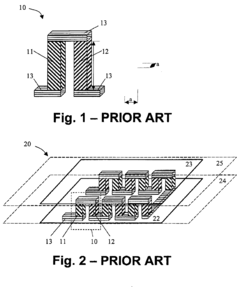
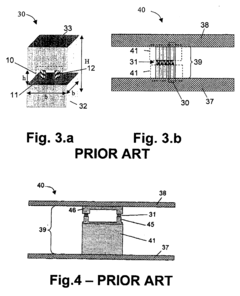
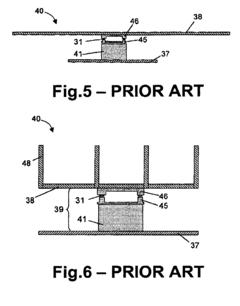
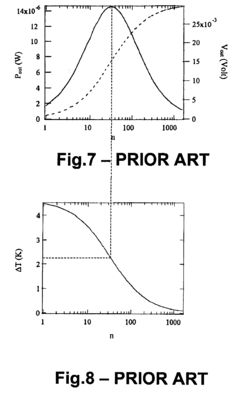
Method for thermal matching of a thermoelectric generator with a heat source having high thermal resistance and thermoelectric generator thus obtained
PatentInactiveEP1970973A1
Innovation
- A method for thermal matching of TEGs with heat sources and sinks is developed, involving a thermopile unit with a specific number of thermocouples and thermal resistance configuration, along with the use of spacers and radiators to optimize heat transfer, ensuring the thermal resistance of the TEG matches the ambient thermal resistance within a certain percentage, thereby enhancing power output.
Materials Science Advancements for Thermopile Design
Recent advancements in materials science have revolutionized thermopile design, offering unprecedented opportunities to enhance sensitivity and efficiency. The traditional materials used in thermopile construction, primarily bismuth-antimony and silicon-based semiconductors, are being supplemented or replaced by novel nanomaterials and composite structures that demonstrate superior thermoelectric properties.
Nanoscale engineering has emerged as a critical frontier in thermopile material development. Quantum confinement effects in nanostructured materials can significantly enhance the Seebeck coefficient while simultaneously reducing thermal conductivity—a combination that directly improves thermopile sensitivity. Materials such as quantum dots, nanowires, and two-dimensional materials like graphene and transition metal dichalcogenides exhibit these beneficial characteristics when properly engineered.
Thin-film deposition techniques have evolved to enable precise control over material composition and structure at the atomic level. Advanced methods including atomic layer deposition (ALD), molecular beam epitaxy (MBE), and pulsed laser deposition (PLD) allow for the creation of highly uniform, defect-free thermoelectric materials with optimized carrier concentration and reduced lattice thermal conductivity.
Composite materials represent another promising direction, where the integration of different materials creates beneficial interfaces that scatter phonons while allowing electrons to flow freely. Silicon-germanium alloys, skutterudites filled with rattler atoms, and half-Heusler compounds have demonstrated figure of merit (ZT) values approaching 2.0, substantially higher than conventional materials.
Surface engineering techniques have also contributed significantly to thermopile performance enhancement. Controlled introduction of surface texturing, selective doping, and interface engineering can modify electron and phonon transport pathways, leading to improved thermoelectric conversion efficiency. These techniques are particularly effective when combined with nanoscale structuring.
Emerging materials such as organic thermoelectrics and flexible thermoelectric films are expanding the application space for thermopiles. These materials offer advantages in weight, cost, and conformability, making them suitable for wearable sensors and IoT applications where traditional rigid thermopiles would be impractical.
The integration of metamaterials and phononic crystals represents the cutting edge of thermopile material design. These artificially structured materials can be engineered to have thermal and electrical properties not found in nature, potentially breaking traditional performance trade-offs that have limited thermopile efficiency.
Nanoscale engineering has emerged as a critical frontier in thermopile material development. Quantum confinement effects in nanostructured materials can significantly enhance the Seebeck coefficient while simultaneously reducing thermal conductivity—a combination that directly improves thermopile sensitivity. Materials such as quantum dots, nanowires, and two-dimensional materials like graphene and transition metal dichalcogenides exhibit these beneficial characteristics when properly engineered.
Thin-film deposition techniques have evolved to enable precise control over material composition and structure at the atomic level. Advanced methods including atomic layer deposition (ALD), molecular beam epitaxy (MBE), and pulsed laser deposition (PLD) allow for the creation of highly uniform, defect-free thermoelectric materials with optimized carrier concentration and reduced lattice thermal conductivity.
Composite materials represent another promising direction, where the integration of different materials creates beneficial interfaces that scatter phonons while allowing electrons to flow freely. Silicon-germanium alloys, skutterudites filled with rattler atoms, and half-Heusler compounds have demonstrated figure of merit (ZT) values approaching 2.0, substantially higher than conventional materials.
Surface engineering techniques have also contributed significantly to thermopile performance enhancement. Controlled introduction of surface texturing, selective doping, and interface engineering can modify electron and phonon transport pathways, leading to improved thermoelectric conversion efficiency. These techniques are particularly effective when combined with nanoscale structuring.
Emerging materials such as organic thermoelectrics and flexible thermoelectric films are expanding the application space for thermopiles. These materials offer advantages in weight, cost, and conformability, making them suitable for wearable sensors and IoT applications where traditional rigid thermopiles would be impractical.
The integration of metamaterials and phononic crystals represents the cutting edge of thermopile material design. These artificially structured materials can be engineered to have thermal and electrical properties not found in nature, potentially breaking traditional performance trade-offs that have limited thermopile efficiency.
Environmental Factors Affecting Thermopile Performance
Thermopile performance is significantly influenced by various environmental factors that can either enhance or degrade sensitivity. Temperature fluctuations represent one of the most critical environmental variables affecting thermopile operation. When ambient temperature changes rapidly, it creates thermal gradients across the device that can interfere with the intended measurement signal. These temperature differentials generate parasitic thermoelectric effects that may mask the actual signal being measured, particularly in applications requiring high precision.
Humidity levels also play a substantial role in thermopile performance. High humidity environments can lead to condensation on sensing elements, altering thermal conductivity pathways and potentially causing signal drift over time. In extreme cases, moisture ingress may permanently damage the thermopile structure or associated electronics, necessitating appropriate environmental sealing and protection measures.
Atmospheric pressure variations affect the thermal conductivity of the gas surrounding the thermopile elements. Lower pressure environments reduce convective heat transfer, which can actually improve sensitivity in some applications by minimizing thermal noise. However, this relationship is non-linear and must be carefully characterized for each specific thermopile design and implementation scenario.
Air flow patterns around the thermopile sensor create complex thermal interactions that can significantly impact measurement accuracy. Uncontrolled or turbulent air currents may introduce noise into the system by creating unpredictable temperature gradients across the sensing elements. Conversely, in some applications, controlled air flow can be deliberately utilized to enhance sensitivity by maintaining optimal thermal conditions around the sensor.
Electromagnetic interference (EMI) represents another environmental challenge for thermopile systems. Since thermopiles generate very small voltage signals, they are particularly susceptible to electrical noise from nearby equipment or power sources. Proper shielding and signal conditioning are essential to maintain sensitivity in electromagnetically noisy environments.
Dust and particulate contamination can physically obstruct the optical path in radiation-sensing thermopiles, reducing incident energy and therefore decreasing sensitivity. In industrial or outdoor applications, regular maintenance protocols must address this issue to ensure consistent performance over time. Additionally, certain atmospheric gases may selectively absorb infrared radiation at specific wavelengths, affecting the spectral response characteristics of the thermopile sensor.
Understanding these environmental factors is crucial for designing robust thermopile systems with optimized sensitivity. Effective solutions often incorporate environmental compensation algorithms, physical protection measures, and careful calibration procedures that account for the specific operating conditions of the application.
Humidity levels also play a substantial role in thermopile performance. High humidity environments can lead to condensation on sensing elements, altering thermal conductivity pathways and potentially causing signal drift over time. In extreme cases, moisture ingress may permanently damage the thermopile structure or associated electronics, necessitating appropriate environmental sealing and protection measures.
Atmospheric pressure variations affect the thermal conductivity of the gas surrounding the thermopile elements. Lower pressure environments reduce convective heat transfer, which can actually improve sensitivity in some applications by minimizing thermal noise. However, this relationship is non-linear and must be carefully characterized for each specific thermopile design and implementation scenario.
Air flow patterns around the thermopile sensor create complex thermal interactions that can significantly impact measurement accuracy. Uncontrolled or turbulent air currents may introduce noise into the system by creating unpredictable temperature gradients across the sensing elements. Conversely, in some applications, controlled air flow can be deliberately utilized to enhance sensitivity by maintaining optimal thermal conditions around the sensor.
Electromagnetic interference (EMI) represents another environmental challenge for thermopile systems. Since thermopiles generate very small voltage signals, they are particularly susceptible to electrical noise from nearby equipment or power sources. Proper shielding and signal conditioning are essential to maintain sensitivity in electromagnetically noisy environments.
Dust and particulate contamination can physically obstruct the optical path in radiation-sensing thermopiles, reducing incident energy and therefore decreasing sensitivity. In industrial or outdoor applications, regular maintenance protocols must address this issue to ensure consistent performance over time. Additionally, certain atmospheric gases may selectively absorb infrared radiation at specific wavelengths, affecting the spectral response characteristics of the thermopile sensor.
Understanding these environmental factors is crucial for designing robust thermopile systems with optimized sensitivity. Effective solutions often incorporate environmental compensation algorithms, physical protection measures, and careful calibration procedures that account for the specific operating conditions of the application.
Unlock deeper insights with PatSnap Eureka Quick Research — get a full tech report to explore trends and direct your research. Try now!
Generate Your Research Report Instantly with AI Agent
Supercharge your innovation with PatSnap Eureka AI Agent Platform!