How to Resolve FEA Challenges Using Multi Point Constraint
MAR 13, 20269 MIN READ
Generate Your Research Report Instantly with AI Agent
Patsnap Eureka helps you evaluate technical feasibility & market potential.
FEA Multi Point Constraint Background and Objectives
Finite Element Analysis (FEA) has evolved as a cornerstone computational method in engineering design and analysis since its inception in the 1940s. Initially developed for structural analysis in aerospace applications, FEA has expanded across multiple engineering disciplines including mechanical, civil, automotive, and biomedical engineering. The method discretizes complex geometries into smaller, manageable elements, enabling engineers to predict structural behavior, thermal distribution, fluid flow, and electromagnetic phenomena with remarkable accuracy.
The evolution of FEA technology has been marked by significant milestones, from early matrix-based formulations to modern adaptive mesh refinement techniques. Contemporary FEA software packages have incorporated advanced algorithms, parallel computing capabilities, and sophisticated visualization tools, making complex simulations more accessible to engineering practitioners. However, as engineering systems become increasingly complex and interconnected, traditional FEA approaches face mounting challenges in accurately representing real-world constraints and boundary conditions.
Multi Point Constraint (MPC) technology emerged as a critical solution to address limitations in conventional FEA methodologies. Traditional constraint methods often struggle with complex geometric interfaces, non-conforming meshes, and sophisticated coupling requirements between different structural components. These limitations become particularly pronounced in modern engineering applications involving composite materials, multi-physics simulations, and large-scale assemblies where multiple components interact through complex interfaces.
The primary objective of implementing MPC in FEA is to establish robust mathematical relationships between multiple degrees of freedom across different nodes or elements. This capability enables accurate representation of rigid connections, flexible joints, contact interfaces, and distributed loading conditions that conventional constraint methods cannot adequately capture. MPC technology aims to enhance simulation fidelity while maintaining computational efficiency and numerical stability.
Furthermore, MPC implementation seeks to address mesh compatibility issues that frequently arise in complex assemblies. When connecting components with dissimilar mesh densities or incompatible element types, traditional tie constraints often introduce artificial stiffness or stress concentrations. MPC provides a more sophisticated approach to handle these interface challenges, ensuring smooth load transfer and realistic deformation patterns across component boundaries.
The strategic goal of advancing MPC technology extends beyond immediate technical challenges to encompass broader engineering simulation objectives. These include reducing simulation setup time, improving solution convergence, enhancing result accuracy, and enabling more complex multi-physics coupling scenarios. As engineering designs continue to push boundaries in terms of complexity and performance requirements, MPC technology represents a fundamental enabler for next-generation simulation capabilities.
The evolution of FEA technology has been marked by significant milestones, from early matrix-based formulations to modern adaptive mesh refinement techniques. Contemporary FEA software packages have incorporated advanced algorithms, parallel computing capabilities, and sophisticated visualization tools, making complex simulations more accessible to engineering practitioners. However, as engineering systems become increasingly complex and interconnected, traditional FEA approaches face mounting challenges in accurately representing real-world constraints and boundary conditions.
Multi Point Constraint (MPC) technology emerged as a critical solution to address limitations in conventional FEA methodologies. Traditional constraint methods often struggle with complex geometric interfaces, non-conforming meshes, and sophisticated coupling requirements between different structural components. These limitations become particularly pronounced in modern engineering applications involving composite materials, multi-physics simulations, and large-scale assemblies where multiple components interact through complex interfaces.
The primary objective of implementing MPC in FEA is to establish robust mathematical relationships between multiple degrees of freedom across different nodes or elements. This capability enables accurate representation of rigid connections, flexible joints, contact interfaces, and distributed loading conditions that conventional constraint methods cannot adequately capture. MPC technology aims to enhance simulation fidelity while maintaining computational efficiency and numerical stability.
Furthermore, MPC implementation seeks to address mesh compatibility issues that frequently arise in complex assemblies. When connecting components with dissimilar mesh densities or incompatible element types, traditional tie constraints often introduce artificial stiffness or stress concentrations. MPC provides a more sophisticated approach to handle these interface challenges, ensuring smooth load transfer and realistic deformation patterns across component boundaries.
The strategic goal of advancing MPC technology extends beyond immediate technical challenges to encompass broader engineering simulation objectives. These include reducing simulation setup time, improving solution convergence, enhancing result accuracy, and enabling more complex multi-physics coupling scenarios. As engineering designs continue to push boundaries in terms of complexity and performance requirements, MPC technology represents a fundamental enabler for next-generation simulation capabilities.
Market Demand for Advanced FEA Simulation Solutions
The global finite element analysis market continues to experience robust growth driven by increasing complexity in engineering design challenges across multiple industries. Aerospace and automotive sectors represent the largest demand segments, where traditional FEA methods often encounter limitations when dealing with complex multi-body interactions, contact problems, and large deformation scenarios. These industries require sophisticated simulation capabilities to reduce physical prototyping costs and accelerate product development cycles.
Manufacturing industries increasingly demand advanced FEA solutions capable of handling intricate assembly simulations where multiple components interact through various constraint mechanisms. The rise of additive manufacturing and composite materials has further intensified the need for simulation tools that can accurately model complex material behaviors and interface conditions that conventional FEA approaches struggle to address effectively.
The electronics and semiconductor industries present emerging market opportunities for advanced FEA solutions, particularly as device miniaturization creates new challenges in thermal management and mechanical reliability analysis. These applications often involve multiple physics interactions and require precise modeling of component interfaces and connections, areas where multi-point constraint methodologies demonstrate significant value.
Energy sector applications, including renewable energy systems and oil and gas infrastructure, generate substantial demand for simulation solutions capable of modeling large-scale structural systems with complex boundary conditions. Wind turbine design, offshore platform analysis, and pipeline integrity assessments require advanced constraint handling capabilities to accurately represent real-world operating conditions.
The medical device industry represents a rapidly growing market segment where regulatory requirements drive demand for comprehensive simulation validation. Implant design, surgical instrument development, and biomechanical analysis applications require sophisticated modeling approaches that can handle complex material interactions and physiological boundary conditions.
Market research indicates that organizations are increasingly seeking integrated simulation platforms that can address multiple physics domains while maintaining computational efficiency. The demand for cloud-based simulation services and real-time analysis capabilities continues to expand, particularly among small and medium enterprises seeking access to advanced FEA technologies without significant infrastructure investments.
Educational institutions and research organizations constitute an important market segment driving demand for advanced simulation methodologies. These entities require flexible, powerful tools for investigating novel engineering concepts and training the next generation of simulation engineers in sophisticated analysis techniques.
Manufacturing industries increasingly demand advanced FEA solutions capable of handling intricate assembly simulations where multiple components interact through various constraint mechanisms. The rise of additive manufacturing and composite materials has further intensified the need for simulation tools that can accurately model complex material behaviors and interface conditions that conventional FEA approaches struggle to address effectively.
The electronics and semiconductor industries present emerging market opportunities for advanced FEA solutions, particularly as device miniaturization creates new challenges in thermal management and mechanical reliability analysis. These applications often involve multiple physics interactions and require precise modeling of component interfaces and connections, areas where multi-point constraint methodologies demonstrate significant value.
Energy sector applications, including renewable energy systems and oil and gas infrastructure, generate substantial demand for simulation solutions capable of modeling large-scale structural systems with complex boundary conditions. Wind turbine design, offshore platform analysis, and pipeline integrity assessments require advanced constraint handling capabilities to accurately represent real-world operating conditions.
The medical device industry represents a rapidly growing market segment where regulatory requirements drive demand for comprehensive simulation validation. Implant design, surgical instrument development, and biomechanical analysis applications require sophisticated modeling approaches that can handle complex material interactions and physiological boundary conditions.
Market research indicates that organizations are increasingly seeking integrated simulation platforms that can address multiple physics domains while maintaining computational efficiency. The demand for cloud-based simulation services and real-time analysis capabilities continues to expand, particularly among small and medium enterprises seeking access to advanced FEA technologies without significant infrastructure investments.
Educational institutions and research organizations constitute an important market segment driving demand for advanced simulation methodologies. These entities require flexible, powerful tools for investigating novel engineering concepts and training the next generation of simulation engineers in sophisticated analysis techniques.
Current FEA MPC Implementation Challenges and Limitations
Multi-Point Constraint (MPC) implementation in current Finite Element Analysis software faces several significant computational and methodological challenges that limit its effectiveness in complex engineering applications. The primary computational bottleneck stems from the increased matrix conditioning problems that arise when multiple constraint equations are simultaneously applied to large-scale models. These constraints often lead to ill-conditioned system matrices, resulting in numerical instability and convergence difficulties during iterative solution processes.
Memory allocation and storage requirements present another critical limitation in contemporary MPC implementations. When dealing with models containing thousands of constraint equations, the additional memory overhead for storing constraint matrices and associated data structures can become prohibitive, particularly in distributed computing environments. This challenge is exacerbated when constraint equations involve non-linear relationships or time-dependent parameters.
Solver compatibility issues represent a persistent challenge across different FEA platforms. Many existing solvers were originally designed for unconstrained or simply constrained problems, making the integration of complex MPC formulations problematic. Direct solvers often struggle with the modified system matrices, while iterative solvers may experience slow convergence or fail to converge entirely when constraint equations are poorly formulated or numerically incompatible with the underlying physics.
The accuracy degradation phenomenon occurs frequently in current MPC implementations, particularly when constraint equations are over-specified or when multiple constraints interact in unexpected ways. This leads to artificial stiffening or softening of structural responses, compromising the physical validity of simulation results. The challenge is particularly pronounced in contact mechanics and multi-body dynamics applications where constraint forces must be accurately computed.
Preprocessing complexity remains a significant barrier to widespread MPC adoption. Current implementations often require extensive manual intervention to properly define constraint equations, verify their mathematical consistency, and ensure numerical stability. The lack of automated constraint generation tools and validation mechanisms increases the likelihood of user errors and reduces overall simulation reliability.
Scalability limitations become apparent when MPC methods are applied to large-scale industrial problems involving millions of degrees of freedom. The computational overhead associated with constraint enforcement grows disproportionately with model size, making real-time or near-real-time simulations impractical for many applications. This scalability issue is particularly problematic in optimization workflows where multiple design iterations are required.
Memory allocation and storage requirements present another critical limitation in contemporary MPC implementations. When dealing with models containing thousands of constraint equations, the additional memory overhead for storing constraint matrices and associated data structures can become prohibitive, particularly in distributed computing environments. This challenge is exacerbated when constraint equations involve non-linear relationships or time-dependent parameters.
Solver compatibility issues represent a persistent challenge across different FEA platforms. Many existing solvers were originally designed for unconstrained or simply constrained problems, making the integration of complex MPC formulations problematic. Direct solvers often struggle with the modified system matrices, while iterative solvers may experience slow convergence or fail to converge entirely when constraint equations are poorly formulated or numerically incompatible with the underlying physics.
The accuracy degradation phenomenon occurs frequently in current MPC implementations, particularly when constraint equations are over-specified or when multiple constraints interact in unexpected ways. This leads to artificial stiffening or softening of structural responses, compromising the physical validity of simulation results. The challenge is particularly pronounced in contact mechanics and multi-body dynamics applications where constraint forces must be accurately computed.
Preprocessing complexity remains a significant barrier to widespread MPC adoption. Current implementations often require extensive manual intervention to properly define constraint equations, verify their mathematical consistency, and ensure numerical stability. The lack of automated constraint generation tools and validation mechanisms increases the likelihood of user errors and reduces overall simulation reliability.
Scalability limitations become apparent when MPC methods are applied to large-scale industrial problems involving millions of degrees of freedom. The computational overhead associated with constraint enforcement grows disproportionately with model size, making real-time or near-real-time simulations impractical for many applications. This scalability issue is particularly problematic in optimization workflows where multiple design iterations are required.
Existing MPC Solutions for Complex FEA Problems
01 Multi-point constraint formulation and implementation methods
Various methods for formulating and implementing multi-point constraints in finite element analysis systems are disclosed. These approaches focus on establishing mathematical relationships between multiple nodes or degrees of freedom to enforce specific kinematic or physical conditions. The methods include techniques for defining constraint equations, handling dependent and independent variables, and ensuring numerical stability during the solution process.- Multi-point constraint formulation and implementation methods: Various methods for formulating and implementing multi-point constraints in finite element analysis systems are disclosed. These approaches focus on establishing mathematical relationships between multiple nodes or degrees of freedom to enforce specific kinematic or physical conditions. The methods include techniques for defining constraint equations, handling dependent and independent variables, and ensuring numerical stability during solution processes.
- Computational efficiency and solver optimization for constrained systems: Techniques for improving computational efficiency when solving finite element problems with multi-point constraints are presented. These include optimized matrix assembly procedures, efficient equation solving algorithms, and methods for reducing computational complexity. The approaches address challenges related to large-scale systems and aim to minimize solution time while maintaining accuracy.
- Handling non-linear and dynamic multi-point constraints: Methods for addressing multi-point constraints in non-linear and dynamic finite element analyses are described. These techniques deal with time-dependent constraints, large deformation scenarios, and non-linear material behavior. The approaches include iterative solution schemes, constraint stabilization methods, and techniques for maintaining constraint satisfaction throughout dynamic simulations.
- Contact and interface modeling with multi-point constraints: Approaches for modeling contact interfaces and connections between components using multi-point constraint formulations are disclosed. These methods address challenges in simulating mechanical joints, bonded interfaces, and contact conditions between multiple bodies. The techniques include penalty methods, Lagrange multiplier approaches, and hybrid formulations for enforcing interface compatibility conditions.
- Mesh refinement and adaptive constraint handling: Techniques for managing multi-point constraints in adaptive mesh refinement scenarios and handling constraint transitions are presented. These methods address challenges when mesh topology changes during analysis, including constraint projection, remapping procedures, and maintaining constraint consistency across different mesh densities. The approaches ensure accurate constraint enforcement during adaptive solution processes.
02 Computational efficiency and solver optimization for constrained systems
Techniques for improving computational efficiency when solving finite element problems with multi-point constraints are presented. These include optimization of matrix assembly procedures, efficient handling of constraint equations in iterative solvers, reduction of computational overhead, and parallel processing strategies. The methods aim to reduce solution time while maintaining accuracy in constrained finite element models.Expand Specific Solutions03 Handling of over-constrained and ill-conditioned systems
Solutions for addressing numerical challenges arising from over-constrained or ill-conditioned multi-point constraint systems in finite element analysis are described. These approaches include detection and resolution of redundant constraints, regularization techniques, condition number monitoring, and methods for ensuring solution uniqueness and stability when multiple constraints interact.Expand Specific Solutions04 Contact and interface modeling with multi-point constraints
Methods for applying multi-point constraints in contact mechanics and interface problems are disclosed. These techniques address challenges in modeling interactions between different components, surfaces, or materials using constraint-based approaches. Applications include tie constraints, coupling surfaces, and enforcing continuity conditions across dissimilar meshes or material interfaces.Expand Specific Solutions05 Adaptive and dynamic constraint management
Approaches for managing multi-point constraints that change during analysis or require adaptive treatment are presented. These include methods for activating or deactivating constraints based on solution state, updating constraint definitions during nonlinear analysis, handling time-dependent constraints, and automatically adjusting constraint formulations to improve convergence and accuracy in complex simulations.Expand Specific Solutions
Key Players in FEA Software and MPC Development
The competitive landscape for resolving FEA challenges using Multi Point Constraint technology is characterized by a mature development stage with established market players and evolving technological capabilities. The market demonstrates significant scale, driven by aerospace, automotive, and engineering sectors requiring advanced simulation solutions. Technology maturity varies across segments, with industry leaders like ANSYS, Inc. and Autodesk, Inc. offering sophisticated commercial FEA platforms, while Livermore Software Technology Corp. and Dassault Systèmes SolidWorks Corp. provide specialized constraint modeling capabilities. Academic institutions including MIT, Huazhong University of Science & Technology, and Tongji University contribute fundamental research advancements. Industrial players such as Boeing Co., Honda Motor Co., and SAP SE integrate these technologies into their engineering workflows, indicating strong market adoption and practical implementation across diverse applications requiring complex structural analysis and constraint-based modeling solutions.
Livermore Software Technology Corp.
Technical Solution: LS-DYNA, developed by Livermore Software Technology Corp., offers sophisticated MPC capabilities specifically designed for explicit dynamic analysis and crash simulation scenarios. Their MPC implementation focuses on maintaining stability during large deformation events and contact scenarios. The software provides specialized constraint formulations for automotive and aerospace applications, including spotweld modeling, rigid body connections, and kinematic joints. LS-DYNA's MPC algorithms are optimized for parallel processing environments and can handle complex multi-physics coupling scenarios. The system includes advanced constraint enforcement methods that prevent numerical instabilities during extreme loading conditions and provides real-time constraint monitoring capabilities.
Strengths: Excellent performance in dynamic simulations, specialized automotive industry features, strong parallel processing capabilities. Weaknesses: Limited to explicit analysis methods, complex setup procedures, requires specialized expertise for optimal utilization.
ANSYS, Inc.
Technical Solution: ANSYS provides comprehensive Multi Point Constraint (MPC) capabilities through its flagship software ANSYS Mechanical. The system implements advanced constraint equations that can couple degrees of freedom between non-conforming meshes, enabling efficient modeling of complex assemblies. Their MPC technology supports rigid body connections, flexible joints, and contact interfaces with automatic constraint generation algorithms. The software features sophisticated constraint solvers that handle large-scale problems with millions of degrees of freedom while maintaining numerical stability. ANSYS MPC implementation includes specialized algorithms for handling over-constrained systems and provides detailed diagnostic tools for constraint validation and troubleshooting.
Strengths: Industry-leading solver technology with robust numerical algorithms, extensive validation across multiple industries, comprehensive documentation and support. Weaknesses: High licensing costs, steep learning curve for advanced MPC features, computational overhead for very large constraint systems.
Core Innovations in Multi Point Constraint Algorithms
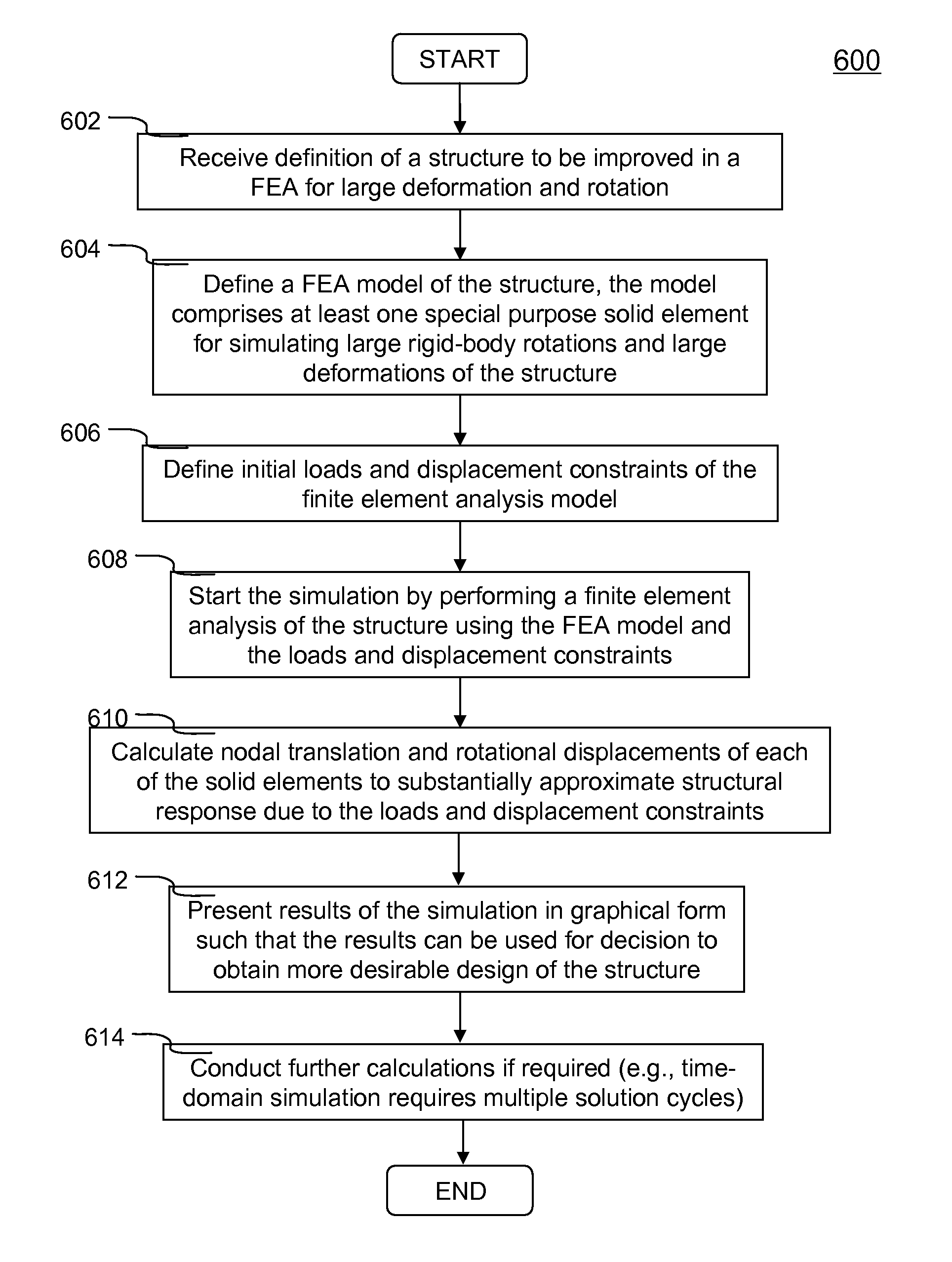
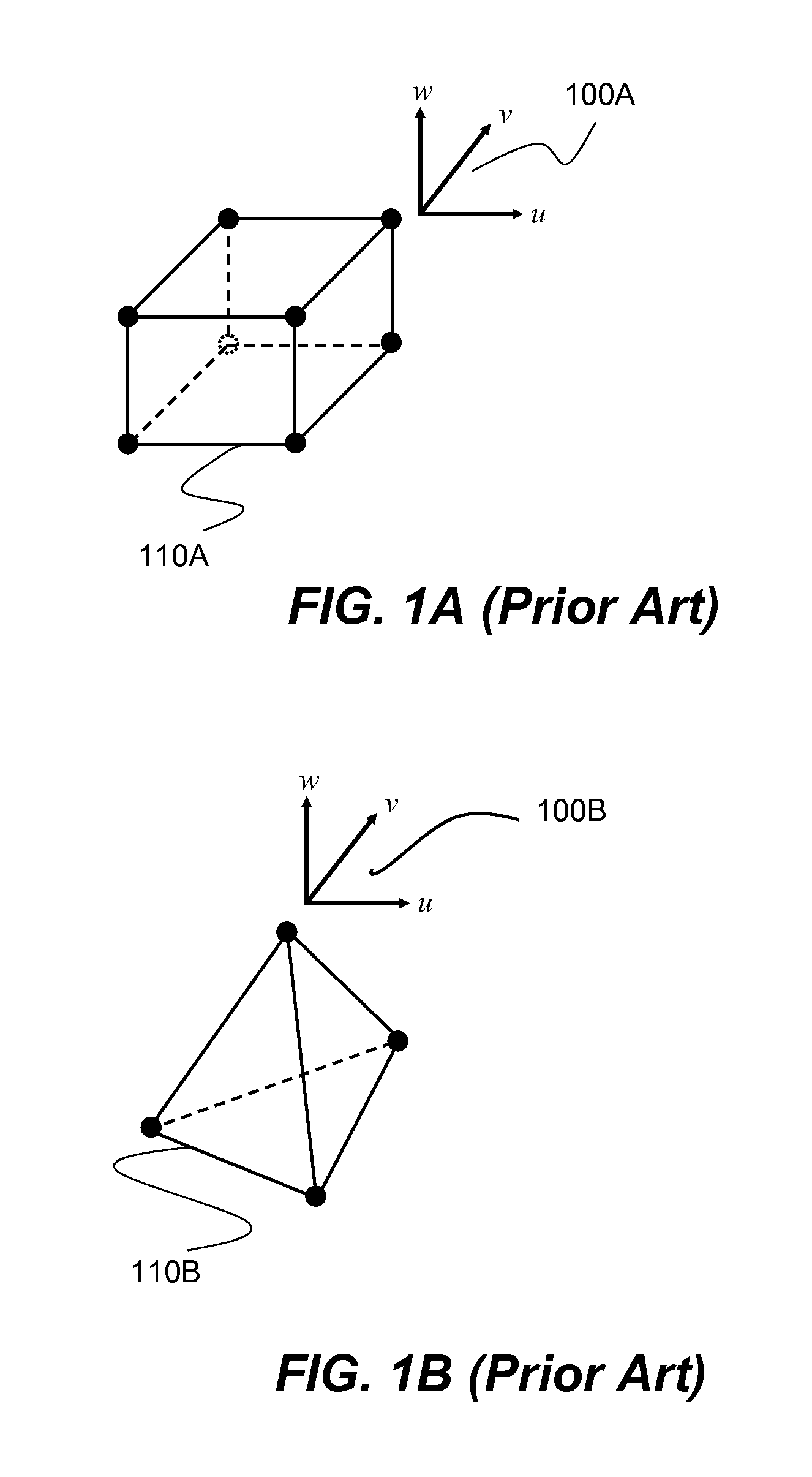
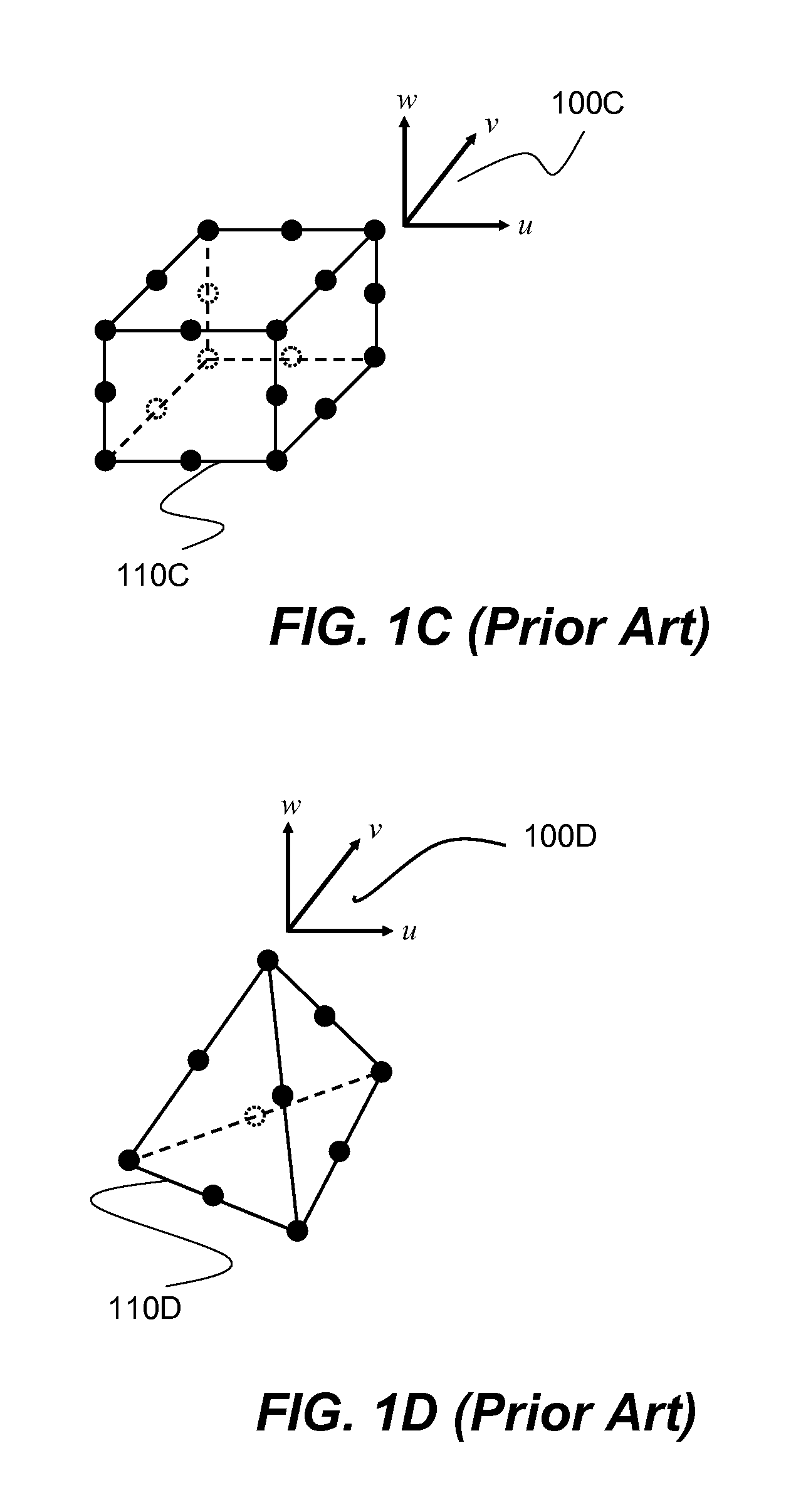
Solid finite elements suitable for simulating large deformations and/or rotations of a structure
PatentActiveUS20100145662A1
Innovation
- The development of special purpose solid finite elements with corner nodes having six degrees-of-freedom (three translational and three rotational components) allows for improved simulation of large deformations and rotations, enabling implicit mid-edge translational deformation derivation from adjacent nodes, facilitating more accurate and efficient computations.

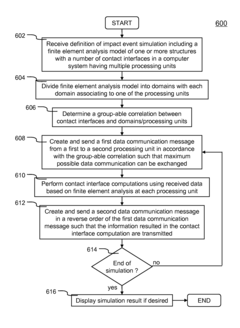
Method of Simulating Impact Events in a Multi-processor Computer System
PatentActiveUS20100161296A1
Innovation
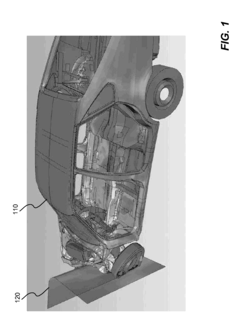
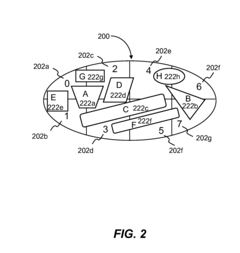
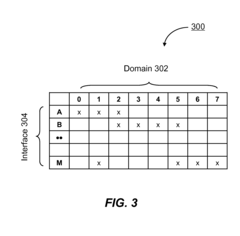
- The method involves dividing the finite element analysis model into domains associated with processing units, determining a group-able correlation between contact interfaces and domains, and performing time-marching simulations with optimized data communication and computation sequences to maximize parallel processing efficiency.
Computational Performance Optimization for MPC Systems
Computational performance optimization in Multi Point Constraint (MPC) systems represents a critical bottleneck in large-scale finite element analysis applications. The inherent complexity of MPC formulations introduces significant computational overhead, particularly when dealing with systems containing thousands of constraint equations. Traditional direct solution methods often struggle with the increased matrix density and conditioning issues that arise from constraint enforcement, leading to exponential growth in solution times as model complexity increases.
Memory management emerges as a primary concern in MPC implementations, where constraint matrices can consume substantial system resources. The sparse matrix structures typical in FEA become increasingly dense when MPC relationships are incorporated, challenging conventional storage schemes. Advanced sparse matrix techniques, including compressed row storage and block-compressed formats, have shown promise in reducing memory footprint while maintaining computational efficiency.
Parallel processing strategies offer substantial performance gains for MPC systems through domain decomposition and constraint partitioning approaches. Modern implementations leverage multi-threading capabilities to distribute constraint evaluation and matrix assembly operations across available processor cores. GPU acceleration has demonstrated particular effectiveness for repetitive constraint calculations, achieving speedup factors of 10-50x compared to traditional CPU-based approaches.
Iterative solver optimization represents another crucial performance enhancement avenue. Preconditioned conjugate gradient methods, specifically tailored for constrained systems, can significantly reduce solution times compared to direct factorization approaches. Specialized preconditioning techniques that account for constraint structure have shown superior convergence characteristics in large-scale applications.
Adaptive constraint activation strategies provide dynamic performance optimization by selectively enforcing only active constraints during solution iterations. This approach reduces computational burden while maintaining solution accuracy, particularly beneficial in contact and nonlinear analysis scenarios where constraint states evolve throughout the solution process.
Memory management emerges as a primary concern in MPC implementations, where constraint matrices can consume substantial system resources. The sparse matrix structures typical in FEA become increasingly dense when MPC relationships are incorporated, challenging conventional storage schemes. Advanced sparse matrix techniques, including compressed row storage and block-compressed formats, have shown promise in reducing memory footprint while maintaining computational efficiency.
Parallel processing strategies offer substantial performance gains for MPC systems through domain decomposition and constraint partitioning approaches. Modern implementations leverage multi-threading capabilities to distribute constraint evaluation and matrix assembly operations across available processor cores. GPU acceleration has demonstrated particular effectiveness for repetitive constraint calculations, achieving speedup factors of 10-50x compared to traditional CPU-based approaches.
Iterative solver optimization represents another crucial performance enhancement avenue. Preconditioned conjugate gradient methods, specifically tailored for constrained systems, can significantly reduce solution times compared to direct factorization approaches. Specialized preconditioning techniques that account for constraint structure have shown superior convergence characteristics in large-scale applications.
Adaptive constraint activation strategies provide dynamic performance optimization by selectively enforcing only active constraints during solution iterations. This approach reduces computational burden while maintaining solution accuracy, particularly beneficial in contact and nonlinear analysis scenarios where constraint states evolve throughout the solution process.
Industry Standards and Validation Requirements for FEA MPC
The implementation of Multi Point Constraints in Finite Element Analysis must adhere to rigorous industry standards to ensure computational accuracy and reliability. The American Society of Mechanical Engineers (ASME) provides fundamental guidelines through ASME V&V 10 standard, which establishes verification and validation procedures for computational solid mechanics. This standard specifically addresses constraint implementation methodologies and requires comprehensive documentation of MPC formulations, including mathematical derivations and numerical implementation details.
International Organization for Standardization (ISO) 16269 series offers complementary frameworks for statistical validation of FEA results when MPCs are employed. These standards mandate statistical analysis of constraint force distributions and displacement field continuity across constrained interfaces. The European Committee for Standardization (CEN) has developed EN 1990 Eurocode, which provides specific requirements for structural analysis validation when rigid body constraints and kinematic coupling are utilized in safety-critical applications.
Aerospace industries follow stringent validation protocols outlined in RTCA DO-178C and ARP4754A standards. These frameworks require extensive verification testing of MPC implementations, including convergence studies, mesh sensitivity analyses, and comparison with analytical solutions where available. The validation process must demonstrate that constraint equations maintain numerical stability across various loading conditions and geometric configurations.
Automotive sector compliance follows ISO 26262 functional safety standards, which mandate rigorous validation of FEA models incorporating MPCs for crash simulation and structural integrity assessment. This includes validation against physical test data, with specific requirements for constraint force accuracy and energy conservation verification. The standard requires documented evidence that MPC implementations preserve physical behavior and do not introduce artificial stiffness or compliance.
Nuclear industry applications must comply with ASME Section III Division 5 requirements, which establish comprehensive validation procedures for high-temperature structural analysis using advanced constraint methodologies. These standards require extensive benchmarking against experimental data and analytical solutions, with particular emphasis on thermal-mechanical coupling validation when temperature-dependent MPCs are employed.
Validation requirements typically include convergence verification studies, comparison with alternative solution methods, and demonstration of constraint satisfaction within specified tolerance limits. Documentation must include detailed uncertainty quantification and sensitivity analysis results to ensure regulatory compliance and technical credibility.
International Organization for Standardization (ISO) 16269 series offers complementary frameworks for statistical validation of FEA results when MPCs are employed. These standards mandate statistical analysis of constraint force distributions and displacement field continuity across constrained interfaces. The European Committee for Standardization (CEN) has developed EN 1990 Eurocode, which provides specific requirements for structural analysis validation when rigid body constraints and kinematic coupling are utilized in safety-critical applications.
Aerospace industries follow stringent validation protocols outlined in RTCA DO-178C and ARP4754A standards. These frameworks require extensive verification testing of MPC implementations, including convergence studies, mesh sensitivity analyses, and comparison with analytical solutions where available. The validation process must demonstrate that constraint equations maintain numerical stability across various loading conditions and geometric configurations.
Automotive sector compliance follows ISO 26262 functional safety standards, which mandate rigorous validation of FEA models incorporating MPCs for crash simulation and structural integrity assessment. This includes validation against physical test data, with specific requirements for constraint force accuracy and energy conservation verification. The standard requires documented evidence that MPC implementations preserve physical behavior and do not introduce artificial stiffness or compliance.
Nuclear industry applications must comply with ASME Section III Division 5 requirements, which establish comprehensive validation procedures for high-temperature structural analysis using advanced constraint methodologies. These standards require extensive benchmarking against experimental data and analytical solutions, with particular emphasis on thermal-mechanical coupling validation when temperature-dependent MPCs are employed.
Validation requirements typically include convergence verification studies, comparison with alternative solution methods, and demonstration of constraint satisfaction within specified tolerance limits. Documentation must include detailed uncertainty quantification and sensitivity analysis results to ensure regulatory compliance and technical credibility.
Unlock deeper insights with Patsnap Eureka Quick Research — get a full tech report to explore trends and direct your research. Try now!
Generate Your Research Report Instantly with AI Agent
Supercharge your innovation with Patsnap Eureka AI Agent Platform!