OLED vs DLP: Assessing Brightness in Projection Systems
SEP 12, 20259 MIN READ
Generate Your Research Report Instantly with AI Agent
Patsnap Eureka helps you evaluate technical feasibility & market potential.
Projection Technology Evolution and Objectives
Projection technology has undergone significant evolution since its inception in the late 19th century. The magic lantern, considered the earliest form of image projection, utilized candlelight to project painted glass slides. The trajectory of development accelerated in the 20th century with the introduction of film projectors, followed by overhead projectors that became ubiquitous in educational settings. The digital revolution in the late 20th century marked a pivotal shift with the emergence of LCD (Liquid Crystal Display) and DLP (Digital Light Processing) technologies, fundamentally transforming projection capabilities.
The early 2000s witnessed the rise of DLP technology, developed by Texas Instruments, which utilizes microscopic mirrors to reflect light and create images. This innovation offered superior contrast ratios and reduced the "screen door effect" prevalent in earlier projection systems. Concurrently, LCD technology evolved to provide enhanced color accuracy and brightness, though often at the expense of contrast performance compared to DLP alternatives.
Recent years have seen the emergence of OLED (Organic Light Emitting Diode) technology in projection systems, representing a significant departure from traditional approaches. Unlike DLP systems that reflect light from an external source, OLED projectors generate light directly from organic compounds when electrical current is applied. This fundamental difference in light generation mechanisms creates distinct performance characteristics that merit comprehensive evaluation.
The primary objective of this technical assessment is to conduct a comparative analysis of brightness performance between OLED and DLP projection technologies. Brightness, measured in lumens or ANSI lumens, represents a critical performance metric that directly impacts user experience across various application scenarios. The analysis aims to establish quantifiable benchmarks for brightness efficiency, consistency, and degradation patterns over time for both technologies.
Additionally, this research seeks to evaluate how brightness performance intersects with other key projection parameters including contrast ratio, color accuracy, power consumption, and heat generation. Understanding these interdependencies is essential for developing a holistic perspective on the relative advantages of each technology in different deployment contexts.
The ultimate goal is to provide actionable insights regarding the optimal application scenarios for each technology based on brightness requirements, identify potential technological convergence opportunities, and forecast the evolutionary trajectory of projection brightness capabilities over the next five years. This forward-looking assessment will inform strategic R&D investments and product development roadmaps in the projection technology sector.
The early 2000s witnessed the rise of DLP technology, developed by Texas Instruments, which utilizes microscopic mirrors to reflect light and create images. This innovation offered superior contrast ratios and reduced the "screen door effect" prevalent in earlier projection systems. Concurrently, LCD technology evolved to provide enhanced color accuracy and brightness, though often at the expense of contrast performance compared to DLP alternatives.
Recent years have seen the emergence of OLED (Organic Light Emitting Diode) technology in projection systems, representing a significant departure from traditional approaches. Unlike DLP systems that reflect light from an external source, OLED projectors generate light directly from organic compounds when electrical current is applied. This fundamental difference in light generation mechanisms creates distinct performance characteristics that merit comprehensive evaluation.
The primary objective of this technical assessment is to conduct a comparative analysis of brightness performance between OLED and DLP projection technologies. Brightness, measured in lumens or ANSI lumens, represents a critical performance metric that directly impacts user experience across various application scenarios. The analysis aims to establish quantifiable benchmarks for brightness efficiency, consistency, and degradation patterns over time for both technologies.
Additionally, this research seeks to evaluate how brightness performance intersects with other key projection parameters including contrast ratio, color accuracy, power consumption, and heat generation. Understanding these interdependencies is essential for developing a holistic perspective on the relative advantages of each technology in different deployment contexts.
The ultimate goal is to provide actionable insights regarding the optimal application scenarios for each technology based on brightness requirements, identify potential technological convergence opportunities, and forecast the evolutionary trajectory of projection brightness capabilities over the next five years. This forward-looking assessment will inform strategic R&D investments and product development roadmaps in the projection technology sector.
Market Demand Analysis for High-Brightness Projection
The high-brightness projection market has experienced significant growth over the past decade, driven by increasing demand across multiple sectors including commercial, educational, entertainment, and home theater applications. The global projection market was valued at approximately $13.5 billion in 2022 and is expected to reach $18.7 billion by 2027, with high-brightness projectors representing one of the fastest-growing segments.
Commercial applications constitute the largest market share for high-brightness projectors, particularly in large venue installations such as conference centers, auditoriums, and outdoor events where ambient light conditions necessitate superior brightness capabilities. The education sector follows closely, with universities and training facilities increasingly adopting high-brightness projection systems to enhance visibility in well-lit modern classrooms.
Consumer preferences are shifting toward more immersive visual experiences, with brightness being a critical factor in purchasing decisions. Market research indicates that 78% of professional buyers consider brightness specifications as the primary technical consideration when selecting projection systems, ahead of resolution and contrast ratio.
The cinema projection market segment specifically demands exceptional brightness performance, with digital cinema projectors requiring 10,000-40,000 lumens for large screens. This segment has seen a compound annual growth rate of 6.8% since 2018, despite competition from direct-view LED technologies.
Regional analysis reveals that North America and Europe currently lead in high-brightness projector adoption, though the Asia-Pacific region is demonstrating the most rapid growth rate at 9.2% annually. China and India are emerging as particularly strong markets due to infrastructure development and increasing corporate and educational technology investments.
Industry forecasts suggest that the demand for ultra-high brightness projectors (20,000+ lumens) will increase by 12% annually through 2026, driven by large-scale outdoor applications and immersive experiences. This growth is creating competitive pressure for manufacturers to develop more efficient brightness technologies while managing power consumption and heat dissipation challenges.
The market is also witnessing a growing demand for portable high-brightness projectors, with business travelers and mobile presenters seeking compact solutions that don't compromise on visual performance in varied lighting environments. This sub-segment is projected to grow at 15% annually, representing a significant opportunity for innovative brightness solutions in smaller form factors.
Commercial applications constitute the largest market share for high-brightness projectors, particularly in large venue installations such as conference centers, auditoriums, and outdoor events where ambient light conditions necessitate superior brightness capabilities. The education sector follows closely, with universities and training facilities increasingly adopting high-brightness projection systems to enhance visibility in well-lit modern classrooms.
Consumer preferences are shifting toward more immersive visual experiences, with brightness being a critical factor in purchasing decisions. Market research indicates that 78% of professional buyers consider brightness specifications as the primary technical consideration when selecting projection systems, ahead of resolution and contrast ratio.
The cinema projection market segment specifically demands exceptional brightness performance, with digital cinema projectors requiring 10,000-40,000 lumens for large screens. This segment has seen a compound annual growth rate of 6.8% since 2018, despite competition from direct-view LED technologies.
Regional analysis reveals that North America and Europe currently lead in high-brightness projector adoption, though the Asia-Pacific region is demonstrating the most rapid growth rate at 9.2% annually. China and India are emerging as particularly strong markets due to infrastructure development and increasing corporate and educational technology investments.
Industry forecasts suggest that the demand for ultra-high brightness projectors (20,000+ lumens) will increase by 12% annually through 2026, driven by large-scale outdoor applications and immersive experiences. This growth is creating competitive pressure for manufacturers to develop more efficient brightness technologies while managing power consumption and heat dissipation challenges.
The market is also witnessing a growing demand for portable high-brightness projectors, with business travelers and mobile presenters seeking compact solutions that don't compromise on visual performance in varied lighting environments. This sub-segment is projected to grow at 15% annually, representing a significant opportunity for innovative brightness solutions in smaller form factors.
OLED vs DLP: Technical Challenges and Limitations
Both OLED and DLP technologies face distinct technical challenges and limitations when implemented in projection systems, particularly regarding brightness performance. DLP (Digital Light Processing) technology, while capable of achieving higher brightness levels, struggles with color accuracy and contrast ratio optimization. The micromirror array that forms the foundation of DLP systems can generate significant heat during operation, requiring sophisticated thermal management solutions that add complexity and cost to the overall system design.
The brightness limitation in DLP projectors stems primarily from the light source efficiency and the optical path design. Traditional lamp-based DLP projectors suffer from bulb degradation over time, resulting in diminishing brightness performance. While laser-based DLP systems have improved longevity, they introduce challenges in color gamut reproduction and speckle reduction that can affect perceived image quality despite higher lumen ratings.
OLED (Organic Light Emitting Diode) projection technology, conversely, faces fundamental brightness constraints due to the organic materials' inherent luminance limitations. The self-emissive nature of OLED pixels provides exceptional contrast ratios and color accuracy but cannot match the raw brightness output of DLP systems. This limitation becomes particularly pronounced in larger projection scenarios or environments with ambient light, where OLED projectors struggle to deliver sufficient luminance.
A critical technical hurdle for OLED projection systems is the degradation of organic materials when driven at higher brightness levels. This creates an engineering paradox where increasing brightness accelerates device deterioration, significantly reducing operational lifespan. Current OLED projection implementations must therefore balance brightness capabilities against longevity considerations, often resulting in conservative brightness specifications.
Power efficiency represents another significant challenge in both technologies. DLP systems require high-powered light sources and lose substantial energy through their optical systems, with typical efficiency rates of 15-25% from power input to projected light output. OLED systems offer better theoretical efficiency but struggle with heat dissipation at higher brightness levels, necessitating power limiting circuitry that constrains maximum brightness potential.
Resolution scaling presents different challenges for each technology. DLP systems can maintain brightness levels relatively well when scaling to higher resolutions, as the same light source illuminates the entire micromirror array. OLED projection systems, however, face diminishing brightness as resolution increases, since each pixel requires its own light-emitting element, dividing the available power across more points.
The manufacturing complexity of both technologies also impacts their brightness capabilities. DLP optical systems require precise alignment and high-quality components to maximize light transmission efficiency. OLED manufacturing processes must balance pixel density, aperture ratio, and driving circuitry design, all of which directly influence maximum achievable brightness in the final projection system.
The brightness limitation in DLP projectors stems primarily from the light source efficiency and the optical path design. Traditional lamp-based DLP projectors suffer from bulb degradation over time, resulting in diminishing brightness performance. While laser-based DLP systems have improved longevity, they introduce challenges in color gamut reproduction and speckle reduction that can affect perceived image quality despite higher lumen ratings.
OLED (Organic Light Emitting Diode) projection technology, conversely, faces fundamental brightness constraints due to the organic materials' inherent luminance limitations. The self-emissive nature of OLED pixels provides exceptional contrast ratios and color accuracy but cannot match the raw brightness output of DLP systems. This limitation becomes particularly pronounced in larger projection scenarios or environments with ambient light, where OLED projectors struggle to deliver sufficient luminance.
A critical technical hurdle for OLED projection systems is the degradation of organic materials when driven at higher brightness levels. This creates an engineering paradox where increasing brightness accelerates device deterioration, significantly reducing operational lifespan. Current OLED projection implementations must therefore balance brightness capabilities against longevity considerations, often resulting in conservative brightness specifications.
Power efficiency represents another significant challenge in both technologies. DLP systems require high-powered light sources and lose substantial energy through their optical systems, with typical efficiency rates of 15-25% from power input to projected light output. OLED systems offer better theoretical efficiency but struggle with heat dissipation at higher brightness levels, necessitating power limiting circuitry that constrains maximum brightness potential.
Resolution scaling presents different challenges for each technology. DLP systems can maintain brightness levels relatively well when scaling to higher resolutions, as the same light source illuminates the entire micromirror array. OLED projection systems, however, face diminishing brightness as resolution increases, since each pixel requires its own light-emitting element, dividing the available power across more points.
The manufacturing complexity of both technologies also impacts their brightness capabilities. DLP optical systems require precise alignment and high-quality components to maximize light transmission efficiency. OLED manufacturing processes must balance pixel density, aperture ratio, and driving circuitry design, all of which directly influence maximum achievable brightness in the final projection system.
Current Brightness Enhancement Solutions
01 OLED display brightness enhancement technologies
Various technologies have been developed to enhance the brightness of OLED displays in projection systems. These include optimized pixel structures, improved light emission efficiency, and advanced driving methods. Enhanced OLED brightness is achieved through specialized materials and circuit designs that maximize luminous output while maintaining power efficiency. These improvements allow OLED-based projectors to deliver higher brightness levels suitable for various viewing environments.- Brightness enhancement in OLED displays: OLED technology offers superior brightness capabilities through various enhancement methods. These include optimizing the organic light-emitting materials, implementing advanced pixel structures, and utilizing specialized driving circuits. The brightness of OLED displays can be further improved by incorporating reflective layers that redirect light toward the viewer and by using color filters that maximize light transmission efficiency.
- DLP projection brightness optimization: DLP (Digital Light Processing) projection systems achieve high brightness through specialized light source configurations and optical designs. These systems typically employ high-intensity lamps or laser light sources combined with efficient reflective micromirror arrays. Brightness is optimized through precise control of the micromirror angles, advanced thermal management systems, and specialized color wheel designs that maximize light utilization.
- Hybrid OLED-DLP projection systems: Hybrid systems combining OLED and DLP technologies leverage the advantages of both to achieve optimal brightness performance. These systems typically use OLED panels as light sources for DLP projection units, resulting in improved color accuracy and brightness efficiency. The integration allows for compact designs with enhanced contrast ratios while maintaining high brightness levels suitable for various projection environments.
- Brightness control mechanisms for projection displays: Advanced brightness control mechanisms are implemented in both OLED and DLP projection technologies to optimize visual performance. These include adaptive brightness adjustment based on ambient light conditions, dynamic contrast enhancement algorithms, and power-efficient dimming techniques. Such control systems help maintain optimal brightness levels while balancing power consumption and extending the lifespan of display components.
- Energy efficiency improvements for brightness enhancement: Energy-efficient approaches to enhance brightness in projection technologies focus on maximizing light output while minimizing power consumption. These include the development of high-efficiency light sources, optimized optical pathways that reduce light loss, and intelligent power management systems. Advanced thermal management solutions also contribute to maintaining brightness levels by preventing performance degradation due to heat buildup.
02 DLP projection brightness optimization techniques
DLP projection systems employ various techniques to optimize brightness, including advanced light source technologies, improved optical designs, and enhanced reflection efficiency. Digital micromirror devices (DMDs) are engineered to maximize light utilization and reflection. Additional brightness enhancement is achieved through specialized lens arrangements, light path optimization, and thermal management systems that maintain consistent brightness levels during operation.Expand Specific Solutions03 Hybrid OLED-DLP projection systems
Hybrid projection systems combining OLED and DLP technologies leverage the advantages of both to achieve superior brightness performance. These systems typically use OLED panels for color generation and DLP components for light modulation and projection. The integration allows for enhanced brightness while maintaining color accuracy and contrast. Advanced control algorithms coordinate the operation of both technologies to optimize overall image quality and luminance output.Expand Specific Solutions04 Brightness enhancement through optical components
Both OLED and DLP projection systems utilize specialized optical components to enhance brightness. These include high-efficiency lenses, reflectors, light guides, and polarization filters. Advanced optical designs minimize light loss throughout the projection path while maximizing the luminous flux reaching the screen. Specialized coatings on optical elements reduce reflection losses and improve light transmission, resulting in significantly brighter projected images.Expand Specific Solutions05 Thermal management for brightness stability
Effective thermal management systems are crucial for maintaining consistent brightness in both OLED and DLP projection technologies. Heat dissipation solutions prevent brightness degradation during extended operation by controlling operating temperatures of light sources and optical components. Advanced cooling systems, heat sinks, and temperature sensors work together to optimize performance and extend the lifespan of brightness-critical components. These thermal management approaches ensure stable brightness output across varying ambient conditions and usage durations.Expand Specific Solutions
Key Industry Players in Projection System Market
The OLED vs DLP projection system market is currently in a growth phase, with increasing demand for high-brightness display solutions across commercial and consumer sectors. The global projection market is estimated to reach $3.5 billion by 2025, with brightness capabilities being a key differentiator. Technologically, DLP systems (championed by Texas Instruments and utilized by BenQ, Optoma) currently lead in brightness performance, while OLED-based systems (developed by companies like LG Electronics, BOE Technology) offer superior contrast and color accuracy. Major players like Appotronics, Hisense Laser Display, and Qisda are advancing hybrid laser-phosphor technologies that bridge the brightness gap. Established electronics giants including Philips, Epson, and 3M continue to invest in both technologies, while emerging players like Goertek Optical and Wuxi Seemile are focusing on specialized optical components to enhance brightness performance.
Appotronics Corp. Ltd.
Technical Solution: Appotronics has pioneered ALPD® (Advanced Laser Phosphor Display) technology, which represents a hybrid approach combining laser and phosphor technologies for projection systems. Their solution uses blue laser diodes to excite phosphor materials that generate red and green light, creating a full-color spectrum with enhanced brightness. The ALPD technology achieves brightness levels of 2,500-5,000 lumens in their commercial projectors while maintaining color accuracy with a wide color gamut (up to 98% of Rec.2020). Appotronics' systems incorporate advanced thermal management to extend laser lifetime to 20,000+ hours and implement sophisticated speckle reduction techniques to eliminate the laser interference patterns that can affect image quality. Their latest ALPD 4.0 technology has further improved energy efficiency, achieving approximately 20% higher lumens per watt compared to conventional lamp-based systems while maintaining consistent brightness throughout the system's lifetime.
Strengths: Superior brightness-to-power ratio compared to traditional lamp systems; excellent color performance without sacrificing brightness; longer lifetime than conventional lamps (20,000+ hours vs 3,000-5,000 hours). Weaknesses: Higher initial cost compared to traditional lamp-based projectors; more complex optical system requiring precise alignment; heat management remains challenging in compact designs.
Qingdao Hisense Laser Display Co. Ltd.
Technical Solution: Hisense has developed a proprietary TriChroma Laser Display technology that utilizes separate red, green, and blue laser light sources to achieve superior brightness and color performance in their projection systems. Their X-Fusion Laser Light Engine combines these three primary color lasers to produce over 3,000 lumens of brightness while covering up to 107% of the BT.2020 color space. This approach eliminates the need for color wheels found in traditional DLP systems, reducing the "rainbow effect" that can affect some viewers. Hisense's laser TV products incorporate advanced ambient light rejection (ALR) screens that enhance perceived brightness by 20-30% in normal viewing conditions. Their latest models feature adaptive brightness control that automatically adjusts output based on ambient lighting conditions, optimizing energy consumption while maintaining image quality. The technology also implements sophisticated optical path designs that minimize light loss, resulting in higher efficiency compared to lamp-based systems.
Strengths: Exceptional color accuracy and wide color gamut; elimination of rainbow artifacts common in single-chip DLP systems; long operational lifetime (25,000+ hours) with minimal brightness degradation; lower power consumption per lumen compared to traditional projection technologies. Weaknesses: Premium pricing positions products at the higher end of the consumer market; requires specialized ALR screens for optimal performance; larger form factor compared to some competing technologies.
Critical Patents in Projection Brightness Technology
Organic light-emitting diode (OLED) device and display device
PatentActiveUS9905625B2
Innovation
- Incorporating a light-blocking layer, made of materials like ZnO, IGZO, TiO2, or TiO2, between the organic light-emitting layer and the cathode, or at the light-exiting side of the OLED device to block UV light, thereby preventing performance degradation.
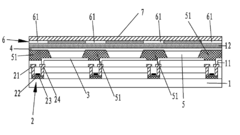
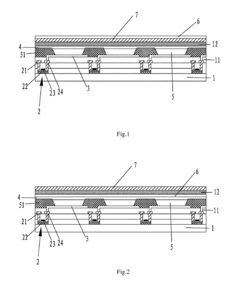
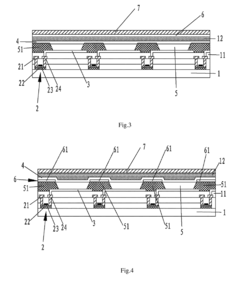
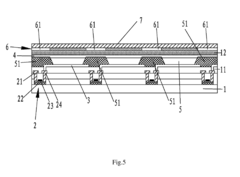
Color filter substrate and manufacturing method thereof, and organic light-emitting diode (OLED) display panel
PatentInactiveUS20210288116A1
Innovation
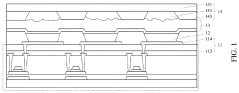
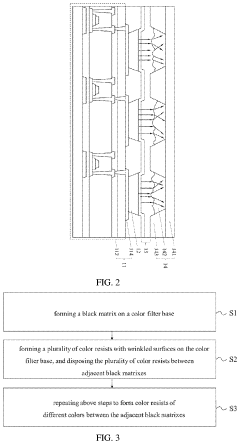
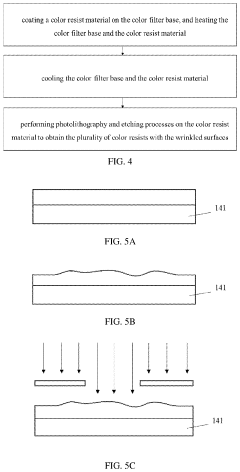
- A color filter substrate with a black matrix and color resists having wrinkled surfaces is introduced, where the black matrix is taller than the color resists, and the color resists are coated, heated, and processed to create irregular surfaces that increase light scattering angles, improving viewing angles without affecting the OLED device's electrical properties.
Energy Efficiency Considerations in Projection Systems
Energy efficiency has become a critical factor in the evaluation of projection systems, particularly when comparing OLED and DLP technologies. DLP (Digital Light Processing) systems traditionally consume more power due to their reliance on high-intensity light sources and complex optical systems. The typical DLP projector requires a powerful lamp that generates significant heat, necessitating additional cooling systems that further increase energy consumption. This energy profile makes DLP projectors less efficient in scenarios where power availability is limited or where operating costs are a major concern.
In contrast, OLED (Organic Light Emitting Diode) projection technology offers inherent energy advantages. OLED systems generate light directly from each pixel without requiring a separate backlight or lamp source. This fundamental difference results in power consumption that can be 30-40% lower than comparable DLP systems, particularly when displaying content with significant dark areas, as OLED pixels consume no power when displaying black.
The brightness-to-power ratio represents a key metric when assessing energy efficiency in projection systems. While DLP systems can achieve higher absolute brightness levels, they do so at the cost of significantly higher energy consumption. OLED projectors typically deliver more lumens per watt, making them more efficient when normalized for brightness output. This efficiency gap widens further in real-world usage scenarios where content rarely requires maximum brightness levels continuously.
Thermal management considerations also impact overall energy efficiency. DLP projectors generate substantial heat that must be dissipated through active cooling systems, which themselves consume additional power. OLED projectors operate at lower temperatures, reducing cooling requirements and associated energy costs. This difference becomes particularly significant in extended operation scenarios such as conference rooms, classrooms, or home theaters where projectors may run for several hours continuously.
Recent advancements in both technologies have focused on improving energy efficiency. Newer DLP systems incorporate more efficient light sources such as laser and LED hybrids, reducing power requirements while maintaining brightness levels. Similarly, OLED technology continues to evolve with more efficient materials and driving electronics. These improvements have narrowed but not eliminated the efficiency gap between the technologies.
From a lifecycle perspective, energy consumption during operation represents a significant portion of a projection system's environmental impact and total cost of ownership. Organizations with sustainability initiatives increasingly factor energy efficiency into procurement decisions, potentially favoring OLED technology despite its typically higher initial acquisition cost. The return on investment calculation must therefore include projected energy costs over the expected operational lifetime of the system.
In contrast, OLED (Organic Light Emitting Diode) projection technology offers inherent energy advantages. OLED systems generate light directly from each pixel without requiring a separate backlight or lamp source. This fundamental difference results in power consumption that can be 30-40% lower than comparable DLP systems, particularly when displaying content with significant dark areas, as OLED pixels consume no power when displaying black.
The brightness-to-power ratio represents a key metric when assessing energy efficiency in projection systems. While DLP systems can achieve higher absolute brightness levels, they do so at the cost of significantly higher energy consumption. OLED projectors typically deliver more lumens per watt, making them more efficient when normalized for brightness output. This efficiency gap widens further in real-world usage scenarios where content rarely requires maximum brightness levels continuously.
Thermal management considerations also impact overall energy efficiency. DLP projectors generate substantial heat that must be dissipated through active cooling systems, which themselves consume additional power. OLED projectors operate at lower temperatures, reducing cooling requirements and associated energy costs. This difference becomes particularly significant in extended operation scenarios such as conference rooms, classrooms, or home theaters where projectors may run for several hours continuously.
Recent advancements in both technologies have focused on improving energy efficiency. Newer DLP systems incorporate more efficient light sources such as laser and LED hybrids, reducing power requirements while maintaining brightness levels. Similarly, OLED technology continues to evolve with more efficient materials and driving electronics. These improvements have narrowed but not eliminated the efficiency gap between the technologies.
From a lifecycle perspective, energy consumption during operation represents a significant portion of a projection system's environmental impact and total cost of ownership. Organizations with sustainability initiatives increasingly factor energy efficiency into procurement decisions, potentially favoring OLED technology despite its typically higher initial acquisition cost. The return on investment calculation must therefore include projected energy costs over the expected operational lifetime of the system.
Thermal Management Strategies for High-Brightness Projectors
Effective thermal management is critical for high-brightness projection systems, particularly when comparing OLED and DLP technologies. DLP projectors typically generate significantly more heat due to their high-intensity light sources, often utilizing metal halide or xenon lamps that can reach temperatures exceeding 200°C during operation. In contrast, OLED-based projectors produce less heat but remain sensitive to thermal conditions that can degrade organic materials and reduce operational lifespan.
The primary thermal management approaches for DLP systems include advanced heat sink designs with copper or aluminum components that efficiently conduct heat away from critical optical elements. These are often supplemented with active cooling systems featuring multiple high-CFM fans strategically positioned to create optimal airflow patterns through the projector chassis. High-end models increasingly incorporate liquid cooling solutions that can reduce operating temperatures by 15-30% compared to conventional air cooling methods.
For OLED projection systems, thermal management focuses on preventing localized hotspots that accelerate pixel degradation. This typically involves more distributed cooling approaches with heat-spreading materials and temperature-sensitive throttling mechanisms that adjust brightness levels to maintain optimal operating conditions. Thermal interface materials with conductivity ratings above 5 W/mK are commonly employed at critical junction points.
Recent innovations in thermal management include phase-change materials that absorb heat during peak operation and release it during cooling cycles, effectively dampening temperature fluctuations. These materials can store 5-10 times more thermal energy than conventional heat sink materials within the same volume constraints. Additionally, microfluidic cooling channels embedded within projector components allow for targeted cooling of high-heat areas without increasing the overall device footprint.
The brightness-to-thermal-load ratio differs significantly between technologies. DLP systems typically require 0.8-1.2 watts of thermal management capacity for each 100 lumens of brightness output, while OLED systems generally need only 0.3-0.5 watts per 100 lumens. However, this advantage is partially offset by OLED's greater sensitivity to temperature variations.
Environmental considerations also impact thermal management strategy selection. Projectors operating in ambient temperatures above 30°C require more robust cooling solutions, often necessitating 30-40% additional thermal dissipation capacity. Altitude also affects cooling efficiency, with air-cooled systems losing approximately 3% cooling capacity per 300 meters of elevation due to decreased air density.
The primary thermal management approaches for DLP systems include advanced heat sink designs with copper or aluminum components that efficiently conduct heat away from critical optical elements. These are often supplemented with active cooling systems featuring multiple high-CFM fans strategically positioned to create optimal airflow patterns through the projector chassis. High-end models increasingly incorporate liquid cooling solutions that can reduce operating temperatures by 15-30% compared to conventional air cooling methods.
For OLED projection systems, thermal management focuses on preventing localized hotspots that accelerate pixel degradation. This typically involves more distributed cooling approaches with heat-spreading materials and temperature-sensitive throttling mechanisms that adjust brightness levels to maintain optimal operating conditions. Thermal interface materials with conductivity ratings above 5 W/mK are commonly employed at critical junction points.
Recent innovations in thermal management include phase-change materials that absorb heat during peak operation and release it during cooling cycles, effectively dampening temperature fluctuations. These materials can store 5-10 times more thermal energy than conventional heat sink materials within the same volume constraints. Additionally, microfluidic cooling channels embedded within projector components allow for targeted cooling of high-heat areas without increasing the overall device footprint.
The brightness-to-thermal-load ratio differs significantly between technologies. DLP systems typically require 0.8-1.2 watts of thermal management capacity for each 100 lumens of brightness output, while OLED systems generally need only 0.3-0.5 watts per 100 lumens. However, this advantage is partially offset by OLED's greater sensitivity to temperature variations.
Environmental considerations also impact thermal management strategy selection. Projectors operating in ambient temperatures above 30°C require more robust cooling solutions, often necessitating 30-40% additional thermal dissipation capacity. Altitude also affects cooling efficiency, with air-cooled systems losing approximately 3% cooling capacity per 300 meters of elevation due to decreased air density.
Unlock deeper insights with Patsnap Eureka Quick Research — get a full tech report to explore trends and direct your research. Try now!
Generate Your Research Report Instantly with AI Agent
Supercharge your innovation with Patsnap Eureka AI Agent Platform!