
Optimizing Power Circuits for OLED Low-Heat Emission
SEP 12, 20259 MIN READ
Generate Your Research Report Instantly with AI Agent
Patsnap Eureka helps you evaluate technical feasibility & market potential.
OLED Power Circuit Evolution and Objectives
Organic Light-Emitting Diode (OLED) technology has undergone significant evolution since its discovery in the 1950s and practical implementation in the 1980s. The journey from simple monochrome displays to today's flexible, high-resolution panels represents a remarkable technological progression driven by continuous improvements in power circuit design. Early OLED implementations suffered from excessive heat generation, power inefficiency, and shortened device lifespan—issues directly linked to suboptimal power circuit architecture.
The fundamental challenge with OLED power circuits stems from their unique operational characteristics. Unlike traditional LED technology, OLEDs require precise current control rather than voltage regulation, as their luminance is directly proportional to the current flowing through the organic layers. This current-driven nature necessitates specialized power management solutions that have evolved through several distinct generations of circuit design.
First-generation OLED power circuits employed basic voltage-to-current conversion techniques with limited efficiency, resulting in significant power loss manifested as heat. Second-generation designs introduced pulse-width modulation (PWM) to improve efficiency but still struggled with heat dissipation at higher brightness levels. Current third-generation architectures incorporate advanced current mirror configurations and digital control systems that have substantially improved thermal performance.
The primary objective in optimizing OLED power circuits for low-heat emission is to maximize energy conversion efficiency while maintaining precise current control across varying operational conditions. This involves minimizing resistive losses in the driving circuitry, implementing intelligent power management algorithms, and developing novel semiconductor materials specifically engineered for OLED applications.
Secondary objectives include reducing circuit complexity to enhance manufacturing yield, improving response to dynamic content to optimize power consumption during real-world usage, and extending device longevity by preventing thermal degradation of organic materials. These goals must be achieved while maintaining compatibility with existing manufacturing processes and meeting increasingly stringent energy efficiency regulations worldwide.
The technological trajectory points toward integrated power management solutions that combine analog precision with digital intelligence. Future developments aim to reduce standby power consumption to near-zero levels, implement predictive brightness algorithms that anticipate content changes to optimize power delivery, and create self-calibrating circuits that adapt to component aging and environmental conditions.
As OLED technology continues to penetrate new markets beyond smartphones and televisions—including automotive displays, wearable devices, and architectural lighting—the demand for ultra-efficient, low-heat power circuits becomes increasingly critical. The ultimate goal is to develop power management systems that enable OLED devices to operate at their theoretical maximum efficiency, where virtually all electrical energy is converted to light rather than heat.
The fundamental challenge with OLED power circuits stems from their unique operational characteristics. Unlike traditional LED technology, OLEDs require precise current control rather than voltage regulation, as their luminance is directly proportional to the current flowing through the organic layers. This current-driven nature necessitates specialized power management solutions that have evolved through several distinct generations of circuit design.
First-generation OLED power circuits employed basic voltage-to-current conversion techniques with limited efficiency, resulting in significant power loss manifested as heat. Second-generation designs introduced pulse-width modulation (PWM) to improve efficiency but still struggled with heat dissipation at higher brightness levels. Current third-generation architectures incorporate advanced current mirror configurations and digital control systems that have substantially improved thermal performance.
The primary objective in optimizing OLED power circuits for low-heat emission is to maximize energy conversion efficiency while maintaining precise current control across varying operational conditions. This involves minimizing resistive losses in the driving circuitry, implementing intelligent power management algorithms, and developing novel semiconductor materials specifically engineered for OLED applications.
Secondary objectives include reducing circuit complexity to enhance manufacturing yield, improving response to dynamic content to optimize power consumption during real-world usage, and extending device longevity by preventing thermal degradation of organic materials. These goals must be achieved while maintaining compatibility with existing manufacturing processes and meeting increasingly stringent energy efficiency regulations worldwide.
The technological trajectory points toward integrated power management solutions that combine analog precision with digital intelligence. Future developments aim to reduce standby power consumption to near-zero levels, implement predictive brightness algorithms that anticipate content changes to optimize power delivery, and create self-calibrating circuits that adapt to component aging and environmental conditions.
As OLED technology continues to penetrate new markets beyond smartphones and televisions—including automotive displays, wearable devices, and architectural lighting—the demand for ultra-efficient, low-heat power circuits becomes increasingly critical. The ultimate goal is to develop power management systems that enable OLED devices to operate at their theoretical maximum efficiency, where virtually all electrical energy is converted to light rather than heat.
Market Analysis for Low-Heat OLED Applications
The OLED display market is experiencing robust growth, with a projected market value reaching $48.8 billion by 2026, growing at a CAGR of 12.9% from 2021. This expansion is primarily driven by increasing adoption in smartphones, televisions, and emerging applications where low heat emission is critical. The demand for low-heat OLED solutions is particularly pronounced in three key market segments.
Consumer electronics represents the largest market segment for low-heat OLED applications. Smartphones alone account for approximately 46% of the global OLED market, with manufacturers like Samsung, Apple, and Huawei increasingly prioritizing devices with reduced thermal signatures. The wearable technology sector, valued at $32.6 billion in 2023, demands ultra-low heat emission displays due to direct skin contact, creating significant opportunities for optimized OLED power circuits.
The automotive industry presents a rapidly growing market for low-heat OLED applications, with the automotive display market expected to reach $30.4 billion by 2025. Premium vehicle manufacturers are incorporating OLED technology in dashboard displays, center consoles, and rear-seat entertainment systems. The reduced heat emission is particularly valuable in automotive environments where thermal management is challenging and component longevity is paramount.
Healthcare and medical devices constitute an emerging but high-value market segment. The medical display market, valued at $2.1 billion in 2022, is increasingly adopting OLED technology for surgical monitors, patient monitoring systems, and portable diagnostic equipment. These applications demand displays that minimize heat transfer to sensitive biological tissues and reduce thermal interference with temperature-sensitive medical procedures.
Regional analysis reveals Asia-Pacific as the dominant market for low-heat OLED applications, accounting for 63% of global production capacity. South Korea leads with Samsung and LG Display controlling 65% of the global OLED panel production. China is rapidly expanding its manufacturing capabilities with significant investments from BOE Technology and CSOT. North America and Europe represent smaller but premium markets, focusing on specialized applications in medical, automotive, and industrial sectors.
Market research indicates that power efficiency has become a primary purchasing consideration for 78% of smartphone consumers and 82% of wearable device buyers. This consumer preference is driving manufacturers to prioritize thermal management solutions, creating a strong market pull for innovations in OLED power circuit optimization that minimize heat emission while maintaining display performance.
Consumer electronics represents the largest market segment for low-heat OLED applications. Smartphones alone account for approximately 46% of the global OLED market, with manufacturers like Samsung, Apple, and Huawei increasingly prioritizing devices with reduced thermal signatures. The wearable technology sector, valued at $32.6 billion in 2023, demands ultra-low heat emission displays due to direct skin contact, creating significant opportunities for optimized OLED power circuits.
The automotive industry presents a rapidly growing market for low-heat OLED applications, with the automotive display market expected to reach $30.4 billion by 2025. Premium vehicle manufacturers are incorporating OLED technology in dashboard displays, center consoles, and rear-seat entertainment systems. The reduced heat emission is particularly valuable in automotive environments where thermal management is challenging and component longevity is paramount.
Healthcare and medical devices constitute an emerging but high-value market segment. The medical display market, valued at $2.1 billion in 2022, is increasingly adopting OLED technology for surgical monitors, patient monitoring systems, and portable diagnostic equipment. These applications demand displays that minimize heat transfer to sensitive biological tissues and reduce thermal interference with temperature-sensitive medical procedures.
Regional analysis reveals Asia-Pacific as the dominant market for low-heat OLED applications, accounting for 63% of global production capacity. South Korea leads with Samsung and LG Display controlling 65% of the global OLED panel production. China is rapidly expanding its manufacturing capabilities with significant investments from BOE Technology and CSOT. North America and Europe represent smaller but premium markets, focusing on specialized applications in medical, automotive, and industrial sectors.
Market research indicates that power efficiency has become a primary purchasing consideration for 78% of smartphone consumers and 82% of wearable device buyers. This consumer preference is driving manufacturers to prioritize thermal management solutions, creating a strong market pull for innovations in OLED power circuit optimization that minimize heat emission while maintaining display performance.
Current Power Circuit Limitations and Thermal Challenges
Current OLED power circuit designs face significant limitations in thermal management, presenting a critical challenge for next-generation display technologies. Conventional power circuits typically operate at efficiency levels between 75-85%, with the remaining energy converted to heat directly within or adjacent to the OLED panel. This heat generation is particularly problematic as OLEDs are inherently temperature-sensitive, with performance degradation accelerating at temperatures exceeding 40°C and potential structural damage occurring above 80°C.
The primary thermal challenges stem from several interconnected factors in current circuit designs. First, traditional switching regulators operate at frequencies between 100kHz-2MHz, creating substantial switching losses that manifest as heat. These losses increase exponentially with higher refresh rates and brightness levels demanded by modern applications. Industry measurements indicate that power conversion losses can account for 15-25% of total system power consumption in high-brightness scenarios.
Capacitive and inductive components in existing circuits further contribute to thermal issues through ESR (Equivalent Series Resistance) losses. Current filtering capacitors typically exhibit ESR values of 50-200mΩ, generating localized hotspots that can reach temperatures 10-15°C above ambient conditions under peak loads. This temperature differential creates thermal gradients across the display, resulting in non-uniform aging and visible performance inconsistencies.
Another significant limitation lies in the spatial constraints of modern device designs. As displays become thinner and bezels narrower, thermal dissipation pathways are increasingly restricted. Current thermal management solutions rely heavily on passive cooling techniques that become inadequate when power densities exceed 0.5W/cm². The thermal conductivity of materials commonly used in OLED stacks (0.2-0.5 W/m·K) creates substantial barriers to efficient heat removal.
Power ripple in existing circuits presents an additional challenge, with typical ripple values of 50-150mV causing fluctuations in OLED brightness. These fluctuations not only impact visual quality but also generate additional heat through the constant adjustment of pixel states. Measurements show that reducing power ripple by 50% can decrease thermal generation by 5-8% in typical usage scenarios.
The industry currently lacks standardized approaches for integrated thermal-electrical co-design. Most power circuit optimizations focus primarily on electrical efficiency metrics without adequately addressing the unique thermal sensitivity of OLED materials. This disconnect has resulted in solutions that achieve nominal electrical specifications but fail to deliver optimal real-world performance due to thermal constraints.
The primary thermal challenges stem from several interconnected factors in current circuit designs. First, traditional switching regulators operate at frequencies between 100kHz-2MHz, creating substantial switching losses that manifest as heat. These losses increase exponentially with higher refresh rates and brightness levels demanded by modern applications. Industry measurements indicate that power conversion losses can account for 15-25% of total system power consumption in high-brightness scenarios.
Capacitive and inductive components in existing circuits further contribute to thermal issues through ESR (Equivalent Series Resistance) losses. Current filtering capacitors typically exhibit ESR values of 50-200mΩ, generating localized hotspots that can reach temperatures 10-15°C above ambient conditions under peak loads. This temperature differential creates thermal gradients across the display, resulting in non-uniform aging and visible performance inconsistencies.
Another significant limitation lies in the spatial constraints of modern device designs. As displays become thinner and bezels narrower, thermal dissipation pathways are increasingly restricted. Current thermal management solutions rely heavily on passive cooling techniques that become inadequate when power densities exceed 0.5W/cm². The thermal conductivity of materials commonly used in OLED stacks (0.2-0.5 W/m·K) creates substantial barriers to efficient heat removal.
Power ripple in existing circuits presents an additional challenge, with typical ripple values of 50-150mV causing fluctuations in OLED brightness. These fluctuations not only impact visual quality but also generate additional heat through the constant adjustment of pixel states. Measurements show that reducing power ripple by 50% can decrease thermal generation by 5-8% in typical usage scenarios.
The industry currently lacks standardized approaches for integrated thermal-electrical co-design. Most power circuit optimizations focus primarily on electrical efficiency metrics without adequately addressing the unique thermal sensitivity of OLED materials. This disconnect has resulted in solutions that achieve nominal electrical specifications but fail to deliver optimal real-world performance due to thermal constraints.
Contemporary Heat Dissipation Solutions for OLED Circuits
01 Heat dissipation circuits for OLED displays
Specialized power circuits designed to manage and dissipate heat generated by OLED displays during operation. These circuits incorporate thermal management components that help regulate temperature and prevent overheating, which can degrade OLED performance and lifespan. The circuits may include heat sinks, thermal pads, or other conductive elements to efficiently transfer heat away from sensitive display components.- Thermal management circuits for OLED displays: Power circuits designed specifically for managing heat emission in OLED displays. These circuits monitor temperature and adjust power delivery to prevent overheating while maintaining display performance. They incorporate temperature sensors and feedback mechanisms to regulate current flow based on thermal conditions, effectively reducing heat generation during operation while preserving image quality.
- Compensation circuits for heat-induced degradation: Specialized circuits that compensate for performance degradation caused by heat emission in OLEDs. These circuits detect changes in OLED characteristics due to temperature variations and apply corrective signals to maintain consistent brightness and color accuracy. The compensation mechanisms adjust voltage or current parameters to counteract thermal effects, extending the operational lifespan of OLED panels.
- Power efficiency optimization for heat reduction: Circuit designs focused on improving power efficiency to minimize heat generation in OLED displays. These circuits employ advanced power management techniques such as dynamic voltage scaling, current limiting, and selective pixel activation to reduce overall power consumption. By optimizing power delivery based on display content and ambient conditions, these circuits significantly decrease heat emission while maintaining visual performance.
- Heat dissipation structures integrated with power circuits: Power circuit designs that incorporate physical heat dissipation structures for OLED displays. These integrated solutions combine electronic power management with thermal conduction paths, heat sinks, or other passive cooling elements. The circuits work in conjunction with these thermal structures to distribute and remove heat from critical components, preventing hotspots and ensuring more uniform temperature across the display.
- Adaptive power control based on display content: Intelligent power circuits that analyze display content to optimize power delivery and reduce heat emission in OLED displays. These circuits dynamically adjust power parameters based on the brightness, color, and complexity of the displayed image. By reducing power to darker areas while maintaining appropriate levels for brighter regions, these systems minimize overall heat generation while preserving visual quality and extending battery life in portable devices.
02 Power efficiency optimization circuits
Circuits designed to optimize power consumption in OLED displays while minimizing heat generation. These circuits employ various techniques such as voltage regulation, current limiting, and power management algorithms to ensure efficient operation. By reducing unnecessary power consumption, these circuits effectively lower heat emission, extending the operational life of OLED displays and improving overall energy efficiency.Expand Specific Solutions03 Temperature compensation circuits for OLEDs
Circuits that actively monitor and compensate for temperature variations in OLED displays. These systems use temperature sensors and feedback mechanisms to adjust power delivery based on detected heat levels. When temperature rises above optimal thresholds, the circuits can modify driving currents or voltages to reduce heat generation while maintaining display quality. This adaptive approach helps prevent thermal damage and ensures consistent visual performance across varying operating conditions.Expand Specific Solutions04 Pulse-width modulation control for heat reduction
Power circuits that implement pulse-width modulation (PWM) techniques to control OLED brightness while minimizing heat generation. By rapidly switching the display elements on and off at varying duty cycles rather than continuously powering them at lower intensity, these circuits can achieve desired brightness levels with reduced overall power consumption and heat emission. The PWM approach allows for more precise control over both visual output and thermal characteristics of OLED displays.Expand Specific Solutions05 Integrated cooling systems for OLED power circuits
Power circuits with built-in cooling mechanisms specifically designed for OLED applications. These integrated systems combine power delivery with active or passive cooling solutions such as microfluidic channels, thermoelectric coolers, or specialized thermal interface materials. The cooling elements work in conjunction with the power circuits to efficiently remove heat from critical components, maintaining optimal operating temperatures even under high brightness or extended usage conditions.Expand Specific Solutions
Leading OLED Power Circuit Manufacturers and Innovators
The OLED low-heat emission power circuit optimization market is currently in a growth phase, with an estimated global market size of $3-5 billion and expanding at 15-20% annually. The competitive landscape is dominated by established display manufacturers with significant R&D capabilities. Samsung Display and LG Display lead with advanced power management technologies for OLED panels, while BOE Technology Group is rapidly gaining market share through aggressive innovation. The technology maturity varies across applications, with mobile device implementations being more advanced than large-format displays. Companies like Himax Technologies and Richtek Technology provide specialized power management ICs, while emerging players such as Visionox (through Kunshan Govisionox) are developing novel thermal management approaches. The competition is intensifying as OLED adoption accelerates across consumer electronics, automotive, and commercial display sectors.
BOE Technology Group Co., Ltd.
Technical Solution: BOE has developed a comprehensive suite of power optimization technologies for their OLED displays focused on minimizing heat generation. Their Intelligent Power Distribution System (IPDS) utilizes segmented power delivery architecture that divides the display into multiple independently powered zones, reducing overall current density and associated heat generation. BOE has implemented advanced compensation algorithms that adjust pixel driving voltages based on real-time temperature monitoring, preventing thermal runaway conditions. Their power circuits incorporate high-efficiency DC-DC converters with adaptive switching frequencies that optimize power delivery based on display content and ambient conditions. BOE has also developed specialized thin-film transistor (TFT) backplanes with reduced parasitic capacitance, lowering switching losses and associated heat generation. Their latest flexible OLED panels feature integrated thermal management layers that help distribute heat more evenly across the display surface.
Strengths: Cost-effective implementation suitable for mass production; excellent scalability across different display sizes; good integration with various device form factors. Weaknesses: Some solutions prioritize manufacturing efficiency over absolute performance; thermal management in ultra-high brightness scenarios still lags behind some competitors.
Samsung Display Co., Ltd.
Technical Solution: Samsung has developed advanced power management integrated circuits (PMICs) specifically for OLED displays that utilize dynamic voltage scaling techniques. Their technology dynamically adjusts the voltage supplied to OLED panels based on displayed content, significantly reducing heat generation. Samsung's Adaptive Power Management System incorporates sophisticated thermal sensors that continuously monitor panel temperature and adjust power delivery accordingly. The company has implemented multi-phase power delivery architectures that distribute power load across multiple smaller circuits, preventing localized heating. Their latest OLED panels incorporate embedded compensation circuits that adjust for pixel aging while maintaining optimal power efficiency, reducing the need for higher voltage operation as displays age. Samsung has also pioneered the use of low-temperature polysilicon (LTPS) backplanes with optimized transistor designs that minimize resistance and subsequent heat generation.
Strengths: Industry-leading integration of power management directly into display drivers; exceptional thermal distribution across large panels; proprietary algorithms for content-adaptive power scaling. Weaknesses: Higher manufacturing costs compared to conventional solutions; requires sophisticated factory calibration; some solutions are heavily optimized for mobile applications and less suitable for larger displays.
Critical Patents in Low-Heat OLED Power Management
Low power consumption OLED material for display applications
PatentInactiveUS20060003487A1
Innovation
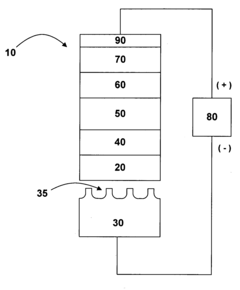
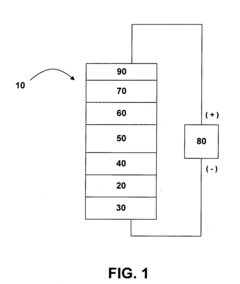
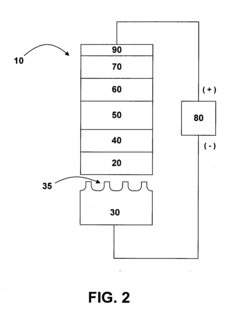
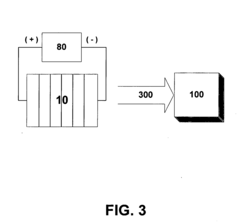
- Incorporating polar compounds with dielectric anisotropy into OLED structures that align when exposed to an electric field, directing light emission in a specific direction to reduce scatter and enhance light transmission to the viewer.
Organic light emitting diode display and driving method thereof
PatentActiveUS7978161B2
Innovation
- The implementation of a driving current stabilizing circuit that compares the driving voltage with pre-set reference voltages for R, G, and B OLED devices, adjusting the current flow to minimize temperature-induced changes and compensate for device degradation, using a temperature sensing circuit to adjust reference voltages accordingly.


Energy Efficiency Standards and Compliance Requirements
Energy efficiency standards for OLED display technologies have evolved significantly over the past decade, establishing increasingly stringent requirements for power consumption and heat emission. The European Union's Ecodesign Directive (2009/125/EC) specifically addresses electronic displays, requiring manufacturers to meet minimum energy efficiency standards that directly impact OLED power circuit design. These regulations mandate standby power consumption below 0.5W and set operational power limits based on screen size and resolution.
In the United States, ENERGY STAR certification for displays requires OLEDs to demonstrate power consumption at least 25% lower than standard models. The latest ENERGY STAR 8.0 specification, effective since 2020, has further tightened these requirements, pushing manufacturers to innovate in power circuit design. California's Title 20 regulations impose additional state-level requirements that often exceed federal standards, creating a complex compliance landscape for OLED manufacturers.
The International Electrotechnical Commission (IEC) has established the IEC 62087 standard specifically for measuring power consumption in display technologies. This standard provides testing methodologies that manufacturers must follow to verify compliance with various regional regulations. Additionally, the IEC 62301 standard addresses measurement of standby power consumption, which is particularly relevant for OLED displays that maintain minimal functionality in standby mode.
China's energy efficiency certification system has introduced the China Energy Label (CEL) with tiered ratings from 1 to 5, with Level 1 representing the most efficient products. These standards are particularly significant given China's dominant position in display manufacturing. Japanese regulations under the Top Runner Program take a different approach by identifying the most efficient products in each category and setting those as benchmarks for future compliance requirements.
Heat emission standards are increasingly being incorporated into energy efficiency frameworks. The International Organization for Standardization (ISO) 9241-307 addresses ergonomic requirements for electronic visual displays, including thermal considerations. These standards limit maximum surface temperatures to prevent user discomfort and potential safety hazards, directly influencing power circuit design decisions.
Compliance with these diverse regulatory frameworks requires sophisticated testing protocols. Manufacturers must demonstrate conformity through standardized testing procedures that measure power consumption across various operational modes, including active use, standby, and off states. Documentation requirements have also become more comprehensive, with detailed technical files needed to support compliance claims in different markets.
In the United States, ENERGY STAR certification for displays requires OLEDs to demonstrate power consumption at least 25% lower than standard models. The latest ENERGY STAR 8.0 specification, effective since 2020, has further tightened these requirements, pushing manufacturers to innovate in power circuit design. California's Title 20 regulations impose additional state-level requirements that often exceed federal standards, creating a complex compliance landscape for OLED manufacturers.
The International Electrotechnical Commission (IEC) has established the IEC 62087 standard specifically for measuring power consumption in display technologies. This standard provides testing methodologies that manufacturers must follow to verify compliance with various regional regulations. Additionally, the IEC 62301 standard addresses measurement of standby power consumption, which is particularly relevant for OLED displays that maintain minimal functionality in standby mode.
China's energy efficiency certification system has introduced the China Energy Label (CEL) with tiered ratings from 1 to 5, with Level 1 representing the most efficient products. These standards are particularly significant given China's dominant position in display manufacturing. Japanese regulations under the Top Runner Program take a different approach by identifying the most efficient products in each category and setting those as benchmarks for future compliance requirements.
Heat emission standards are increasingly being incorporated into energy efficiency frameworks. The International Organization for Standardization (ISO) 9241-307 addresses ergonomic requirements for electronic visual displays, including thermal considerations. These standards limit maximum surface temperatures to prevent user discomfort and potential safety hazards, directly influencing power circuit design decisions.
Compliance with these diverse regulatory frameworks requires sophisticated testing protocols. Manufacturers must demonstrate conformity through standardized testing procedures that measure power consumption across various operational modes, including active use, standby, and off states. Documentation requirements have also become more comprehensive, with detailed technical files needed to support compliance claims in different markets.
Thermal Management Materials and Integration Strategies
Thermal management is a critical aspect of OLED power circuit optimization, as excessive heat can significantly degrade device performance and lifespan. Advanced thermal management materials have emerged as essential components in addressing heat dissipation challenges in OLED applications. These materials include thermally conductive adhesives, specialized thermal interface materials (TIMs), and novel ceramic-based substrates that facilitate efficient heat transfer away from sensitive OLED components.
Graphene-based materials represent a breakthrough in thermal management for OLED circuits, offering exceptional thermal conductivity (up to 5000 W/m·K) while maintaining minimal thickness profiles. These materials can be integrated as heat spreaders within the layered structure of OLED panels, effectively distributing localized heat across larger surface areas. Recent developments have produced graphene composites that combine thermal management properties with electrical insulation capabilities, addressing the dual requirements of OLED power circuits.
Integration strategies for thermal management materials must consider the unique structure of OLED displays. The implementation of micro heat pipes embedded within substrate layers has demonstrated significant improvements in thermal uniformity. These microscale structures, typically ranging from 50-200 μm in diameter, create efficient pathways for heat dissipation without compromising the form factor of thin OLED displays. Computational fluid dynamics (CFD) modeling indicates that strategic placement of these heat pipes can reduce hotspot temperatures by up to 40%.
Phase change materials (PCMs) offer another promising approach for managing thermal fluctuations in OLED circuits. These materials absorb excess heat during peak operation periods and release it during lower power states, effectively dampening temperature variations. Microencapsulated PCMs with transition temperatures between 45-60°C have been successfully integrated into OLED panel structures, providing thermal buffering without electrical interference.
The integration architecture of thermal management systems must balance effectiveness with manufacturing practicality. Multi-layer approaches that combine different thermal management materials have shown superior performance compared to single-material solutions. For instance, a configuration utilizing graphene heat spreaders in conjunction with ceramic-filled polymer TIMs can achieve thermal resistance values below 0.1°C·cm²/W while maintaining mechanical flexibility required for modern OLED applications.
Recent advancements in 3D-printed thermal management structures have enabled customized cooling solutions that conform precisely to specific OLED circuit geometries. These structures incorporate microchannels and optimized surface topographies that maximize heat transfer efficiency while minimizing material usage. Preliminary testing indicates that such tailored solutions can improve thermal performance by 25-30% compared to conventional approaches.
Graphene-based materials represent a breakthrough in thermal management for OLED circuits, offering exceptional thermal conductivity (up to 5000 W/m·K) while maintaining minimal thickness profiles. These materials can be integrated as heat spreaders within the layered structure of OLED panels, effectively distributing localized heat across larger surface areas. Recent developments have produced graphene composites that combine thermal management properties with electrical insulation capabilities, addressing the dual requirements of OLED power circuits.
Integration strategies for thermal management materials must consider the unique structure of OLED displays. The implementation of micro heat pipes embedded within substrate layers has demonstrated significant improvements in thermal uniformity. These microscale structures, typically ranging from 50-200 μm in diameter, create efficient pathways for heat dissipation without compromising the form factor of thin OLED displays. Computational fluid dynamics (CFD) modeling indicates that strategic placement of these heat pipes can reduce hotspot temperatures by up to 40%.
Phase change materials (PCMs) offer another promising approach for managing thermal fluctuations in OLED circuits. These materials absorb excess heat during peak operation periods and release it during lower power states, effectively dampening temperature variations. Microencapsulated PCMs with transition temperatures between 45-60°C have been successfully integrated into OLED panel structures, providing thermal buffering without electrical interference.
The integration architecture of thermal management systems must balance effectiveness with manufacturing practicality. Multi-layer approaches that combine different thermal management materials have shown superior performance compared to single-material solutions. For instance, a configuration utilizing graphene heat spreaders in conjunction with ceramic-filled polymer TIMs can achieve thermal resistance values below 0.1°C·cm²/W while maintaining mechanical flexibility required for modern OLED applications.
Recent advancements in 3D-printed thermal management structures have enabled customized cooling solutions that conform precisely to specific OLED circuit geometries. These structures incorporate microchannels and optimized surface topographies that maximize heat transfer efficiency while minimizing material usage. Preliminary testing indicates that such tailored solutions can improve thermal performance by 25-30% compared to conventional approaches.
Unlock deeper insights with Patsnap Eureka Quick Research — get a full tech report to explore trends and direct your research. Try now!
Generate Your Research Report Instantly with AI Agent
Supercharge your innovation with Patsnap Eureka AI Agent Platform!