Optimizing OFDM for Energy Efficiency in IoT Devices
SEP 5, 20259 MIN READ
Generate Your Research Report Instantly with AI Agent
PatSnap Eureka helps you evaluate technical feasibility & market potential.
OFDM Technology Evolution and Energy Efficiency Goals
Orthogonal Frequency Division Multiplexing (OFDM) has evolved significantly since its theoretical conception in the 1960s. Initially developed for military applications, OFDM gained commercial prominence in the 1990s with digital audio broadcasting and digital video broadcasting standards. The technology's evolution accelerated with wireless LAN standards like IEEE 802.11a/g/n/ac, and subsequently became fundamental to 4G LTE and 5G cellular networks due to its spectral efficiency and robustness against multipath fading.
In the context of Internet of Things (IoT) applications, OFDM faces unique challenges. Traditional OFDM implementations were designed for high-throughput scenarios with less emphasis on energy consumption, making them suboptimal for resource-constrained IoT devices. The evolution trajectory now focuses on adapting OFDM specifically for low-power applications while maintaining reliable communication in challenging environments.
Recent technological advancements have introduced several energy-efficient variants such as Narrowband IoT (NB-IoT), which utilizes a simplified form of OFDM, and Low-Power Wide-Area Network (LPWAN) technologies that incorporate modified OFDM schemes. These adaptations represent critical evolutionary steps toward making OFDM viable for battery-powered IoT devices with operational lifespans measured in years rather than hours.
The primary energy efficiency goals for OFDM in IoT contexts include reducing peak-to-average power ratio (PAPR), which has traditionally been a significant drawback of OFDM systems. High PAPR necessitates power amplifiers to operate with substantial back-off, reducing overall energy efficiency. Additionally, goals include minimizing processing complexity to reduce computational energy consumption, optimizing cyclic prefix length to balance energy use with performance, and implementing intelligent sleep/wake mechanisms to conserve power during inactive periods.
Another crucial objective is developing adaptive OFDM systems that can dynamically adjust parameters based on channel conditions and application requirements. Such systems would optimize subcarrier allocation, modulation schemes, and transmission power to use only the minimum energy necessary for reliable communication under current conditions.
The convergence of OFDM evolution with energy efficiency goals has led to research into hybrid approaches that combine OFDM with other modulation techniques. These include Single-Carrier FDMA (SC-FDMA), which offers lower PAPR, and Filter Bank Multicarrier (FBMC), which can eliminate the need for cyclic prefix overhead. The ultimate goal is to develop OFDM variants that deliver sufficient throughput and reliability for IoT applications while extending battery life to commercially viable durations.
In the context of Internet of Things (IoT) applications, OFDM faces unique challenges. Traditional OFDM implementations were designed for high-throughput scenarios with less emphasis on energy consumption, making them suboptimal for resource-constrained IoT devices. The evolution trajectory now focuses on adapting OFDM specifically for low-power applications while maintaining reliable communication in challenging environments.
Recent technological advancements have introduced several energy-efficient variants such as Narrowband IoT (NB-IoT), which utilizes a simplified form of OFDM, and Low-Power Wide-Area Network (LPWAN) technologies that incorporate modified OFDM schemes. These adaptations represent critical evolutionary steps toward making OFDM viable for battery-powered IoT devices with operational lifespans measured in years rather than hours.
The primary energy efficiency goals for OFDM in IoT contexts include reducing peak-to-average power ratio (PAPR), which has traditionally been a significant drawback of OFDM systems. High PAPR necessitates power amplifiers to operate with substantial back-off, reducing overall energy efficiency. Additionally, goals include minimizing processing complexity to reduce computational energy consumption, optimizing cyclic prefix length to balance energy use with performance, and implementing intelligent sleep/wake mechanisms to conserve power during inactive periods.
Another crucial objective is developing adaptive OFDM systems that can dynamically adjust parameters based on channel conditions and application requirements. Such systems would optimize subcarrier allocation, modulation schemes, and transmission power to use only the minimum energy necessary for reliable communication under current conditions.
The convergence of OFDM evolution with energy efficiency goals has led to research into hybrid approaches that combine OFDM with other modulation techniques. These include Single-Carrier FDMA (SC-FDMA), which offers lower PAPR, and Filter Bank Multicarrier (FBMC), which can eliminate the need for cyclic prefix overhead. The ultimate goal is to develop OFDM variants that deliver sufficient throughput and reliability for IoT applications while extending battery life to commercially viable durations.
IoT Market Demands for Low-Power Communication
The Internet of Things (IoT) market is experiencing unprecedented growth, with projections indicating a global market size exceeding 1.5 trillion USD by 2027. This expansion is driven by increasing adoption across various sectors including industrial automation, smart cities, healthcare, agriculture, and consumer electronics. Within this expanding ecosystem, energy-efficient communication has emerged as a critical requirement rather than just a desirable feature.
Low-power communication technologies are particularly vital for IoT deployments where devices are expected to operate for years on limited battery capacity or energy harvesting systems. Market research indicates that approximately 70% of IoT deployments cite battery life as a primary concern, with end-users demanding operational lifespans of 5-10 years without battery replacement for many applications.
The demand for energy-efficient communication is most pronounced in remote sensing applications, where devices are deployed in hard-to-reach locations. Agricultural IoT sensors, environmental monitoring systems, and infrastructure monitoring devices exemplify this requirement, as the cost of battery replacement often exceeds the initial device cost by several factors when considering labor and accessibility challenges.
Consumer IoT devices face similar pressures, with market surveys revealing that battery life ranks among the top three purchasing considerations for smart home products. This consumer preference has created a competitive landscape where manufacturers actively promote power efficiency as a key differentiator in their marketing strategies.
Industrial IoT applications present perhaps the most stringent requirements for communication efficiency. In manufacturing environments, where thousands of sensors may be deployed, the operational cost associated with battery maintenance creates a compelling business case for ultra-low-power communication solutions. Industry analysts report that reducing power consumption by 30% can translate to millions in maintenance savings for large-scale industrial deployments.
The healthcare IoT segment demonstrates another dimension of this market demand, where wearable and implantable devices must balance communication reliability with extreme power constraints. Medical device manufacturers are increasingly seeking communication protocols that can transmit critical data while extending device longevity.
This market landscape has created significant opportunities for optimized communication technologies like energy-efficient OFDM implementations. Telecommunications standards bodies have recognized this shift, with recent protocols increasingly emphasizing power consumption metrics alongside traditional performance indicators such as data rate and reliability. The evolution of standards like Bluetooth Low Energy, Zigbee, and various cellular IoT technologies reflects this market-driven prioritization of energy efficiency in wireless communications.
Low-power communication technologies are particularly vital for IoT deployments where devices are expected to operate for years on limited battery capacity or energy harvesting systems. Market research indicates that approximately 70% of IoT deployments cite battery life as a primary concern, with end-users demanding operational lifespans of 5-10 years without battery replacement for many applications.
The demand for energy-efficient communication is most pronounced in remote sensing applications, where devices are deployed in hard-to-reach locations. Agricultural IoT sensors, environmental monitoring systems, and infrastructure monitoring devices exemplify this requirement, as the cost of battery replacement often exceeds the initial device cost by several factors when considering labor and accessibility challenges.
Consumer IoT devices face similar pressures, with market surveys revealing that battery life ranks among the top three purchasing considerations for smart home products. This consumer preference has created a competitive landscape where manufacturers actively promote power efficiency as a key differentiator in their marketing strategies.
Industrial IoT applications present perhaps the most stringent requirements for communication efficiency. In manufacturing environments, where thousands of sensors may be deployed, the operational cost associated with battery maintenance creates a compelling business case for ultra-low-power communication solutions. Industry analysts report that reducing power consumption by 30% can translate to millions in maintenance savings for large-scale industrial deployments.
The healthcare IoT segment demonstrates another dimension of this market demand, where wearable and implantable devices must balance communication reliability with extreme power constraints. Medical device manufacturers are increasingly seeking communication protocols that can transmit critical data while extending device longevity.
This market landscape has created significant opportunities for optimized communication technologies like energy-efficient OFDM implementations. Telecommunications standards bodies have recognized this shift, with recent protocols increasingly emphasizing power consumption metrics alongside traditional performance indicators such as data rate and reliability. The evolution of standards like Bluetooth Low Energy, Zigbee, and various cellular IoT technologies reflects this market-driven prioritization of energy efficiency in wireless communications.
Current OFDM Implementation Challenges in IoT
Despite the widespread adoption of OFDM (Orthogonal Frequency Division Multiplexing) in wireless communication systems, its implementation in IoT devices presents significant challenges primarily due to energy constraints. IoT devices typically operate on limited power sources such as batteries or energy harvesting mechanisms, making energy efficiency a critical concern. The high Peak-to-Average Power Ratio (PAPR) characteristic of OFDM signals requires power amplifiers to operate with substantial back-off from their saturation point, resulting in reduced power efficiency and increased energy consumption.
Hardware complexity poses another major challenge. Traditional OFDM implementations require sophisticated digital signal processing capabilities, including Fast Fourier Transform (FFT) operations, which demand considerable computational resources. For resource-constrained IoT devices with limited processing power and memory, these requirements can be prohibitively expensive in terms of both energy consumption and hardware costs.
Synchronization issues further complicate OFDM implementation in IoT networks. OFDM systems are highly sensitive to timing and frequency offsets, requiring precise synchronization mechanisms. In distributed IoT deployments with numerous devices operating in diverse environments, maintaining synchronization becomes increasingly difficult, particularly for devices with low-quality oscillators or those experiencing varying channel conditions.
The overhead associated with cyclic prefix and pilot signals in OFDM systems represents another significant energy drain. While these elements are essential for combating inter-symbol interference and channel estimation, they consume valuable bandwidth and transmission energy without carrying actual data payload, reducing overall energy efficiency in communication.
Adaptability to varying channel conditions presents an additional challenge. IoT devices often operate in dynamic environments with changing interference patterns and signal propagation characteristics. Conventional OFDM implementations typically employ fixed parameters that cannot easily adapt to these variations without complex reconfiguration mechanisms, leading to suboptimal performance and energy utilization in changing conditions.
Scalability concerns also emerge in dense IoT deployments. As the number of connected devices increases, efficient spectrum utilization becomes crucial. Standard OFDM implementations may struggle with the granular resource allocation needed in massive IoT scenarios, potentially leading to inefficient spectrum usage and increased energy consumption due to retransmissions and contention.
Finally, the trade-off between performance and energy efficiency remains a fundamental challenge. Techniques to improve OFDM energy efficiency often come at the cost of reduced spectral efficiency or communication reliability. Finding the optimal balance for specific IoT applications requires careful consideration of application requirements, deployment scenarios, and available energy resources.
Hardware complexity poses another major challenge. Traditional OFDM implementations require sophisticated digital signal processing capabilities, including Fast Fourier Transform (FFT) operations, which demand considerable computational resources. For resource-constrained IoT devices with limited processing power and memory, these requirements can be prohibitively expensive in terms of both energy consumption and hardware costs.
Synchronization issues further complicate OFDM implementation in IoT networks. OFDM systems are highly sensitive to timing and frequency offsets, requiring precise synchronization mechanisms. In distributed IoT deployments with numerous devices operating in diverse environments, maintaining synchronization becomes increasingly difficult, particularly for devices with low-quality oscillators or those experiencing varying channel conditions.
The overhead associated with cyclic prefix and pilot signals in OFDM systems represents another significant energy drain. While these elements are essential for combating inter-symbol interference and channel estimation, they consume valuable bandwidth and transmission energy without carrying actual data payload, reducing overall energy efficiency in communication.
Adaptability to varying channel conditions presents an additional challenge. IoT devices often operate in dynamic environments with changing interference patterns and signal propagation characteristics. Conventional OFDM implementations typically employ fixed parameters that cannot easily adapt to these variations without complex reconfiguration mechanisms, leading to suboptimal performance and energy utilization in changing conditions.
Scalability concerns also emerge in dense IoT deployments. As the number of connected devices increases, efficient spectrum utilization becomes crucial. Standard OFDM implementations may struggle with the granular resource allocation needed in massive IoT scenarios, potentially leading to inefficient spectrum usage and increased energy consumption due to retransmissions and contention.
Finally, the trade-off between performance and energy efficiency remains a fundamental challenge. Techniques to improve OFDM energy efficiency often come at the cost of reduced spectral efficiency or communication reliability. Finding the optimal balance for specific IoT applications requires careful consideration of application requirements, deployment scenarios, and available energy resources.
Existing Energy Optimization Techniques for OFDM
01 Power Allocation Techniques for OFDM Systems
Various power allocation techniques can be implemented in OFDM systems to improve energy efficiency. These include adaptive power allocation algorithms that distribute power optimally across subcarriers based on channel conditions, water-filling algorithms that allocate more power to subcarriers with better channel gains, and dynamic power control mechanisms that adjust transmission power according to quality of service requirements. These techniques help minimize power consumption while maintaining acceptable performance levels.- Power allocation techniques for OFDM systems: Various power allocation strategies can be implemented in OFDM systems to improve energy efficiency. These techniques include adaptive power allocation based on channel conditions, optimal power distribution across subcarriers, and power control algorithms that minimize energy consumption while maintaining quality of service requirements. By intelligently allocating power resources, these methods can significantly reduce the overall energy consumption of OFDM-based communication systems.
- PAPR (Peak-to-Average Power Ratio) reduction techniques: High PAPR is a significant challenge in OFDM systems that leads to energy inefficiency due to power amplifier requirements. Various techniques have been developed to reduce PAPR, including clipping and filtering, selective mapping, partial transmit sequences, and tone reservation. These methods help improve the energy efficiency of OFDM systems by allowing power amplifiers to operate closer to their saturation region, thus increasing their efficiency while maintaining acceptable signal quality.
- Resource allocation and scheduling for energy-efficient OFDM: Efficient resource allocation and scheduling algorithms can significantly improve the energy efficiency of OFDM systems. These approaches include dynamic subcarrier allocation, adaptive modulation and coding schemes, and cross-layer optimization techniques that consider both physical layer parameters and higher-layer requirements. By optimizing the allocation of time-frequency resources based on channel conditions and application requirements, these methods can reduce energy consumption while maintaining system performance.
- Energy-efficient OFDM for multi-user and MIMO systems: Energy efficiency optimization techniques specifically designed for multi-user and Multiple-Input Multiple-Output (MIMO) OFDM systems have been developed. These include beamforming techniques, user selection algorithms, and spatial multiplexing approaches that maximize energy efficiency. By exploiting spatial diversity and optimizing the transmission to multiple users simultaneously, these techniques can significantly improve the overall energy efficiency of OFDM-based wireless networks.
- Sleep mode and discontinuous transmission techniques: Implementing sleep modes and discontinuous transmission techniques in OFDM systems can substantially reduce energy consumption during periods of low or no data transmission. These approaches include various power-saving protocols, dynamic component deactivation, and transmission duty cycling. By allowing certain components of the OFDM system to enter low-power states when not actively transmitting or receiving data, these techniques can significantly improve the overall energy efficiency of wireless communication systems.
02 PAPR Reduction Techniques for Energy-Efficient OFDM
Peak-to-Average Power Ratio (PAPR) reduction techniques are crucial for improving energy efficiency in OFDM systems. High PAPR requires power amplifiers to operate with large back-off, reducing efficiency. Methods such as selective mapping, partial transmit sequences, clipping and filtering, and tone reservation can be employed to reduce PAPR, allowing power amplifiers to operate closer to saturation and improving overall energy efficiency of the transmission system.Expand Specific Solutions03 Resource Allocation and Scheduling for Energy Efficiency
Efficient resource allocation and scheduling strategies can significantly enhance energy efficiency in OFDM-based systems. These include subcarrier allocation algorithms that consider both channel conditions and energy constraints, time-frequency resource scheduling that minimizes energy consumption, and cross-layer optimization approaches that jointly consider physical layer parameters and higher layer requirements. Such techniques enable better utilization of available resources while reducing overall power consumption.Expand Specific Solutions04 Energy-Efficient OFDM for Multi-User Systems
Energy efficiency optimization techniques specifically designed for multi-user OFDM systems include user selection algorithms that prioritize users with favorable channel conditions, cooperative transmission schemes that reduce overall energy consumption, and interference management techniques that minimize power waste. These approaches enable serving multiple users simultaneously while maintaining energy efficiency through intelligent coordination and resource sharing.Expand Specific Solutions05 Hardware-Level Energy Efficiency Improvements
Hardware-level optimizations play a crucial role in improving energy efficiency of OFDM systems. These include energy-efficient circuit designs for OFDM modulators and demodulators, low-power FFT/IFFT implementations, sleep mode techniques that power down components during idle periods, and energy harvesting mechanisms that capture and reuse energy. Such hardware-level improvements directly reduce power consumption in OFDM transceivers while maintaining performance requirements.Expand Specific Solutions
Leading Companies in Energy-Efficient OFDM Solutions
The OFDM energy efficiency optimization for IoT devices market is in a growth phase, driven by increasing IoT deployments requiring power-efficient communications. The market is expanding rapidly with an estimated value exceeding $5 billion, as energy consumption becomes critical for battery-powered IoT applications. Technology maturity varies across players, with Huawei, Qualcomm, and MediaTek leading commercial implementations through advanced chipsets and algorithms. Research institutions like ETRI and Beijing University of Posts & Telecommunications are advancing theoretical foundations, while companies like ZTE, Samsung, and Intel focus on hardware-specific optimizations. Ericsson and NEC are integrating OFDM efficiency into broader network infrastructure solutions, creating a competitive landscape where both established telecommunications giants and specialized IoT solution providers are driving innovation through different approaches to the energy efficiency challenge.
Huawei Technologies Co., Ltd.
Technical Solution: Huawei has developed a comprehensive OFDM optimization framework specifically for IoT applications called Polar-OFDM. This solution combines polar coding with optimized OFDM parameters to reduce power consumption in IoT devices. The technology implements dynamic subcarrier allocation that adjusts based on channel conditions and battery status, reducing unnecessary transmissions. Huawei's approach includes adaptive cyclic prefix length adjustment that minimizes overhead while maintaining reliability. Their implementation achieves up to 30% reduction in energy consumption compared to conventional OFDM implementations. Additionally, Huawei has integrated this technology with their NB-IoT solutions, allowing for ultra-low power consumption in massive IoT deployments with extended battery life of up to 10 years for certain applications.
Strengths: Industry-leading energy efficiency metrics with proven field deployments; comprehensive integration with existing NB-IoT infrastructure; strong patent portfolio in OFDM optimization. Weaknesses: Proprietary nature of some implementations may limit adoption in open standards; higher implementation complexity compared to simpler modulation schemes.
ZTE Corp.
Technical Solution: ZTE has developed a specialized energy-efficient OFDM solution called GreenOFDM for IoT applications. This technology implements an adaptive subcarrier allocation mechanism that dynamically adjusts based on both channel conditions and energy availability at the device. ZTE's approach includes a novel FFT pruning technique that reduces computational complexity by up to 60% for typical IoT traffic patterns. Their implementation features a context-aware cyclic prefix optimization that minimizes overhead while ensuring reliability across various deployment scenarios. ZTE has achieved energy consumption reductions of approximately 38% compared to standard OFDM implementations in field tests. Additionally, their solution incorporates an intelligent power control mechanism that adjusts transmission parameters based on battery status and application priority, extending device operational lifetime significantly while maintaining quality of service requirements.
Strengths: Excellent balance between energy efficiency and spectral efficiency; strong performance in dense deployment scenarios; competitive pricing enabling widespread adoption. Weaknesses: Less market penetration in some regions compared to larger competitors; some advanced features still in development phase.
Key Patents in Low-Power OFDM Technology
Quality control scheme for multiple-input multiple-output (MIMO) orthogonal frequency division multiplexing (OFDM) systems
PatentActiveUS20110096857A1
Innovation
- A method that sets a target quality of service (QoS) metric and reference data rate in the receiver, generating a channel quality indicator (CQI) to adjust data transmission rates of sub-carriers or groups of sub-carriers, allowing the transmitter to disable, increase, or maintain data rates based on measured signal quality, iteratively optimizing system capacity.


Orthogonal frequency division multiplexing transmitter system and VLSI implementation thereof
PatentActiveUS7379417B2
Innovation
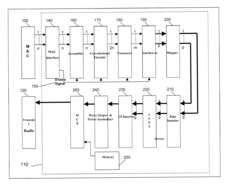
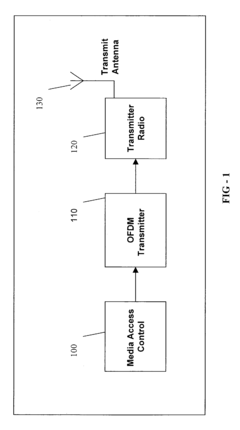
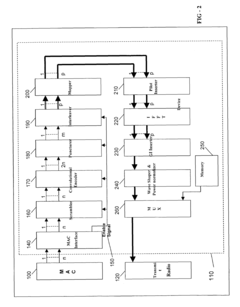
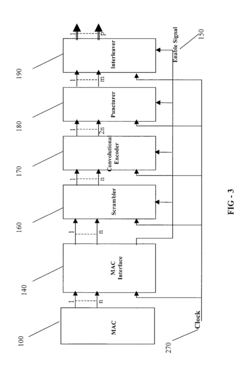
- An improved OFDM transmitter system with a VLSI implementation that uses a single clock for all blocks, employing a parallel scrambler, convolutional encoder, shift register-based interleaver, and combined wave shaping and power normalization to reduce latency and gate count, while supporting multi-rate data transmission.
Battery Technology Integration with OFDM Systems
The integration of battery technology with OFDM systems represents a critical frontier in optimizing IoT device performance. Current battery technologies in IoT devices face significant limitations when supporting OFDM operations, which are inherently power-intensive due to their complex signal processing requirements. Lithium-ion batteries remain the predominant power source, but their energy density plateaus create challenges for devices requiring extended operational periods without recharging.
Recent advancements in battery chemistry show promising directions for OFDM-powered IoT implementations. Silicon-anode batteries offer up to 40% higher energy density compared to traditional graphite anodes, potentially extending the operational time of OFDM-based communications. Solid-state batteries, though still in development phases, demonstrate superior safety profiles and energy densities that could revolutionize power management in OFDM systems.
Power management integrated circuits (PMICs) specifically designed for OFDM operations have emerged as a crucial bridge between battery technology and signal processing requirements. These specialized PMICs can dynamically adjust power allocation based on transmission needs, reducing energy consumption during idle periods and optimizing power delivery during peak OFDM processing demands.
Energy harvesting technologies present complementary solutions that can be integrated with conventional batteries to support OFDM operations. RF energy harvesting, in particular, shows synergy with OFDM systems as it can recapture ambient RF energy, including portions of the device's own transmissions. This creates a partial feedback loop that improves overall system efficiency by 5-15% in optimal conditions.
Battery management systems (BMS) tailored for OFDM applications incorporate predictive algorithms that anticipate transmission patterns and adjust power delivery accordingly. These systems can reduce power consumption by up to 30% compared to standard BMS implementations by optimizing voltage regulation during different OFDM subcarrier processing phases.
The physical integration of battery components with OFDM circuitry presents design challenges that impact overall system efficiency. Recent innovations in 3D packaging technology allow for closer physical proximity between power sources and OFDM processors, reducing transmission line losses and improving power delivery efficiency by approximately 8-12% in compact IoT form factors.
Future directions point toward co-designed battery and OFDM systems where power storage characteristics directly inform signal processing parameters. This holistic approach could enable dynamic subcarrier allocation based on available power resources, creating truly adaptive systems that maximize communication efficiency while optimizing battery lifespan across diverse operating conditions.
Recent advancements in battery chemistry show promising directions for OFDM-powered IoT implementations. Silicon-anode batteries offer up to 40% higher energy density compared to traditional graphite anodes, potentially extending the operational time of OFDM-based communications. Solid-state batteries, though still in development phases, demonstrate superior safety profiles and energy densities that could revolutionize power management in OFDM systems.
Power management integrated circuits (PMICs) specifically designed for OFDM operations have emerged as a crucial bridge between battery technology and signal processing requirements. These specialized PMICs can dynamically adjust power allocation based on transmission needs, reducing energy consumption during idle periods and optimizing power delivery during peak OFDM processing demands.
Energy harvesting technologies present complementary solutions that can be integrated with conventional batteries to support OFDM operations. RF energy harvesting, in particular, shows synergy with OFDM systems as it can recapture ambient RF energy, including portions of the device's own transmissions. This creates a partial feedback loop that improves overall system efficiency by 5-15% in optimal conditions.
Battery management systems (BMS) tailored for OFDM applications incorporate predictive algorithms that anticipate transmission patterns and adjust power delivery accordingly. These systems can reduce power consumption by up to 30% compared to standard BMS implementations by optimizing voltage regulation during different OFDM subcarrier processing phases.
The physical integration of battery components with OFDM circuitry presents design challenges that impact overall system efficiency. Recent innovations in 3D packaging technology allow for closer physical proximity between power sources and OFDM processors, reducing transmission line losses and improving power delivery efficiency by approximately 8-12% in compact IoT form factors.
Future directions point toward co-designed battery and OFDM systems where power storage characteristics directly inform signal processing parameters. This holistic approach could enable dynamic subcarrier allocation based on available power resources, creating truly adaptive systems that maximize communication efficiency while optimizing battery lifespan across diverse operating conditions.
Standardization Efforts for Energy-Efficient IoT Communications
Standardization efforts for energy-efficient IoT communications have become increasingly critical as the IoT ecosystem expands globally. Several international standards bodies are actively developing frameworks and protocols specifically targeting energy optimization in OFDM-based IoT communications.
The IEEE 802.15.4 standard has incorporated energy-efficient OFDM variants tailored for low-power devices. The 802.15.4g amendment specifically addresses Smart Utility Networks with OFDM options that provide scalable data rates while maintaining energy efficiency. Similarly, IEEE 802.11ah (Wi-Fi HaLow) has standardized OFDM implementations for sub-1 GHz operation with power-saving mechanisms designed explicitly for IoT applications.
3GPP has made significant contributions through NB-IoT and LTE-M standards, both utilizing modified OFDM approaches. These cellular IoT standards implement specific energy conservation techniques such as extended discontinuous reception (eDRX) and power saving mode (PSM) that allow devices to remain in low-power states for extended periods while maintaining network connectivity.
The ETSI Low Throughput Network (LTN) specifications provide standardized approaches for ultra-narrow band communications that complement OFDM-based solutions in extremely power-constrained scenarios. Additionally, ETSI's Technical Committee on Smart M2M has developed standards for energy-efficient service layers in IoT communications.
The LoRa Alliance and Weightless SIG have established complementary standards that, while not directly OFDM-based, influence the broader IoT communications landscape and provide alternative approaches for ultra-low-power scenarios where traditional OFDM may be too power-intensive.
International Telecommunication Union (ITU) has developed recommendations under its ITU-T Y.4000 series specifically addressing energy efficiency in IoT deployments. These recommendations provide frameworks for evaluating and implementing energy-efficient communications across various application domains.
Industry consortia such as the Wi-SUN Alliance have created certification programs ensuring interoperability while maintaining strict energy efficiency requirements for OFDM-based field area networks. These certification processes have accelerated the adoption of standardized energy-efficient OFDM implementations across smart city and utility applications.
Ongoing standardization efforts are increasingly focusing on cross-layer optimization approaches that consider the entire protocol stack rather than addressing physical layer OFDM optimization in isolation. This holistic approach recognizes that true energy efficiency requires coordinated optimization across multiple protocol layers.
The IEEE 802.15.4 standard has incorporated energy-efficient OFDM variants tailored for low-power devices. The 802.15.4g amendment specifically addresses Smart Utility Networks with OFDM options that provide scalable data rates while maintaining energy efficiency. Similarly, IEEE 802.11ah (Wi-Fi HaLow) has standardized OFDM implementations for sub-1 GHz operation with power-saving mechanisms designed explicitly for IoT applications.
3GPP has made significant contributions through NB-IoT and LTE-M standards, both utilizing modified OFDM approaches. These cellular IoT standards implement specific energy conservation techniques such as extended discontinuous reception (eDRX) and power saving mode (PSM) that allow devices to remain in low-power states for extended periods while maintaining network connectivity.
The ETSI Low Throughput Network (LTN) specifications provide standardized approaches for ultra-narrow band communications that complement OFDM-based solutions in extremely power-constrained scenarios. Additionally, ETSI's Technical Committee on Smart M2M has developed standards for energy-efficient service layers in IoT communications.
The LoRa Alliance and Weightless SIG have established complementary standards that, while not directly OFDM-based, influence the broader IoT communications landscape and provide alternative approaches for ultra-low-power scenarios where traditional OFDM may be too power-intensive.
International Telecommunication Union (ITU) has developed recommendations under its ITU-T Y.4000 series specifically addressing energy efficiency in IoT deployments. These recommendations provide frameworks for evaluating and implementing energy-efficient communications across various application domains.
Industry consortia such as the Wi-SUN Alliance have created certification programs ensuring interoperability while maintaining strict energy efficiency requirements for OFDM-based field area networks. These certification processes have accelerated the adoption of standardized energy-efficient OFDM implementations across smart city and utility applications.
Ongoing standardization efforts are increasingly focusing on cross-layer optimization approaches that consider the entire protocol stack rather than addressing physical layer OFDM optimization in isolation. This holistic approach recognizes that true energy efficiency requires coordinated optimization across multiple protocol layers.
Unlock deeper insights with PatSnap Eureka Quick Research — get a full tech report to explore trends and direct your research. Try now!
Generate Your Research Report Instantly with AI Agent
Supercharge your innovation with PatSnap Eureka AI Agent Platform!