

Optimizing Thermoelectric Materials for Fast Response Applications
AUG 27, 202510 MIN READ
Generate Your Research Report Instantly with AI Agent
PatSnap Eureka helps you evaluate technical feasibility & market potential.
Thermoelectric Materials Background and Objectives
Thermoelectric materials have evolved significantly since their discovery in the early 19th century, with the Seebeck effect first observed in 1821 by Thomas Johann Seebeck. This phenomenon, where a temperature difference across a material creates an electrical potential, forms the foundation of thermoelectric technology. Over the past two centuries, research has progressed from basic understanding of thermoelectric principles to sophisticated material engineering aimed at enhancing efficiency and response times.
The evolution of thermoelectric materials has seen three distinct generations. First-generation materials were primarily based on bismuth telluride (Bi₂Te₃) and lead telluride (PbTe), offering modest efficiency but limited by their response speed. Second-generation materials introduced nanostructuring techniques to reduce thermal conductivity while maintaining electrical conductivity, improving the figure of merit (ZT). Current third-generation materials explore complex structures, including skutterudites, half-Heusler alloys, and organic-inorganic hybrids, specifically designed to optimize both efficiency and response time.
Recent technological trends indicate a growing focus on fast-response thermoelectric materials, driven by emerging applications in wearable electronics, IoT sensors, and rapid thermal management systems. The ability to quickly convert temperature differentials into electrical signals or vice versa has become increasingly critical for real-time monitoring and control systems. This shift represents a departure from traditional thermoelectric research, which primarily emphasized maximizing the ZT value without significant consideration for response dynamics.
The primary objective of this technical research is to identify and develop thermoelectric materials optimized specifically for fast response applications. This involves investigating novel material compositions, innovative nanostructuring approaches, and interface engineering techniques that can reduce thermal mass while maintaining or improving thermoelectric conversion efficiency. The target is to achieve response times in the sub-second range, representing an order of magnitude improvement over conventional thermoelectric materials.
Secondary objectives include enhancing material stability under rapid thermal cycling conditions, reducing manufacturing complexity to enable cost-effective scaling, and ensuring compatibility with flexible substrates for wearable applications. Additionally, the research aims to establish standardized testing protocols for evaluating response dynamics in thermoelectric materials, addressing a significant gap in current characterization methodologies.
The long-term technological goal is to enable a new generation of responsive thermoelectric devices capable of adapting to rapidly changing thermal environments, opening new application domains beyond traditional steady-state energy harvesting and cooling systems. This represents a paradigm shift in thermoelectric technology from static to dynamic thermal management solutions.
The evolution of thermoelectric materials has seen three distinct generations. First-generation materials were primarily based on bismuth telluride (Bi₂Te₃) and lead telluride (PbTe), offering modest efficiency but limited by their response speed. Second-generation materials introduced nanostructuring techniques to reduce thermal conductivity while maintaining electrical conductivity, improving the figure of merit (ZT). Current third-generation materials explore complex structures, including skutterudites, half-Heusler alloys, and organic-inorganic hybrids, specifically designed to optimize both efficiency and response time.
Recent technological trends indicate a growing focus on fast-response thermoelectric materials, driven by emerging applications in wearable electronics, IoT sensors, and rapid thermal management systems. The ability to quickly convert temperature differentials into electrical signals or vice versa has become increasingly critical for real-time monitoring and control systems. This shift represents a departure from traditional thermoelectric research, which primarily emphasized maximizing the ZT value without significant consideration for response dynamics.
The primary objective of this technical research is to identify and develop thermoelectric materials optimized specifically for fast response applications. This involves investigating novel material compositions, innovative nanostructuring approaches, and interface engineering techniques that can reduce thermal mass while maintaining or improving thermoelectric conversion efficiency. The target is to achieve response times in the sub-second range, representing an order of magnitude improvement over conventional thermoelectric materials.
Secondary objectives include enhancing material stability under rapid thermal cycling conditions, reducing manufacturing complexity to enable cost-effective scaling, and ensuring compatibility with flexible substrates for wearable applications. Additionally, the research aims to establish standardized testing protocols for evaluating response dynamics in thermoelectric materials, addressing a significant gap in current characterization methodologies.
The long-term technological goal is to enable a new generation of responsive thermoelectric devices capable of adapting to rapidly changing thermal environments, opening new application domains beyond traditional steady-state energy harvesting and cooling systems. This represents a paradigm shift in thermoelectric technology from static to dynamic thermal management solutions.
Market Demand Analysis for Fast Response Thermoelectric Applications
The global market for fast response thermoelectric applications has witnessed significant growth in recent years, driven by increasing demand across multiple sectors including automotive, medical, consumer electronics, and industrial applications. The thermoelectric materials market was valued at approximately $51.6 billion in 2022 and is projected to reach $79.7 billion by 2028, growing at a CAGR of 7.5% during the forecast period.
In the automotive sector, thermoelectric generators (TEGs) for waste heat recovery represent a substantial market opportunity. With stringent emission regulations worldwide, automotive manufacturers are increasingly incorporating thermoelectric systems to improve fuel efficiency. The automotive thermoelectric market segment alone is expected to grow at 9.2% annually through 2030, with particular emphasis on materials that can respond rapidly to temperature fluctuations.
The medical device industry presents another significant market for fast-response thermoelectric materials. Precision temperature control in diagnostic equipment, patient monitoring systems, and therapeutic devices requires materials with minimal thermal lag. Market analysis indicates that medical applications of thermoelectric cooling systems are growing at 8.7% annually, with particular demand for miniaturized, responsive cooling solutions.
Consumer electronics represents perhaps the most volume-intensive application area. Thermal management in smartphones, laptops, and wearable devices increasingly relies on thermoelectric solutions that can quickly respond to processing loads. This segment values materials that can provide rapid cooling without significant power consumption, with market research showing consumers willing to pay premium prices for devices with superior thermal management.
Industrial applications, particularly in semiconductor manufacturing and precision instrumentation, require extremely responsive temperature control systems. The industrial segment values stability and reliability alongside response time, with market growth of 6.8% annually for specialized thermoelectric solutions.
Geographically, North America and Asia-Pacific dominate the market for advanced thermoelectric materials. China has emerged as both a major consumer and producer, with substantial investments in research and manufacturing capacity. Japan maintains leadership in high-performance applications, while European markets focus primarily on automotive and industrial applications.
Market barriers include the relatively high cost of high-performance thermoelectric materials and competition from alternative cooling technologies. However, the unique advantages of thermoelectric systems—including solid-state operation, precise temperature control, and scalability—continue to drive adoption in applications where rapid thermal response is critical.
In the automotive sector, thermoelectric generators (TEGs) for waste heat recovery represent a substantial market opportunity. With stringent emission regulations worldwide, automotive manufacturers are increasingly incorporating thermoelectric systems to improve fuel efficiency. The automotive thermoelectric market segment alone is expected to grow at 9.2% annually through 2030, with particular emphasis on materials that can respond rapidly to temperature fluctuations.
The medical device industry presents another significant market for fast-response thermoelectric materials. Precision temperature control in diagnostic equipment, patient monitoring systems, and therapeutic devices requires materials with minimal thermal lag. Market analysis indicates that medical applications of thermoelectric cooling systems are growing at 8.7% annually, with particular demand for miniaturized, responsive cooling solutions.
Consumer electronics represents perhaps the most volume-intensive application area. Thermal management in smartphones, laptops, and wearable devices increasingly relies on thermoelectric solutions that can quickly respond to processing loads. This segment values materials that can provide rapid cooling without significant power consumption, with market research showing consumers willing to pay premium prices for devices with superior thermal management.
Industrial applications, particularly in semiconductor manufacturing and precision instrumentation, require extremely responsive temperature control systems. The industrial segment values stability and reliability alongside response time, with market growth of 6.8% annually for specialized thermoelectric solutions.
Geographically, North America and Asia-Pacific dominate the market for advanced thermoelectric materials. China has emerged as both a major consumer and producer, with substantial investments in research and manufacturing capacity. Japan maintains leadership in high-performance applications, while European markets focus primarily on automotive and industrial applications.
Market barriers include the relatively high cost of high-performance thermoelectric materials and competition from alternative cooling technologies. However, the unique advantages of thermoelectric systems—including solid-state operation, precise temperature control, and scalability—continue to drive adoption in applications where rapid thermal response is critical.
Current State and Challenges in Thermoelectric Material Development
Thermoelectric materials have witnessed significant advancements over the past decade, yet several challenges persist in optimizing these materials for fast response applications. Current commercial thermoelectric devices primarily utilize bismuth telluride (Bi2Te3) based materials, which offer a figure of merit (ZT) of approximately 1.0 at room temperature. While this performance is adequate for steady-state applications, it falls short for scenarios requiring rapid thermal response times.
The global research landscape reveals intensive efforts across North America, Europe, and East Asia, with China and the United States leading in publication output. Recent breakthroughs include nanostructured materials achieving ZT values exceeding 2.0 in laboratory settings, though translating these achievements to commercial production remains problematic. The gap between laboratory performance and industrial implementation represents one of the field's most significant challenges.
Material stability presents another critical obstacle, particularly for fast response applications where thermal cycling occurs frequently. Current materials often exhibit performance degradation after repeated thermal cycles, limiting their operational lifespan. Additionally, the mechanical properties of high-performance thermoelectric materials tend to be suboptimal, with many being brittle and susceptible to fracture under thermal stress.
Manufacturing scalability constitutes a substantial barrier to widespread adoption. Laboratory techniques for creating high-performance nanostructured thermoelectric materials typically involve complex processes that are difficult to scale economically. The precision required for maintaining optimal nanostructure during mass production has proven particularly challenging.
Environmental concerns also impact development trajectories, as many high-performance thermoelectric materials contain toxic or rare elements like tellurium, lead, and antimony. Regulatory pressures and sustainability considerations are driving research toward alternative compositions with reduced environmental impact, though these alternatives currently demonstrate lower performance metrics.
Interface engineering remains a technical bottleneck for fast response applications. The thermal and electrical contact resistances at material interfaces significantly affect response times and overall efficiency. Current joining technologies often introduce performance penalties that disproportionately impact dynamic applications requiring rapid response.
Cost factors continue to limit market penetration, with high-performance thermoelectric materials typically costing orders of magnitude more than conventional thermal management solutions. The complex manufacturing processes, expensive raw materials, and low production volumes contribute to this cost premium, restricting applications primarily to specialized markets where performance justifies the expense.
Recent innovations in flexible thermoelectric materials show promise for wearable and conformal applications, though these materials generally exhibit lower ZT values compared to rigid alternatives. The trade-off between mechanical flexibility and thermoelectric performance represents an ongoing challenge for expanding application possibilities.
The global research landscape reveals intensive efforts across North America, Europe, and East Asia, with China and the United States leading in publication output. Recent breakthroughs include nanostructured materials achieving ZT values exceeding 2.0 in laboratory settings, though translating these achievements to commercial production remains problematic. The gap between laboratory performance and industrial implementation represents one of the field's most significant challenges.
Material stability presents another critical obstacle, particularly for fast response applications where thermal cycling occurs frequently. Current materials often exhibit performance degradation after repeated thermal cycles, limiting their operational lifespan. Additionally, the mechanical properties of high-performance thermoelectric materials tend to be suboptimal, with many being brittle and susceptible to fracture under thermal stress.
Manufacturing scalability constitutes a substantial barrier to widespread adoption. Laboratory techniques for creating high-performance nanostructured thermoelectric materials typically involve complex processes that are difficult to scale economically. The precision required for maintaining optimal nanostructure during mass production has proven particularly challenging.
Environmental concerns also impact development trajectories, as many high-performance thermoelectric materials contain toxic or rare elements like tellurium, lead, and antimony. Regulatory pressures and sustainability considerations are driving research toward alternative compositions with reduced environmental impact, though these alternatives currently demonstrate lower performance metrics.
Interface engineering remains a technical bottleneck for fast response applications. The thermal and electrical contact resistances at material interfaces significantly affect response times and overall efficiency. Current joining technologies often introduce performance penalties that disproportionately impact dynamic applications requiring rapid response.
Cost factors continue to limit market penetration, with high-performance thermoelectric materials typically costing orders of magnitude more than conventional thermal management solutions. The complex manufacturing processes, expensive raw materials, and low production volumes contribute to this cost premium, restricting applications primarily to specialized markets where performance justifies the expense.
Recent innovations in flexible thermoelectric materials show promise for wearable and conformal applications, though these materials generally exhibit lower ZT values compared to rigid alternatives. The trade-off between mechanical flexibility and thermoelectric performance represents an ongoing challenge for expanding application possibilities.
Current Optimization Approaches for Fast Response Thermoelectrics
01 Response time improvement in thermoelectric materials
Various methods and compositions have been developed to improve the response time of thermoelectric materials. These include optimizing material composition, reducing thermal mass, and enhancing thermal conductivity pathways. Improved response time allows thermoelectric devices to react more quickly to temperature changes, making them more efficient for applications requiring rapid heating or cooling cycles.- Response time optimization in thermoelectric materials: Thermoelectric materials can be optimized to improve their response time to temperature changes. This involves engineering the material composition and structure to enhance thermal conductivity while maintaining electrical properties. Faster response times are critical for applications requiring rapid temperature sensing or quick conversion between thermal and electrical energy. Various doping techniques and nanostructuring approaches can significantly reduce the thermal lag in these materials.
- Nanostructured thermoelectric materials for improved performance: Nanostructuring of thermoelectric materials can dramatically improve their response characteristics. By creating materials with features at the nanoscale, phonon scattering can be enhanced while preserving electron transport, leading to improved figure of merit and faster response times. These nanostructured materials exhibit reduced thermal inertia, allowing them to respond more quickly to temperature gradients and improve overall system efficiency in dynamic operating conditions.
- Thin-film thermoelectric devices with enhanced response time: Thin-film thermoelectric devices offer significantly faster response times compared to bulk materials due to their reduced thermal mass. These films can be fabricated using various deposition techniques to create precisely controlled structures with optimized interfaces. The reduced thickness minimizes the thermal diffusion distance, allowing for nearly instantaneous response to temperature changes, making them ideal for rapid cooling applications and high-frequency thermal energy harvesting systems.
- Composite thermoelectric materials for balanced properties: Composite thermoelectric materials combine different constituents to achieve an optimal balance between response time and other performance metrics. By integrating materials with complementary properties, these composites can overcome the traditional trade-offs between thermal conductivity, electrical conductivity, and Seebeck coefficient. The strategic combination of materials with different thermal diffusivities allows for tailored response characteristics while maintaining high conversion efficiency across various operating conditions.
- Dynamic response characterization methods for thermoelectric materials: Various methods have been developed to accurately characterize the dynamic response of thermoelectric materials. These techniques include transient measurements, frequency-domain analysis, and pulse response testing. Advanced characterization methods enable precise determination of thermal time constants and response delays in thermoelectric systems. This information is crucial for designing applications where rapid thermal-to-electrical energy conversion is required, such as in sensors, waste heat recovery systems, and temperature control devices.
02 Nanostructured thermoelectric materials for faster response
Nanostructured thermoelectric materials demonstrate significantly faster response times compared to bulk materials. By reducing the characteristic dimensions to the nanoscale, thermal and electrical transport properties can be independently optimized. These materials feature enhanced phonon scattering at interfaces while maintaining good electrical conductivity, resulting in both improved efficiency and faster thermal response.Expand Specific Solutions03 Thin-film thermoelectric devices with rapid response characteristics
Thin-film thermoelectric devices offer significantly reduced response times due to their minimal thermal mass and short heat transfer paths. These films, often deposited using techniques such as sputtering or vapor deposition, can respond to temperature changes in milliseconds rather than seconds. The reduced thickness allows for faster temperature equilibration and more immediate generation of thermoelectric effects when exposed to temperature gradients.Expand Specific Solutions04 Circuit designs for optimizing thermoelectric response time
Specialized circuit designs can significantly improve the effective response time of thermoelectric systems. These include pulse-width modulation controllers, adaptive feedback mechanisms, and pre-emptive control algorithms that anticipate thermal loads. By optimizing the electrical input to thermoelectric modules based on real-time temperature sensing, these circuits can achieve faster temperature stabilization and more responsive thermal management.Expand Specific Solutions05 Novel composite materials for enhanced thermoelectric response
Composite thermoelectric materials combine different constituents to achieve faster response times while maintaining high efficiency. These may include polymer-inorganic hybrids, multi-phase alloys, or gradient structures that optimize both thermal and electrical properties. By engineering interfaces between dissimilar materials, phonon transport can be disrupted while preserving electron flow, leading to devices that respond more quickly to temperature changes.Expand Specific Solutions
Key Industry Players in Thermoelectric Materials Research
The thermoelectric materials optimization market for fast response applications is currently in a growth phase, with increasing demand driven by energy harvesting and thermal management needs. The market size is expanding rapidly, projected to reach significant value as industries seek more efficient thermal solutions. Technologically, the field shows varying maturity levels across applications. Leading academic institutions like Zhejiang University, California Institute of Technology, and The University of Manchester are advancing fundamental research, while commercial players demonstrate different specialization levels. Companies like O-Flexx Technologies and Toyota are developing practical applications, with LG Innotek, Samsung, and BASF bringing materials expertise. Continental Automotive and MAHLE are focusing on automotive implementations, indicating the technology's cross-industry relevance and growing commercial viability.
BASF Corp.
Technical Solution: BASF在热电材料快速响应应用领域的技术方案围绕着有机-无机杂化热电材料系统。他们开发了一种创新的聚合物/无机纳米复合材料,将导电聚合物(如PEDOT:PSS)与纳米结构无机填料(如碲化铋纳米线或石墨烯)结合,创造出兼具柔性和快速热响应特性的新型材料。BASF的研究团队通过精确控制聚合物链构型和纳米填料的分散度,优化了电子传输路径,同时利用聚合物-纳米填料界面散射声子,有效降低了热导率。这种材料在室温下实现了ZT值约0.6,虽低于最佳无机材料,但响应速度显著提升,达到约50毫秒。BASF还开发了一种专有的溶液加工技术,可在柔性基板上大面积制备均匀的热电薄膜,厚度可控制在100-500纳米范围内。这种薄膜热电器件具有极低的热质量,能够对环境温度的微小快速变化做出响应。BASF的材料系统特别适合于可穿戴设备、医疗监测和环境传感等对响应速度要求高但工作温度相对较低的应用场景。他们的技术已在智能织物和医疗贴片中得到初步应用,能够有效捕获人体热能并转换为电能。
优势:材料柔性好,可制作成形状复杂的器件;加工工艺简单,成本相对较低;环境友好,无重金属污染;在低温差条件下仍能有效工作。劣势:ZT值低于传统无机材料;高温稳定性较差,通常仅适用于200°C以下环境;长期稳定性和耐久性有待提高。
O-Flexx Technologies GmbH
Technical Solution: O-Flexx Technologies专注于开发用于快速响应应用的薄膜热电解决方案。其核心技术方案是基于MEMS工艺制造的超薄热电器件,厚度仅为5-20微米,热质量极低,实现了毫秒级的热响应时间。O-Flexx开发的专利"ThermoGenerator-in-Package"(TGiP)技术采用了创新的垂直热流设计,而非传统的平面结构,大幅提高了功率密度。其热电材料采用改性的Bi2Te3基合金,通过精确控制的溅射沉积工艺实现了纳米结构优化,ZT值达到1.2。为解决快速温度变化环境中的机械应力问题,O-Flexx开发了一种柔性基板技术和特殊的封装方法,使器件能够承受高达10^6次的热循环而不失效。该公司还开发了专有的热界面材料和热管理系统,使热电器件在温度快速波动环境中保持最佳工作点。O-Flexx的技术已成功应用于汽车传感器、工业过程监控和物联网设备等领域,其微型热电模块能在1秒内达到稳定输出,比传统热电器件快10-20倍。
优势:响应速度极快,适合瞬态热源应用;微型化程度高,易于集成到小型设备中;制造工艺与半导体产业兼容,便于规模化生产。劣势:单位面积输出功率相对较低;在高温环境(>200°C)下长期稳定性存在挑战;成本较高,限制了某些大规模应用。
Core Innovations in High-Performance Thermoelectric Materials
Thermoelectric material, and thermoelectric element and thermoelectric module comprising same
PatentInactiveUS20100206349A1
Innovation
- A thermoelectric material represented by the formula CePd3-xAx, where A is a transition metal, is irradiated with energetic particles like protons, neutrons, or ion beams to enhance its Seebeck coefficient and figure-of-merit (ZT) from 0.2 to a range of 0.3 to 1.2 at 300K, improving its thermoelectric properties.


Thermoelectric systems employing distributed transport properties to increase cooling and heating performance
PatentActiveUS20210302075A1
Innovation
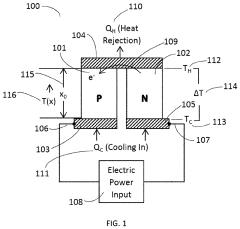
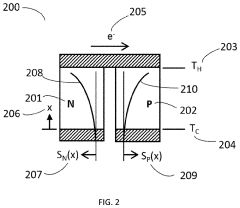
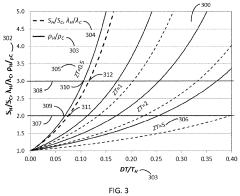
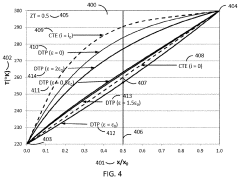
- Development of thermoelectric devices with distributed transport properties (DTP) that vary Seebeck coefficient, thermal conductivity, and electrical resistivity along the direction of current flow, guided by new design equations and computer models, allowing for increased efficiency and heat pumping capacity through optimized material selection and composite material designs.
Energy Efficiency and Sustainability Considerations
The optimization of thermoelectric materials for fast response applications must be evaluated through the lens of energy efficiency and sustainability. Current thermoelectric systems typically operate at efficiency levels between 5-8%, significantly lower than conventional power generation methods. Improving this efficiency is crucial not only for performance but also for reducing overall energy consumption and environmental impact throughout the material lifecycle.
Material selection plays a pivotal role in sustainability considerations. Traditional thermoelectric materials often contain rare or toxic elements such as tellurium, bismuth, and lead. These elements present environmental challenges in mining, processing, and end-of-life disposal. Recent research has focused on developing alternative materials using earth-abundant elements like silicon, zinc, and tin-based compounds that maintain comparable performance while reducing ecological footprint.
Manufacturing processes for thermoelectric devices contribute significantly to their overall environmental impact. Conventional fabrication methods typically require high-temperature processing and energy-intensive steps. Emerging techniques such as additive manufacturing, solution-based processing, and low-temperature sintering offer promising pathways to reduce energy consumption during production by up to 40% compared to traditional methods.
Life cycle assessment (LCA) studies indicate that the environmental benefits of thermoelectric materials in fast response applications depend heavily on their operational lifetime and efficiency. For applications requiring rapid thermal response, the trade-off between response time and energy efficiency becomes particularly important. Materials optimized solely for response speed may sacrifice long-term efficiency, potentially negating sustainability benefits.
Recovery and recycling of thermoelectric materials present both challenges and opportunities. The complex composition of these materials often makes separation difficult, but developing effective recycling pathways could significantly reduce primary resource demands. Research indicates that up to 85% of certain thermoelectric materials could be recovered and reused with appropriate recycling technologies.
When evaluating fast response thermoelectric applications, system-level energy analysis reveals that auxiliary components such as heat exchangers and control electronics can consume substantial energy. Holistic design approaches that optimize the entire thermal management system, not just the thermoelectric material itself, have demonstrated energy savings of 15-30% in practical implementations.
The integration of thermoelectric materials into existing energy systems offers potential for waste heat recovery, particularly in industrial processes and transportation applications. Fast-responding thermoelectric generators can capture intermittent waste heat that would otherwise be lost, potentially improving overall system efficiency by 3-7% depending on the application context.
Material selection plays a pivotal role in sustainability considerations. Traditional thermoelectric materials often contain rare or toxic elements such as tellurium, bismuth, and lead. These elements present environmental challenges in mining, processing, and end-of-life disposal. Recent research has focused on developing alternative materials using earth-abundant elements like silicon, zinc, and tin-based compounds that maintain comparable performance while reducing ecological footprint.
Manufacturing processes for thermoelectric devices contribute significantly to their overall environmental impact. Conventional fabrication methods typically require high-temperature processing and energy-intensive steps. Emerging techniques such as additive manufacturing, solution-based processing, and low-temperature sintering offer promising pathways to reduce energy consumption during production by up to 40% compared to traditional methods.
Life cycle assessment (LCA) studies indicate that the environmental benefits of thermoelectric materials in fast response applications depend heavily on their operational lifetime and efficiency. For applications requiring rapid thermal response, the trade-off between response time and energy efficiency becomes particularly important. Materials optimized solely for response speed may sacrifice long-term efficiency, potentially negating sustainability benefits.
Recovery and recycling of thermoelectric materials present both challenges and opportunities. The complex composition of these materials often makes separation difficult, but developing effective recycling pathways could significantly reduce primary resource demands. Research indicates that up to 85% of certain thermoelectric materials could be recovered and reused with appropriate recycling technologies.
When evaluating fast response thermoelectric applications, system-level energy analysis reveals that auxiliary components such as heat exchangers and control electronics can consume substantial energy. Holistic design approaches that optimize the entire thermal management system, not just the thermoelectric material itself, have demonstrated energy savings of 15-30% in practical implementations.
The integration of thermoelectric materials into existing energy systems offers potential for waste heat recovery, particularly in industrial processes and transportation applications. Fast-responding thermoelectric generators can capture intermittent waste heat that would otherwise be lost, potentially improving overall system efficiency by 3-7% depending on the application context.
Manufacturing Scalability and Cost Analysis
The scalability of manufacturing processes for thermoelectric materials represents a critical factor in their commercial viability for fast response applications. Current production methods for high-performance thermoelectric materials often involve complex, multi-step processes including powder metallurgy, hot pressing, spark plasma sintering, and precision doping. These techniques, while effective for laboratory-scale production, present significant challenges when scaled to industrial volumes required for widespread adoption.
Cost analysis reveals that material expenses constitute approximately 40-60% of total production costs for thermoelectric devices, with rare earth elements and specialized dopants being particularly price-sensitive components. Manufacturing overhead, including specialized equipment maintenance and energy consumption during high-temperature processing, accounts for an additional 25-30% of costs. Labor costs vary significantly by region but typically represent 15-20% of total production expenses.
Recent innovations in manufacturing techniques show promising pathways toward cost reduction. Additive manufacturing approaches, particularly 3D printing of thermoelectric materials, have demonstrated potential for reducing material waste by up to 30% compared to traditional subtractive manufacturing methods. Additionally, roll-to-roll processing techniques being developed for flexible thermoelectric generators could decrease production time by 40-50% for certain applications, though these methods currently struggle with achieving the precision doping required for optimal performance.
Economic analysis indicates that current production costs for high-performance thermoelectric materials range from $200-500 per kilogram, significantly higher than the $50-100 per kilogram threshold generally considered necessary for widespread commercial adoption in consumer applications. However, for specialized fast-response applications in aerospace, medical devices, and precision instrumentation, the current cost structure may already be economically viable given the premium performance requirements.
Supply chain considerations further complicate scalability, with critical materials including tellurium, bismuth, and various rare earth elements facing potential supply constraints. Geopolitical factors affect material availability, with over 70% of rare earth processing currently concentrated in specific regions, creating vulnerability to market disruptions.
Emerging approaches to address these challenges include development of earth-abundant thermoelectric materials, implementation of continuous flow manufacturing processes, and exploration of nanomaterial-based composites that can achieve comparable performance with reduced reliance on scarce elements. These innovations collectively suggest a potential manufacturing cost reduction of 30-45% within the next 5-7 years, potentially bringing thermoelectric materials within economically viable ranges for broader fast-response applications.
Cost analysis reveals that material expenses constitute approximately 40-60% of total production costs for thermoelectric devices, with rare earth elements and specialized dopants being particularly price-sensitive components. Manufacturing overhead, including specialized equipment maintenance and energy consumption during high-temperature processing, accounts for an additional 25-30% of costs. Labor costs vary significantly by region but typically represent 15-20% of total production expenses.
Recent innovations in manufacturing techniques show promising pathways toward cost reduction. Additive manufacturing approaches, particularly 3D printing of thermoelectric materials, have demonstrated potential for reducing material waste by up to 30% compared to traditional subtractive manufacturing methods. Additionally, roll-to-roll processing techniques being developed for flexible thermoelectric generators could decrease production time by 40-50% for certain applications, though these methods currently struggle with achieving the precision doping required for optimal performance.
Economic analysis indicates that current production costs for high-performance thermoelectric materials range from $200-500 per kilogram, significantly higher than the $50-100 per kilogram threshold generally considered necessary for widespread commercial adoption in consumer applications. However, for specialized fast-response applications in aerospace, medical devices, and precision instrumentation, the current cost structure may already be economically viable given the premium performance requirements.
Supply chain considerations further complicate scalability, with critical materials including tellurium, bismuth, and various rare earth elements facing potential supply constraints. Geopolitical factors affect material availability, with over 70% of rare earth processing currently concentrated in specific regions, creating vulnerability to market disruptions.
Emerging approaches to address these challenges include development of earth-abundant thermoelectric materials, implementation of continuous flow manufacturing processes, and exploration of nanomaterial-based composites that can achieve comparable performance with reduced reliance on scarce elements. These innovations collectively suggest a potential manufacturing cost reduction of 30-45% within the next 5-7 years, potentially bringing thermoelectric materials within economically viable ranges for broader fast-response applications.
Unlock deeper insights with PatSnap Eureka Quick Research — get a full tech report to explore trends and direct your research. Try now!
Generate Your Research Report Instantly with AI Agent
Supercharge your innovation with PatSnap Eureka AI Agent Platform!