Plate Heat Exchanger Applications in Dairy Processing
JUL 15, 20259 MIN READ
Generate Your Research Report Instantly with AI Agent
Patsnap Eureka helps you evaluate technical feasibility & market potential.
PHE in Dairy: Background and Objectives
Plate heat exchangers (PHEs) have become an integral part of dairy processing over the past several decades, revolutionizing the industry's approach to thermal treatment of milk and dairy products. The evolution of PHE technology in dairy applications can be traced back to the mid-20th century when the need for more efficient and hygienic heat transfer methods became apparent.
The primary objective of implementing PHEs in dairy processing is to achieve precise temperature control during various stages of production, including pasteurization, sterilization, and cooling. This technology aims to enhance product safety, extend shelf life, and maintain the nutritional and sensory qualities of dairy products while optimizing energy efficiency and reducing processing time.
As the dairy industry has grown and diversified, the demands on heat exchange technology have increased. PHEs have adapted to meet these challenges, evolving from simple designs to more complex, customized solutions capable of handling a wide range of dairy products with varying viscosities and heat-sensitive properties.
The development of PHE technology in dairy processing has been driven by several factors, including stricter food safety regulations, increasing consumer demand for high-quality dairy products, and the industry's push for more sustainable and cost-effective production methods. These drivers have led to continuous improvements in PHE design, materials, and operational capabilities.
One of the key trends in PHE technology for dairy applications has been the focus on minimizing product degradation during thermal treatment. This has resulted in the development of PHEs with improved flow distribution, reduced hold-up volumes, and more precise temperature control. Additionally, advancements in plate design and materials have led to enhanced heat transfer efficiency and reduced fouling, addressing some of the long-standing challenges in dairy processing.
The future trajectory of PHE technology in dairy processing is likely to be influenced by emerging trends such as the demand for plant-based dairy alternatives, the need for more flexible and modular processing systems, and the integration of smart technologies for process optimization and predictive maintenance.
As we delve deeper into the applications of PHEs in dairy processing, it is essential to consider the broader context of the industry's technological landscape and the specific challenges that this technology aims to address. This understanding will provide a foundation for evaluating current solutions and identifying potential areas for innovation in the field of dairy thermal processing.
The primary objective of implementing PHEs in dairy processing is to achieve precise temperature control during various stages of production, including pasteurization, sterilization, and cooling. This technology aims to enhance product safety, extend shelf life, and maintain the nutritional and sensory qualities of dairy products while optimizing energy efficiency and reducing processing time.
As the dairy industry has grown and diversified, the demands on heat exchange technology have increased. PHEs have adapted to meet these challenges, evolving from simple designs to more complex, customized solutions capable of handling a wide range of dairy products with varying viscosities and heat-sensitive properties.
The development of PHE technology in dairy processing has been driven by several factors, including stricter food safety regulations, increasing consumer demand for high-quality dairy products, and the industry's push for more sustainable and cost-effective production methods. These drivers have led to continuous improvements in PHE design, materials, and operational capabilities.
One of the key trends in PHE technology for dairy applications has been the focus on minimizing product degradation during thermal treatment. This has resulted in the development of PHEs with improved flow distribution, reduced hold-up volumes, and more precise temperature control. Additionally, advancements in plate design and materials have led to enhanced heat transfer efficiency and reduced fouling, addressing some of the long-standing challenges in dairy processing.
The future trajectory of PHE technology in dairy processing is likely to be influenced by emerging trends such as the demand for plant-based dairy alternatives, the need for more flexible and modular processing systems, and the integration of smart technologies for process optimization and predictive maintenance.
As we delve deeper into the applications of PHEs in dairy processing, it is essential to consider the broader context of the industry's technological landscape and the specific challenges that this technology aims to address. This understanding will provide a foundation for evaluating current solutions and identifying potential areas for innovation in the field of dairy thermal processing.
Dairy Industry Demand for PHE Technology
The dairy industry has witnessed a significant surge in demand for Plate Heat Exchanger (PHE) technology in recent years. This increased demand is driven by several factors, including the need for improved energy efficiency, enhanced product quality, and stricter hygiene standards in dairy processing operations.
PHE technology offers numerous advantages that align with the evolving needs of the dairy industry. One of the primary drivers of demand is the superior heat transfer efficiency of PHEs compared to traditional heat exchangers. This efficiency translates to reduced energy consumption and lower operating costs, which are crucial considerations for dairy processors facing rising energy prices and increasing pressure to reduce their carbon footprint.
The dairy industry's focus on product quality and safety has also contributed to the growing demand for PHE technology. PHEs provide precise temperature control during pasteurization and other heat treatment processes, ensuring consistent product quality and extended shelf life. This precision is particularly important for sensitive dairy products such as yogurt and cheese, where even slight temperature variations can significantly impact the final product's texture and flavor.
Furthermore, the compact design of PHEs offers space-saving benefits, which is particularly valuable for dairy processing facilities with limited floor space. This compact nature also allows for easier installation and maintenance, reducing downtime and associated costs.
The increasing emphasis on hygiene and food safety regulations in the dairy industry has further fueled the demand for PHE technology. PHEs are designed with sanitary features that facilitate easy cleaning and minimize the risk of product contamination. Many PHE models are compatible with Clean-in-Place (CIP) systems, allowing for efficient and thorough cleaning without disassembly, which is crucial in maintaining high hygiene standards in dairy processing environments.
Another factor driving demand is the versatility of PHEs in handling various dairy processing applications. From milk pasteurization and cream cooling to whey processing and cheese production, PHEs can be customized to meet specific process requirements. This adaptability makes PHEs an attractive option for dairy processors looking to streamline their operations and reduce equipment complexity.
The growing trend towards product diversification in the dairy industry has also contributed to the increased demand for PHE technology. As dairy processors expand their product lines to include specialty products and functional dairy ingredients, they require flexible and efficient heat exchange solutions that can handle a wide range of viscosities and processing conditions. PHEs meet this need by offering modular designs that can be easily modified or expanded to accommodate new product lines or increased production capacity.
PHE technology offers numerous advantages that align with the evolving needs of the dairy industry. One of the primary drivers of demand is the superior heat transfer efficiency of PHEs compared to traditional heat exchangers. This efficiency translates to reduced energy consumption and lower operating costs, which are crucial considerations for dairy processors facing rising energy prices and increasing pressure to reduce their carbon footprint.
The dairy industry's focus on product quality and safety has also contributed to the growing demand for PHE technology. PHEs provide precise temperature control during pasteurization and other heat treatment processes, ensuring consistent product quality and extended shelf life. This precision is particularly important for sensitive dairy products such as yogurt and cheese, where even slight temperature variations can significantly impact the final product's texture and flavor.
Furthermore, the compact design of PHEs offers space-saving benefits, which is particularly valuable for dairy processing facilities with limited floor space. This compact nature also allows for easier installation and maintenance, reducing downtime and associated costs.
The increasing emphasis on hygiene and food safety regulations in the dairy industry has further fueled the demand for PHE technology. PHEs are designed with sanitary features that facilitate easy cleaning and minimize the risk of product contamination. Many PHE models are compatible with Clean-in-Place (CIP) systems, allowing for efficient and thorough cleaning without disassembly, which is crucial in maintaining high hygiene standards in dairy processing environments.
Another factor driving demand is the versatility of PHEs in handling various dairy processing applications. From milk pasteurization and cream cooling to whey processing and cheese production, PHEs can be customized to meet specific process requirements. This adaptability makes PHEs an attractive option for dairy processors looking to streamline their operations and reduce equipment complexity.
The growing trend towards product diversification in the dairy industry has also contributed to the increased demand for PHE technology. As dairy processors expand their product lines to include specialty products and functional dairy ingredients, they require flexible and efficient heat exchange solutions that can handle a wide range of viscosities and processing conditions. PHEs meet this need by offering modular designs that can be easily modified or expanded to accommodate new product lines or increased production capacity.
PHE Challenges in Dairy Processing
While plate heat exchangers (PHEs) have revolutionized dairy processing, they face several challenges in this demanding industry. Fouling remains a primary concern, as milk proteins and minerals tend to accumulate on heat transfer surfaces, reducing efficiency and necessitating frequent cleaning cycles. This issue is particularly pronounced in high-temperature applications, such as pasteurization and ultra-high temperature (UHT) processing.
The complex composition of dairy products, including varying fat content and viscosity, poses difficulties in maintaining consistent heat transfer rates across different product lines. PHEs must be carefully designed and optimized for each specific dairy application to ensure optimal performance and product quality. This often requires extensive testing and fine-tuning of plate configurations and flow patterns.
Temperature control is another critical challenge in dairy processing. Precise temperature management is essential to prevent product degradation, maintain nutritional value, and ensure food safety. PHEs must provide accurate and responsive temperature control, especially during start-up, shutdown, and product changeovers. This becomes increasingly difficult when dealing with products that have different thermal properties or when processing multiple product types on the same line.
Cleaning and sanitation present ongoing challenges for PHEs in dairy applications. The intricate plate designs that enhance heat transfer efficiency can also create areas where product residues are difficult to remove. Developing effective clean-in-place (CIP) protocols that thoroughly clean all surfaces without excessive downtime or chemical usage is a constant balancing act for dairy processors.
Pressure drop across the PHE is another consideration, particularly for viscous dairy products. Excessive pressure drop can lead to increased pumping costs and potential product damage. Designers must carefully balance heat transfer efficiency with acceptable pressure losses, often requiring compromises in plate geometry or flow arrangements.
The potential for product contamination due to plate or gasket failures is a significant concern in dairy processing. PHEs must maintain their integrity under varying temperature and pressure conditions while preventing any cross-contamination between product and utility streams. This necessitates robust design, high-quality materials, and regular maintenance to ensure food safety standards are consistently met.
Lastly, the scalability of PHEs in dairy processing presents challenges as production volumes increase. Expanding capacity while maintaining optimal heat transfer characteristics and uniform product treatment can be complex, often requiring careful system redesign or the implementation of multiple PHE units in series or parallel configurations.
The complex composition of dairy products, including varying fat content and viscosity, poses difficulties in maintaining consistent heat transfer rates across different product lines. PHEs must be carefully designed and optimized for each specific dairy application to ensure optimal performance and product quality. This often requires extensive testing and fine-tuning of plate configurations and flow patterns.
Temperature control is another critical challenge in dairy processing. Precise temperature management is essential to prevent product degradation, maintain nutritional value, and ensure food safety. PHEs must provide accurate and responsive temperature control, especially during start-up, shutdown, and product changeovers. This becomes increasingly difficult when dealing with products that have different thermal properties or when processing multiple product types on the same line.
Cleaning and sanitation present ongoing challenges for PHEs in dairy applications. The intricate plate designs that enhance heat transfer efficiency can also create areas where product residues are difficult to remove. Developing effective clean-in-place (CIP) protocols that thoroughly clean all surfaces without excessive downtime or chemical usage is a constant balancing act for dairy processors.
Pressure drop across the PHE is another consideration, particularly for viscous dairy products. Excessive pressure drop can lead to increased pumping costs and potential product damage. Designers must carefully balance heat transfer efficiency with acceptable pressure losses, often requiring compromises in plate geometry or flow arrangements.
The potential for product contamination due to plate or gasket failures is a significant concern in dairy processing. PHEs must maintain their integrity under varying temperature and pressure conditions while preventing any cross-contamination between product and utility streams. This necessitates robust design, high-quality materials, and regular maintenance to ensure food safety standards are consistently met.
Lastly, the scalability of PHEs in dairy processing presents challenges as production volumes increase. Expanding capacity while maintaining optimal heat transfer characteristics and uniform product treatment can be complex, often requiring careful system redesign or the implementation of multiple PHE units in series or parallel configurations.
Current PHE Solutions for Dairy
01 Plate design and configuration
Innovations in plate design and configuration for heat exchangers, including improvements in plate geometry, corrugation patterns, and stacking arrangements to enhance heat transfer efficiency and reduce pressure drop. These designs aim to optimize fluid flow distribution and increase the overall heat transfer surface area.- Plate design and configuration: Innovations in plate design and configuration for heat exchangers, including improvements in plate geometry, corrugation patterns, and stacking arrangements to enhance heat transfer efficiency and reduce pressure drop.
- Sealing and gasket systems: Advanced sealing and gasket systems for plate heat exchangers, focusing on improved leak prevention, durability, and ease of maintenance. These innovations aim to enhance the overall reliability and longevity of the heat exchanger.
- Flow distribution optimization: Techniques for optimizing flow distribution within plate heat exchangers, including the use of flow guides, baffles, and channel designs to ensure uniform fluid distribution and maximize heat transfer efficiency across the entire plate surface.
- Material selection and surface treatments: Advancements in material selection and surface treatments for plate heat exchangers, focusing on corrosion resistance, fouling mitigation, and enhanced heat transfer properties. This includes the use of specialized alloys and coatings to improve performance and longevity.
- Modular and customizable designs: Development of modular and customizable plate heat exchanger designs, allowing for easy scalability, maintenance, and adaptation to various industrial applications. These innovations focus on flexibility in capacity adjustment and simplified assembly processes.
02 Sealing and gasket systems
Advanced sealing and gasket systems for plate heat exchangers, focusing on improved leak prevention, durability, and ease of maintenance. These innovations include new gasket materials, designs, and attachment methods to ensure reliable operation under various temperature and pressure conditions.Expand Specific Solutions03 Flow distribution and turbulence enhancement
Techniques for optimizing flow distribution and enhancing turbulence within plate heat exchangers. These methods include the use of flow guides, baffles, and specially designed inlet and outlet ports to improve heat transfer rates and reduce fouling by ensuring uniform fluid distribution across the plates.Expand Specific Solutions04 Material selection and surface treatments
Advancements in material selection and surface treatments for plate heat exchangers, focusing on corrosion resistance, fouling mitigation, and thermal conductivity enhancement. This includes the use of specialized alloys, coatings, and surface modifications to improve performance and longevity in various applications.Expand Specific Solutions05 Modular and customizable designs
Development of modular and customizable plate heat exchanger designs that allow for easy scaling, maintenance, and adaptation to specific application requirements. These innovations focus on flexibility in plate arrangement, frame design, and connection options to optimize performance across a wide range of operating conditions.Expand Specific Solutions
Key Players in Dairy PHE Market
The plate heat exchanger market in dairy processing is in a mature growth stage, with a significant global market size driven by increasing demand for efficient and hygienic heat transfer solutions. The technology has reached a high level of maturity, with continuous innovations focusing on improving efficiency and sustainability. Key players like Alfa Laval Corporate AB, Tetra Laval Holdings & Finance SA, and GEA Group AG dominate the market, leveraging their extensive experience and technological expertise. Emerging companies such as Jiangyin Hagenuo Heat Exchange Equipment Co., Ltd. and Anhui Purepler Heat Transfer Technology Co., Ltd. are also making strides in this competitive landscape, offering specialized solutions for the dairy industry. The market is characterized by ongoing research and development efforts to enhance performance, reduce energy consumption, and meet stringent hygiene standards in dairy processing applications.
Alfa Laval Corporate AB
Technical Solution: Alfa Laval is a leading player in plate heat exchanger technology for dairy processing. Their innovative AlfaNovaM HP plate heat exchanger is specifically designed for high-pressure dairy applications, capable of handling pressures up to 42 bar[1]. This technology utilizes fusion-bonded plates made of 100% stainless steel, ensuring excellent hygiene and product safety. The company's PureBallast system incorporates advanced UV technology for treating ballast water, which can be adapted for dairy processing to ensure microbial safety[2]. Alfa Laval's plate heat exchangers feature optimized plate designs that enhance heat transfer efficiency while minimizing fouling, a critical factor in dairy processing[3]. Their systems also incorporate CIP (Cleaning-in-Place) compatibility, allowing for thorough cleaning without disassembly, which is crucial for maintaining hygiene standards in dairy operations[4].
Strengths: Industry-leading technology, high-pressure capabilities, excellent hygiene standards, and efficient heat transfer. Weaknesses: Potentially higher initial costs compared to simpler systems, and may require specialized maintenance.
Jiangyin Hagenuo Heat Exchange Equipment Co., Ltd.
Technical Solution: Jiangyin Hagenuo specializes in plate heat exchangers for various industries, including dairy processing. Their dairy-specific plate heat exchangers feature corrugated plates designed to enhance turbulence and heat transfer efficiency[5]. The company utilizes advanced gasket materials that are FDA-compliant and resistant to high temperatures and chemicals used in dairy processing. Hagenuo's plate heat exchangers incorporate a modular design, allowing for easy expansion or modification to meet changing production needs[6]. They also offer customized solutions for specific dairy applications, such as milk pasteurization, cream cooling, and whey processing. The company's heat exchangers are designed with a focus on reducing product loss during changeovers, which is particularly important in dairy processing where product consistency is crucial[7].
Strengths: Customizable solutions, FDA-compliant materials, and modular design for scalability. Weaknesses: May have less global presence compared to larger multinational corporations, potentially limiting access to certain markets or support networks.
Innovative PHE Designs for Dairy
Plate heat exchanger for feed processing
PatentActiveJP2022531257A
Innovation
- A plate heat exchanger design with symmetrical port arrangement and gasket configuration allows heat exchange plates to be rotated 180 degrees, reducing gasket count and maintaining identical plate types, thus optimizing area efficiency.


Plate heat exchanger
PatentWO2024183631A1
Innovation
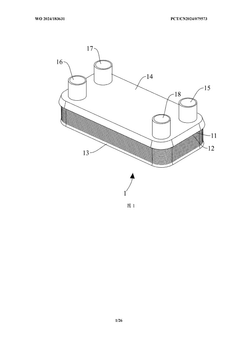
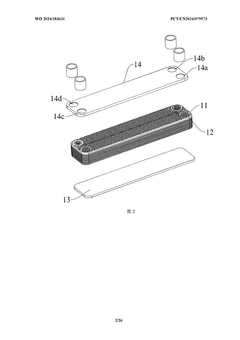
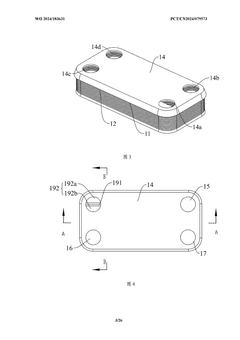
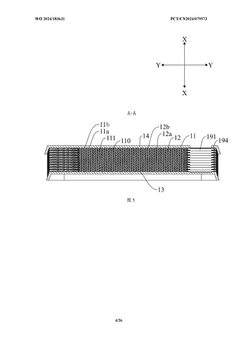
- A plate heat exchanger is designed, which uses a plurality of first plates and second plates in an alternating stacked structure, and sets a first channel and a second channel in the distribution part to form a "U"-shaped heat exchange medium flow path. , through the connection between the first hole and the second hole, the flow path is enlarged to ensure uniform flow distribution of the medium.
Energy Efficiency in Dairy PHEs
Energy efficiency in dairy plate heat exchangers (PHEs) has become a critical focus in the industry due to rising energy costs and environmental concerns. PHEs are widely used in dairy processing for their superior heat transfer capabilities and compact design. In recent years, significant advancements have been made to improve their energy efficiency, resulting in reduced operational costs and environmental impact.
One of the key factors contributing to enhanced energy efficiency in dairy PHEs is the optimization of plate design. Modern plates feature intricate patterns and corrugations that promote turbulent flow, increasing heat transfer rates while minimizing pressure drop. These designs allow for more efficient heat exchange between the product and the heating or cooling medium, reducing the overall energy requirements of the process.
Another important aspect of energy efficiency in dairy PHEs is the implementation of regenerative heating and cooling systems. By utilizing the heat from outgoing pasteurized milk to pre-heat incoming raw milk, these systems can significantly reduce the energy needed for pasteurization. This regenerative approach can recover up to 95% of the heat, resulting in substantial energy savings and improved overall process efficiency.
The use of advanced control systems and automation has also contributed to improved energy efficiency in dairy PHEs. Real-time monitoring and adjustment of process parameters, such as flow rates and temperatures, ensure optimal performance and minimize energy waste. Intelligent control algorithms can adapt to changing conditions, maintaining efficiency across various production scenarios.
Material innovations have played a crucial role in enhancing the energy efficiency of dairy PHEs. The development of high-performance, corrosion-resistant alloys and surface treatments has improved heat transfer properties while extending equipment lifespan. These materials allow for thinner plates, reducing thermal resistance and improving overall heat transfer coefficients.
Proper maintenance and cleaning procedures are essential for maintaining energy efficiency in dairy PHEs. Regular cleaning and inspection prevent fouling and scaling, which can significantly impair heat transfer and increase energy consumption. Advanced cleaning-in-place (CIP) systems and non-fouling surface treatments have been developed to minimize downtime and maintain optimal performance.
The integration of renewable energy sources and waste heat recovery systems has further improved the energy efficiency of dairy PHEs. By utilizing solar thermal energy or recovering waste heat from other processes, dairy plants can reduce their reliance on conventional energy sources and lower their carbon footprint.
One of the key factors contributing to enhanced energy efficiency in dairy PHEs is the optimization of plate design. Modern plates feature intricate patterns and corrugations that promote turbulent flow, increasing heat transfer rates while minimizing pressure drop. These designs allow for more efficient heat exchange between the product and the heating or cooling medium, reducing the overall energy requirements of the process.
Another important aspect of energy efficiency in dairy PHEs is the implementation of regenerative heating and cooling systems. By utilizing the heat from outgoing pasteurized milk to pre-heat incoming raw milk, these systems can significantly reduce the energy needed for pasteurization. This regenerative approach can recover up to 95% of the heat, resulting in substantial energy savings and improved overall process efficiency.
The use of advanced control systems and automation has also contributed to improved energy efficiency in dairy PHEs. Real-time monitoring and adjustment of process parameters, such as flow rates and temperatures, ensure optimal performance and minimize energy waste. Intelligent control algorithms can adapt to changing conditions, maintaining efficiency across various production scenarios.
Material innovations have played a crucial role in enhancing the energy efficiency of dairy PHEs. The development of high-performance, corrosion-resistant alloys and surface treatments has improved heat transfer properties while extending equipment lifespan. These materials allow for thinner plates, reducing thermal resistance and improving overall heat transfer coefficients.
Proper maintenance and cleaning procedures are essential for maintaining energy efficiency in dairy PHEs. Regular cleaning and inspection prevent fouling and scaling, which can significantly impair heat transfer and increase energy consumption. Advanced cleaning-in-place (CIP) systems and non-fouling surface treatments have been developed to minimize downtime and maintain optimal performance.
The integration of renewable energy sources and waste heat recovery systems has further improved the energy efficiency of dairy PHEs. By utilizing solar thermal energy or recovering waste heat from other processes, dairy plants can reduce their reliance on conventional energy sources and lower their carbon footprint.
Sanitation Standards for Dairy PHEs
Sanitation standards for Plate Heat Exchangers (PHEs) in dairy processing are crucial to ensure product safety and quality. These standards are designed to prevent microbial contamination and maintain the integrity of dairy products throughout the processing cycle. The dairy industry adheres to strict regulatory guidelines, such as those set by the FDA and USDA in the United States, and similar bodies in other countries.
One of the primary sanitation requirements for dairy PHEs is the implementation of Cleaning-in-Place (CIP) systems. CIP allows for thorough cleaning and sanitization without disassembling the equipment, which is essential for maintaining a hygienic processing environment. The CIP process typically involves a series of rinses and chemical treatments, including alkaline and acid washes, followed by a final sanitization step.
The materials used in dairy PHEs must meet food-grade standards and be resistant to corrosion from both dairy products and cleaning chemicals. Stainless steel, particularly grades 304 and 316, is commonly used due to its durability and ease of cleaning. The plate design must also facilitate effective cleaning, with smooth surfaces and minimal crevices where bacteria could potentially accumulate.
Temperature control during processing and cleaning is another critical aspect of sanitation standards. PHEs must be capable of reaching and maintaining temperatures high enough to eliminate harmful microorganisms during pasteurization and sterilization processes. During cleaning cycles, temperatures must be carefully controlled to ensure the effectiveness of cleaning agents without damaging the equipment.
Regular microbiological testing is mandated to verify the efficacy of cleaning procedures and to detect any potential contamination. This includes swab tests of equipment surfaces and product testing at various stages of processing. Documentation of cleaning procedures, test results, and maintenance activities is essential for regulatory compliance and traceability.
The frequency of cleaning and sanitization is determined by factors such as the type of dairy product being processed, production volume, and regulatory requirements. Some operations may require daily cleaning, while others might operate on longer cycles between thorough sanitization procedures.
Employee training is a crucial component of maintaining sanitation standards. Workers must be well-versed in proper cleaning techniques, the use of protective equipment, and the importance of adhering to sanitation protocols. This includes understanding the risks associated with inadequate cleaning and the potential consequences for product safety and quality.
Continuous monitoring and validation of sanitation processes are necessary to ensure ongoing compliance with standards. This may involve the use of automated monitoring systems that track cleaning parameters such as temperature, chemical concentration, and flow rates during CIP cycles. Regular audits and inspections, both internal and by regulatory bodies, help maintain high sanitation standards and identify areas for improvement in PHE sanitation practices within dairy processing facilities.
One of the primary sanitation requirements for dairy PHEs is the implementation of Cleaning-in-Place (CIP) systems. CIP allows for thorough cleaning and sanitization without disassembling the equipment, which is essential for maintaining a hygienic processing environment. The CIP process typically involves a series of rinses and chemical treatments, including alkaline and acid washes, followed by a final sanitization step.
The materials used in dairy PHEs must meet food-grade standards and be resistant to corrosion from both dairy products and cleaning chemicals. Stainless steel, particularly grades 304 and 316, is commonly used due to its durability and ease of cleaning. The plate design must also facilitate effective cleaning, with smooth surfaces and minimal crevices where bacteria could potentially accumulate.
Temperature control during processing and cleaning is another critical aspect of sanitation standards. PHEs must be capable of reaching and maintaining temperatures high enough to eliminate harmful microorganisms during pasteurization and sterilization processes. During cleaning cycles, temperatures must be carefully controlled to ensure the effectiveness of cleaning agents without damaging the equipment.
Regular microbiological testing is mandated to verify the efficacy of cleaning procedures and to detect any potential contamination. This includes swab tests of equipment surfaces and product testing at various stages of processing. Documentation of cleaning procedures, test results, and maintenance activities is essential for regulatory compliance and traceability.
The frequency of cleaning and sanitization is determined by factors such as the type of dairy product being processed, production volume, and regulatory requirements. Some operations may require daily cleaning, while others might operate on longer cycles between thorough sanitization procedures.
Employee training is a crucial component of maintaining sanitation standards. Workers must be well-versed in proper cleaning techniques, the use of protective equipment, and the importance of adhering to sanitation protocols. This includes understanding the risks associated with inadequate cleaning and the potential consequences for product safety and quality.
Continuous monitoring and validation of sanitation processes are necessary to ensure ongoing compliance with standards. This may involve the use of automated monitoring systems that track cleaning parameters such as temperature, chemical concentration, and flow rates during CIP cycles. Regular audits and inspections, both internal and by regulatory bodies, help maintain high sanitation standards and identify areas for improvement in PHE sanitation practices within dairy processing facilities.
Unlock deeper insights with Patsnap Eureka Quick Research — get a full tech report to explore trends and direct your research. Try now!
Generate Your Research Report Instantly with AI Agent
Supercharge your innovation with Patsnap Eureka AI Agent Platform!