Plate Heat Exchanger Fluid Dynamics Analysis
JUL 15, 20259 MIN READ
Generate Your Research Report Instantly with AI Agent
PatSnap Eureka helps you evaluate technical feasibility & market potential.
PHE Fluid Dynamics Background and Objectives
Plate heat exchangers (PHEs) have been a cornerstone in industrial heat transfer applications for decades, revolutionizing thermal management across various sectors. The study of fluid dynamics within PHEs is crucial for optimizing their performance and efficiency. This field of research has evolved significantly since the introduction of PHEs in the 1920s, with advancements in computational fluid dynamics (CFD) and experimental techniques driving progress.
The primary objective of PHE fluid dynamics analysis is to enhance heat transfer efficiency while minimizing pressure drop. This involves a comprehensive understanding of flow patterns, turbulence characteristics, and thermal boundary layers within the complex geometries of plate channels. Recent technological advancements have enabled researchers to delve deeper into micro-scale phenomena, such as flow maldistribution and local heat transfer coefficients.
As energy efficiency and sustainability become increasingly important, the demand for more effective heat exchangers has grown. This has led to a surge in research focused on novel plate designs, surface enhancements, and innovative flow arrangements. The goal is to develop PHEs that can handle a wider range of operating conditions, fluids, and heat loads while maintaining compact size and cost-effectiveness.
Another key trend in PHE fluid dynamics research is the integration of multi-physics simulations. These advanced models combine fluid dynamics with structural analysis, fouling predictions, and even phase change phenomena. Such holistic approaches provide a more accurate representation of real-world operating conditions and enable engineers to optimize PHE designs for specific applications.
The evolution of PHE fluid dynamics analysis has also been marked by the development of new experimental techniques. Advanced flow visualization methods, such as particle image velocimetry (PIV) and laser-induced fluorescence (LIF), have allowed researchers to validate CFD models and gain insights into complex flow structures within PHEs. These experimental advancements have been crucial in bridging the gap between theoretical predictions and practical performance.
Looking ahead, the field of PHE fluid dynamics analysis is poised for further innovation. Emerging areas of focus include the application of artificial intelligence and machine learning algorithms to optimize PHE designs, the development of self-cleaning surfaces to mitigate fouling, and the exploration of novel materials to enhance heat transfer and reduce manufacturing costs. These advancements aim to push the boundaries of PHE performance and expand their applicability in emerging industries such as renewable energy systems and advanced manufacturing processes.
The primary objective of PHE fluid dynamics analysis is to enhance heat transfer efficiency while minimizing pressure drop. This involves a comprehensive understanding of flow patterns, turbulence characteristics, and thermal boundary layers within the complex geometries of plate channels. Recent technological advancements have enabled researchers to delve deeper into micro-scale phenomena, such as flow maldistribution and local heat transfer coefficients.
As energy efficiency and sustainability become increasingly important, the demand for more effective heat exchangers has grown. This has led to a surge in research focused on novel plate designs, surface enhancements, and innovative flow arrangements. The goal is to develop PHEs that can handle a wider range of operating conditions, fluids, and heat loads while maintaining compact size and cost-effectiveness.
Another key trend in PHE fluid dynamics research is the integration of multi-physics simulations. These advanced models combine fluid dynamics with structural analysis, fouling predictions, and even phase change phenomena. Such holistic approaches provide a more accurate representation of real-world operating conditions and enable engineers to optimize PHE designs for specific applications.
The evolution of PHE fluid dynamics analysis has also been marked by the development of new experimental techniques. Advanced flow visualization methods, such as particle image velocimetry (PIV) and laser-induced fluorescence (LIF), have allowed researchers to validate CFD models and gain insights into complex flow structures within PHEs. These experimental advancements have been crucial in bridging the gap between theoretical predictions and practical performance.
Looking ahead, the field of PHE fluid dynamics analysis is poised for further innovation. Emerging areas of focus include the application of artificial intelligence and machine learning algorithms to optimize PHE designs, the development of self-cleaning surfaces to mitigate fouling, and the exploration of novel materials to enhance heat transfer and reduce manufacturing costs. These advancements aim to push the boundaries of PHE performance and expand their applicability in emerging industries such as renewable energy systems and advanced manufacturing processes.
Market Demand for Efficient Heat Exchangers
The market demand for efficient heat exchangers, particularly plate heat exchangers (PHEs), has been steadily increasing across various industries. This growth is primarily driven by the need for more energy-efficient and compact heat transfer solutions in sectors such as chemical processing, food and beverage, HVAC, and power generation.
In the chemical processing industry, there is a growing demand for PHEs due to their ability to handle corrosive fluids and operate at high temperatures and pressures. The food and beverage sector requires efficient heat exchangers for pasteurization, sterilization, and cooling processes, where PHEs excel due to their superior heat transfer capabilities and ease of cleaning.
The HVAC industry is experiencing a surge in demand for efficient heat exchangers as building energy codes become more stringent. PHEs are increasingly being adopted in this sector due to their compact size and ability to provide high heat transfer rates, which contribute to overall system efficiency improvements.
In the power generation sector, the shift towards renewable energy sources and the need for waste heat recovery systems have created new opportunities for PHEs. Their ability to handle multiple fluid streams and operate efficiently at varying load conditions makes them ideal for these applications.
The global market for plate heat exchangers is expected to grow significantly in the coming years. This growth is fueled by increasing industrialization in developing countries, stringent environmental regulations promoting energy efficiency, and the ongoing replacement of older, less efficient heat exchange systems.
Manufacturers are responding to this demand by developing innovative PHE designs that offer improved performance and reliability. These advancements include enhanced plate geometries for better fluid distribution, new materials for improved corrosion resistance, and modular designs for easier maintenance and scalability.
The market is also seeing a trend towards customized PHE solutions tailored to specific industry needs. This customization allows for optimized heat transfer in unique applications, further driving the adoption of PHEs across various sectors.
As energy costs continue to rise and environmental concerns become more pressing, the demand for efficient heat exchangers is expected to remain strong. Industries are increasingly recognizing the long-term cost benefits and reduced environmental impact associated with high-efficiency PHEs, despite their higher initial investment compared to traditional heat exchangers.
In the chemical processing industry, there is a growing demand for PHEs due to their ability to handle corrosive fluids and operate at high temperatures and pressures. The food and beverage sector requires efficient heat exchangers for pasteurization, sterilization, and cooling processes, where PHEs excel due to their superior heat transfer capabilities and ease of cleaning.
The HVAC industry is experiencing a surge in demand for efficient heat exchangers as building energy codes become more stringent. PHEs are increasingly being adopted in this sector due to their compact size and ability to provide high heat transfer rates, which contribute to overall system efficiency improvements.
In the power generation sector, the shift towards renewable energy sources and the need for waste heat recovery systems have created new opportunities for PHEs. Their ability to handle multiple fluid streams and operate efficiently at varying load conditions makes them ideal for these applications.
The global market for plate heat exchangers is expected to grow significantly in the coming years. This growth is fueled by increasing industrialization in developing countries, stringent environmental regulations promoting energy efficiency, and the ongoing replacement of older, less efficient heat exchange systems.
Manufacturers are responding to this demand by developing innovative PHE designs that offer improved performance and reliability. These advancements include enhanced plate geometries for better fluid distribution, new materials for improved corrosion resistance, and modular designs for easier maintenance and scalability.
The market is also seeing a trend towards customized PHE solutions tailored to specific industry needs. This customization allows for optimized heat transfer in unique applications, further driving the adoption of PHEs across various sectors.
As energy costs continue to rise and environmental concerns become more pressing, the demand for efficient heat exchangers is expected to remain strong. Industries are increasingly recognizing the long-term cost benefits and reduced environmental impact associated with high-efficiency PHEs, despite their higher initial investment compared to traditional heat exchangers.
Current Challenges in PHE Fluid Dynamics
Plate heat exchangers (PHEs) have become increasingly popular in various industries due to their compact design and high efficiency. However, the fluid dynamics within PHEs present several challenges that researchers and engineers are currently grappling with. One of the primary issues is the complex flow patterns that develop within the narrow channels of PHEs. These patterns are influenced by factors such as plate geometry, corrugation design, and flow distribution, making it difficult to accurately predict and optimize heat transfer performance.
The presence of turbulence in PHE channels is another significant challenge. While turbulence can enhance heat transfer, it also leads to increased pressure drop, which affects the overall efficiency of the system. Striking the right balance between heat transfer enhancement and pressure drop minimization remains a key area of research in PHE fluid dynamics.
Flow maldistribution is a persistent problem in PHEs, particularly in larger units with multiple plates. Uneven flow distribution can result in reduced thermal performance and increased fouling tendencies. Addressing this issue requires a comprehensive understanding of the flow behavior across the entire exchanger, which is challenging due to the complex geometry and large number of channels.
The occurrence of two-phase flow in PHEs presents additional complications. In applications involving phase change, such as condensation or evaporation, the dynamics of liquid-vapor interactions within the narrow channels are not fully understood. This lack of knowledge hampers the development of accurate models for predicting heat transfer and pressure drop in two-phase PHE systems.
Fouling and its impact on fluid dynamics is another area of concern. As deposits accumulate on heat transfer surfaces, they not only reduce thermal efficiency but also alter the flow characteristics within the channels. Predicting and mitigating fouling effects on fluid dynamics is crucial for maintaining long-term performance of PHEs.
The development of accurate numerical models for PHE fluid dynamics remains challenging due to the complex geometry and multi-scale nature of the flow. While Computational Fluid Dynamics (CFD) has made significant strides, simulating the entire PHE with high fidelity is computationally intensive and often impractical for design optimization.
Lastly, the lack of comprehensive experimental data for validation of numerical models hinders progress in PHE fluid dynamics research. Obtaining detailed flow measurements within the narrow channels of PHEs is technically challenging, limiting the ability to validate and refine theoretical models.
Addressing these challenges requires interdisciplinary approaches combining advanced experimental techniques, high-performance computing, and innovative modeling strategies. As the demand for more efficient and compact heat exchangers grows, overcoming these fluid dynamics challenges will be crucial for the continued evolution of PHE technology.
The presence of turbulence in PHE channels is another significant challenge. While turbulence can enhance heat transfer, it also leads to increased pressure drop, which affects the overall efficiency of the system. Striking the right balance between heat transfer enhancement and pressure drop minimization remains a key area of research in PHE fluid dynamics.
Flow maldistribution is a persistent problem in PHEs, particularly in larger units with multiple plates. Uneven flow distribution can result in reduced thermal performance and increased fouling tendencies. Addressing this issue requires a comprehensive understanding of the flow behavior across the entire exchanger, which is challenging due to the complex geometry and large number of channels.
The occurrence of two-phase flow in PHEs presents additional complications. In applications involving phase change, such as condensation or evaporation, the dynamics of liquid-vapor interactions within the narrow channels are not fully understood. This lack of knowledge hampers the development of accurate models for predicting heat transfer and pressure drop in two-phase PHE systems.
Fouling and its impact on fluid dynamics is another area of concern. As deposits accumulate on heat transfer surfaces, they not only reduce thermal efficiency but also alter the flow characteristics within the channels. Predicting and mitigating fouling effects on fluid dynamics is crucial for maintaining long-term performance of PHEs.
The development of accurate numerical models for PHE fluid dynamics remains challenging due to the complex geometry and multi-scale nature of the flow. While Computational Fluid Dynamics (CFD) has made significant strides, simulating the entire PHE with high fidelity is computationally intensive and often impractical for design optimization.
Lastly, the lack of comprehensive experimental data for validation of numerical models hinders progress in PHE fluid dynamics research. Obtaining detailed flow measurements within the narrow channels of PHEs is technically challenging, limiting the ability to validate and refine theoretical models.
Addressing these challenges requires interdisciplinary approaches combining advanced experimental techniques, high-performance computing, and innovative modeling strategies. As the demand for more efficient and compact heat exchangers grows, overcoming these fluid dynamics challenges will be crucial for the continued evolution of PHE technology.
State-of-the-Art CFD Techniques for PHEs
01 Flow distribution optimization
Plate heat exchangers are designed to optimize fluid flow distribution for improved heat transfer efficiency. This involves careful consideration of plate geometry, channel design, and flow patterns to ensure uniform distribution of fluids across the heat transfer surface. Techniques such as variable plate spacing and strategic placement of flow obstructions can be employed to achieve optimal flow distribution.- Flow distribution optimization: Improving fluid distribution in plate heat exchangers through design modifications such as channel geometry, plate patterns, and flow arrangements. These optimizations aim to enhance heat transfer efficiency and reduce pressure drop by ensuring uniform flow across the exchanger plates.
- Turbulence enhancement techniques: Implementing features to increase turbulence in the fluid flow, such as corrugated plates, dimples, or protrusions. These techniques promote mixing and boundary layer disruption, leading to improved heat transfer rates and overall exchanger performance.
- Fouling mitigation strategies: Developing methods to reduce fouling in plate heat exchangers, including surface treatments, self-cleaning mechanisms, and flow pattern modifications. These strategies aim to maintain heat transfer efficiency over time and reduce maintenance requirements.
- Multi-phase flow handling: Designing plate heat exchangers to effectively manage multi-phase flows, such as gas-liquid or liquid-liquid mixtures. This involves optimizing plate geometry, flow arrangements, and phase separation techniques to ensure efficient heat transfer and prevent flow instabilities.
- Computational fluid dynamics (CFD) modeling: Utilizing advanced CFD techniques to simulate and analyze fluid flow and heat transfer in plate heat exchangers. These models help optimize design parameters, predict performance, and identify areas for improvement in exchanger efficiency and reliability.
02 Turbulence enhancement
Enhancing turbulence in plate heat exchangers is crucial for improving heat transfer rates. This can be achieved through the use of corrugated plates, chevron patterns, or other surface modifications that promote fluid mixing and boundary layer disruption. Increased turbulence leads to better heat exchange between fluids while minimizing the formation of stagnant zones.Expand Specific Solutions03 Pressure drop management
Managing pressure drop across plate heat exchangers is essential for maintaining efficient operation. This involves balancing the need for turbulence and heat transfer with the energy requirements for fluid pumping. Techniques such as optimizing plate spacing, adjusting flow channel geometry, and implementing strategic flow distributors can help minimize pressure drop while maintaining high heat transfer rates.Expand Specific Solutions04 Multi-phase flow handling
Plate heat exchangers can be designed to handle multi-phase flows, such as gas-liquid or liquid-liquid mixtures. This requires special consideration of flow patterns, phase separation, and distribution to ensure efficient heat transfer and prevent issues like flow maldistribution or phase accumulation. Techniques may include specialized plate designs or the incorporation of phase separation devices within the exchanger.Expand Specific Solutions05 Computational fluid dynamics modeling
Computational fluid dynamics (CFD) modeling is increasingly used in the design and optimization of plate heat exchangers. CFD simulations allow for detailed analysis of fluid flow patterns, heat transfer characteristics, and pressure drop within the exchanger. This enables engineers to optimize designs, predict performance, and identify potential issues before physical prototyping, leading to more efficient and reliable heat exchanger designs.Expand Specific Solutions
Key Players in PHE Manufacturing
The plate heat exchanger fluid dynamics analysis market is in a growth phase, driven by increasing demand for energy-efficient heat transfer solutions across industries. The market size is expanding, with a projected CAGR of 6-8% over the next five years. Technologically, the field is advancing rapidly, with companies like Alfa Laval, Danfoss, and Valeo leading innovation in computational fluid dynamics and advanced materials. Emerging players such as Zhejiang Sanhua and Hisaka Works are also making significant contributions, particularly in specialized applications. The competitive landscape is characterized by a mix of established global leaders and innovative regional manufacturers, with a focus on improving performance, reducing costs, and enhancing sustainability in heat exchanger design and operation.
Valeo Thermique Moteur SAS
Technical Solution: Valeo has developed a comprehensive fluid dynamics analysis platform for automotive thermal management systems, including plate heat exchangers. Their approach combines high-fidelity CFD simulations with thermal imaging and in-situ flow measurements to optimize heat exchanger designs for electric and hybrid vehicles. Valeo's technology focuses on multi-physics simulations that account for the complex interactions between coolant flow, phase change phenomena, and electromagnetic fields in electric powertrains. The company reports achieving a 40% reduction in coolant pump energy consumption and a 15% improvement in overall thermal management efficiency through their advanced fluid dynamics analysis and optimization techniques[8][9]. Valeo has also implemented machine learning algorithms to predict long-term fouling behavior and optimize maintenance schedules for their heat exchanger systems.
Strengths: Specialized expertise in automotive thermal management, integration of multi-physics simulations. Weaknesses: Primarily focused on automotive applications, which may limit applicability in other industries.
Danfoss A/S
Technical Solution: Danfoss has developed a proprietary fluid dynamics analysis tool specifically tailored for micro-channel heat exchangers used in refrigeration and air conditioning systems. Their approach combines CFD with experimental validation, utilizing high-speed imaging and particle image velocimetry (PIV) to visualize and quantify flow distribution in real-time. The company's technology focuses on optimizing refrigerant distribution in multi-pass configurations, addressing issues such as flow maldistribution and two-phase flow instabilities. Danfoss reports achieving up to 20% improvement in heat transfer performance and a 25% reduction in refrigerant charge through their advanced fluid dynamics analysis and design optimization techniques[4][5].
Strengths: Specialized expertise in micro-channel heat exchangers, strong integration of experimental and computational methods. Weaknesses: Primarily focused on refrigeration applications, which may limit broader applicability in other industries.
Innovative Flow Pattern Optimization Methods
Plate heat exchanger
PatentWO2001073366A1
Innovation
- Incorporating an attached member within the outlet manifold that continuously reduces the fluid passage section from the bottom of the manifold, such as a conical body, to enhance fluid distribution and reduce pressure losses.
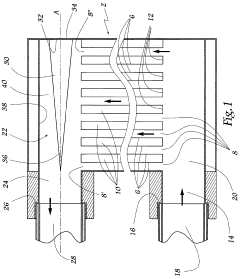
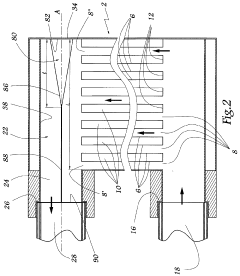
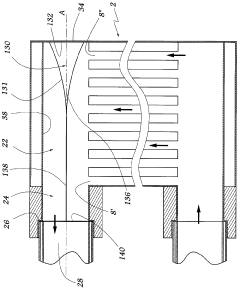
Heat exchanger plate, and a plate heat exchanger
PatentActiveUS12215937B2
Innovation
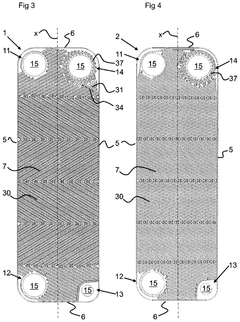
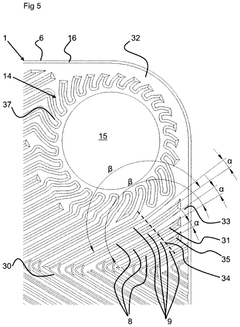
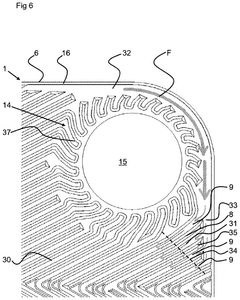
- The heat exchanger plate features tapering valleys in the local part area that decrease in width towards the longitudinal central axis, reducing flow resistance for fluids flowing around portholes and into the main heat exchanger area.
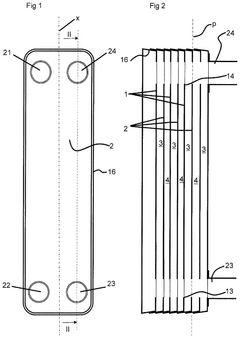
Energy Efficiency and Sustainability Aspects
Plate heat exchangers (PHEs) play a crucial role in various industries, and their energy efficiency and sustainability aspects are of paramount importance in today's environmentally conscious world. The fluid dynamics analysis of PHEs directly impacts their performance, energy consumption, and overall environmental footprint.
One of the primary focuses in improving PHE energy efficiency is optimizing the flow distribution within the exchanger. Uneven flow distribution can lead to reduced heat transfer rates and increased pressure drops, resulting in higher energy consumption. Advanced computational fluid dynamics (CFD) simulations have enabled researchers to identify and mitigate flow maldistribution issues, leading to more efficient designs that minimize energy losses.
The development of enhanced heat transfer surfaces has been another key area of improvement in PHE energy efficiency. Novel plate geometries, such as corrugated or dimpled surfaces, have been shown to increase turbulence and promote better mixing of fluids. These innovations result in higher heat transfer coefficients and reduced fouling, ultimately leading to improved energy efficiency and reduced maintenance requirements.
Material selection also plays a significant role in the sustainability of PHEs. The use of corrosion-resistant materials, such as titanium or high-grade stainless steel, can extend the operational life of the exchanger and reduce the need for frequent replacements. Additionally, the development of bio-based or recycled materials for gaskets and other components contributes to reducing the overall environmental impact of PHE manufacturing and disposal.
The integration of PHEs into waste heat recovery systems has become increasingly important in enhancing overall process sustainability. By capturing and utilizing waste heat from industrial processes, PHEs contribute to significant energy savings and reduced greenhouse gas emissions. This application is particularly relevant in industries such as power generation, chemical processing, and food production.
Smart monitoring and control systems have emerged as valuable tools for optimizing PHE performance and energy efficiency. Real-time data analysis and predictive maintenance algorithms can detect early signs of fouling or performance degradation, allowing for timely interventions that maintain optimal energy efficiency throughout the exchanger's lifecycle.
As the world moves towards more sustainable energy sources, PHEs are playing a crucial role in renewable energy applications. In geothermal power plants and solar thermal systems, PHEs facilitate efficient heat transfer between working fluids, contributing to the overall efficiency and viability of these clean energy technologies.
One of the primary focuses in improving PHE energy efficiency is optimizing the flow distribution within the exchanger. Uneven flow distribution can lead to reduced heat transfer rates and increased pressure drops, resulting in higher energy consumption. Advanced computational fluid dynamics (CFD) simulations have enabled researchers to identify and mitigate flow maldistribution issues, leading to more efficient designs that minimize energy losses.
The development of enhanced heat transfer surfaces has been another key area of improvement in PHE energy efficiency. Novel plate geometries, such as corrugated or dimpled surfaces, have been shown to increase turbulence and promote better mixing of fluids. These innovations result in higher heat transfer coefficients and reduced fouling, ultimately leading to improved energy efficiency and reduced maintenance requirements.
Material selection also plays a significant role in the sustainability of PHEs. The use of corrosion-resistant materials, such as titanium or high-grade stainless steel, can extend the operational life of the exchanger and reduce the need for frequent replacements. Additionally, the development of bio-based or recycled materials for gaskets and other components contributes to reducing the overall environmental impact of PHE manufacturing and disposal.
The integration of PHEs into waste heat recovery systems has become increasingly important in enhancing overall process sustainability. By capturing and utilizing waste heat from industrial processes, PHEs contribute to significant energy savings and reduced greenhouse gas emissions. This application is particularly relevant in industries such as power generation, chemical processing, and food production.
Smart monitoring and control systems have emerged as valuable tools for optimizing PHE performance and energy efficiency. Real-time data analysis and predictive maintenance algorithms can detect early signs of fouling or performance degradation, allowing for timely interventions that maintain optimal energy efficiency throughout the exchanger's lifecycle.
As the world moves towards more sustainable energy sources, PHEs are playing a crucial role in renewable energy applications. In geothermal power plants and solar thermal systems, PHEs facilitate efficient heat transfer between working fluids, contributing to the overall efficiency and viability of these clean energy technologies.
Regulatory Standards for Heat Exchanger Performance
Regulatory standards for heat exchanger performance play a crucial role in ensuring the safety, efficiency, and reliability of plate heat exchangers across various industries. These standards are typically established by national and international organizations to provide guidelines for design, manufacturing, testing, and operation of heat exchangers.
One of the primary regulatory bodies for heat exchanger standards is the American Society of Mechanical Engineers (ASME). The ASME Boiler and Pressure Vessel Code, particularly Section VIII, Division 1, sets forth requirements for the construction of pressure vessels, including plate heat exchangers. This code addresses aspects such as material selection, design calculations, fabrication methods, and quality control procedures.
In Europe, the Pressure Equipment Directive (PED) 2014/68/EU governs the design and manufacture of pressure equipment, including plate heat exchangers. This directive ensures that equipment meets essential safety requirements and undergoes appropriate conformity assessment procedures before being placed on the market.
The Tubular Exchanger Manufacturers Association (TEMA) standards are widely recognized in the industry for shell and tube heat exchangers but also provide valuable guidelines applicable to plate heat exchangers. TEMA standards cover aspects such as mechanical design, fabrication, and testing procedures.
For fluid dynamics analysis in plate heat exchangers, regulatory standards often reference specific test methods and performance criteria. The International Organization for Standardization (ISO) has developed several relevant standards, including ISO 15547 for petroleum, petrochemical, and natural gas industries, which provides guidelines for plate-type heat exchangers.
Performance testing of plate heat exchangers is typically conducted in accordance with standards such as AHRI Standard 400 (Performance Rating of Liquid to Liquid Heat Exchangers) in North America. This standard outlines procedures for determining thermal performance, pressure drop, and other critical parameters.
Regulatory standards also address environmental and energy efficiency concerns. For instance, the European Union's Ecodesign Directive sets minimum efficiency requirements for various types of heat exchangers used in heating, ventilation, and air conditioning (HVAC) systems.
Compliance with these regulatory standards is essential for manufacturers and end-users of plate heat exchangers. It ensures that the equipment meets minimum safety and performance requirements, facilitates fair competition in the market, and promotes energy efficiency and environmental sustainability.
One of the primary regulatory bodies for heat exchanger standards is the American Society of Mechanical Engineers (ASME). The ASME Boiler and Pressure Vessel Code, particularly Section VIII, Division 1, sets forth requirements for the construction of pressure vessels, including plate heat exchangers. This code addresses aspects such as material selection, design calculations, fabrication methods, and quality control procedures.
In Europe, the Pressure Equipment Directive (PED) 2014/68/EU governs the design and manufacture of pressure equipment, including plate heat exchangers. This directive ensures that equipment meets essential safety requirements and undergoes appropriate conformity assessment procedures before being placed on the market.
The Tubular Exchanger Manufacturers Association (TEMA) standards are widely recognized in the industry for shell and tube heat exchangers but also provide valuable guidelines applicable to plate heat exchangers. TEMA standards cover aspects such as mechanical design, fabrication, and testing procedures.
For fluid dynamics analysis in plate heat exchangers, regulatory standards often reference specific test methods and performance criteria. The International Organization for Standardization (ISO) has developed several relevant standards, including ISO 15547 for petroleum, petrochemical, and natural gas industries, which provides guidelines for plate-type heat exchangers.
Performance testing of plate heat exchangers is typically conducted in accordance with standards such as AHRI Standard 400 (Performance Rating of Liquid to Liquid Heat Exchangers) in North America. This standard outlines procedures for determining thermal performance, pressure drop, and other critical parameters.
Regulatory standards also address environmental and energy efficiency concerns. For instance, the European Union's Ecodesign Directive sets minimum efficiency requirements for various types of heat exchangers used in heating, ventilation, and air conditioning (HVAC) systems.
Compliance with these regulatory standards is essential for manufacturers and end-users of plate heat exchangers. It ensures that the equipment meets minimum safety and performance requirements, facilitates fair competition in the market, and promotes energy efficiency and environmental sustainability.
Unlock deeper insights with PatSnap Eureka Quick Research — get a full tech report to explore trends and direct your research. Try now!
Generate Your Research Report Instantly with AI Agent
Supercharge your innovation with PatSnap Eureka AI Agent Platform!