

Quantify PCM Contribution to Carbon Neutral Buildings
FEB 26, 202610 MIN READ
Generate Your Research Report Instantly with AI Agent
PatSnap Eureka helps you evaluate technical feasibility & market potential.
PCM Carbon Neutral Building Background and Objectives
Phase Change Materials (PCMs) have emerged as a critical technology in the pursuit of carbon-neutral buildings, representing a paradigm shift in thermal energy management systems. These materials undergo phase transitions at specific temperatures, absorbing and releasing substantial amounts of latent heat during melting and solidification processes. This unique thermodynamic property enables buildings to store excess thermal energy during peak periods and release it when needed, fundamentally altering traditional heating, ventilation, and air conditioning (HVAC) energy consumption patterns.
The global construction sector accounts for approximately 39% of total carbon emissions, with operational energy consumption representing the largest contributor to building-related greenhouse gas emissions. Traditional building thermal management relies heavily on active mechanical systems that consume significant electrical energy, often sourced from fossil fuel-based power generation. PCM integration offers a passive thermal regulation approach that can substantially reduce HVAC system dependency while maintaining optimal indoor comfort conditions.
The evolution of PCM technology in building applications has progressed through distinct phases, beginning with basic paraffin-based materials in the 1980s to today's sophisticated microencapsulated and bio-based formulations. Early implementations focused primarily on thermal comfort enhancement, but contemporary research emphasizes quantifiable carbon footprint reduction and energy performance optimization. This technological maturation coincides with increasingly stringent building energy codes and carbon neutrality mandates across major global markets.
Current PCM applications in buildings encompass diverse integration strategies, including incorporation into wallboard systems, ceiling panels, floor assemblies, and specialized thermal storage units. These implementations demonstrate varying degrees of effectiveness depending on climate conditions, building orientation, occupancy patterns, and system design parameters. However, establishing standardized methodologies for quantifying PCM contributions to carbon neutrality remains a significant challenge facing the industry.
The primary objective of quantifying PCM contribution to carbon-neutral buildings centers on developing comprehensive assessment frameworks that accurately measure energy savings, carbon emission reductions, and lifecycle environmental impacts. This quantification must encompass direct energy consumption reductions through decreased HVAC operation, peak load shifting benefits that reduce grid strain during high-demand periods, and long-term carbon sequestration potential through reduced building operational emissions.
Secondary objectives include establishing standardized testing protocols for PCM thermal performance evaluation, developing predictive modeling tools for carbon impact assessment, and creating economic valuation methodologies that account for both energy cost savings and carbon credit potential. These objectives collectively aim to provide building designers, policymakers, and investors with reliable data to support PCM adoption decisions and carbon neutrality planning strategies.
The global construction sector accounts for approximately 39% of total carbon emissions, with operational energy consumption representing the largest contributor to building-related greenhouse gas emissions. Traditional building thermal management relies heavily on active mechanical systems that consume significant electrical energy, often sourced from fossil fuel-based power generation. PCM integration offers a passive thermal regulation approach that can substantially reduce HVAC system dependency while maintaining optimal indoor comfort conditions.
The evolution of PCM technology in building applications has progressed through distinct phases, beginning with basic paraffin-based materials in the 1980s to today's sophisticated microencapsulated and bio-based formulations. Early implementations focused primarily on thermal comfort enhancement, but contemporary research emphasizes quantifiable carbon footprint reduction and energy performance optimization. This technological maturation coincides with increasingly stringent building energy codes and carbon neutrality mandates across major global markets.
Current PCM applications in buildings encompass diverse integration strategies, including incorporation into wallboard systems, ceiling panels, floor assemblies, and specialized thermal storage units. These implementations demonstrate varying degrees of effectiveness depending on climate conditions, building orientation, occupancy patterns, and system design parameters. However, establishing standardized methodologies for quantifying PCM contributions to carbon neutrality remains a significant challenge facing the industry.
The primary objective of quantifying PCM contribution to carbon-neutral buildings centers on developing comprehensive assessment frameworks that accurately measure energy savings, carbon emission reductions, and lifecycle environmental impacts. This quantification must encompass direct energy consumption reductions through decreased HVAC operation, peak load shifting benefits that reduce grid strain during high-demand periods, and long-term carbon sequestration potential through reduced building operational emissions.
Secondary objectives include establishing standardized testing protocols for PCM thermal performance evaluation, developing predictive modeling tools for carbon impact assessment, and creating economic valuation methodologies that account for both energy cost savings and carbon credit potential. These objectives collectively aim to provide building designers, policymakers, and investors with reliable data to support PCM adoption decisions and carbon neutrality planning strategies.
Market Demand for PCM in Sustainable Construction
The global construction industry is experiencing unprecedented pressure to reduce carbon emissions, with buildings accounting for nearly 40% of global energy-related CO2 emissions. This environmental imperative has created substantial market demand for Phase Change Materials (PCMs) in sustainable construction applications. PCMs offer unique thermal energy storage capabilities that can significantly reduce building energy consumption by maintaining stable indoor temperatures through latent heat absorption and release cycles.
Market drivers for PCM adoption in construction are multifaceted and increasingly compelling. Stringent building energy codes and green certification requirements, such as LEED, BREEAM, and ENERGY STAR, are pushing developers toward innovative thermal management solutions. Government incentives and carbon pricing mechanisms further accelerate market adoption by making energy-efficient building technologies economically attractive. The growing awareness of operational cost savings through reduced HVAC energy consumption has made PCMs particularly appealing to commercial building owners and facility managers.
The residential construction segment represents a rapidly expanding market for PCM applications. Homeowners increasingly seek energy-efficient solutions that provide both environmental benefits and long-term cost savings. PCM-integrated building materials, including wallboards, ceiling tiles, and insulation systems, are gaining traction in both new construction and retrofit projects. The technology's ability to reduce peak cooling loads and improve thermal comfort without mechanical systems aligns perfectly with consumer preferences for sustainable living solutions.
Commercial and industrial building sectors demonstrate even stronger demand patterns for PCM technologies. Large-scale facilities with significant thermal loads can achieve substantial energy savings through strategic PCM implementation. Data centers, warehouses, and manufacturing facilities are particularly well-suited for PCM applications due to their consistent thermal management requirements and high energy costs. The potential for demand response participation and grid stabilization services adds additional value propositions for commercial PCM installations.
Regional market dynamics vary significantly based on climate conditions, regulatory frameworks, and construction practices. Hot climate regions show strong demand for cooling-focused PCM applications, while temperate zones emphasize heating and cooling balance. Emerging markets with rapid urbanization present substantial growth opportunities, particularly as building codes evolve to incorporate energy efficiency requirements.
The market faces challenges including higher upfront costs compared to conventional building materials and limited awareness among construction professionals. However, decreasing PCM production costs and increasing energy prices are improving the economic case for adoption. Technical advances in PCM formulations and integration methods continue to expand application possibilities and market potential.
Supply chain development and standardization efforts are crucial for market expansion. Established building material manufacturers are increasingly incorporating PCM technologies into their product portfolios, improving market accessibility and reducing implementation barriers for construction professionals.
Market drivers for PCM adoption in construction are multifaceted and increasingly compelling. Stringent building energy codes and green certification requirements, such as LEED, BREEAM, and ENERGY STAR, are pushing developers toward innovative thermal management solutions. Government incentives and carbon pricing mechanisms further accelerate market adoption by making energy-efficient building technologies economically attractive. The growing awareness of operational cost savings through reduced HVAC energy consumption has made PCMs particularly appealing to commercial building owners and facility managers.
The residential construction segment represents a rapidly expanding market for PCM applications. Homeowners increasingly seek energy-efficient solutions that provide both environmental benefits and long-term cost savings. PCM-integrated building materials, including wallboards, ceiling tiles, and insulation systems, are gaining traction in both new construction and retrofit projects. The technology's ability to reduce peak cooling loads and improve thermal comfort without mechanical systems aligns perfectly with consumer preferences for sustainable living solutions.
Commercial and industrial building sectors demonstrate even stronger demand patterns for PCM technologies. Large-scale facilities with significant thermal loads can achieve substantial energy savings through strategic PCM implementation. Data centers, warehouses, and manufacturing facilities are particularly well-suited for PCM applications due to their consistent thermal management requirements and high energy costs. The potential for demand response participation and grid stabilization services adds additional value propositions for commercial PCM installations.
Regional market dynamics vary significantly based on climate conditions, regulatory frameworks, and construction practices. Hot climate regions show strong demand for cooling-focused PCM applications, while temperate zones emphasize heating and cooling balance. Emerging markets with rapid urbanization present substantial growth opportunities, particularly as building codes evolve to incorporate energy efficiency requirements.
The market faces challenges including higher upfront costs compared to conventional building materials and limited awareness among construction professionals. However, decreasing PCM production costs and increasing energy prices are improving the economic case for adoption. Technical advances in PCM formulations and integration methods continue to expand application possibilities and market potential.
Supply chain development and standardization efforts are crucial for market expansion. Established building material manufacturers are increasingly incorporating PCM technologies into their product portfolios, improving market accessibility and reducing implementation barriers for construction professionals.
Current PCM Integration Challenges in Buildings
Despite the promising thermal properties of Phase Change Materials (PCMs), their widespread integration into building systems faces significant technical and practical challenges that limit their contribution to carbon neutrality goals. These obstacles span across material performance, installation complexity, economic viability, and long-term reliability concerns.
Material performance inconsistencies represent a primary challenge in PCM implementation. Many commercially available PCMs exhibit thermal cycling degradation, where repeated melting and solidification cycles gradually reduce their heat storage capacity and alter their phase transition temperatures. This degradation directly impacts the long-term effectiveness of PCM systems in maintaining optimal indoor temperatures and reducing HVAC energy consumption.
Encapsulation and containment issues pose another critical barrier. PCMs require robust containment systems to prevent leakage during phase transitions, particularly for organic materials that may experience volume changes. Current encapsulation technologies often add significant weight and cost to building systems while potentially creating thermal bridges that reduce overall system efficiency.
Integration with existing building systems presents complex engineering challenges. Retrofitting PCM solutions into established HVAC systems requires careful consideration of thermal compatibility, structural load capacity, and maintenance accessibility. The lack of standardized integration protocols makes each installation a custom engineering project, increasing costs and implementation complexity.
Temperature control precision remains problematic for many PCM applications. The phase transition temperature range of available PCMs may not align perfectly with optimal comfort temperatures for different climate zones and building types. This mismatch can result in suboptimal thermal regulation and reduced energy savings compared to theoretical projections.
Economic barriers significantly impede widespread PCM adoption. High initial material costs, specialized installation requirements, and uncertain return on investment timelines make PCM systems less attractive compared to conventional insulation and HVAC solutions. The absence of comprehensive lifecycle cost analyses further complicates investment decisions for building developers and owners.
Quality control and performance verification challenges also limit PCM deployment. Current testing standards and monitoring systems are inadequate for accurately quantifying PCM performance in real-world building conditions. This measurement gap makes it difficult to validate carbon reduction claims and optimize system performance over time.
Material performance inconsistencies represent a primary challenge in PCM implementation. Many commercially available PCMs exhibit thermal cycling degradation, where repeated melting and solidification cycles gradually reduce their heat storage capacity and alter their phase transition temperatures. This degradation directly impacts the long-term effectiveness of PCM systems in maintaining optimal indoor temperatures and reducing HVAC energy consumption.
Encapsulation and containment issues pose another critical barrier. PCMs require robust containment systems to prevent leakage during phase transitions, particularly for organic materials that may experience volume changes. Current encapsulation technologies often add significant weight and cost to building systems while potentially creating thermal bridges that reduce overall system efficiency.
Integration with existing building systems presents complex engineering challenges. Retrofitting PCM solutions into established HVAC systems requires careful consideration of thermal compatibility, structural load capacity, and maintenance accessibility. The lack of standardized integration protocols makes each installation a custom engineering project, increasing costs and implementation complexity.
Temperature control precision remains problematic for many PCM applications. The phase transition temperature range of available PCMs may not align perfectly with optimal comfort temperatures for different climate zones and building types. This mismatch can result in suboptimal thermal regulation and reduced energy savings compared to theoretical projections.
Economic barriers significantly impede widespread PCM adoption. High initial material costs, specialized installation requirements, and uncertain return on investment timelines make PCM systems less attractive compared to conventional insulation and HVAC solutions. The absence of comprehensive lifecycle cost analyses further complicates investment decisions for building developers and owners.
Quality control and performance verification challenges also limit PCM deployment. Current testing standards and monitoring systems are inadequate for accurately quantifying PCM performance in real-world building conditions. This measurement gap makes it difficult to validate carbon reduction claims and optimize system performance over time.
Existing PCM Quantification Methods for Buildings
01 PCM integration in building materials for thermal energy storage
Phase change materials can be incorporated into building construction materials such as concrete, wallboards, and insulation to store and release thermal energy. This passive thermal regulation reduces the need for active heating and cooling systems, thereby decreasing energy consumption and contributing to carbon neutrality goals. The materials absorb excess heat during warm periods and release it during cooler times, maintaining comfortable indoor temperatures with minimal energy input.- PCM integration in building materials for thermal energy storage: Phase change materials can be incorporated into building construction materials such as concrete, wallboards, and insulation to store and release thermal energy. This passive thermal regulation reduces the need for active heating and cooling systems, thereby decreasing energy consumption and contributing to carbon neutrality goals. The materials absorb excess heat during warm periods and release it during cooler times, maintaining comfortable indoor temperatures with minimal energy input.
- PCM-based thermal management systems for renewable energy optimization: Phase change materials are utilized in thermal management systems to optimize the performance of renewable energy sources such as solar panels and wind turbines. By stabilizing temperature fluctuations and storing excess thermal energy, these systems improve the efficiency of energy generation and reduce reliance on fossil fuel-based backup systems. This enhanced efficiency directly supports carbon reduction efforts by maximizing clean energy utilization.
- PCM applications in cold chain and refrigeration systems: Phase change materials are employed in refrigeration and cold chain logistics to maintain stable temperatures without continuous energy input. These materials absorb and release latent heat at specific temperature ranges, reducing the energy required for cooling systems. The decreased energy consumption in refrigeration contributes to lower carbon emissions, particularly in food storage and pharmaceutical transportation sectors.
- PCM-enhanced thermal storage for industrial waste heat recovery: Phase change materials are integrated into industrial systems to capture and store waste heat that would otherwise be released into the environment. This recovered thermal energy can be reused in manufacturing processes or converted to electricity, reducing the overall energy demand from external sources. By improving industrial energy efficiency and minimizing waste, these systems contribute significantly to carbon neutrality objectives.
- PCM composite materials with enhanced thermal conductivity: Advanced phase change material composites incorporate additives such as carbon-based materials, metal particles, or graphene to improve thermal conductivity and heat transfer rates. These enhanced materials enable more efficient thermal energy storage and release cycles, making PCM systems more effective in various applications. The improved performance leads to greater energy savings and reduced carbon footprint across multiple sectors including construction, transportation, and electronics cooling.
02 PCM-based thermal management systems for renewable energy optimization
Phase change materials are utilized in thermal management systems to optimize the performance of renewable energy sources such as solar panels and wind turbines. By stabilizing temperature fluctuations and storing excess thermal energy, these systems improve the efficiency of energy generation and reduce reliance on fossil fuel backup systems. This enhanced efficiency directly supports carbon reduction efforts by maximizing clean energy utilization.Expand Specific Solutions03 PCM applications in cold chain logistics and refrigeration
Phase change materials are employed in cold chain transportation and refrigeration systems to maintain stable temperatures without continuous mechanical cooling. These materials reduce energy consumption in refrigerated transport and storage by providing passive temperature control. The decreased reliance on conventional refrigeration systems leads to lower greenhouse gas emissions and supports carbon neutrality in the logistics sector.Expand Specific Solutions04 PCM-enhanced thermal insulation for industrial processes
Phase change materials are integrated into industrial thermal insulation systems to capture and reuse waste heat from manufacturing processes. This heat recovery mechanism reduces the overall energy demand of industrial operations by recycling thermal energy that would otherwise be lost. The implementation of such systems contributes significantly to industrial carbon footprint reduction and supports sustainable manufacturing practices.Expand Specific Solutions05 PCM composite materials with enhanced thermal properties
Advanced composite phase change materials are developed by combining traditional PCMs with carbon-based materials, polymers, or other additives to improve thermal conductivity, stability, and energy storage capacity. These enhanced materials offer superior performance in various applications including electronics cooling, automotive thermal management, and building climate control. The improved efficiency of these composites amplifies their contribution to energy conservation and carbon emission reduction across multiple sectors.Expand Specific Solutions
Key Players in PCM Building Materials Industry
The PCM (Phase Change Materials) contribution to carbon neutral buildings represents an emerging technology sector in the early growth stage of industry development. The market demonstrates significant expansion potential as global carbon neutrality commitments drive demand for energy-efficient building solutions. Current market size remains relatively modest but shows accelerating growth trajectory driven by regulatory support and sustainability mandates. Technology maturity varies considerably across the competitive landscape, with established players like NGK Insulators and State Grid Corp. of China advancing industrial-scale applications, while research institutions including Southeast University, Nanyang Technological University, and Purdue Research Foundation drive fundamental innovation. Chinese entities dominate the ecosystem, with companies like Shenzhen Institute of Building Research, China Architectural Design & Research Institute, and Glodon Co. providing integrated solutions. The sector exhibits strong academic-industry collaboration, particularly evident through partnerships involving Guangdong University of Technology and Shenzhen University, indicating robust knowledge transfer mechanisms supporting technological advancement toward commercial viability.
Glodon Co., Ltd.
Technical Solution: Glodon has developed comprehensive Building Information Modeling (BIM) solutions that integrate PCM thermal performance analysis with carbon footprint assessment tools. Their platform enables real-time quantification of PCM contributions to building energy efficiency through advanced simulation algorithms that model phase change thermal dynamics and calculate corresponding carbon emission reductions. The system incorporates lifecycle assessment methodologies to track PCM performance from manufacturing through operational phases, providing detailed metrics on energy savings and carbon offset potential in building applications.
Strengths: Leading BIM integration capabilities and comprehensive lifecycle assessment tools. Weaknesses: Limited focus on advanced PCM material development and research.
Southeast University
Technical Solution: Southeast University has conducted extensive research on PCM integration in building systems with focus on quantifying carbon reduction benefits through experimental and computational approaches. Their work includes development of standardized testing protocols for PCM thermal performance evaluation and establishment of carbon accounting frameworks specific to phase change material applications in building envelopes. The university has created comprehensive models linking PCM thermal regulation capabilities to measurable reductions in building operational carbon emissions.
Strengths: Strong academic research foundation and standardized testing protocol development. Weaknesses: Limited commercial partnerships and market application of research outcomes.
Core PCM Carbon Impact Assessment Technologies
Latent heat storage materials
PatentInactiveEP2488463A1
Innovation
- A latent heat storage material composition incorporating a binder, phase change material, and water with a higher water-to-binder ratio, utilizing magnesia cement or pozzolan cement, and a magnesium chloride solution to achieve higher enthalpy values and improved fire retardant properties, allowing for increased phase change material incorporation and enhanced thermal energy storage.
Phase change materials and methods of regulating temperature
PatentWO2017042530A1
Innovation
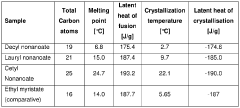
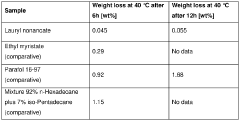
- A PCM composition comprising an ester of a linear alcohol with at least 4 carbon atoms and a linear carboxylic acid with at least 4 carbon atoms, with a total carbon range of 13 to 31, which reduces evaporation rates and improves melting point, thereby enhancing containment and performance.
Green Building Standards and PCM Regulations
The integration of Phase Change Materials (PCM) into building systems has prompted the development of comprehensive regulatory frameworks and green building standards worldwide. These standards serve as critical benchmarks for quantifying PCM contributions to carbon neutral buildings, establishing measurable criteria for energy performance and environmental impact assessment.
LEED (Leadership in Energy and Environmental Design) has emerged as one of the most influential green building certification systems globally, incorporating specific provisions for thermal energy storage technologies including PCM applications. The LEED v4.1 framework awards credits for innovative building materials that demonstrate measurable energy savings and carbon footprint reduction. PCM systems can contribute to multiple LEED categories, including Energy and Atmosphere credits through demonstrated energy performance improvements and Materials and Resources credits when utilizing sustainable PCM formulations.
BREEAM (Building Research Establishment Environmental Assessment Method) provides another significant regulatory pathway for PCM integration assessment. The BREEAM framework emphasizes lifecycle carbon analysis and operational energy efficiency, creating opportunities for PCM technologies to demonstrate quantifiable contributions to carbon neutrality goals. The standard's Energy section specifically recognizes thermal mass enhancement technologies, allowing PCM systems to earn credits through validated energy modeling and post-occupancy performance verification.
The European Union's Energy Performance of Buildings Directive (EPBD) has established mandatory energy performance standards that directly impact PCM adoption in member states. The directive's emphasis on nearly zero-energy buildings (nZEB) creates regulatory demand for innovative thermal management solutions, positioning PCM as a compliance strategy for meeting stringent energy efficiency requirements.
National and regional building codes increasingly incorporate provisions for thermal energy storage systems. The International Energy Conservation Code (IECC) and ASHRAE Standard 90.1 have begun recognizing PCM contributions through updated calculation methodologies for building thermal mass. These standards provide standardized approaches for quantifying PCM energy savings and carbon reduction benefits.
Emerging regulations focus specifically on embodied carbon assessment, requiring comprehensive lifecycle analysis of building materials including PCM systems. These frameworks establish methodologies for quantifying both operational and embodied carbon impacts, enabling more accurate assessment of PCM contributions to overall building carbon neutrality objectives.
LEED (Leadership in Energy and Environmental Design) has emerged as one of the most influential green building certification systems globally, incorporating specific provisions for thermal energy storage technologies including PCM applications. The LEED v4.1 framework awards credits for innovative building materials that demonstrate measurable energy savings and carbon footprint reduction. PCM systems can contribute to multiple LEED categories, including Energy and Atmosphere credits through demonstrated energy performance improvements and Materials and Resources credits when utilizing sustainable PCM formulations.
BREEAM (Building Research Establishment Environmental Assessment Method) provides another significant regulatory pathway for PCM integration assessment. The BREEAM framework emphasizes lifecycle carbon analysis and operational energy efficiency, creating opportunities for PCM technologies to demonstrate quantifiable contributions to carbon neutrality goals. The standard's Energy section specifically recognizes thermal mass enhancement technologies, allowing PCM systems to earn credits through validated energy modeling and post-occupancy performance verification.
The European Union's Energy Performance of Buildings Directive (EPBD) has established mandatory energy performance standards that directly impact PCM adoption in member states. The directive's emphasis on nearly zero-energy buildings (nZEB) creates regulatory demand for innovative thermal management solutions, positioning PCM as a compliance strategy for meeting stringent energy efficiency requirements.
National and regional building codes increasingly incorporate provisions for thermal energy storage systems. The International Energy Conservation Code (IECC) and ASHRAE Standard 90.1 have begun recognizing PCM contributions through updated calculation methodologies for building thermal mass. These standards provide standardized approaches for quantifying PCM energy savings and carbon reduction benefits.
Emerging regulations focus specifically on embodied carbon assessment, requiring comprehensive lifecycle analysis of building materials including PCM systems. These frameworks establish methodologies for quantifying both operational and embodied carbon impacts, enabling more accurate assessment of PCM contributions to overall building carbon neutrality objectives.
Life Cycle Assessment Methods for PCM Systems
Life Cycle Assessment (LCA) represents the most comprehensive methodology for quantifying the environmental impact of Phase Change Materials (PCM) systems throughout their entire operational lifespan in building applications. This systematic approach evaluates environmental burdens from raw material extraction through manufacturing, installation, operation, and end-of-life disposal phases. For PCM systems in carbon-neutral buildings, LCA provides critical insights into net carbon benefits by comparing energy savings during operation against embodied carbon costs.
The cradle-to-grave LCA framework for PCM systems encompasses four distinct phases: goal and scope definition, inventory analysis, impact assessment, and interpretation. The goal definition phase establishes functional units typically measured in terms of thermal energy storage capacity per unit mass or volume over specified time periods. Scope boundaries must clearly delineate system components including PCM materials, encapsulation systems, heat exchangers, and integration hardware within building envelope assemblies.
Inventory analysis quantifies material and energy flows throughout the PCM system lifecycle. This phase requires detailed data collection on raw material consumption, manufacturing energy requirements, transportation impacts, and operational energy performance. Critical parameters include PCM production pathways, encapsulation material selection, thermal cycling durability, and maintenance requirements. Data quality assessment ensures reliability of inventory inputs through uncertainty analysis and sensitivity testing.
Impact assessment translates inventory data into environmental indicators relevant to carbon neutrality objectives. Primary impact categories include global warming potential, primary energy demand, and resource depletion metrics. Advanced LCA methodologies incorporate dynamic assessment approaches that account for temporal variations in building energy performance and grid carbon intensity. This temporal dimension proves essential for accurately quantifying PCM contributions to carbon reduction targets.
Comparative LCA studies evaluate PCM systems against conventional thermal management alternatives including increased insulation, mechanical cooling systems, or thermal mass strategies. These comparative assessments reveal conditions under which PCM integration delivers net carbon benefits. Climate-specific analysis demonstrates regional variations in PCM effectiveness based on local temperature profiles, heating and cooling degree days, and electricity grid carbon factors.
Emerging LCA methodologies address PCM-specific challenges including thermal performance degradation over multiple phase change cycles, material compatibility issues, and recycling potential. Probabilistic LCA approaches incorporate uncertainty ranges for key parameters such as PCM lifespan, thermal conductivity variations, and phase change enthalpy stability. These advanced methods provide robust quantitative foundations for PCM deployment decisions in carbon-neutral building strategies.
The cradle-to-grave LCA framework for PCM systems encompasses four distinct phases: goal and scope definition, inventory analysis, impact assessment, and interpretation. The goal definition phase establishes functional units typically measured in terms of thermal energy storage capacity per unit mass or volume over specified time periods. Scope boundaries must clearly delineate system components including PCM materials, encapsulation systems, heat exchangers, and integration hardware within building envelope assemblies.
Inventory analysis quantifies material and energy flows throughout the PCM system lifecycle. This phase requires detailed data collection on raw material consumption, manufacturing energy requirements, transportation impacts, and operational energy performance. Critical parameters include PCM production pathways, encapsulation material selection, thermal cycling durability, and maintenance requirements. Data quality assessment ensures reliability of inventory inputs through uncertainty analysis and sensitivity testing.
Impact assessment translates inventory data into environmental indicators relevant to carbon neutrality objectives. Primary impact categories include global warming potential, primary energy demand, and resource depletion metrics. Advanced LCA methodologies incorporate dynamic assessment approaches that account for temporal variations in building energy performance and grid carbon intensity. This temporal dimension proves essential for accurately quantifying PCM contributions to carbon reduction targets.
Comparative LCA studies evaluate PCM systems against conventional thermal management alternatives including increased insulation, mechanical cooling systems, or thermal mass strategies. These comparative assessments reveal conditions under which PCM integration delivers net carbon benefits. Climate-specific analysis demonstrates regional variations in PCM effectiveness based on local temperature profiles, heating and cooling degree days, and electricity grid carbon factors.
Emerging LCA methodologies address PCM-specific challenges including thermal performance degradation over multiple phase change cycles, material compatibility issues, and recycling potential. Probabilistic LCA approaches incorporate uncertainty ranges for key parameters such as PCM lifespan, thermal conductivity variations, and phase change enthalpy stability. These advanced methods provide robust quantitative foundations for PCM deployment decisions in carbon-neutral building strategies.
Unlock deeper insights with PatSnap Eureka Quick Research — get a full tech report to explore trends and direct your research. Try now!
Generate Your Research Report Instantly with AI Agent
Supercharge your innovation with PatSnap Eureka AI Agent Platform!