

Quantify PCM Efficiency in Low-Temperature Applications
FEB 26, 20269 MIN READ
Generate Your Research Report Instantly with AI Agent
PatSnap Eureka helps you evaluate technical feasibility & market potential.
PCM Low-Temp Background and Efficiency Goals
Phase Change Materials (PCMs) have emerged as critical components in thermal energy storage systems, particularly gaining prominence in low-temperature applications ranging from building climate control to cold chain logistics. The fundamental principle underlying PCM technology involves the absorption and release of latent heat during phase transitions, typically between solid and liquid states. This mechanism enables PCMs to store substantial amounts of thermal energy within relatively narrow temperature ranges, making them invaluable for applications requiring precise temperature control and energy efficiency optimization.
The evolution of PCM technology has been driven by increasing demands for sustainable energy solutions and enhanced thermal management systems. Early applications focused primarily on high-temperature industrial processes, but recent decades have witnessed a significant shift toward low-temperature implementations. This transition reflects growing awareness of energy conservation needs in residential, commercial, and specialized industrial sectors where temperature requirements typically range from -20°C to 30°C.
Low-temperature PCM applications present unique challenges that distinguish them from their high-temperature counterparts. The reduced temperature differential between ambient conditions and target temperatures necessitates more sophisticated efficiency quantification methods. Traditional efficiency metrics often prove inadequate when applied to systems operating within narrow temperature bands, where small variations can significantly impact overall performance.
Current technological objectives in low-temperature PCM efficiency focus on developing comprehensive measurement frameworks that accurately capture energy storage and release characteristics under realistic operating conditions. These goals encompass establishing standardized testing protocols, developing advanced thermal characterization techniques, and creating predictive models that account for real-world variables such as thermal cycling, subcooling effects, and heat transfer limitations.
The primary technical challenge lies in achieving consistent and measurable efficiency improvements while maintaining cost-effectiveness and practical applicability. Research efforts are increasingly directed toward understanding the complex interplay between material properties, system design parameters, and operational variables that collectively determine PCM performance in low-temperature environments.
Emerging efficiency targets emphasize not only peak performance metrics but also long-term stability, cycling durability, and integration compatibility with existing thermal management systems. These objectives reflect the industry's maturation toward practical deployment scenarios where theoretical performance must translate into reliable, economically viable solutions for diverse low-temperature applications.
The evolution of PCM technology has been driven by increasing demands for sustainable energy solutions and enhanced thermal management systems. Early applications focused primarily on high-temperature industrial processes, but recent decades have witnessed a significant shift toward low-temperature implementations. This transition reflects growing awareness of energy conservation needs in residential, commercial, and specialized industrial sectors where temperature requirements typically range from -20°C to 30°C.
Low-temperature PCM applications present unique challenges that distinguish them from their high-temperature counterparts. The reduced temperature differential between ambient conditions and target temperatures necessitates more sophisticated efficiency quantification methods. Traditional efficiency metrics often prove inadequate when applied to systems operating within narrow temperature bands, where small variations can significantly impact overall performance.
Current technological objectives in low-temperature PCM efficiency focus on developing comprehensive measurement frameworks that accurately capture energy storage and release characteristics under realistic operating conditions. These goals encompass establishing standardized testing protocols, developing advanced thermal characterization techniques, and creating predictive models that account for real-world variables such as thermal cycling, subcooling effects, and heat transfer limitations.
The primary technical challenge lies in achieving consistent and measurable efficiency improvements while maintaining cost-effectiveness and practical applicability. Research efforts are increasingly directed toward understanding the complex interplay between material properties, system design parameters, and operational variables that collectively determine PCM performance in low-temperature environments.
Emerging efficiency targets emphasize not only peak performance metrics but also long-term stability, cycling durability, and integration compatibility with existing thermal management systems. These objectives reflect the industry's maturation toward practical deployment scenarios where theoretical performance must translate into reliable, economically viable solutions for diverse low-temperature applications.
Market Demand for Low-Temp PCM Solutions
The global demand for low-temperature phase change materials (PCMs) is experiencing significant growth driven by multiple converging market forces. Cold chain logistics represents one of the most substantial demand drivers, as the pharmaceutical and food industries require increasingly sophisticated temperature control solutions. The expansion of vaccine distribution networks, particularly following recent global health initiatives, has highlighted the critical need for reliable thermal management systems operating in sub-zero temperature ranges.
Data center cooling applications constitute another major market segment, where low-temperature PCMs offer energy-efficient alternatives to traditional cooling systems. The growing computational demands and the push toward sustainable data center operations are creating substantial opportunities for PCM-based thermal management solutions that can operate effectively at lower temperatures while reducing overall energy consumption.
The renewable energy sector presents emerging demand patterns, particularly in thermal energy storage systems designed to operate in colder climates. Wind and solar installations in northern regions require thermal management solutions that maintain efficiency at low ambient temperatures, creating specialized market niches for low-temperature PCM applications.
Automotive and aerospace industries are driving demand for lightweight, efficient thermal management systems that function reliably across wide temperature ranges. Electric vehicle battery thermal management systems, in particular, require PCM solutions that can maintain optimal performance in cold weather conditions, representing a rapidly expanding market segment.
Geographic demand distribution shows strong concentration in northern hemisphere markets, including North America, Northern Europe, and parts of Asia where cold climate applications are prevalent. Industrial refrigeration and HVAC applications in these regions increasingly specify low-temperature PCM solutions for improved energy efficiency and operational reliability.
The market trajectory indicates sustained growth potential, supported by regulatory pressures for energy efficiency improvements and the ongoing transition toward sustainable thermal management technologies. Healthcare cold storage requirements continue expanding globally, while emerging applications in building thermal regulation and industrial process cooling create additional demand streams for specialized low-temperature PCM formulations.
Data center cooling applications constitute another major market segment, where low-temperature PCMs offer energy-efficient alternatives to traditional cooling systems. The growing computational demands and the push toward sustainable data center operations are creating substantial opportunities for PCM-based thermal management solutions that can operate effectively at lower temperatures while reducing overall energy consumption.
The renewable energy sector presents emerging demand patterns, particularly in thermal energy storage systems designed to operate in colder climates. Wind and solar installations in northern regions require thermal management solutions that maintain efficiency at low ambient temperatures, creating specialized market niches for low-temperature PCM applications.
Automotive and aerospace industries are driving demand for lightweight, efficient thermal management systems that function reliably across wide temperature ranges. Electric vehicle battery thermal management systems, in particular, require PCM solutions that can maintain optimal performance in cold weather conditions, representing a rapidly expanding market segment.
Geographic demand distribution shows strong concentration in northern hemisphere markets, including North America, Northern Europe, and parts of Asia where cold climate applications are prevalent. Industrial refrigeration and HVAC applications in these regions increasingly specify low-temperature PCM solutions for improved energy efficiency and operational reliability.
The market trajectory indicates sustained growth potential, supported by regulatory pressures for energy efficiency improvements and the ongoing transition toward sustainable thermal management technologies. Healthcare cold storage requirements continue expanding globally, while emerging applications in building thermal regulation and industrial process cooling create additional demand streams for specialized low-temperature PCM formulations.
Current PCM Performance Challenges at Low Temperatures
Phase change materials operating in low-temperature environments face significant performance degradation that fundamentally limits their practical applications. The primary challenge stems from the inherent relationship between temperature and molecular kinetic energy, where reduced thermal conditions directly impact the material's ability to undergo efficient phase transitions. This temperature dependency creates a cascade of performance issues that affect both the thermodynamic and kinetic aspects of PCM operation.
Crystallization kinetics represent one of the most critical bottlenecks in low-temperature PCM performance. At reduced temperatures, the nucleation rate decreases substantially, leading to prolonged phase transition times and incomplete crystallization processes. This phenomenon results in reduced latent heat storage capacity and creates thermal hysteresis effects that compromise the material's cyclic reliability. The slower crystallization kinetics also contribute to supercooling issues, where the material remains in liquid state well below its theoretical freezing point.
Thermal conductivity degradation poses another significant challenge, as most PCMs exhibit reduced heat transfer coefficients at lower operating temperatures. This reduction in thermal conductivity creates thermal gradients within the material, leading to non-uniform phase transitions and reduced overall system efficiency. The decreased heat transfer rates particularly impact applications requiring rapid charge-discharge cycles, making the PCM unsuitable for dynamic thermal management applications.
Viscosity-related constraints become increasingly problematic as temperatures decrease, with many organic PCMs experiencing exponential increases in viscosity that impede natural convection processes. This viscosity increase restricts fluid motion during the liquid phase, reducing heat transfer effectiveness and creating stagnant zones that further compromise thermal performance. The elevated viscosity also affects the material's ability to accommodate volume changes during phase transitions.
Material stability issues emerge as temperature-dependent chemical and physical degradation mechanisms become more pronounced. Low-temperature cycling can induce phase separation in composite PCMs, while repeated freeze-thaw cycles may cause structural damage to encapsulation materials. These stability concerns are particularly acute in salt hydrate PCMs, where incongruent melting and crystallization can lead to permanent performance degradation over extended operational periods.
Crystallization kinetics represent one of the most critical bottlenecks in low-temperature PCM performance. At reduced temperatures, the nucleation rate decreases substantially, leading to prolonged phase transition times and incomplete crystallization processes. This phenomenon results in reduced latent heat storage capacity and creates thermal hysteresis effects that compromise the material's cyclic reliability. The slower crystallization kinetics also contribute to supercooling issues, where the material remains in liquid state well below its theoretical freezing point.
Thermal conductivity degradation poses another significant challenge, as most PCMs exhibit reduced heat transfer coefficients at lower operating temperatures. This reduction in thermal conductivity creates thermal gradients within the material, leading to non-uniform phase transitions and reduced overall system efficiency. The decreased heat transfer rates particularly impact applications requiring rapid charge-discharge cycles, making the PCM unsuitable for dynamic thermal management applications.
Viscosity-related constraints become increasingly problematic as temperatures decrease, with many organic PCMs experiencing exponential increases in viscosity that impede natural convection processes. This viscosity increase restricts fluid motion during the liquid phase, reducing heat transfer effectiveness and creating stagnant zones that further compromise thermal performance. The elevated viscosity also affects the material's ability to accommodate volume changes during phase transitions.
Material stability issues emerge as temperature-dependent chemical and physical degradation mechanisms become more pronounced. Low-temperature cycling can induce phase separation in composite PCMs, while repeated freeze-thaw cycles may cause structural damage to encapsulation materials. These stability concerns are particularly acute in salt hydrate PCMs, where incongruent melting and crystallization can lead to permanent performance degradation over extended operational periods.
Existing PCM Efficiency Quantification Methods
01 Enhanced thermal conductivity through composite materials
Improving PCM efficiency by incorporating high thermal conductivity materials such as graphene, carbon nanotubes, metal foams, or expanded graphite into the phase change material matrix. These additives create conductive pathways that facilitate faster heat transfer during phase transitions, reducing charging and discharging times while maintaining the latent heat storage capacity of the PCM.- Enhanced thermal conductivity through composite materials: Improving PCM efficiency by incorporating high thermal conductivity materials such as graphene, carbon nanotubes, metal foams, or expanded graphite into the phase change material matrix. These additives create conductive pathways that facilitate faster heat transfer during phase transitions, reducing charging and discharging times while maintaining the latent heat storage capacity of the PCM.
- Microencapsulation and nanoencapsulation techniques: Encapsulating phase change materials in micro or nano-scale shells to prevent leakage, increase surface area for heat exchange, and improve thermal cycling stability. The encapsulation process enhances the mechanical strength and chemical stability of PCMs while allowing for better integration into various applications and maintaining consistent thermal performance over extended use cycles.
- Optimization of PCM composition and phase transition temperature: Developing PCM formulations with tailored melting points and enhanced latent heat capacity through the use of eutectic mixtures, salt hydrates, or organic-inorganic hybrid materials. This approach allows for precise temperature control in specific applications and maximizes energy storage density by selecting optimal material combinations that exhibit minimal supercooling and phase separation.
- Integration of PCM with heat transfer enhancement structures: Incorporating fins, heat pipes, porous media, or honeycomb structures within PCM systems to improve heat distribution and reduce thermal resistance. These structural modifications create larger heat exchange surfaces and promote convective flow patterns, significantly accelerating the melting and solidification processes while ensuring uniform temperature distribution throughout the PCM volume.
- Advanced containment and packaging systems: Designing specialized containers, panels, or modular units that optimize PCM performance through improved thermal contact, leak prevention, and volumetric efficiency. These systems incorporate features such as flexible membranes to accommodate volume changes during phase transitions, corrosion-resistant materials for long-term stability, and geometric configurations that maximize heat transfer surface area relative to PCM volume.
02 Microencapsulation and nanoencapsulation techniques
Encapsulating phase change materials in protective shells at micro or nano scale to prevent leakage, enhance thermal stability, and increase the surface area for heat exchange. This approach improves the efficiency of PCMs by enabling better integration into various substrates, reducing supercooling effects, and maintaining structural integrity during repeated phase change cycles.Expand Specific Solutions03 Optimization of PCM container and heat exchanger design
Enhancing PCM efficiency through innovative geometric configurations, fin structures, and heat exchanger designs that maximize contact surface area and minimize thermal resistance. These designs facilitate uniform temperature distribution, reduce phase change time, and improve overall energy storage and release rates in thermal management systems.Expand Specific Solutions04 Hybrid PCM systems with multiple phase change temperatures
Developing composite PCM systems that combine multiple materials with different melting points to create cascaded or layered thermal storage solutions. This approach extends the operational temperature range, improves energy density, and provides more stable temperature control across varying thermal loads, thereby increasing overall system efficiency.Expand Specific Solutions05 Integration of PCM with renewable energy systems
Incorporating phase change materials into solar thermal collectors, photovoltaic systems, and building envelopes to store excess thermal energy and release it during periods of low energy availability. This integration improves energy utilization efficiency, reduces peak load demands, and enhances the overall performance of renewable energy installations through effective thermal buffering.Expand Specific Solutions
Key Players in Low-Temperature PCM Industry
The PCM efficiency quantification in low-temperature applications represents an emerging market segment within the broader thermal energy storage industry, currently in its early commercialization phase with significant growth potential driven by increasing demand for sustainable cooling solutions. The market demonstrates moderate fragmentation with diverse players ranging from specialized PCM manufacturers like Phase Change Solutions Inc. and Sunamp Ltd., to established industrial giants such as General Electric Company and Croda International Plc. Technology maturity varies considerably across the competitive landscape, with research institutions including King Fahd University of Petroleum & Minerals, Nanyang Technological University, and Beihang University advancing fundamental PCM science, while companies like Tan90 Thermal Solutions and PureTemp.com focus on practical applications. Semiconductor manufacturers including Taiwan Semiconductor Manufacturing Co. and QUALCOMM Inc. contribute advanced materials expertise, indicating cross-industry convergence that accelerates technological development and market adoption potential.
Sunamp Ltd.
Technical Solution: Sunamp has developed innovative thermal storage systems using proprietary PCM technology specifically designed for low-temperature efficiency optimization. Their approach combines advanced PCM formulations with intelligent control systems that continuously monitor and quantify thermal performance in real-time. The company's technology incorporates machine learning algorithms to predict PCM behavior and optimize efficiency based on ambient temperature conditions. Their systems feature integrated sensors and data analytics platforms that provide precise measurements of energy storage and release rates, enabling accurate efficiency quantification even in challenging low-temperature environments below -10°C.
Strengths: Integrated smart monitoring systems, real-time efficiency quantification capabilities, proven commercial deployment. Weaknesses: Higher initial investment costs, complexity of integrated systems may require specialized maintenance.
Tan90 Thermal Solutions Pte Ltd.
Technical Solution: Tan90 Thermal Solutions has developed specialized PCM testing and characterization services focused on low-temperature efficiency quantification. Their technical approach involves advanced differential scanning calorimetry (DSC) and thermal conductivity measurement techniques specifically calibrated for sub-zero temperature ranges. The company provides comprehensive thermal property analysis including enthalpy measurements, thermal cycling stability assessment, and supercooling characterization. Their methodology enables precise quantification of PCM efficiency parameters such as energy density, charge/discharge rates, and thermal response times in applications operating between -25°C and +10°C, particularly for cold climate energy storage and thermal regulation systems.
Strengths: Specialized testing capabilities, precise measurement techniques for low-temperature characterization. Weaknesses: Service-based model limits direct technology development, smaller market presence compared to established players.
Core Innovations in Low-Temp PCM Performance Metrics
Composition and methods for a heat storage capacity device for thermal management of fluids
PatentWO2019133461A1
Innovation
- A heat storage capacity device featuring a continuous coaxial design with a PCM-filled body encapsulated in polymer layers, eliminating the need for multiple closures and allowing for efficient thermal exchange, with a coaxial cable that can be manufactured using existing electrical wire production processes, providing high heat storage capacity and reliability.


Phase change materials and methods of regulating temperature
PatentWO2017042530A1
Innovation
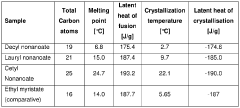
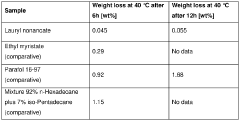
- A PCM composition comprising an ester of a linear alcohol with at least 4 carbon atoms and a linear carboxylic acid with at least 4 carbon atoms, with a total carbon range of 13 to 31, which reduces evaporation rates and improves melting point, thereby enhancing containment and performance.
Energy Storage Standards for Cold Climate Applications
The development of comprehensive energy storage standards for cold climate applications has become increasingly critical as Phase Change Materials (PCM) gain prominence in low-temperature environments. Current standardization efforts focus on establishing unified testing protocols, performance metrics, and safety requirements specifically tailored for sub-zero operational conditions. These standards address the unique challenges posed by freeze-thaw cycles, thermal cycling durability, and material stability in extreme cold environments.
International standardization bodies, including IEC and ASTM, are actively developing frameworks that encompass thermal performance characterization, cycling life assessment, and safety protocols for PCM systems operating below 0°C. These emerging standards emphasize the need for standardized measurement techniques to evaluate heat storage capacity, thermal conductivity variations, and phase transition efficiency under cold climate conditions. The standards also incorporate requirements for material compatibility testing and long-term stability assessment in harsh environmental conditions.
Key standardization areas include establishing uniform testing methodologies for supercooling behavior, nucleation control mechanisms, and thermal hysteresis effects that significantly impact PCM performance in cold climates. The standards define specific test conditions, measurement accuracy requirements, and data reporting formats to ensure consistency across different manufacturers and research institutions. Temperature cycling protocols, ranging from -40°C to +20°C, are being standardized to simulate real-world cold climate applications.
Safety standards for cold climate PCM applications address containment integrity, material toxicity, and fire safety considerations under extreme temperature conditions. These standards specify requirements for encapsulation materials, leak detection systems, and emergency response protocols specific to cold environment installations. Environmental impact assessments and end-of-life disposal procedures are also incorporated into the standardization framework.
The standardization process involves collaboration between industry stakeholders, research institutions, and regulatory bodies to ensure practical applicability while maintaining rigorous performance requirements. These standards will facilitate market adoption, enable fair performance comparisons, and support the development of reliable PCM-based energy storage solutions for cold climate applications across various sectors including building heating, industrial processes, and renewable energy integration.
International standardization bodies, including IEC and ASTM, are actively developing frameworks that encompass thermal performance characterization, cycling life assessment, and safety protocols for PCM systems operating below 0°C. These emerging standards emphasize the need for standardized measurement techniques to evaluate heat storage capacity, thermal conductivity variations, and phase transition efficiency under cold climate conditions. The standards also incorporate requirements for material compatibility testing and long-term stability assessment in harsh environmental conditions.
Key standardization areas include establishing uniform testing methodologies for supercooling behavior, nucleation control mechanisms, and thermal hysteresis effects that significantly impact PCM performance in cold climates. The standards define specific test conditions, measurement accuracy requirements, and data reporting formats to ensure consistency across different manufacturers and research institutions. Temperature cycling protocols, ranging from -40°C to +20°C, are being standardized to simulate real-world cold climate applications.
Safety standards for cold climate PCM applications address containment integrity, material toxicity, and fire safety considerations under extreme temperature conditions. These standards specify requirements for encapsulation materials, leak detection systems, and emergency response protocols specific to cold environment installations. Environmental impact assessments and end-of-life disposal procedures are also incorporated into the standardization framework.
The standardization process involves collaboration between industry stakeholders, research institutions, and regulatory bodies to ensure practical applicability while maintaining rigorous performance requirements. These standards will facilitate market adoption, enable fair performance comparisons, and support the development of reliable PCM-based energy storage solutions for cold climate applications across various sectors including building heating, industrial processes, and renewable energy integration.
Environmental Impact Assessment of Low-Temp PCM Systems
The environmental implications of low-temperature phase change material systems present a complex landscape of benefits and challenges that require comprehensive evaluation across multiple dimensions. These systems, while offering significant energy efficiency improvements, introduce unique environmental considerations that differ substantially from conventional thermal management technologies.
Life cycle assessment studies indicate that low-temperature PCM systems demonstrate favorable environmental profiles primarily through their energy conservation capabilities. The reduced energy consumption for heating and cooling applications translates directly into decreased greenhouse gas emissions, particularly in regions where electricity generation relies heavily on fossil fuels. Quantitative analyses suggest emission reductions of 15-30% compared to traditional HVAC systems over operational lifespans.
Material sourcing and production phases reveal mixed environmental impacts depending on PCM composition. Organic PCMs, including paraffins and fatty acids, generally exhibit lower manufacturing energy requirements but raise concerns regarding petroleum-based feedstock dependency. Bio-based alternatives derived from renewable sources show promise for reducing carbon footprints, though current production scales limit widespread adoption.
Waste management considerations present both opportunities and challenges for PCM system deployment. The encapsulation materials, typically polymers or metals, require careful end-of-life planning to prevent environmental contamination. However, many PCM formulations retain their thermodynamic properties through numerous phase change cycles, extending system lifespans and reducing replacement frequencies compared to conventional materials.
Water resource impacts vary significantly based on system design and application context. Passive PCM integration in building envelopes eliminates water consumption associated with traditional cooling systems, while active PCM systems may require minimal water usage for heat exchange processes. Regional water scarcity considerations increasingly influence technology selection decisions.
Emerging regulatory frameworks increasingly recognize PCM systems' environmental benefits, with several jurisdictions incorporating thermal energy storage technologies into green building standards and carbon reduction incentive programs. This regulatory support accelerates adoption while establishing environmental performance benchmarks for future system developments.
Life cycle assessment studies indicate that low-temperature PCM systems demonstrate favorable environmental profiles primarily through their energy conservation capabilities. The reduced energy consumption for heating and cooling applications translates directly into decreased greenhouse gas emissions, particularly in regions where electricity generation relies heavily on fossil fuels. Quantitative analyses suggest emission reductions of 15-30% compared to traditional HVAC systems over operational lifespans.
Material sourcing and production phases reveal mixed environmental impacts depending on PCM composition. Organic PCMs, including paraffins and fatty acids, generally exhibit lower manufacturing energy requirements but raise concerns regarding petroleum-based feedstock dependency. Bio-based alternatives derived from renewable sources show promise for reducing carbon footprints, though current production scales limit widespread adoption.
Waste management considerations present both opportunities and challenges for PCM system deployment. The encapsulation materials, typically polymers or metals, require careful end-of-life planning to prevent environmental contamination. However, many PCM formulations retain their thermodynamic properties through numerous phase change cycles, extending system lifespans and reducing replacement frequencies compared to conventional materials.
Water resource impacts vary significantly based on system design and application context. Passive PCM integration in building envelopes eliminates water consumption associated with traditional cooling systems, while active PCM systems may require minimal water usage for heat exchange processes. Regional water scarcity considerations increasingly influence technology selection decisions.
Emerging regulatory frameworks increasingly recognize PCM systems' environmental benefits, with several jurisdictions incorporating thermal energy storage technologies into green building standards and carbon reduction incentive programs. This regulatory support accelerates adoption while establishing environmental performance benchmarks for future system developments.
Unlock deeper insights with PatSnap Eureka Quick Research — get a full tech report to explore trends and direct your research. Try now!
Generate Your Research Report Instantly with AI Agent
Supercharge your innovation with PatSnap Eureka AI Agent Platform!