

Random Access With Toehold Structures For DNA Data Storage
AUG 27, 20259 MIN READ
Generate Your Research Report Instantly with AI Agent
PatSnap Eureka helps you evaluate technical feasibility & market potential.
DNA Storage Background and Objectives
DNA data storage has emerged as a promising solution to the exponential growth of digital data, leveraging the remarkable information density and longevity of deoxyribonucleic acid. Since the groundbreaking work by Church et al. in 2012, which demonstrated the feasibility of storing digital information in DNA, this field has witnessed significant advancements in encoding strategies, synthesis techniques, and retrieval mechanisms.
The evolution of DNA storage technology has progressed through several distinct phases. Initially, researchers focused on proof-of-concept demonstrations with limited capacity and retrieval capabilities. This was followed by improvements in coding schemes to enhance data density and error correction. The current frontier involves developing practical systems that address real-world implementation challenges, particularly random access capabilities that allow selective retrieval of specific data without sequencing the entire DNA pool.
Toehold structures represent a revolutionary approach to enabling random access in DNA storage systems. These structures, consisting of single-stranded DNA overhangs that facilitate strand displacement reactions, provide a mechanism for selectively identifying and extracting specific DNA sequences containing target data. The strategic incorporation of toehold domains creates addressable data blocks within the DNA storage medium.
The primary objective of random access with toehold structures is to overcome one of the most significant barriers to practical DNA data storage: the ability to efficiently retrieve specific data subsets without processing the entire archive. This capability is essential for DNA storage to compete with conventional digital storage technologies in terms of operational efficiency and access speed.
Technical goals in this domain include optimizing toehold design parameters for maximum specificity and minimal cross-reactivity, developing robust addressing schemes that scale to large data archives, and creating efficient workflows that integrate synthesis, storage, and retrieval processes. Additionally, researchers aim to minimize the physical and computational resources required for random access operations.
The convergence of synthetic biology, information theory, and computer science has accelerated progress in this interdisciplinary field. Recent advancements in DNA synthesis and sequencing technologies have further enhanced the feasibility of DNA-based storage systems, reducing costs and improving throughput. However, significant challenges remain in scaling these technologies to meet the demands of data-intensive applications.
As we look toward the future of digital storage infrastructure, DNA storage with efficient random access capabilities represents a transformative technology with the potential to address the sustainability and capacity challenges of conventional storage media. The development of effective toehold-based random access mechanisms will be crucial in realizing the full potential of DNA as a next-generation storage medium.
The evolution of DNA storage technology has progressed through several distinct phases. Initially, researchers focused on proof-of-concept demonstrations with limited capacity and retrieval capabilities. This was followed by improvements in coding schemes to enhance data density and error correction. The current frontier involves developing practical systems that address real-world implementation challenges, particularly random access capabilities that allow selective retrieval of specific data without sequencing the entire DNA pool.
Toehold structures represent a revolutionary approach to enabling random access in DNA storage systems. These structures, consisting of single-stranded DNA overhangs that facilitate strand displacement reactions, provide a mechanism for selectively identifying and extracting specific DNA sequences containing target data. The strategic incorporation of toehold domains creates addressable data blocks within the DNA storage medium.
The primary objective of random access with toehold structures is to overcome one of the most significant barriers to practical DNA data storage: the ability to efficiently retrieve specific data subsets without processing the entire archive. This capability is essential for DNA storage to compete with conventional digital storage technologies in terms of operational efficiency and access speed.
Technical goals in this domain include optimizing toehold design parameters for maximum specificity and minimal cross-reactivity, developing robust addressing schemes that scale to large data archives, and creating efficient workflows that integrate synthesis, storage, and retrieval processes. Additionally, researchers aim to minimize the physical and computational resources required for random access operations.
The convergence of synthetic biology, information theory, and computer science has accelerated progress in this interdisciplinary field. Recent advancements in DNA synthesis and sequencing technologies have further enhanced the feasibility of DNA-based storage systems, reducing costs and improving throughput. However, significant challenges remain in scaling these technologies to meet the demands of data-intensive applications.
As we look toward the future of digital storage infrastructure, DNA storage with efficient random access capabilities represents a transformative technology with the potential to address the sustainability and capacity challenges of conventional storage media. The development of effective toehold-based random access mechanisms will be crucial in realizing the full potential of DNA as a next-generation storage medium.
Market Analysis for DNA Data Storage Solutions
The DNA data storage market is experiencing significant growth as organizations seek innovative solutions for long-term data preservation. Current projections indicate the global DNA data storage market will reach approximately $3.3 billion by 2030, with a compound annual growth rate exceeding 58% between 2023 and 2030. This remarkable growth is driven by the exponential increase in global data production, which is expected to reach 175 zettabytes by 2025, creating urgent demand for sustainable, high-density storage alternatives.
The market for random access DNA storage solutions specifically represents a critical segment within this broader landscape. Traditional DNA storage methods suffer from sequential access limitations, requiring retrieval of entire datasets even when only specific segments are needed. Toehold-based random access technologies address this fundamental challenge, potentially unlocking significant commercial value by enabling practical, selective data retrieval.
Key market segments demonstrating strong demand include government archives, scientific research institutions, and large technology corporations with massive cold storage requirements. These sectors prioritize data longevity, security, and retrieval efficiency—attributes that toehold-structured DNA storage uniquely provides. Market research indicates that approximately 60% of potential enterprise customers identify random access capability as "essential" or "very important" for adoption consideration.
Geographically, North America currently dominates the DNA data storage market with approximately 45% market share, followed by Europe at 30% and Asia-Pacific at 20%. However, the Asia-Pacific region is expected to demonstrate the fastest growth rate over the next decade as technological infrastructure expands and data preservation needs intensify.
Customer pain points driving market demand include escalating costs of traditional storage media replacement cycles, growing energy consumption concerns with conventional data centers, and increasing regulatory requirements for long-term data preservation. Toehold-based random access solutions directly address these challenges by offering theoretical storage density of 215 petabytes per gram of DNA with minimal energy requirements for maintenance.
Market adoption barriers remain significant, primarily centered around high synthesis and sequencing costs, which currently exceed $1,000 per megabyte of stored data. However, technological advancements are rapidly reducing these costs, with industry analysts projecting a critical price threshold of $100 per gigabyte within the next 5-7 years—a point at which widespread commercial adoption becomes economically viable for cold storage applications.
Competitive analysis reveals increasing investment in random access DNA storage technologies, with venture capital funding exceeding $600 million in 2022 alone. This market momentum suggests strong confidence in the commercial potential of advanced DNA storage solutions incorporating random access capabilities.
The market for random access DNA storage solutions specifically represents a critical segment within this broader landscape. Traditional DNA storage methods suffer from sequential access limitations, requiring retrieval of entire datasets even when only specific segments are needed. Toehold-based random access technologies address this fundamental challenge, potentially unlocking significant commercial value by enabling practical, selective data retrieval.
Key market segments demonstrating strong demand include government archives, scientific research institutions, and large technology corporations with massive cold storage requirements. These sectors prioritize data longevity, security, and retrieval efficiency—attributes that toehold-structured DNA storage uniquely provides. Market research indicates that approximately 60% of potential enterprise customers identify random access capability as "essential" or "very important" for adoption consideration.
Geographically, North America currently dominates the DNA data storage market with approximately 45% market share, followed by Europe at 30% and Asia-Pacific at 20%. However, the Asia-Pacific region is expected to demonstrate the fastest growth rate over the next decade as technological infrastructure expands and data preservation needs intensify.
Customer pain points driving market demand include escalating costs of traditional storage media replacement cycles, growing energy consumption concerns with conventional data centers, and increasing regulatory requirements for long-term data preservation. Toehold-based random access solutions directly address these challenges by offering theoretical storage density of 215 petabytes per gram of DNA with minimal energy requirements for maintenance.
Market adoption barriers remain significant, primarily centered around high synthesis and sequencing costs, which currently exceed $1,000 per megabyte of stored data. However, technological advancements are rapidly reducing these costs, with industry analysts projecting a critical price threshold of $100 per gigabyte within the next 5-7 years—a point at which widespread commercial adoption becomes economically viable for cold storage applications.
Competitive analysis reveals increasing investment in random access DNA storage technologies, with venture capital funding exceeding $600 million in 2022 alone. This market momentum suggests strong confidence in the commercial potential of advanced DNA storage solutions incorporating random access capabilities.
Technical Challenges in Random Access DNA Storage
Despite the promising potential of DNA data storage, random access retrieval remains one of the most significant technical challenges in the field. The primary difficulty stems from the need to selectively access specific data fragments within vast DNA pools without retrieving the entire dataset. Traditional random access methods in electronic storage rely on physical addressing mechanisms that cannot be directly translated to the biochemical environment of DNA storage.
The toehold-mediated strand displacement approach, while innovative, faces several technical hurdles. The design of unique address sequences that can function as effective toeholds requires sophisticated computational algorithms to ensure specificity while avoiding cross-hybridization. Even minor errors in toehold design can lead to failed retrieval attempts or contamination with unwanted sequences, significantly reducing the reliability of the storage system.
Scalability presents another major challenge. As storage capacity increases, the number of unique address sequences required grows exponentially. Current biochemical techniques struggle to maintain selectivity when millions or billions of different DNA fragments coexist in solution. The physical limitations of molecular diffusion and reaction kinetics create bottlenecks that impede rapid random access in large-scale systems.
Environmental factors further complicate random access operations. Temperature fluctuations, pH changes, and ionic strength variations can dramatically alter the thermodynamics of toehold-mediated strand displacement reactions. These sensitivities necessitate highly controlled laboratory conditions that are difficult to maintain in practical storage environments, limiting the robustness of current random access methods.
The speed of random access retrieval remains substantially slower than electronic counterparts. While electronic storage systems can access data in nanoseconds, DNA-based random access typically requires minutes to hours due to the inherent kinetics of biochemical reactions. This temporal disparity represents a fundamental challenge for applications requiring rapid data retrieval.
Error rates in DNA synthesis and sequencing compound the difficulties of random access. Address regions containing errors may fail to hybridize with their complementary toeholds, resulting in missed data fragments. Conversely, partial hybridization can lead to false positives, where incorrect fragments are retrieved alongside the targeted data.
The integration of random access mechanisms with other essential functions of storage systems, such as error correction, data encoding, and physical storage architecture, creates complex engineering trade-offs that have not been fully resolved. Each additional functional requirement constrains the design space for toehold structures, often forcing compromises in random access performance.
The toehold-mediated strand displacement approach, while innovative, faces several technical hurdles. The design of unique address sequences that can function as effective toeholds requires sophisticated computational algorithms to ensure specificity while avoiding cross-hybridization. Even minor errors in toehold design can lead to failed retrieval attempts or contamination with unwanted sequences, significantly reducing the reliability of the storage system.
Scalability presents another major challenge. As storage capacity increases, the number of unique address sequences required grows exponentially. Current biochemical techniques struggle to maintain selectivity when millions or billions of different DNA fragments coexist in solution. The physical limitations of molecular diffusion and reaction kinetics create bottlenecks that impede rapid random access in large-scale systems.
Environmental factors further complicate random access operations. Temperature fluctuations, pH changes, and ionic strength variations can dramatically alter the thermodynamics of toehold-mediated strand displacement reactions. These sensitivities necessitate highly controlled laboratory conditions that are difficult to maintain in practical storage environments, limiting the robustness of current random access methods.
The speed of random access retrieval remains substantially slower than electronic counterparts. While electronic storage systems can access data in nanoseconds, DNA-based random access typically requires minutes to hours due to the inherent kinetics of biochemical reactions. This temporal disparity represents a fundamental challenge for applications requiring rapid data retrieval.
Error rates in DNA synthesis and sequencing compound the difficulties of random access. Address regions containing errors may fail to hybridize with their complementary toeholds, resulting in missed data fragments. Conversely, partial hybridization can lead to false positives, where incorrect fragments are retrieved alongside the targeted data.
The integration of random access mechanisms with other essential functions of storage systems, such as error correction, data encoding, and physical storage architecture, creates complex engineering trade-offs that have not been fully resolved. Each additional functional requirement constrains the design space for toehold structures, often forcing compromises in random access performance.
Current Toehold-Based Random Access Methods
01 Toehold-mediated strand displacement for DNA data access
Toehold structures enable selective access to stored DNA data through strand displacement mechanisms. By designing DNA strands with toehold regions that serve as nucleation sites for hybridization, specific data sequences can be targeted and retrieved from storage. This approach allows for random access to stored information without requiring sequential reading of the entire dataset, significantly improving retrieval efficiency in DNA-based storage systems.- Toehold-mediated strand displacement for DNA data access: Toehold structures enable selective access to stored DNA data through strand displacement mechanisms. By designing DNA strands with toehold regions that serve as nucleation sites for hybridization, specific data sequences can be targeted and retrieved from storage. This approach allows for random access to stored information without requiring sequential reading of the entire dataset, significantly improving retrieval efficiency in DNA-based storage systems.
- DNA memory architecture with random access capabilities: Specialized DNA memory architectures incorporate toehold structures to facilitate random access to stored data. These architectures organize DNA sequences into addressable units that can be selectively accessed using toehold-mediated mechanisms. By implementing hierarchical organization of DNA strands with unique address sequences and toehold regions, these systems enable efficient retrieval of specific data fragments without processing the entire storage medium.
- Error correction in toehold-based DNA data storage: Error correction mechanisms are integrated with toehold structures to enhance the reliability of DNA data storage systems. These approaches use redundancy coding and specialized toehold designs that can detect and correct errors during data retrieval. By incorporating error-checking sequences alongside toehold regions, these systems maintain data integrity despite the natural degradation of DNA molecules or errors introduced during synthesis and sequencing processes.
- Parallel access methods using multiple toehold structures: Parallel access methods leverage multiple toehold structures to simultaneously retrieve different data segments from DNA storage. These techniques employ orthogonal toehold sequences that can operate independently without cross-interference, allowing for concurrent access to multiple data points. By designing non-interacting toehold domains and implementing multiplexed retrieval strategies, these approaches significantly increase the throughput of data access operations in DNA-based storage systems.
- Integration of toehold structures with conventional memory systems: Hybrid storage architectures combine DNA-based storage using toehold structures with conventional electronic memory systems. These integrated approaches leverage the high-density storage capabilities of DNA while maintaining rapid access through electronic interfaces. By developing specialized controllers and protocols that can translate between electronic addressing schemes and toehold-mediated DNA access mechanisms, these systems create bridges between traditional computing architectures and biomolecular data storage.
02 DNA memory architecture with random access capabilities
Specialized DNA memory architectures incorporate toehold structures to enable random access functionality. These systems organize DNA data into addressable units that can be selectively accessed using toehold-based recognition sequences. The architecture includes mechanisms for identifying, retrieving, and processing specific data segments from large DNA datasets, similar to random access memory in conventional computing systems but utilizing DNA's molecular properties.Expand Specific Solutions03 Encoding and indexing methods for DNA data storage
Advanced encoding and indexing methods utilize toehold structures to create searchable DNA data repositories. These techniques involve embedding address tags or index sequences with toehold regions into the stored DNA, allowing for efficient searching and retrieval of specific data segments. The encoding schemes optimize for both storage density and random access capabilities, enabling practical implementation of DNA-based information systems.Expand Specific Solutions04 Toehold-based error correction in DNA storage
Toehold structures are employed in error correction mechanisms for DNA data storage systems. By designing redundant toehold regions that can identify and repair corrupted data sequences, these systems enhance the reliability and longevity of stored information. The error correction protocols utilize strand displacement reactions to replace damaged DNA segments, ensuring data integrity over extended storage periods despite the natural degradation of DNA molecules.Expand Specific Solutions05 Integration of toehold structures with conventional storage systems
Hybrid storage architectures combine DNA-based storage utilizing toehold structures with conventional electronic memory systems. These integrated approaches leverage the massive storage capacity of DNA while addressing access speed limitations through strategic caching and hierarchical storage management. The systems employ specialized interfaces that translate between electronic data formats and DNA-encoded information, creating comprehensive storage solutions that optimize for both capacity and accessibility.Expand Specific Solutions
Leading Organizations in DNA Storage Research
DNA data storage technology is currently in an early development phase, with significant research momentum but limited commercial applications. The market size remains relatively small, estimated under $100 million, but shows promising growth potential as data storage demands increase exponentially. Key players in this emerging field include academic institutions like Tsinghua University, Tianjin University, and California Institute of Technology, which are pioneering fundamental research on random access mechanisms using toehold structures. Microsoft Technology Licensing represents the primary corporate entity investing significantly in this space, while government research bodies from China and the US are providing substantial funding. The technology remains at TRL 3-4, with laboratory proof-of-concepts demonstrated but significant challenges in scalability, cost-effectiveness, and standardization before widespread commercial adoption becomes viable.
Microsoft Technology Licensing LLC
Technical Solution: Microsoft has pioneered significant advancements in DNA data storage with random access capabilities using toehold structures. Their approach utilizes DNA strand displacement reactions with carefully designed toehold domains that serve as unique molecular addresses. These toeholds enable selective hybridization and displacement reactions, allowing for targeted retrieval of specific data blocks without sequencing the entire DNA pool. Microsoft's system employs a hierarchical addressing scheme where DNA strands contain both primary and secondary toehold regions, creating a multi-level access mechanism that improves specificity while reducing false positives during retrieval operations[1]. Their technology incorporates error correction codes specifically optimized for the DNA storage medium, addressing the unique error profiles encountered in synthesis and sequencing processes. Microsoft has demonstrated practical random access retrieval with access times significantly faster than sequential methods, achieving retrieval of targeted data in minutes rather than hours required for whole-pool sequencing[2].
Strengths: Microsoft's system offers exceptional data density (exabytes per gram) with demonstrated random access capabilities at scale. Their error correction algorithms are specifically tailored for DNA storage environments. Weaknesses: The technology still faces challenges with synthesis cost and speed limitations, making it primarily suitable for archival storage rather than active computing applications. The retrieval process requires specialized laboratory equipment and expertise.
Tsinghua University
Technical Solution: Tsinghua University has developed an innovative DNA data storage platform utilizing advanced toehold-mediated strand displacement for efficient random access capabilities. Their system employs a hierarchical addressing architecture where DNA strands contain strategically positioned toehold domains that serve as molecular access points. These toeholds are designed with specific thermodynamic properties to ensure high specificity during hybridization events. Tsinghua's approach incorporates a multi-layer encoding scheme where information is stored in both the sequence composition and the structural arrangement of DNA molecules. For random access operations, they utilize specially engineered primer sequences that selectively bind to toehold regions, initiating strand displacement reactions that expose the target data sequences[9]. The system includes innovative error detection and correction mechanisms, including redundant encoding and parity-based verification, specifically optimized for the unique error profiles encountered in DNA synthesis and sequencing. Tsinghua researchers have demonstrated successful random access retrieval with high specificity, achieving selective data extraction from complex DNA pools containing millions of unique sequences with minimal cross-reactivity[10]. Their recent advancements have focused on improving the kinetics of toehold-mediated strand displacement to enhance retrieval speeds while maintaining high specificity.
Strengths: Tsinghua's system demonstrates exceptional selectivity in random access operations with minimal cross-hybridization between data blocks. Their multi-layer encoding approach provides robust error resilience while maintaining high information density. Weaknesses: The technology requires complex biochemical processing for retrieval operations, limiting practical deployment outside specialized laboratory settings. The system also faces challenges with scaling to very large datasets due to increasing cross-talk risks at higher storage densities.
Key Innovations in Toehold Structure Design
Re-writable DNA-Based Digital Storage with Random Access
PatentActiveUS20200035331A1
Innovation
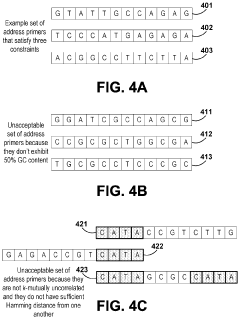
- The implementation of a DNA sequence encoding method that uses unique address sequences at each end of data blocks, allowing for random access by using PCR amplification and sequencing, and enabling data rewriting through DNA editing techniques, ensuring high probability of selecting the correct data block and allowing for replacement or modification of stored information.
Use of DNA origami nanostructures for molecular information based data storage systems
PatentPendingUS20250188449A1
Innovation
- The use of DNA Origami (DNAO) techniques to package data-encoded DNA strands into DNA Files (DNAFiles), allowing for a single-step method of random access without the need to remove data-containing oligonucleotides from the storage pool.


Scalability and Cost Analysis of Toehold Structures
The scalability of toehold-mediated DNA data storage systems presents both significant opportunities and challenges for large-scale implementation. Current cost analysis indicates that while DNA synthesis remains expensive at approximately $0.001 per nucleotide, toehold structures require additional oligonucleotides for random access functionality, increasing overall system costs by 15-30% compared to basic DNA storage approaches. This cost premium must be evaluated against the performance benefits of rapid, selective data retrieval.
Scaling toehold-based systems to petabyte levels requires addressing several economic and technical factors. The synthesis throughput represents a major bottleneck, with current commercial platforms capable of producing only kilogram-scale DNA annually. Industry projections suggest synthesis costs need to decrease by at least two orders of magnitude to make DNA data storage economically competitive with traditional electronic storage media for large-scale applications.
Energy consumption metrics reveal promising sustainability advantages for toehold-based DNA storage. While conventional data centers consume 10-20 kWh per terabyte stored annually, theoretical models predict DNA storage systems could operate at less than 0.1 kWh per terabyte annually when scaled appropriately, representing potential energy savings of 99% at scale. The toehold structures add minimal energy overhead to these calculations.
Physical storage density calculations demonstrate DNA's exceptional potential, with theoretical information density reaching 455 exabytes per gram. Toehold structures maintain approximately 85-90% of this density while enabling random access capabilities. This represents a critical advantage over traditional storage media, which require orders of magnitude more physical space for equivalent data volumes.
Infrastructure requirements for scaled toehold-based systems differ substantially from conventional data centers. Rather than extensive server farms, DNA storage facilities would require specialized molecular biology equipment, controlled environmental conditions, and different maintenance protocols. Initial capital expenditure models suggest higher upfront costs but potentially lower long-term operational expenses compared to traditional data centers.
Market analysis indicates that toehold-based DNA storage may initially find economic viability in specialized applications requiring long-term archival storage with occasional random access needs, such as medical records, historical archives, and regulatory compliance data. The premium cost of toehold structures becomes justified in these use cases where selective retrieval of specific data subsets provides substantial operational value.
Scaling toehold-based systems to petabyte levels requires addressing several economic and technical factors. The synthesis throughput represents a major bottleneck, with current commercial platforms capable of producing only kilogram-scale DNA annually. Industry projections suggest synthesis costs need to decrease by at least two orders of magnitude to make DNA data storage economically competitive with traditional electronic storage media for large-scale applications.
Energy consumption metrics reveal promising sustainability advantages for toehold-based DNA storage. While conventional data centers consume 10-20 kWh per terabyte stored annually, theoretical models predict DNA storage systems could operate at less than 0.1 kWh per terabyte annually when scaled appropriately, representing potential energy savings of 99% at scale. The toehold structures add minimal energy overhead to these calculations.
Physical storage density calculations demonstrate DNA's exceptional potential, with theoretical information density reaching 455 exabytes per gram. Toehold structures maintain approximately 85-90% of this density while enabling random access capabilities. This represents a critical advantage over traditional storage media, which require orders of magnitude more physical space for equivalent data volumes.
Infrastructure requirements for scaled toehold-based systems differ substantially from conventional data centers. Rather than extensive server farms, DNA storage facilities would require specialized molecular biology equipment, controlled environmental conditions, and different maintenance protocols. Initial capital expenditure models suggest higher upfront costs but potentially lower long-term operational expenses compared to traditional data centers.
Market analysis indicates that toehold-based DNA storage may initially find economic viability in specialized applications requiring long-term archival storage with occasional random access needs, such as medical records, historical archives, and regulatory compliance data. The premium cost of toehold structures becomes justified in these use cases where selective retrieval of specific data subsets provides substantial operational value.
Environmental Impact and Sustainability of DNA Storage
DNA data storage represents a promising sustainable alternative to conventional electronic storage systems, offering significant environmental advantages. The production of DNA molecules for storage purposes requires considerably less energy compared to manufacturing traditional storage media like hard drives or solid-state drives. Research indicates that DNA storage systems could potentially reduce energy consumption by up to 99% over their lifecycle when compared to conventional data centers. This energy efficiency translates directly into reduced carbon emissions, addressing a critical environmental concern in the era of exponential data growth.
The materials used in DNA storage systems present another sustainability advantage. While electronic storage relies heavily on rare earth minerals and metals that require environmentally damaging extraction processes, DNA storage primarily utilizes organic compounds that can be synthesized through biochemical processes. The biodegradable nature of DNA molecules further enhances their environmental profile, as they do not contribute to electronic waste—a growing global challenge with conventional storage technologies.
Toehold structures in random access DNA storage systems may offer additional sustainability benefits. By enabling selective retrieval of specific data without accessing the entire dataset, these structures can significantly reduce the energy requirements for data retrieval operations. This targeted approach minimizes unnecessary DNA amplification and sequencing, thereby conserving reagents and energy during the data access process.
Water consumption represents a consideration in DNA synthesis and sequencing processes. Current methods require substantial amounts of purified water, though technological improvements are steadily reducing this requirement. Research teams are developing microfluidic systems that dramatically decrease water usage in DNA storage operations, potentially making these systems viable even in water-stressed regions.
The longevity of DNA as a storage medium further enhances its sustainability credentials. With proper preservation, DNA can potentially store data for thousands of years without degradation, compared to the typical 5-10 year lifespan of conventional storage media. This extended lifespan reduces the frequency of hardware replacement and associated manufacturing impacts, significantly lowering the lifetime environmental footprint of data storage infrastructure.
As random access technologies with toehold structures continue to evolve, their environmental efficiency is expected to improve further. Innovations in enzymatic DNA synthesis methods promise to reduce chemical waste and energy requirements, while advances in nanopore sequencing technologies are decreasing the environmental impact of data retrieval processes.
The materials used in DNA storage systems present another sustainability advantage. While electronic storage relies heavily on rare earth minerals and metals that require environmentally damaging extraction processes, DNA storage primarily utilizes organic compounds that can be synthesized through biochemical processes. The biodegradable nature of DNA molecules further enhances their environmental profile, as they do not contribute to electronic waste—a growing global challenge with conventional storage technologies.
Toehold structures in random access DNA storage systems may offer additional sustainability benefits. By enabling selective retrieval of specific data without accessing the entire dataset, these structures can significantly reduce the energy requirements for data retrieval operations. This targeted approach minimizes unnecessary DNA amplification and sequencing, thereby conserving reagents and energy during the data access process.
Water consumption represents a consideration in DNA synthesis and sequencing processes. Current methods require substantial amounts of purified water, though technological improvements are steadily reducing this requirement. Research teams are developing microfluidic systems that dramatically decrease water usage in DNA storage operations, potentially making these systems viable even in water-stressed regions.
The longevity of DNA as a storage medium further enhances its sustainability credentials. With proper preservation, DNA can potentially store data for thousands of years without degradation, compared to the typical 5-10 year lifespan of conventional storage media. This extended lifespan reduces the frequency of hardware replacement and associated manufacturing impacts, significantly lowering the lifetime environmental footprint of data storage infrastructure.
As random access technologies with toehold structures continue to evolve, their environmental efficiency is expected to improve further. Innovations in enzymatic DNA synthesis methods promise to reduce chemical waste and energy requirements, while advances in nanopore sequencing technologies are decreasing the environmental impact of data retrieval processes.
Unlock deeper insights with PatSnap Eureka Quick Research — get a full tech report to explore trends and direct your research. Try now!
Generate Your Research Report Instantly with AI Agent
Supercharge your innovation with PatSnap Eureka AI Agent Platform!