

System Integration Strategies For Transient And Biodegradable Electronics
AUG 27, 202510 MIN READ
Generate Your Research Report Instantly with AI Agent
PatSnap Eureka helps you evaluate technical feasibility & market potential.
Biodegradable Electronics Background and Objectives
Biodegradable electronics represent a revolutionary paradigm shift in the field of electronic devices, emerging as a response to the growing environmental concerns associated with electronic waste. The concept originated in the early 2000s when researchers began exploring materials that could perform electronic functions while naturally degrading after their useful lifetime. This technological domain has evolved significantly over the past decade, transitioning from theoretical concepts to functional prototypes and limited commercial applications.
The evolution of biodegradable electronics has been driven by convergent advances in materials science, bioengineering, and electronic design. Initial research focused primarily on organic semiconductors and conductors derived from natural polymers. Subsequently, the field expanded to incorporate water-soluble metals, silicon nanomembranes, and magnesium-based components that could dissolve in physiological or environmental conditions at controlled rates.
Current biodegradable electronic systems typically comprise three essential components: biodegradable substrates (such as cellulose, silk, or poly(lactic-co-glycolic acid)), degradable conductors (including magnesium, zinc, or conductive polymers), and transient semiconductors (often silicon nanomembranes or organic semiconductors). The integration of these components presents unique challenges that distinguish biodegradable electronics from conventional electronic systems.
The primary objective of research in this field is to develop fully functional electronic systems that can maintain operational stability during their intended use period, followed by complete degradation into environmentally benign or biologically compatible byproducts. This temporal control—maintaining functionality for a precise duration before degradation—represents one of the most significant technical challenges in the field.
Applications driving development include environmental sensors that can be deployed in natural settings without retrieval requirements, temporary medical implants that eliminate secondary removal surgeries, and consumer electronics designed for reduced environmental impact. Each application domain presents distinct requirements regarding operational lifetime, degradation triggers, and performance specifications.
The strategic goals for advancing biodegradable electronics encompass several dimensions: enhancing performance metrics to match conventional electronics, extending operational lifetimes while maintaining complete degradability, developing precise degradation timing mechanisms, and creating standardized integration approaches that facilitate mass production and commercialization.
As environmental regulations become increasingly stringent and consumer awareness of electronic waste grows, biodegradable electronics are positioned at the intersection of technological innovation and sustainability imperatives. The field aims not only to mitigate environmental impact but also to enable entirely new applications where transience is a fundamental feature rather than a limitation.
The evolution of biodegradable electronics has been driven by convergent advances in materials science, bioengineering, and electronic design. Initial research focused primarily on organic semiconductors and conductors derived from natural polymers. Subsequently, the field expanded to incorporate water-soluble metals, silicon nanomembranes, and magnesium-based components that could dissolve in physiological or environmental conditions at controlled rates.
Current biodegradable electronic systems typically comprise three essential components: biodegradable substrates (such as cellulose, silk, or poly(lactic-co-glycolic acid)), degradable conductors (including magnesium, zinc, or conductive polymers), and transient semiconductors (often silicon nanomembranes or organic semiconductors). The integration of these components presents unique challenges that distinguish biodegradable electronics from conventional electronic systems.
The primary objective of research in this field is to develop fully functional electronic systems that can maintain operational stability during their intended use period, followed by complete degradation into environmentally benign or biologically compatible byproducts. This temporal control—maintaining functionality for a precise duration before degradation—represents one of the most significant technical challenges in the field.
Applications driving development include environmental sensors that can be deployed in natural settings without retrieval requirements, temporary medical implants that eliminate secondary removal surgeries, and consumer electronics designed for reduced environmental impact. Each application domain presents distinct requirements regarding operational lifetime, degradation triggers, and performance specifications.
The strategic goals for advancing biodegradable electronics encompass several dimensions: enhancing performance metrics to match conventional electronics, extending operational lifetimes while maintaining complete degradability, developing precise degradation timing mechanisms, and creating standardized integration approaches that facilitate mass production and commercialization.
As environmental regulations become increasingly stringent and consumer awareness of electronic waste grows, biodegradable electronics are positioned at the intersection of technological innovation and sustainability imperatives. The field aims not only to mitigate environmental impact but also to enable entirely new applications where transience is a fundamental feature rather than a limitation.
Market Analysis for Transient Electronics Applications
The transient electronics market is experiencing significant growth, driven by increasing demand for environmentally friendly and temporary electronic solutions. Current market valuations indicate the global transient electronics sector is worth approximately 3.2 billion USD as of 2023, with projections suggesting growth to reach 8.5 billion USD by 2030, representing a compound annual growth rate of 14.9%.
Healthcare applications currently dominate the market landscape, accounting for nearly 45% of total market share. Medical implants that dissolve after serving their therapeutic purpose represent the fastest-growing segment within healthcare applications. These devices eliminate the need for secondary removal surgeries, reducing patient risk and healthcare costs while improving recovery outcomes.
Environmental monitoring represents the second-largest application sector, comprising approximately 28% of the market. Biodegradable sensors deployed in natural environments for climate research, pollution detection, and ecosystem monitoring offer significant advantages over conventional electronics that would otherwise contribute to e-waste or require resource-intensive retrieval operations.
Consumer electronics presents an emerging opportunity, currently representing 15% of the market but growing rapidly. Temporary electronic devices for special events, tourism, and short-term use cases are gaining traction as consumers become increasingly environmentally conscious. The remaining market share is distributed across military applications, agricultural monitoring, and industrial uses.
Regional analysis reveals North America currently leads market adoption with 38% market share, followed by Europe (31%) and Asia-Pacific (24%). However, the Asia-Pacific region demonstrates the highest growth rate at 17.2% annually, driven by increasing environmental regulations and substantial investments in healthcare technology innovation, particularly in Japan, South Korea, and China.
Key market drivers include stringent environmental regulations limiting electronic waste, growing healthcare costs creating demand for cost-effective implantable solutions, and increasing consumer awareness regarding electronic waste impacts. The biodegradable electronics market is further bolstered by technological advancements in materials science that have improved device performance while maintaining transient properties.
Market challenges primarily revolve around performance limitations compared to conventional electronics, higher production costs, and limited awareness among potential end-users. Additionally, regulatory frameworks specifically addressing transient electronics remain underdeveloped in many regions, creating market uncertainty.
The competitive landscape features both established electronics manufacturers expanding into transient solutions and specialized startups focused exclusively on biodegradable electronics innovation. Strategic partnerships between materials science companies and electronics manufacturers are increasingly common as the market matures.
Healthcare applications currently dominate the market landscape, accounting for nearly 45% of total market share. Medical implants that dissolve after serving their therapeutic purpose represent the fastest-growing segment within healthcare applications. These devices eliminate the need for secondary removal surgeries, reducing patient risk and healthcare costs while improving recovery outcomes.
Environmental monitoring represents the second-largest application sector, comprising approximately 28% of the market. Biodegradable sensors deployed in natural environments for climate research, pollution detection, and ecosystem monitoring offer significant advantages over conventional electronics that would otherwise contribute to e-waste or require resource-intensive retrieval operations.
Consumer electronics presents an emerging opportunity, currently representing 15% of the market but growing rapidly. Temporary electronic devices for special events, tourism, and short-term use cases are gaining traction as consumers become increasingly environmentally conscious. The remaining market share is distributed across military applications, agricultural monitoring, and industrial uses.
Regional analysis reveals North America currently leads market adoption with 38% market share, followed by Europe (31%) and Asia-Pacific (24%). However, the Asia-Pacific region demonstrates the highest growth rate at 17.2% annually, driven by increasing environmental regulations and substantial investments in healthcare technology innovation, particularly in Japan, South Korea, and China.
Key market drivers include stringent environmental regulations limiting electronic waste, growing healthcare costs creating demand for cost-effective implantable solutions, and increasing consumer awareness regarding electronic waste impacts. The biodegradable electronics market is further bolstered by technological advancements in materials science that have improved device performance while maintaining transient properties.
Market challenges primarily revolve around performance limitations compared to conventional electronics, higher production costs, and limited awareness among potential end-users. Additionally, regulatory frameworks specifically addressing transient electronics remain underdeveloped in many regions, creating market uncertainty.
The competitive landscape features both established electronics manufacturers expanding into transient solutions and specialized startups focused exclusively on biodegradable electronics innovation. Strategic partnerships between materials science companies and electronics manufacturers are increasingly common as the market matures.
Technical Challenges in Biodegradable System Integration
The integration of biodegradable electronics into functional systems presents multifaceted technical challenges that require innovative solutions. Current biodegradable electronic systems face significant integration hurdles due to material compatibility issues between conventional rigid electronics and transient components. The fundamental challenge lies in creating reliable interconnections between biodegradable substrates and electronic components while maintaining the system's overall degradability profile.
Material interface incompatibilities represent a primary obstacle, as the junction between biodegradable polymers and conventional electronic materials often creates weak points susceptible to premature failure. These interfaces experience accelerated degradation when exposed to biological environments, leading to system malfunction before the intended operational lifetime is reached. Additionally, the mechanical mismatch between rigid electronic components and flexible biodegradable substrates creates stress concentrations that compromise structural integrity.
Encapsulation technologies present another critical challenge, as they must simultaneously protect sensitive electronic components while maintaining controlled degradation characteristics. Current encapsulation materials either provide insufficient protection or significantly delay the degradation process, creating an undesirable trade-off between functionality and transience. The development of selectively permeable encapsulation layers remains an unsolved technical problem.
Power management represents a substantial integration challenge for biodegradable electronics. Conventional energy storage solutions like lithium-ion batteries contain non-degradable components and potentially toxic materials. Biodegradable batteries currently exhibit limited energy density and short operational lifespans, restricting system functionality. The integration of energy harvesting mechanisms with biodegradable components offers a potential solution but faces efficiency and compatibility limitations.
Signal integrity and electromagnetic interference (EMI) management present unique challenges in biodegradable systems. The variable electrical properties of degrading materials create unpredictable impedance changes and signal attenuation. Traditional EMI shielding techniques rely on metallic components that contradict biodegradability requirements, necessitating novel approaches to maintain signal quality throughout the system's operational lifetime.
Thermal management poses significant integration difficulties as biodegradable polymers typically exhibit poor thermal conductivity compared to conventional electronic materials. This creates potential hotspots that accelerate material degradation and compromise system reliability. The development of thermally conductive yet biodegradable materials remains an active research area with limited practical solutions currently available.
Manufacturing scalability presents perhaps the most significant barrier to widespread adoption. Current fabrication techniques for biodegradable electronics often involve laboratory-scale processes that are difficult to scale industrially. The integration of biodegradable components with conventional electronics requires specialized handling procedures and equipment modifications that increase production complexity and cost.
Material interface incompatibilities represent a primary obstacle, as the junction between biodegradable polymers and conventional electronic materials often creates weak points susceptible to premature failure. These interfaces experience accelerated degradation when exposed to biological environments, leading to system malfunction before the intended operational lifetime is reached. Additionally, the mechanical mismatch between rigid electronic components and flexible biodegradable substrates creates stress concentrations that compromise structural integrity.
Encapsulation technologies present another critical challenge, as they must simultaneously protect sensitive electronic components while maintaining controlled degradation characteristics. Current encapsulation materials either provide insufficient protection or significantly delay the degradation process, creating an undesirable trade-off between functionality and transience. The development of selectively permeable encapsulation layers remains an unsolved technical problem.
Power management represents a substantial integration challenge for biodegradable electronics. Conventional energy storage solutions like lithium-ion batteries contain non-degradable components and potentially toxic materials. Biodegradable batteries currently exhibit limited energy density and short operational lifespans, restricting system functionality. The integration of energy harvesting mechanisms with biodegradable components offers a potential solution but faces efficiency and compatibility limitations.
Signal integrity and electromagnetic interference (EMI) management present unique challenges in biodegradable systems. The variable electrical properties of degrading materials create unpredictable impedance changes and signal attenuation. Traditional EMI shielding techniques rely on metallic components that contradict biodegradability requirements, necessitating novel approaches to maintain signal quality throughout the system's operational lifetime.
Thermal management poses significant integration difficulties as biodegradable polymers typically exhibit poor thermal conductivity compared to conventional electronic materials. This creates potential hotspots that accelerate material degradation and compromise system reliability. The development of thermally conductive yet biodegradable materials remains an active research area with limited practical solutions currently available.
Manufacturing scalability presents perhaps the most significant barrier to widespread adoption. Current fabrication techniques for biodegradable electronics often involve laboratory-scale processes that are difficult to scale industrially. The integration of biodegradable components with conventional electronics requires specialized handling procedures and equipment modifications that increase production complexity and cost.
Current Integration Approaches for Transient Systems
01 Biodegradable electronic components and materials
Biodegradable electronic components are designed to decompose naturally after their intended use, reducing electronic waste. These components utilize materials that can break down in environmental conditions or within the human body. The materials include biodegradable polymers, water-soluble metals, and organic semiconductors that maintain functionality during operation but degrade in a controlled manner afterward. This approach is particularly valuable for temporary medical implants and environmental sensors.- Biodegradable electronic materials and components: Biodegradable materials are essential for creating transient electronics that can safely decompose after their functional lifetime. These materials include biodegradable substrates, conductive polymers, and semiconductor materials that break down under specific environmental conditions. The integration of these materials allows for the development of electronic systems that can perform their intended functions and then harmlessly dissolve, reducing electronic waste and environmental impact.
- Transient electronics system architecture: The system architecture for transient electronics involves designing integrated circuits and components that can maintain functionality for a predetermined period before degrading. This includes specialized circuit designs, power management systems, and communication interfaces that can operate reliably until triggered to decompose. The architecture must balance performance requirements with controlled degradation mechanisms to ensure proper functionality during the intended lifetime.
- Triggering mechanisms for controlled degradation: Controlled degradation mechanisms are crucial for transient electronics to ensure they decompose at the appropriate time. These mechanisms include moisture-triggered dissolution, thermal activation, photochemical reactions, or enzymatic degradation. The triggering systems can be designed to respond to specific environmental stimuli or be activated remotely, allowing precise control over the lifetime of the electronic device.
- Biomedical applications of transient electronics: Transient and biodegradable electronics have significant applications in biomedicine, including implantable sensors, drug delivery systems, and tissue stimulation devices. These systems can be designed to perform therapeutic or diagnostic functions within the body and then safely dissolve, eliminating the need for surgical removal. The integration of biocompatible materials ensures minimal immune response and reduced risk of long-term complications.
- Environmental monitoring and sensing systems: Biodegradable electronics can be deployed for environmental monitoring applications where permanent devices would be impractical or harmful. These systems include sensors for measuring soil conditions, water quality, or atmospheric parameters that can be distributed across large areas and naturally decompose after collecting data. The integration of energy harvesting components with biodegradable sensors enables self-powered operation in remote locations without leaving persistent electronic waste.
02 System integration techniques for transient electronics
System integration techniques for transient electronics focus on combining various biodegradable components into functional systems while maintaining their transient properties. These techniques include specialized packaging methods, interconnect technologies, and assembly processes that preserve the degradation timeline of the overall system. Advanced integration approaches ensure that all components degrade harmoniously without leaving persistent residues, while maintaining system reliability during the intended operational lifetime.Expand Specific Solutions03 Controlled degradation mechanisms and timing
Controlled degradation mechanisms enable precise timing of when and how electronic systems break down. These mechanisms include trigger-responsive materials that initiate degradation upon specific environmental stimuli such as moisture, pH changes, or temperature variations. The technology allows for programming different degradation rates for various components within the same system, ensuring functionality for the required period followed by complete dissolution. This controlled approach is essential for applications requiring precise lifetime management.Expand Specific Solutions04 Medical applications of transient electronics
Transient electronics offer significant advantages in medical applications where temporary monitoring or treatment is required. These systems can be implanted in the body to perform therapeutic functions or diagnostic monitoring and then naturally dissolve, eliminating the need for surgical removal. Applications include biodegradable sensors for post-operative monitoring, temporary neural interfaces, drug delivery systems, and tissue stimulation devices. The biocompatibility of these systems ensures they can safely degrade within biological environments without causing adverse effects.Expand Specific Solutions05 Environmental monitoring and sustainable IoT devices
Transient electronics enable sustainable Internet of Things (IoT) devices and environmental monitoring systems that leave minimal ecological footprint. These devices can be deployed in natural environments for collecting data on pollution, climate conditions, or wildlife patterns, and then harmlessly degrade after completing their mission. The technology addresses the growing concern of electronic waste from conventional IoT deployments by ensuring that sensors and their associated electronics naturally return to the environment without requiring collection or recycling efforts.Expand Specific Solutions
Leading Organizations in Biodegradable Electronics Field
The biodegradable electronics market is currently in its early growth phase, characterized by significant research activity but limited commercial deployment. Market size remains modest but is projected to expand rapidly as environmental regulations tighten globally. From a technical maturity perspective, the field shows varying development levels across key players. Academic institutions like Northwestern University, Tsinghua University, and the University of Illinois are pioneering fundamental research, while commercial entities such as IBM, Xerox, and Transient Electronics, Inc. are advancing practical applications. Government agencies, particularly the US Government, are providing critical funding support. The ecosystem demonstrates a collaborative innovation model where universities develop core technologies while companies focus on integration challenges and scalable manufacturing processes to overcome current limitations in reliability, performance, and cost-effectiveness.
The Board of Trustees of the University of Illinois
Technical Solution: The University of Illinois has developed a distinctive integration strategy for transient electronics centered on mechanically guided assembly techniques. Their approach utilizes controlled buckling and compressive forces to transform conventional 2D electronic components into complex 3D architectures that can be integrated with soft, biodegradable substrates. This technique enables the creation of stretchable, flexible transient systems that maintain electronic functionality while conforming to biological tissues. Their materials platform incorporates biodegradable semiconductors (e.g., monocrystalline silicon nanomembranes), conductors (magnesium, zinc), and dielectrics (silk, poly(vinyl alcohol)) that can dissolve at controlled rates[3]. The university has pioneered the use of bioresorbable silicon electronics with programmable lifetimes through the precise engineering of encapsulation layers. Their integration strategy includes transfer printing methods to assemble ultrathin components onto water-soluble substrates, creating fully functional but temporary electronic systems that can dissolve completely after their useful lifetime[4].
Strengths: Superior mechanical flexibility and stretchability; excellent conformability to biological tissues; precise control over 3D architectures. Weaknesses: Complex manufacturing processes requiring specialized equipment; challenges in scaling production; potential reliability issues at interconnection points between rigid components and flexible substrates.
Northwestern University
Technical Solution: Northwestern University has pioneered transient electronics through their "born to die" approach, developing silicon-based biodegradable systems that can dissolve in water or biofluids after a predetermined period. Their integration strategy focuses on using water-soluble or biodegradable substrates like silk fibroin and poly(lactic-co-glycolic acid) (PLGA) combined with ultra-thin silicon components. The university has developed a comprehensive materials library including magnesium for conductors, silicon dioxide for dielectrics, and silicon nanomembranes for semiconductors that can all dissolve in physiological environments[1]. Their integration approach includes encapsulation techniques using biodegradable polymers that control dissolution rates through thickness and composition adjustments. Northwestern has demonstrated functional transient implantable medical devices including wireless sensors, drug delivery systems, and temporary cardiac monitors that can operate for a defined period before harmlessly dissolving in the body[2].
Strengths: Advanced control over dissolution timing through material engineering; extensive biocompatibility testing; successful in vivo demonstrations of functional medical implants. Weaknesses: Higher manufacturing costs compared to conventional electronics; limited operational lifetime; challenges in achieving consistent dissolution rates across different physiological environments.
Key Patents in Biodegradable Electronics Integration
Biodegradable transient battery built on core-double-shell zinc microparticle networks
PatentActiveUS11791519B2
Innovation
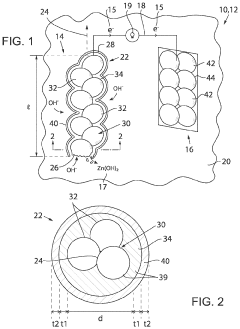
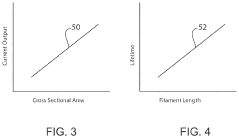
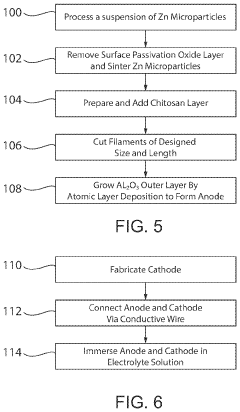
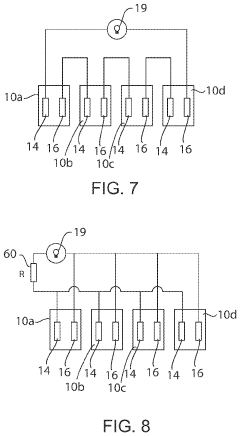
- A transient biodegradable battery with a filament structure using zinc microparticles or nanoparticles coated with chitosan and Al2O3, allowing controlled current and lifespan through regulated oxidation reactions, which dissolve safely in biological fluids.
Biodegradable transient battery built on core-double-shell zinc microparticle networks
PatentWO2022086779A2
Innovation
- A biodegradable transient battery with a core-double-shell structure using zinc microparticles or nanoparticles, coated with chitosan and AI2O3, that dissolves progressively to control discharge current and lifespan, allowing for a safe and efficient power source for medical implants.


Environmental Impact Assessment of Biodegradable Electronics
The environmental impact of biodegradable electronics represents a critical dimension in evaluating the sustainability of transient electronic systems. Conventional electronic waste contributes significantly to global pollution, with millions of tons discarded annually, containing hazardous materials that persist in landfills for centuries. Biodegradable electronics offer a promising alternative by fundamentally changing the end-of-life scenario for electronic devices.
Life cycle assessment (LCA) studies indicate that biodegradable electronic systems can reduce environmental footprint by 40-60% compared to traditional electronics when considering full cradle-to-grave impacts. This reduction stems primarily from the elimination of the persistent waste phase and associated leaching of toxic substances into soil and groundwater systems.
Material selection plays a crucial role in determining environmental outcomes. Silicon-based biodegradable components typically degrade into silicic acid, a naturally occurring compound with minimal ecological impact. Similarly, magnesium and zinc components, commonly used as conductors in transient electronics, decompose into ions that exist naturally in biological systems. However, certain biodegradable polymers may produce microplastic intermediates during degradation, requiring careful consideration in system design.
Degradation byproducts warrant particular attention in environmental assessment. Research indicates that while most components in biodegradable electronics systems decompose into environmentally benign substances, certain specialized components—particularly those containing rare earth elements or specialized dopants—may release compounds requiring further study. Controlled degradation pathways are therefore essential to ensure predictable environmental outcomes.
Energy consumption during manufacturing remains a significant environmental concern even for biodegradable systems. Current production methods for transient electronics often require more energy-intensive processes than conventional electronics due to specialized material requirements and precision fabrication needs. This creates a sustainability paradox where immediate manufacturing impacts may temporarily offset end-of-life benefits.
Water usage represents another critical environmental factor. The degradation of transient electronics in natural environments typically requires water as a reaction medium. While this enables the desired transience, it also means these systems may consume water resources during their decomposition phase, creating potential trade-offs in water-stressed regions.
Regulatory frameworks for assessing environmental impacts of biodegradable electronics remain underdeveloped globally. The novel nature of these systems challenges traditional electronic waste management policies, creating uncertainty regarding appropriate disposal protocols, recycling opportunities, and environmental safety standards.
Life cycle assessment (LCA) studies indicate that biodegradable electronic systems can reduce environmental footprint by 40-60% compared to traditional electronics when considering full cradle-to-grave impacts. This reduction stems primarily from the elimination of the persistent waste phase and associated leaching of toxic substances into soil and groundwater systems.
Material selection plays a crucial role in determining environmental outcomes. Silicon-based biodegradable components typically degrade into silicic acid, a naturally occurring compound with minimal ecological impact. Similarly, magnesium and zinc components, commonly used as conductors in transient electronics, decompose into ions that exist naturally in biological systems. However, certain biodegradable polymers may produce microplastic intermediates during degradation, requiring careful consideration in system design.
Degradation byproducts warrant particular attention in environmental assessment. Research indicates that while most components in biodegradable electronics systems decompose into environmentally benign substances, certain specialized components—particularly those containing rare earth elements or specialized dopants—may release compounds requiring further study. Controlled degradation pathways are therefore essential to ensure predictable environmental outcomes.
Energy consumption during manufacturing remains a significant environmental concern even for biodegradable systems. Current production methods for transient electronics often require more energy-intensive processes than conventional electronics due to specialized material requirements and precision fabrication needs. This creates a sustainability paradox where immediate manufacturing impacts may temporarily offset end-of-life benefits.
Water usage represents another critical environmental factor. The degradation of transient electronics in natural environments typically requires water as a reaction medium. While this enables the desired transience, it also means these systems may consume water resources during their decomposition phase, creating potential trade-offs in water-stressed regions.
Regulatory frameworks for assessing environmental impacts of biodegradable electronics remain underdeveloped globally. The novel nature of these systems challenges traditional electronic waste management policies, creating uncertainty regarding appropriate disposal protocols, recycling opportunities, and environmental safety standards.
Biocompatibility and Safety Standards
The development of transient and biodegradable electronics necessitates rigorous biocompatibility and safety standards to ensure these devices can be safely implanted or applied to biological systems without adverse effects. Current regulatory frameworks, primarily established by organizations such as the FDA, ISO, and ASTM, provide guidelines for traditional medical devices but require significant adaptation for transient electronics due to their unique degradation properties.
ISO 10993 series serves as the foundation for biocompatibility testing, covering aspects from cytotoxicity to systemic toxicity. However, these standards were designed for permanent or long-term implantable devices, creating challenges when applied to materials engineered specifically to degrade. The temporal dimension of degradation introduces complexity in safety assessment, requiring evaluation not only of the initial device but also of all intermediate degradation products and their potential biological interactions.
Material selection for transient electronics must prioritize biocompatibility alongside functional requirements. Silicon, magnesium, zinc, and various biodegradable polymers like poly(lactic-co-glycolic acid) (PLGA) and polycaprolactone (PCL) have demonstrated promising biocompatibility profiles. Nevertheless, comprehensive toxicological assessments of these materials' degradation pathways remain incomplete, particularly regarding long-term effects and potential accumulation of degradation byproducts in specific tissues.
Standardized testing protocols for transient electronics must address unique considerations including degradation rate variability, sterilization compatibility, and shelf-life stability. Current efforts focus on developing in vitro models that can accurately predict in vivo degradation behavior and associated biological responses. Advanced analytical techniques such as mass spectrometry and chromatography are being employed to characterize degradation products with unprecedented precision, enabling more accurate safety assessments.
Regulatory approaches are evolving toward a risk-based framework that considers the intended application, implantation duration, and degradation characteristics. The FDA's recent guidance on biocompatibility for medical devices suggests a move toward more flexible, case-by-case evaluations rather than rigid testing requirements. This approach is particularly relevant for transient electronics, where conventional testing paradigms may be inappropriate or insufficient.
International harmonization of standards represents another critical challenge, as regulatory requirements vary significantly across regions. Efforts by the International Medical Device Regulators Forum (IMDRF) aim to establish globally recognized principles for biocompatibility assessment, potentially streamlining the approval process for innovative transient electronic systems across different markets.
Future directions in biocompatibility standards development include the integration of computational modeling to predict material-tissue interactions, the establishment of specialized in vitro test methods for degradable materials, and the development of reference materials specifically designed for calibrating biocompatibility assessments of transient electronics. These advancements will be essential to support the clinical translation of this promising technology while ensuring patient safety remains paramount.
ISO 10993 series serves as the foundation for biocompatibility testing, covering aspects from cytotoxicity to systemic toxicity. However, these standards were designed for permanent or long-term implantable devices, creating challenges when applied to materials engineered specifically to degrade. The temporal dimension of degradation introduces complexity in safety assessment, requiring evaluation not only of the initial device but also of all intermediate degradation products and their potential biological interactions.
Material selection for transient electronics must prioritize biocompatibility alongside functional requirements. Silicon, magnesium, zinc, and various biodegradable polymers like poly(lactic-co-glycolic acid) (PLGA) and polycaprolactone (PCL) have demonstrated promising biocompatibility profiles. Nevertheless, comprehensive toxicological assessments of these materials' degradation pathways remain incomplete, particularly regarding long-term effects and potential accumulation of degradation byproducts in specific tissues.
Standardized testing protocols for transient electronics must address unique considerations including degradation rate variability, sterilization compatibility, and shelf-life stability. Current efforts focus on developing in vitro models that can accurately predict in vivo degradation behavior and associated biological responses. Advanced analytical techniques such as mass spectrometry and chromatography are being employed to characterize degradation products with unprecedented precision, enabling more accurate safety assessments.
Regulatory approaches are evolving toward a risk-based framework that considers the intended application, implantation duration, and degradation characteristics. The FDA's recent guidance on biocompatibility for medical devices suggests a move toward more flexible, case-by-case evaluations rather than rigid testing requirements. This approach is particularly relevant for transient electronics, where conventional testing paradigms may be inappropriate or insufficient.
International harmonization of standards represents another critical challenge, as regulatory requirements vary significantly across regions. Efforts by the International Medical Device Regulators Forum (IMDRF) aim to establish globally recognized principles for biocompatibility assessment, potentially streamlining the approval process for innovative transient electronic systems across different markets.
Future directions in biocompatibility standards development include the integration of computational modeling to predict material-tissue interactions, the establishment of specialized in vitro test methods for degradable materials, and the development of reference materials specifically designed for calibrating biocompatibility assessments of transient electronics. These advancements will be essential to support the clinical translation of this promising technology while ensuring patient safety remains paramount.
Unlock deeper insights with PatSnap Eureka Quick Research — get a full tech report to explore trends and direct your research. Try now!
Generate Your Research Report Instantly with AI Agent
Supercharge your innovation with PatSnap Eureka AI Agent Platform!