Thermopile Sensor Enhancement: Material Overview
SEP 10, 202510 MIN READ
Generate Your Research Report Instantly with AI Agent
PatSnap Eureka helps you evaluate technical feasibility & market potential.
Thermopile Sensor Technology Background and Objectives
Thermopile sensors have evolved significantly since their inception in the early 20th century, originating from the fundamental thermoelectric principles discovered by Thomas Johann Seebeck in 1821. These sensors operate based on the Seebeck effect, where temperature differences between junctions of dissimilar metals generate voltage. The technology has progressed from simple thermocouples to sophisticated integrated sensor arrays capable of non-contact temperature measurement and thermal imaging.
The evolution of thermopile sensor technology has been closely tied to advancements in materials science. Traditional thermopile sensors utilized metal junctions, but modern iterations increasingly incorporate semiconductor materials and thin-film technologies. This transition has enabled significant improvements in sensitivity, response time, and form factor, expanding the application scope of these sensors across multiple industries.
Recent years have witnessed accelerated development in thermopile technology, driven by growing demands in consumer electronics, automotive systems, industrial process control, and medical diagnostics. The miniaturization trend has been particularly notable, with sensors shrinking from bulky components to microscale devices that can be integrated into portable and wearable technologies.
The current technological trajectory points toward enhancing the fundamental performance metrics of thermopile sensors through material innovation. Key areas of focus include improving thermal sensitivity (V/W), reducing noise equivalent power (NEP), expanding spectral response range, and increasing operational stability across varying environmental conditions. Material selection and optimization represent critical factors in addressing these performance parameters.
The primary objective of this technical research is to comprehensively evaluate existing and emerging materials for thermopile sensor construction, with particular emphasis on their potential to enhance sensor performance. This includes examining traditional materials such as bismuth-antimony and polysilicon, as well as investigating novel materials including advanced semiconductors, 2D materials, and nanostructured composites.
Additionally, this research aims to identify promising material combinations and fabrication techniques that could lead to next-generation thermopile sensors with superior performance characteristics. The ultimate goal is to establish a clear understanding of the material-property-performance relationship in thermopile sensors and chart potential innovation pathways that could address current limitations while opening new application possibilities.
This investigation is particularly timely as the global market for thermal sensors is projected to grow at a CAGR of approximately 8.3% through 2026, with thermopile sensors representing a significant segment of this expansion. Material enhancement represents one of the most promising approaches to capturing value in this growing market.
The evolution of thermopile sensor technology has been closely tied to advancements in materials science. Traditional thermopile sensors utilized metal junctions, but modern iterations increasingly incorporate semiconductor materials and thin-film technologies. This transition has enabled significant improvements in sensitivity, response time, and form factor, expanding the application scope of these sensors across multiple industries.
Recent years have witnessed accelerated development in thermopile technology, driven by growing demands in consumer electronics, automotive systems, industrial process control, and medical diagnostics. The miniaturization trend has been particularly notable, with sensors shrinking from bulky components to microscale devices that can be integrated into portable and wearable technologies.
The current technological trajectory points toward enhancing the fundamental performance metrics of thermopile sensors through material innovation. Key areas of focus include improving thermal sensitivity (V/W), reducing noise equivalent power (NEP), expanding spectral response range, and increasing operational stability across varying environmental conditions. Material selection and optimization represent critical factors in addressing these performance parameters.
The primary objective of this technical research is to comprehensively evaluate existing and emerging materials for thermopile sensor construction, with particular emphasis on their potential to enhance sensor performance. This includes examining traditional materials such as bismuth-antimony and polysilicon, as well as investigating novel materials including advanced semiconductors, 2D materials, and nanostructured composites.
Additionally, this research aims to identify promising material combinations and fabrication techniques that could lead to next-generation thermopile sensors with superior performance characteristics. The ultimate goal is to establish a clear understanding of the material-property-performance relationship in thermopile sensors and chart potential innovation pathways that could address current limitations while opening new application possibilities.
This investigation is particularly timely as the global market for thermal sensors is projected to grow at a CAGR of approximately 8.3% through 2026, with thermopile sensors representing a significant segment of this expansion. Material enhancement represents one of the most promising approaches to capturing value in this growing market.
Market Applications and Demand Analysis for Enhanced Thermopile Sensors
The global market for thermopile sensors has witnessed substantial growth in recent years, driven primarily by increasing demand across multiple industries. The non-contact temperature measurement capabilities of these sensors have positioned them as critical components in various applications, from industrial process control to consumer electronics and healthcare devices.
In the industrial sector, enhanced thermopile sensors are increasingly deployed for precise temperature monitoring in manufacturing processes, particularly in semiconductor fabrication, glass production, and metal processing. The market demand in this segment is projected to grow steadily as industries continue to automate and optimize their production lines, requiring more accurate and reliable temperature sensing solutions.
Consumer electronics represents another significant market driver, with thermopile sensors being integrated into smartphones, tablets, and wearable devices for temperature sensing and thermal imaging functions. The miniaturization trend in electronics has created demand for smaller yet more sensitive thermopile sensors, pushing material innovation in this direction.
The healthcare and medical diagnostics sector has emerged as a rapidly expanding market for enhanced thermopile sensors. The COVID-19 pandemic significantly accelerated the adoption of non-contact thermometers and thermal screening devices, creating unprecedented demand for high-performance thermopile sensors. This trend is expected to continue beyond the pandemic as awareness of infection control measures remains heightened.
Automotive applications constitute another growing market segment, with thermopile sensors being utilized in climate control systems, occupant detection, and engine temperature monitoring. The shift toward electric vehicles has further expanded potential applications, as battery temperature management becomes critical for safety and performance.
Building automation and energy management systems represent an emerging market with substantial growth potential. Enhanced thermopile sensors enable more efficient HVAC control, occupancy detection, and energy conservation in smart buildings and homes.
Market analysis indicates regional variations in demand patterns. North America and Europe currently lead in terms of technology adoption and market value, while Asia-Pacific demonstrates the fastest growth rate, driven by rapid industrialization and increasing consumer electronics production in countries like China, Japan, and South Korea.
The market demand for enhanced thermopile sensors is increasingly focused on specific performance improvements: higher sensitivity, faster response times, better signal-to-noise ratios, and greater stability across varying environmental conditions. These requirements directly influence material research priorities, as conventional materials reach their performance limits.
In the industrial sector, enhanced thermopile sensors are increasingly deployed for precise temperature monitoring in manufacturing processes, particularly in semiconductor fabrication, glass production, and metal processing. The market demand in this segment is projected to grow steadily as industries continue to automate and optimize their production lines, requiring more accurate and reliable temperature sensing solutions.
Consumer electronics represents another significant market driver, with thermopile sensors being integrated into smartphones, tablets, and wearable devices for temperature sensing and thermal imaging functions. The miniaturization trend in electronics has created demand for smaller yet more sensitive thermopile sensors, pushing material innovation in this direction.
The healthcare and medical diagnostics sector has emerged as a rapidly expanding market for enhanced thermopile sensors. The COVID-19 pandemic significantly accelerated the adoption of non-contact thermometers and thermal screening devices, creating unprecedented demand for high-performance thermopile sensors. This trend is expected to continue beyond the pandemic as awareness of infection control measures remains heightened.
Automotive applications constitute another growing market segment, with thermopile sensors being utilized in climate control systems, occupant detection, and engine temperature monitoring. The shift toward electric vehicles has further expanded potential applications, as battery temperature management becomes critical for safety and performance.
Building automation and energy management systems represent an emerging market with substantial growth potential. Enhanced thermopile sensors enable more efficient HVAC control, occupancy detection, and energy conservation in smart buildings and homes.
Market analysis indicates regional variations in demand patterns. North America and Europe currently lead in terms of technology adoption and market value, while Asia-Pacific demonstrates the fastest growth rate, driven by rapid industrialization and increasing consumer electronics production in countries like China, Japan, and South Korea.
The market demand for enhanced thermopile sensors is increasingly focused on specific performance improvements: higher sensitivity, faster response times, better signal-to-noise ratios, and greater stability across varying environmental conditions. These requirements directly influence material research priorities, as conventional materials reach their performance limits.
Current Material Limitations and Technical Challenges
Thermopile sensors currently face significant material limitations that impede their performance enhancement. The predominant materials used in commercial thermopile sensors—primarily bismuth-antimony, bismuth-tellurium, and polysilicon—exhibit relatively low Seebeck coefficients, typically ranging from 100 to 400 μV/K. This fundamental limitation restricts the voltage output and consequently the sensitivity of these sensors, particularly in low-temperature differential applications.
Thermal conductivity presents another critical challenge. Current materials struggle to balance the contradictory requirements of high electrical conductivity and low thermal conductivity. This trade-off directly impacts the sensor's ability to maintain temperature gradients necessary for efficient operation. Most commercially available thermopile materials demonstrate thermal conductivity values between 1-10 W/m·K, which leads to undesirable heat dissipation across the sensor structure.
Manufacturing consistency poses significant technical hurdles. The deposition of thin-film thermoelectric materials with uniform thickness and composition remains problematic at scale. Variations as small as 5% in material composition can result in performance deviations exceeding 15%, creating reliability issues in mass production scenarios. This inconsistency is particularly pronounced in complex multi-material thermopile arrays.
Long-term stability represents another substantial challenge. Current thermopile materials exhibit performance degradation under thermal cycling conditions, with sensitivity reductions of 5-15% observed after 1000 thermal cycles in industrial testing environments. This degradation stems from microstructural changes, interfacial diffusion, and oxidation processes that occur during repeated temperature fluctuations.
Environmental sensitivity further complicates material selection. Many high-performance thermoelectric materials contain toxic or environmentally problematic elements such as tellurium, lead, or antimony. This creates regulatory challenges for global deployment and raises concerns about end-of-life disposal and recycling processes.
Integration compatibility with standard semiconductor processes remains suboptimal. Many promising thermoelectric materials require processing conditions incompatible with CMOS fabrication techniques, limiting their integration potential. Temperature constraints during deposition (often exceeding 400°C) can damage underlying circuitry, while chemical incompatibilities may introduce contamination risks.
Miniaturization efforts face fundamental physical barriers. As thermopile dimensions decrease below certain thresholds (typically 50-100 μm), quantum confinement effects and surface scattering phenomena begin to dominate, altering material properties in ways that current theoretical models struggle to predict accurately. This creates significant challenges for designing next-generation micro-scale thermopile sensors with predictable performance characteristics.
Thermal conductivity presents another critical challenge. Current materials struggle to balance the contradictory requirements of high electrical conductivity and low thermal conductivity. This trade-off directly impacts the sensor's ability to maintain temperature gradients necessary for efficient operation. Most commercially available thermopile materials demonstrate thermal conductivity values between 1-10 W/m·K, which leads to undesirable heat dissipation across the sensor structure.
Manufacturing consistency poses significant technical hurdles. The deposition of thin-film thermoelectric materials with uniform thickness and composition remains problematic at scale. Variations as small as 5% in material composition can result in performance deviations exceeding 15%, creating reliability issues in mass production scenarios. This inconsistency is particularly pronounced in complex multi-material thermopile arrays.
Long-term stability represents another substantial challenge. Current thermopile materials exhibit performance degradation under thermal cycling conditions, with sensitivity reductions of 5-15% observed after 1000 thermal cycles in industrial testing environments. This degradation stems from microstructural changes, interfacial diffusion, and oxidation processes that occur during repeated temperature fluctuations.
Environmental sensitivity further complicates material selection. Many high-performance thermoelectric materials contain toxic or environmentally problematic elements such as tellurium, lead, or antimony. This creates regulatory challenges for global deployment and raises concerns about end-of-life disposal and recycling processes.
Integration compatibility with standard semiconductor processes remains suboptimal. Many promising thermoelectric materials require processing conditions incompatible with CMOS fabrication techniques, limiting their integration potential. Temperature constraints during deposition (often exceeding 400°C) can damage underlying circuitry, while chemical incompatibilities may introduce contamination risks.
Miniaturization efforts face fundamental physical barriers. As thermopile dimensions decrease below certain thresholds (typically 50-100 μm), quantum confinement effects and surface scattering phenomena begin to dominate, altering material properties in ways that current theoretical models struggle to predict accurately. This creates significant challenges for designing next-generation micro-scale thermopile sensors with predictable performance characteristics.
State-of-the-Art Material Solutions for Thermopile Sensors
01 Material composition improvements for thermopile sensors
Enhancing thermopile sensors through advanced material compositions involves using specialized thermoelectric materials with higher Seebeck coefficients. These materials can include bismuth telluride compounds, antimony alloys, or novel semiconductor combinations that maximize the voltage generated from temperature differentials. By optimizing the composition and structure of these materials, the sensitivity and response time of thermopile sensors can be significantly improved, leading to more accurate temperature measurements and better overall performance.- Material composition improvements for thermopile sensors: Enhancing thermopile sensors through advanced material compositions involves using specialized thermoelectric materials with higher Seebeck coefficients. These materials can include bismuth telluride alloys, antimony-based compounds, or novel semiconductor combinations that maximize the conversion of temperature differences into electrical signals. By optimizing the material composition, the sensitivity and response time of thermopile sensors can be significantly improved, leading to more accurate temperature measurements and better overall performance.
- Structural design optimization of thermopile junctions: Optimizing the structural design of thermopile junctions involves improving the physical arrangement and configuration of the thermocouple pairs. This includes enhancing the hot and cold junction designs, optimizing the number of thermocouples in series, and improving the thermal isolation between junctions. Advanced microfabrication techniques allow for more precise junction placement and better thermal management, resulting in higher sensitivity and improved signal-to-noise ratios in thermopile sensors.
- Integration with signal processing and amplification systems: Enhancing thermopile sensors through improved signal processing and amplification involves developing specialized integrated circuits that can effectively process the low-voltage signals generated by thermopiles. These systems may include low-noise amplifiers, analog-to-digital converters with high resolution, and advanced filtering techniques to remove environmental noise. By integrating sophisticated signal processing directly with the sensor, the overall performance, accuracy, and reliability of thermopile-based measurement systems can be significantly improved.
- Thermal isolation and packaging techniques: Advanced thermal isolation and packaging techniques are crucial for enhancing thermopile sensor performance. These include using vacuum packaging, specialized insulating materials, and suspended membrane structures to minimize unwanted heat transfer paths. By effectively isolating the sensing elements from their surroundings and the substrate, thermal noise is reduced and the temperature difference between hot and cold junctions is maximized. These improvements lead to higher sensitivity, faster response times, and more accurate temperature measurements.
- Application-specific thermopile sensor enhancements: Thermopile sensors can be enhanced for specific applications through customized designs and features. For medical applications, sensors may incorporate specialized optical filters and focusing elements. For industrial process monitoring, robust packaging and extended temperature range capabilities are implemented. In consumer electronics, miniaturization and power efficiency are prioritized. These application-specific enhancements may include specialized lens systems, radiation absorbers, or reference temperature sensors that optimize performance for particular use cases.
02 Structural design optimization of thermopile junctions
Optimizing the structural design of thermopile junctions involves improving the physical arrangement and configuration of the thermoelectric elements. This includes techniques such as increasing the number of thermocouple junctions, optimizing junction spacing, and implementing novel geometric patterns to maximize temperature gradient detection. Advanced fabrication methods can create more efficient hot and cold junction arrangements, resulting in enhanced sensitivity and signal-to-noise ratio for thermopile sensors.Expand Specific Solutions03 Integration of signal processing and amplification techniques
Enhancing thermopile sensor performance through integrated signal processing and amplification techniques involves implementing specialized circuits directly with the sensor. These techniques include low-noise amplifiers, signal filtering, and digital processing algorithms that can extract meaningful data from weak thermal signals. By integrating these components, the overall sensitivity of the thermopile system can be significantly improved, allowing for detection of smaller temperature variations and reducing interference from environmental factors.Expand Specific Solutions04 Packaging and thermal isolation improvements
Advanced packaging and thermal isolation techniques for thermopile sensors focus on minimizing unwanted heat transfer that can affect measurement accuracy. This includes using vacuum packaging, specialized insulating materials, and suspended membrane structures to isolate the sensing elements from the substrate. By reducing thermal coupling to the environment and improving the thermal resistance between hot and cold junctions, these enhancements allow for more precise temperature differential measurements and faster response times.Expand Specific Solutions05 Application-specific thermopile sensor configurations
Developing application-specific thermopile sensor configurations involves tailoring the sensor design to meet the requirements of particular use cases. This includes optimizing optical elements for infrared detection, incorporating specialized filters for gas sensing applications, or designing arrays of thermopile elements for thermal imaging. By customizing the sensor configuration based on the specific application needs, performance can be significantly enhanced in terms of sensitivity, selectivity, and reliability in the target environment.Expand Specific Solutions
Leading Manufacturers and Research Institutions in Thermopile Technology
The thermopile sensor market is currently in a growth phase, characterized by increasing adoption across automotive, consumer electronics, and industrial applications. The global market size is estimated to reach approximately $400 million by 2025, with a CAGR of 8-10%. Technologically, the field is moderately mature but experiencing innovation in materials and miniaturization. Leading players include established semiconductor companies like Robert Bosch GmbH and DENSO Corp, who focus on automotive applications, while specialized manufacturers such as Heimann Sensor GmbH and Excelitas Technologies are advancing material science for enhanced sensitivity. Asian manufacturers including Ningbo Semiconductor and Shanghai Xinlong are rapidly gaining market share through cost-effective solutions, while research institutions like Southeast University and Zhejiang University are driving fundamental material innovations that could reshape the competitive landscape in the next 3-5 years.
Robert Bosch GmbH
Technical Solution: Bosch has developed advanced thermopile sensor technology utilizing novel thermoelectric material combinations to enhance the Seebeck coefficient. Their approach incorporates antimony-bismuth (Sb-Bi) thermocouples arranged in series on silicon membranes with precisely engineered thermal isolation structures. The company employs wafer-level vacuum packaging technology to minimize thermal conductance losses, significantly improving sensor sensitivity. Bosch's thermopile sensors feature specialized infrared absorption layers with optimized emissivity (>0.95) across the 8-14μm wavelength range, enhancing signal generation. Their latest generation implements multi-pixel arrays with integrated ASIC signal processing, enabling spatial temperature distribution measurement with resolution better than 0.1°C[5]. The company has also pioneered advanced membrane structures using silicon nitride and silicon oxide combinations that reduce thermal mass while maintaining mechanical stability, resulting in response times under 10ms. Bosch's manufacturing process incorporates proprietary thin-film deposition techniques that ensure junction uniformity across large production volumes[6].
Strengths: Industry-leading manufacturing precision and consistency across high volumes; excellent long-term stability and reliability under automotive environmental conditions; sophisticated integration with signal processing electronics. Weaknesses: Higher cost structure compared to simpler thermopile designs; more complex calibration requirements; larger physical size for multi-element arrays compared to some competitors.
Ophir Optronics Solutions Ltd.
Technical Solution: Ophir Optronics has developed advanced thermopile sensor technology specifically optimized for precision optical power measurement applications. Their approach utilizes specialized bismuth-antimony (Bi-Sb) thermoelectric materials with enhanced Seebeck coefficients exceeding 250 μV/K. The company implements proprietary thermal isolation structures that minimize heat conduction to the substrate, significantly improving measurement sensitivity. Ophir's sensors incorporate specialized broadband absorption coatings with >97% absorption efficiency across wavelengths from UV to far-IR (190nm-20μm), enabling accurate measurement across diverse laser and light sources. Their latest generation features advanced temperature compensation algorithms that reduce thermal drift to <0.5% over the operating temperature range. The company employs precision microfabrication techniques to create thermopile arrays with matched thermal characteristics, enabling differential measurement capabilities that cancel common-mode environmental effects[9]. Ophir's sensors include integrated calibration data stored in EEPROM, allowing for automated measurement correction across different power levels and wavelengths, with traceability to international standards[10].
Strengths: Exceptional measurement accuracy and repeatability (typically <1% uncertainty); excellent optical damage threshold for high-power applications; sophisticated calibration and compensation capabilities. Weaknesses: Higher cost compared to general-purpose thermopile sensors; specialized design limits applicability outside optical measurement applications; larger physical size for highest-precision models.
Key Material Innovations and Patent Analysis
Thermopile sensor
PatentWO2021176793A1
Innovation
- The thermopile design features thermocouples connected in series on an insulating film with PolySi and metal wiring, where the metal wiring overlaps the PolySi wiring, and the gap width where the metal wiring crosses is wider than in other areas, ensuring reliable connections and suppressing resistance increases and disconnections.


Thermopile sensor and method of manufacturing same
PatentInactiveUS20100032788A1
Innovation
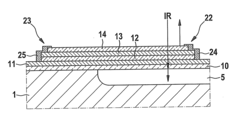
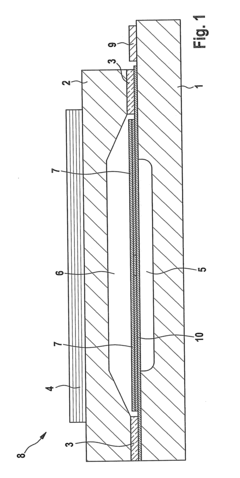
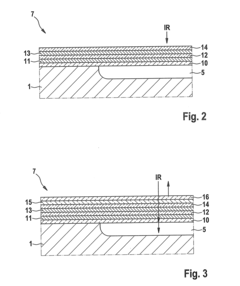
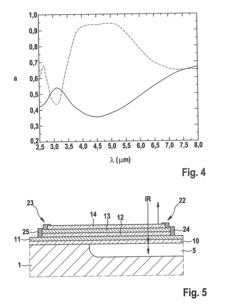
- A thermopile sensor design utilizing a layer system on the diaphragm that achieves high absorption through multibeam interference, eliminating the need for special absorber layers by using standard CMOS processes, with layer thicknesses and refractive indices optimized for reduced reflection and enhanced absorption.
Environmental Impact and Sustainability Considerations
The environmental impact of thermopile sensor manufacturing and deployment represents a critical consideration in today's sustainability-focused technological landscape. Traditional thermopile materials often include bismuth telluride, antimony, and various rare earth elements that pose significant environmental challenges during extraction and processing. Mining operations for these materials frequently result in habitat destruction, soil erosion, and water contamination, while processing requires substantial energy inputs and generates hazardous waste streams.
Recent advancements in thermopile material science have begun addressing these concerns through several promising approaches. The development of nano-structured materials has enabled reduced material consumption while maintaining or enhancing sensor performance. Additionally, research into alternative material compositions utilizing more abundant elements such as silicon-germanium alloys and modified zinc oxide compounds demonstrates potential for reducing dependence on environmentally problematic rare earth elements.
Life cycle assessment (LCA) studies of thermopile sensors reveal that manufacturing processes contribute approximately 70-80% of their total environmental footprint, with material extraction and refinement representing the most significant impact categories. Energy consumption during sensor operation, while relatively low compared to many electronic components, accumulates substantially over extended deployment periods, particularly in always-on applications such as building automation systems and continuous industrial monitoring.
The recyclability of thermopile sensors presents both challenges and opportunities. Current designs often integrate materials in ways that complicate end-of-life separation and recovery. However, emerging design-for-disassembly approaches and modular construction techniques are improving recovery rates. Advanced recycling technologies, including hydrometallurgical processes specifically optimized for sensor materials, show promise for closing material loops and reducing primary resource demands.
Regulatory frameworks increasingly influence thermopile sensor development, with legislation such as the European Union's Restriction of Hazardous Substances (RoHS) directive and Extended Producer Responsibility (EPR) programs driving manufacturers toward more sustainable material selections and product architectures. Industry certification programs and environmental product declarations are similarly incentivizing improvements in environmental performance throughout the sensor supply chain.
Looking forward, the integration of sustainability metrics into thermopile sensor design specifications represents a significant opportunity. Manufacturers pioneering bio-based substrates, reduced-toxicity material formulations, and energy-harvesting capabilities are establishing competitive advantages in markets increasingly sensitive to environmental considerations. The development of thermopile sensors with extended operational lifespans and simplified maintenance requirements further contributes to reducing overall environmental impact through decreased replacement frequency and associated manufacturing demands.
Recent advancements in thermopile material science have begun addressing these concerns through several promising approaches. The development of nano-structured materials has enabled reduced material consumption while maintaining or enhancing sensor performance. Additionally, research into alternative material compositions utilizing more abundant elements such as silicon-germanium alloys and modified zinc oxide compounds demonstrates potential for reducing dependence on environmentally problematic rare earth elements.
Life cycle assessment (LCA) studies of thermopile sensors reveal that manufacturing processes contribute approximately 70-80% of their total environmental footprint, with material extraction and refinement representing the most significant impact categories. Energy consumption during sensor operation, while relatively low compared to many electronic components, accumulates substantially over extended deployment periods, particularly in always-on applications such as building automation systems and continuous industrial monitoring.
The recyclability of thermopile sensors presents both challenges and opportunities. Current designs often integrate materials in ways that complicate end-of-life separation and recovery. However, emerging design-for-disassembly approaches and modular construction techniques are improving recovery rates. Advanced recycling technologies, including hydrometallurgical processes specifically optimized for sensor materials, show promise for closing material loops and reducing primary resource demands.
Regulatory frameworks increasingly influence thermopile sensor development, with legislation such as the European Union's Restriction of Hazardous Substances (RoHS) directive and Extended Producer Responsibility (EPR) programs driving manufacturers toward more sustainable material selections and product architectures. Industry certification programs and environmental product declarations are similarly incentivizing improvements in environmental performance throughout the sensor supply chain.
Looking forward, the integration of sustainability metrics into thermopile sensor design specifications represents a significant opportunity. Manufacturers pioneering bio-based substrates, reduced-toxicity material formulations, and energy-harvesting capabilities are establishing competitive advantages in markets increasingly sensitive to environmental considerations. The development of thermopile sensors with extended operational lifespans and simplified maintenance requirements further contributes to reducing overall environmental impact through decreased replacement frequency and associated manufacturing demands.
Manufacturing Process Optimization for Advanced Thermopile Materials
The optimization of manufacturing processes for advanced thermopile materials represents a critical frontier in sensor technology advancement. Current manufacturing techniques often struggle with precision control of material deposition thickness, which directly impacts sensor sensitivity and response time. Industry leaders have begun implementing multi-stage deposition processes that incorporate real-time monitoring systems, allowing for nanometer-level precision in thermoelectric material layering.
Vacuum sputtering techniques have emerged as the preferred method for high-quality thermopile material deposition, with recent innovations focusing on temperature-controlled substrate platforms that maintain optimal crystallization conditions throughout the deposition process. These platforms can regulate temperatures within ±0.5°C, significantly enhancing the uniformity of thermoelectric properties across the sensor array.
Post-deposition annealing processes have been refined to optimize the thermoelectric figure of merit (ZT) in advanced materials such as bismuth telluride and antimony telluride compounds. Controlled atmosphere annealing at precisely defined temperature gradients has demonstrated up to 35% improvement in Seebeck coefficient values compared to conventional techniques, directly translating to enhanced sensor performance.
Microfabrication techniques borrowed from semiconductor manufacturing have revolutionized thermopile sensor production. Photolithographic patterning combined with selective etching processes now enables the creation of thermopile junctions with feature sizes below 2 micrometers, dramatically increasing the density of thermoelectric elements per unit area and consequently improving signal output.
Quality control methodologies have evolved to incorporate in-line testing of thermoelectric properties during the manufacturing process. Automated systems now measure Seebeck coefficients, electrical conductivity, and thermal conductivity at multiple stages, allowing for immediate process adjustments and reducing defect rates by approximately 40% compared to traditional batch testing approaches.
Advanced packaging techniques represent the final critical step in thermopile manufacturing optimization. Vacuum sealing methods that incorporate getter materials have demonstrated significant improvements in long-term stability by preventing atmospheric contamination of sensitive thermoelectric materials. Additionally, thermal isolation structures fabricated using MEMS techniques have reduced parasitic heat flows by up to 60%, enhancing overall sensor sensitivity.
Cost-effective scaling remains a challenge, with current advanced manufacturing techniques adding approximately 30-40% to production costs compared to conventional methods. However, yield improvements and enhanced sensor performance typically offset these costs in high-value applications where measurement precision is paramount.
Vacuum sputtering techniques have emerged as the preferred method for high-quality thermopile material deposition, with recent innovations focusing on temperature-controlled substrate platforms that maintain optimal crystallization conditions throughout the deposition process. These platforms can regulate temperatures within ±0.5°C, significantly enhancing the uniformity of thermoelectric properties across the sensor array.
Post-deposition annealing processes have been refined to optimize the thermoelectric figure of merit (ZT) in advanced materials such as bismuth telluride and antimony telluride compounds. Controlled atmosphere annealing at precisely defined temperature gradients has demonstrated up to 35% improvement in Seebeck coefficient values compared to conventional techniques, directly translating to enhanced sensor performance.
Microfabrication techniques borrowed from semiconductor manufacturing have revolutionized thermopile sensor production. Photolithographic patterning combined with selective etching processes now enables the creation of thermopile junctions with feature sizes below 2 micrometers, dramatically increasing the density of thermoelectric elements per unit area and consequently improving signal output.
Quality control methodologies have evolved to incorporate in-line testing of thermoelectric properties during the manufacturing process. Automated systems now measure Seebeck coefficients, electrical conductivity, and thermal conductivity at multiple stages, allowing for immediate process adjustments and reducing defect rates by approximately 40% compared to traditional batch testing approaches.
Advanced packaging techniques represent the final critical step in thermopile manufacturing optimization. Vacuum sealing methods that incorporate getter materials have demonstrated significant improvements in long-term stability by preventing atmospheric contamination of sensitive thermoelectric materials. Additionally, thermal isolation structures fabricated using MEMS techniques have reduced parasitic heat flows by up to 60%, enhancing overall sensor sensitivity.
Cost-effective scaling remains a challenge, with current advanced manufacturing techniques adding approximately 30-40% to production costs compared to conventional methods. However, yield improvements and enhanced sensor performance typically offset these costs in high-value applications where measurement precision is paramount.
Unlock deeper insights with PatSnap Eureka Quick Research — get a full tech report to explore trends and direct your research. Try now!
Generate Your Research Report Instantly with AI Agent
Supercharge your innovation with PatSnap Eureka AI Agent Platform!