
Device and method for lysing cells, spores, or microorganisms
a technology of lysing cells and microorganisms, applied in the field of lysing cells, spores, or microorganisms, can solve the problems of complex fluidic assembly and processing algorithms, limited volume of fluid samples which can be processed by robotically operated devices, and complex contemporary biomedical processing instruments. , to achieve the effect of superior blend of efficiency and convenience in design, manufacture and us
- Summary
- Abstract
- Description
- Claims
- Application Information
AI Technical Summary
Benefits of technology
Problems solved by technology
Method used
Image

Examples
Embodiment Construction
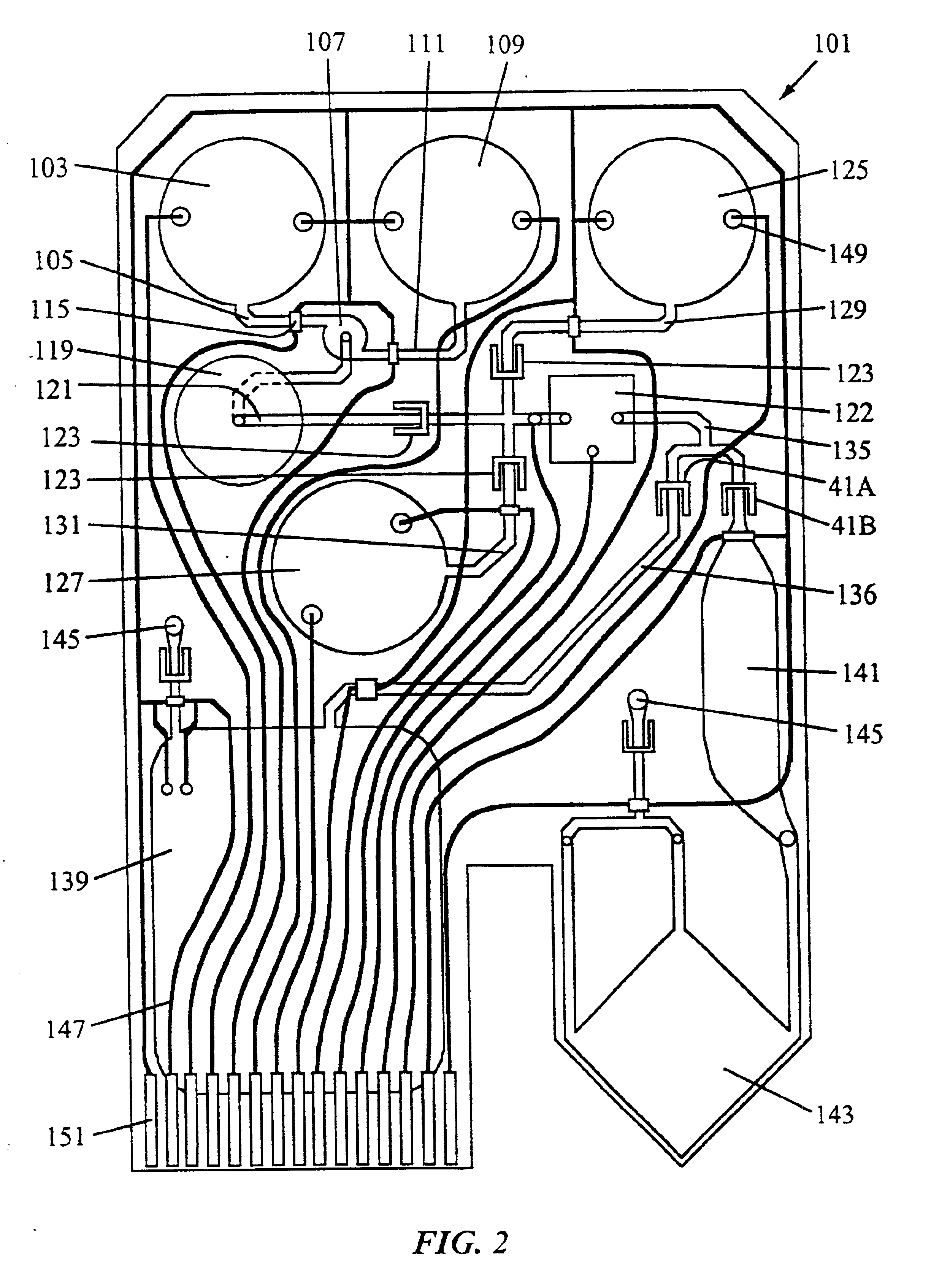
[0043]The present invention provides a cartridge for performing various operations on a fluid sample as the sample flows through a series of interconnected, interactive regions within the cartridge. The regions are located sequentially along a fluid flow path through the cartridge, so that a segment of the fluid stream is exposed to a specific operation at one region, then another operation at the next region, etc. The sample flows through the interactive regions so that it is simultaneously in contact with more than one region at a given time. The sample flow is preferably continuous, so that the operations at each region occur simultaneously and sequentially on the fluid stream.
[0044]The cartridges of the present invention allow for significantly improved processing of a fluid sample for the detection and / or analysis of chemical components in the sample, such as biological molecules. A pioneering improvement over the prior art is the ability to rapidly process a fluid sample that ...
PUM
| Property | Measurement | Unit |
|---|---|---|
| thickness | aaaaa | aaaaa |
| volume | aaaaa | aaaaa |
| volume | aaaaa | aaaaa |
Abstract
Description
Claims
Application Information
 Login to View More