
Concurrent parallelogram-containing three-translational freedom robot mechanism
A parallelogram and tri-translation technology, applied in the field of robotics, can solve problems such as difficulty in ensuring the attitude accuracy of the moving platform and changes in the attitude of the moving platform, and achieve the effect of avoiding attitude errors and ensuring attitude accuracy
Patent Information
- Authority / Receiving Office
- CN · China
- Patent Type
- Patents(China)
- Current Assignee / Owner
- Publication Date
- 2012-05-16
- Estimated Expiration
- Not applicable · inactive patent
Smart Images
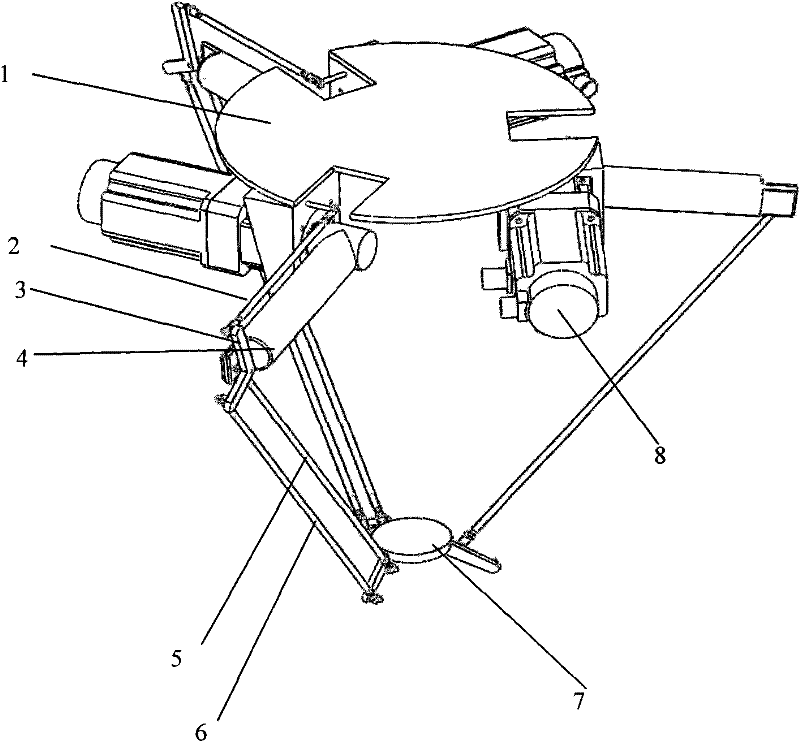
Figure 1 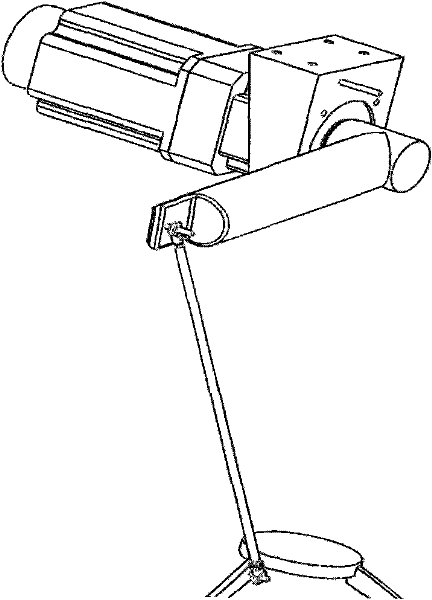
Figure 2 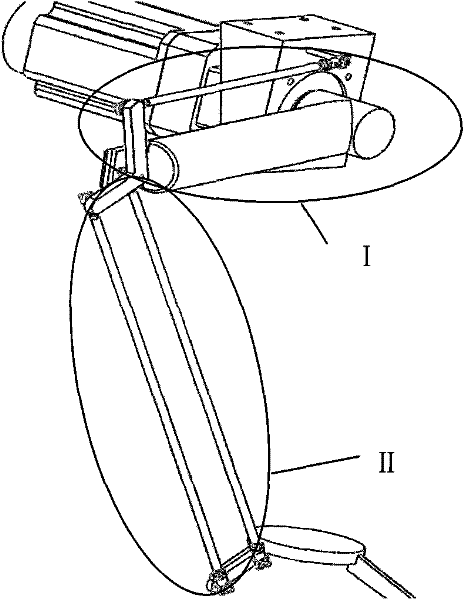
Figure 3
Abstract
Description
technical field
[0001] The invention relates to a robot, in particular to a robot mechanism with three translational degrees of freedom including converging parallelograms. Background technique
[0002] US Patent US4976572 (or WO7703527, EP0250470, CH672079, EP0250470, JP63501760T) discloses a spatially symmetrical three-translation parallel mechanism, which includes three active branch chains, and each branch chain includes two parts: a driving arm and a driven arm. There are two types of branch chains of this kind of mechanism. One is that the main arm and the driven arm are both in the form of a single rod, and the two ends of the driven arm are respectively connected with the main arm and the moving platform through the Hooke hinge; The arm is a single rod, while the slave arm is a double rod, and the double rod slave arm forms a parallelogram. The two ends of each rod are respectively connected with the active arm and the dynamic platform through ball joints, and one en...
Examples
Embodiment Construction
[0014] The present invention will be further described below in conjunction with accompanying drawing:
[0015] Such as figure 1 , figure 2 , image 3 , Figure 4 , Figure 5 As shown, a space three-translational-moving parallel mechanism with converging parallelograms consists of a static platform 1, a moving platform 7, three main branch chains with the same structure and two An auxiliary branch chain connects the static platform 1 and the dynamic platform 7, and the main branch chain and the auxiliary branch chain form two converging parallelogram branch chains, which can limit three degrees of freedom of rotation of the dynamic platform 7.
[0016] See figure 2 , the three main branch chains are respectively composed of the driving device 8, the active arm 4 and the driven arm 5; the connection mode between one of the three active branch chains and the static platform 1 and the moving platform 7 is as follows: figure 1 As shown, the driving device 8 is fixedly conn...