
Master-slave branch chain separate type two-translational motion parallel robot
A robot and two-translation technology, applied in the field of robotics, can solve the problems of limiting the acceleration of the end effector, reducing the range of the working space of the mechanism, and difficult to guarantee the accuracy of position and attitude, and achieve the effect of small inertia, simple structure and high acceleration
Patent Information
- Authority / Receiving Office
- CN · China
- Patent Type
- Patents(China)
- Current Assignee / Owner
- Publication Date
- 2015-03-18
Smart Images
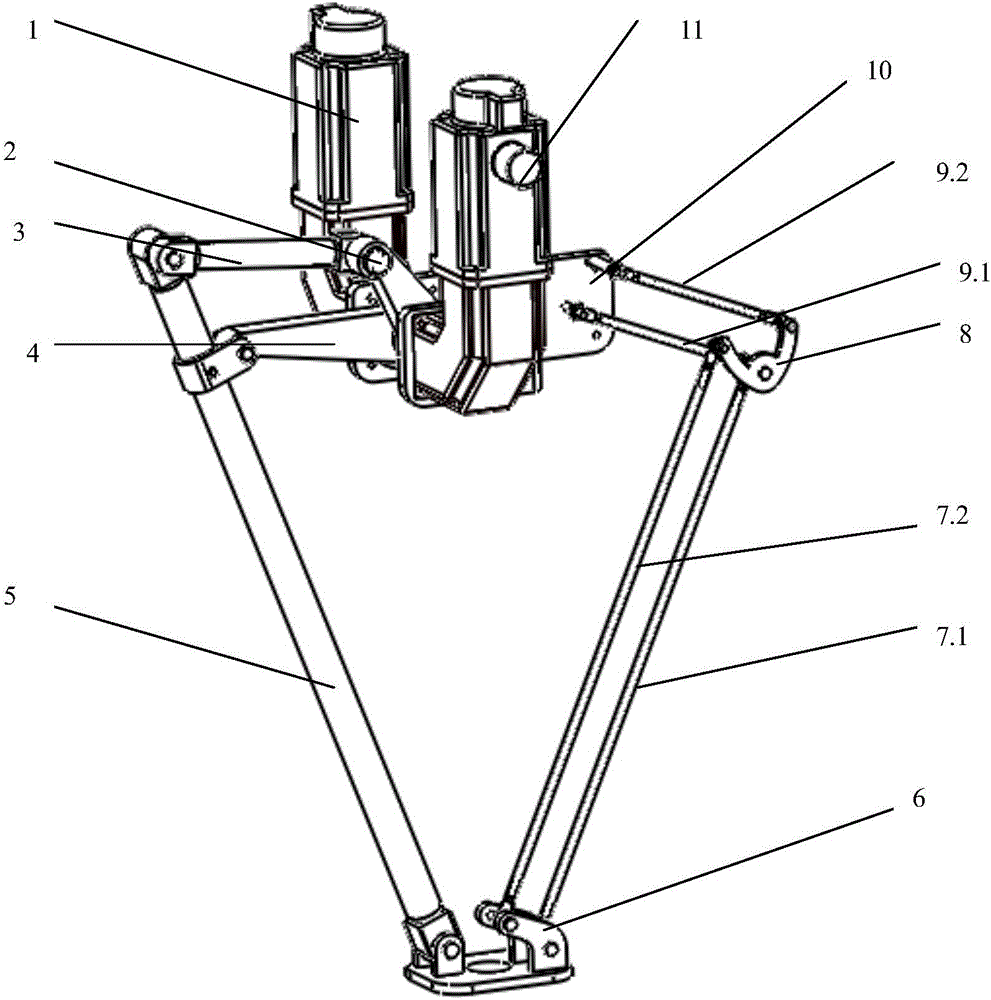
Figure 1 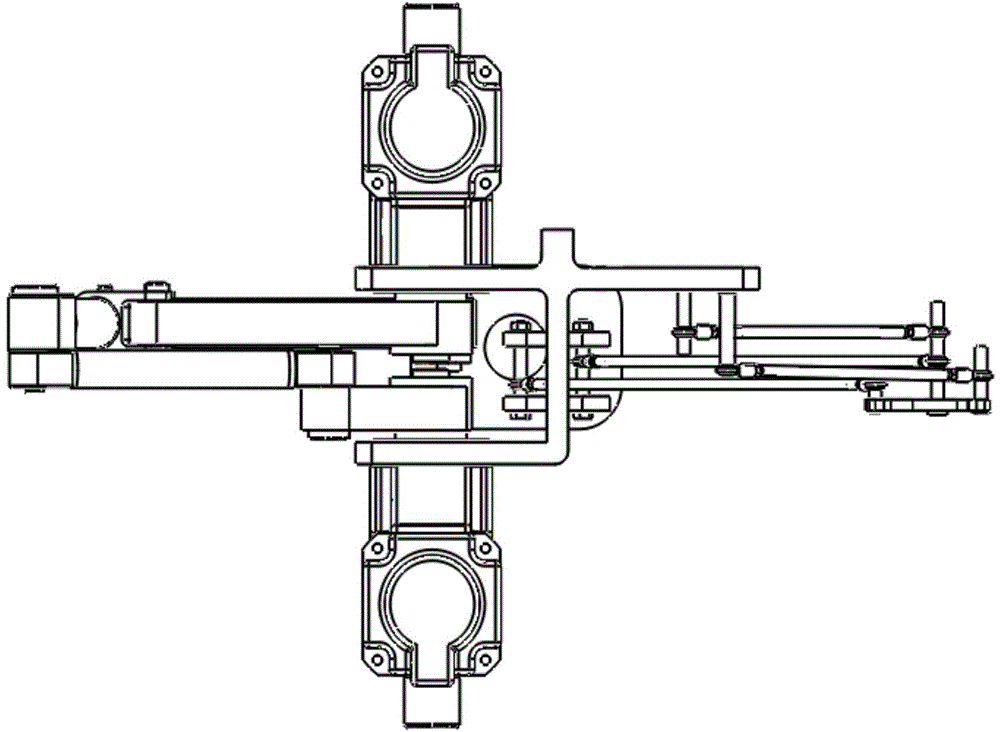
Figure 2 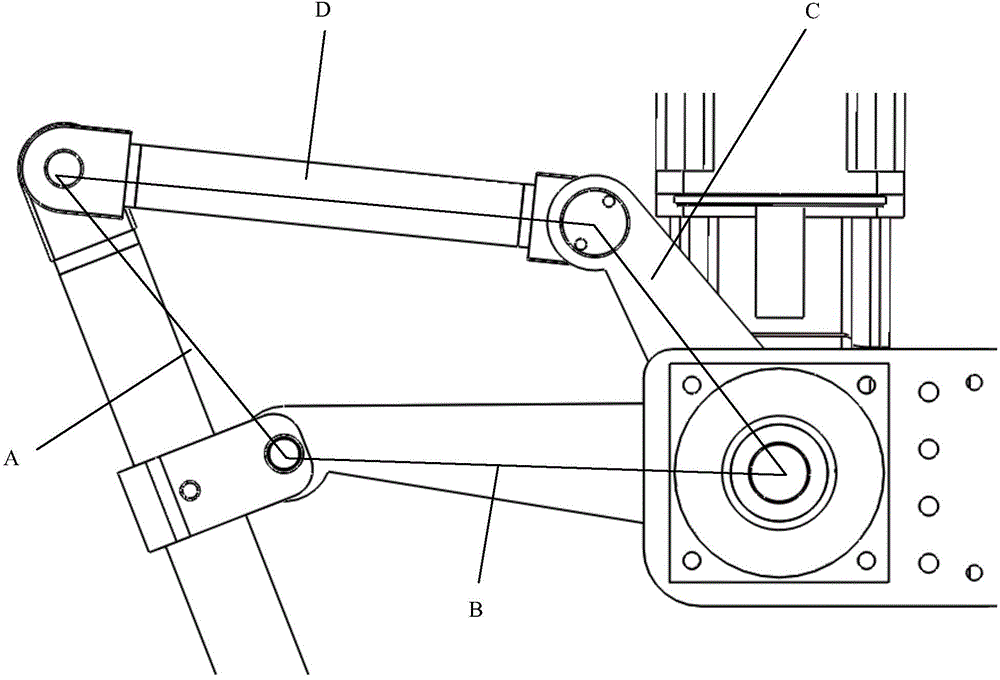
Figure 3
Abstract
Description
Technical field:
[0001] The invention belongs to the technical field of robots, and in particular relates to a two-translational parallel robot of a master-slave branch chain separation type. Background technique:
[0002] In the automated production lines of industries such as light industry, medicine, food, and electronics, operations such as sorting, packaging, and packaging often require manipulators with end-effectors that perform high-speed operations in space, so it is unnecessary to use multi-degree-of-freedom space parallel manipulators , or the manufacturing cost is too high. Patent CN1355087A discloses a robot mechanism, which includes a frame, a moving platform and two branch chains, the moving platform is provided with an actuator; the two ends and the center of the frame are respectively equipped with servo motors; the The moving platform is connected to the frame through two branches to form a parallel closed-loop structure; each of the two branch chains cont...
Examples
Embodiment Construction
[0019] A two-degree-of-freedom parallel robot with master-slave branch chain separation provided by the present invention includes a frame 10 , a driving device, a motion branch chain and a moving platform 6 . The moving platform 6 forms a closed-loop parallel structure with the frame 9 through the kinematic branch chain; the kinematic branch chain includes a driving branch chain and a driven branch chain; The moving platform 6 is connected; the active branch chain drives the end effector to move in translation, and the driven branch chain and the active branch chain restrict three rotational degrees of freedom and one translational degree of freedom of the end effector.
[0020] The active branch chain is composed of the first drive device 1, the second drive device 11, the first active arm 4, the second active arm 2, the linkage arm 3 and the driven arm 5; the rod of the first active arm 4 long (see image 3 The straight line segment B) in is equal to the bar length of link...