

Preparation method of 2,6-dichloro-3-fluorobenzonitrile
A technology for fluorobenzonitrile and fluoroacetophenone, applied in the preparation field, can solve the problems of low total yield, many reaction steps, and high product cost, and achieve the effects of high product quality yield, low production cost, and easy operation.
Patent Information
- Authority / Receiving Office
- CN · China
- Patent Type
- Patents(China)
- Current Assignee / Owner
- Publication Date
- 2014-06-11
Smart Images
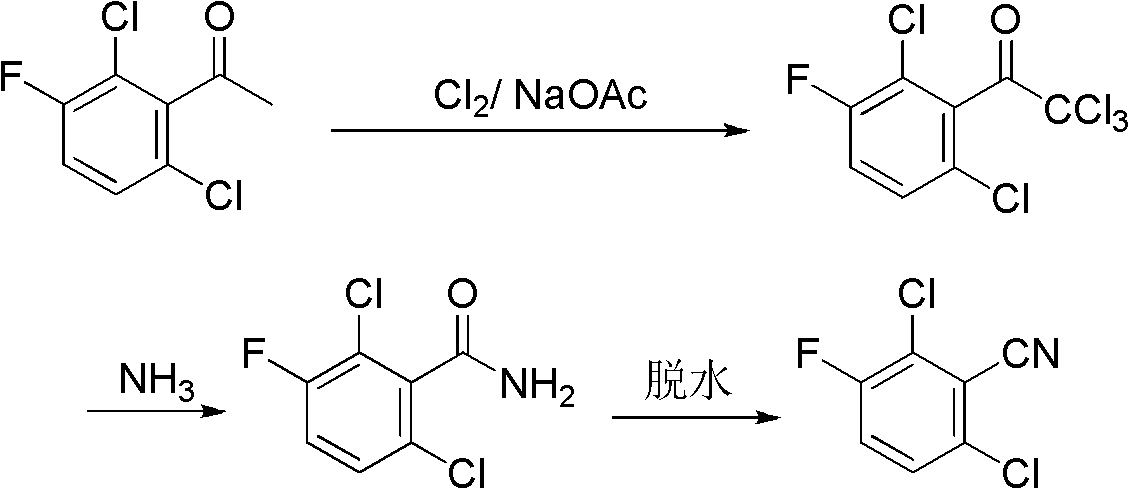
Figure 1
Abstract
Description
(1) Technical field
[0001] The present invention relates to a preparation method of 2,6-dichloro-3-fluorobenzonitrile, in particular to a preparation method of 2,6-dichloro-3-fluoroacetophenone using 2,6-dichloro-3-fluoroacetophenone as a starting material -3-Fluorobenzonitrile method. (2) Background technology
[0002] 2,6-dichloro-3-fluorobenzonitrile is an important pharmaceutical and pesticide intermediate with a high market value, and the current market price is about 200,000 / ton. On the other hand, the synthesis of 2,4-dichloro-5-fluoroacetophenone, the key intermediate of quinolones, mainly uses 2,4-dichlorofluorobenzene, acetyl chloride, and aluminum trichloride as raw materials. It is prepared by acylation reaction, and about 20% of the isomer by-product 2,6-dichloro-3-fluoroacetophenone is simultaneously generated during the preparation process. The large-scale production of this by-product brings thorny problems to environmental protection. If waste can be turne...
Examples
Embodiment 1
[0027] Synthesis of α,α,α,2,6-pentachloro-3-fluoroacetophenone
[0028] In a 500mL round bottom flask equipped with mechanical stirring, reflux condenser, and tail gas absorption device, add 82.8g (0.4mol) of 2,6-dichloro-3-fluoroacetophenone, 200mL of glacial acetic acid, and heat up to 70°C. Chlorine gas was introduced to react for 3 hours, and TLC monitored that 2,6-dichloro-3-fluoroacetophenone was completely converted into α,α,2,6-tetrachloro-3-fluoroacetophenone, and anhydrous sodium acetate was added to the system 50g, continue to react with chlorine at 70°C for 1h, TLC detects that the reaction is complete, after cooling to room temperature, blow in compressed air to drive away excess chlorine in the system, filter to remove the solid sodium chloride generated in the reaction, recover the solvent acetic acid, add 200ml acetic acid Dissolved in ethyl ester, washed with water, anhydrous Na 2 SO 4 After drying, the ethyl acetate solvent was recovered to obtain 121.8 g o...
Embodiment 2
[0030] Synthesis of α,α,α,2,6-pentachloro-3-fluoroacetophenone
[0031] In a 500mL round bottom flask equipped with mechanical stirring, reflux condenser, and tail gas absorption device, add 82.8g (0.4mol) of 2,6-dichloro-3-fluoroacetophenone, 200mL of glacial acetic acid, and heat up to 90°C. Chlorine gas was introduced to react for 2 hours, and TLC monitored that 2,6-dichloro-3-fluoroacetophenone was completely converted into α,α,2,6-tetrachloro-3-fluoroacetophenone, and anhydrous sodium acetate was added to the system 50g, continue to react with chlorine at 90°C for 1h, TLC detects that the reaction is complete, after cooling to room temperature, blow in compressed air to drive away excess chlorine in the system, filter to remove the solid sodium chloride generated in the reaction, recover the solvent acetic acid, add 200mL toluene dissolved, washed with water, anhydrous Na 2 SO 4 After drying, the toluene solvent was recovered to obtain 120.4 g of a colorless oily liquid...
Embodiment 3
[0033] Synthesis of 2,6-dichloro-3-fluorobenzamide
[0034] In a 1000mL round bottom flask equipped with mechanical stirring and tail gas absorption device, add α,α,α,2,6-pentachloro-3-fluoroacetophenone 124.2g (0.4mol), 400mL ethanol, keep the system at 20°C Continue the stirring reaction below 20° C. for 3 h after passing ammonia gas to saturation, and recover the solvent and the chloroform generated by the reaction under reduced pressure to obtain 81.5 g of 2,6-dichloro-3-fluorobenzamide as a solid (98% yield). Melting point 183-185°C, HPLC content analysis 97%.