
Frequency domain arrival detection method of orthogonal frequency division multiplexing system
A technology of orthogonal frequency division and detection method, applied in multi-frequency code system, baseband system components, shaping network in transmitter/receiver, etc., can solve the influence of signal time domain correlation characteristics, false detection and missed detection probability Improve and reduce reliability, etc., to achieve the effect of increasing the probability of successful detection, reducing the probability of false alarms, and reliable signal arrival detection
Patent Information
- Authority / Receiving Office
- CN · China
- Patent Type
- Patents(China)
- Current Assignee / Owner
- Publication Date
- 2014-11-12
Smart Images
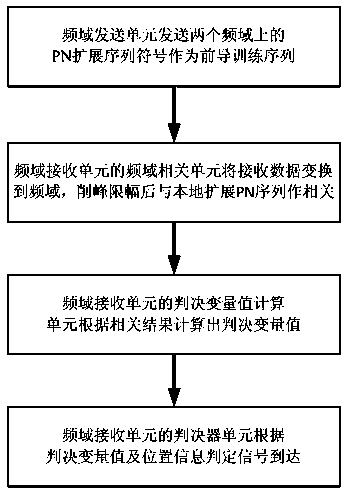
Figure 1 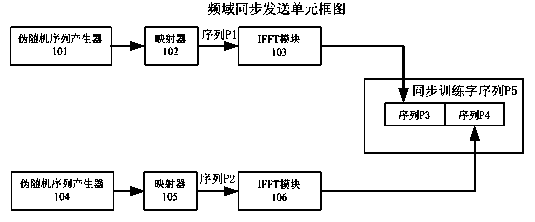
Figure 2 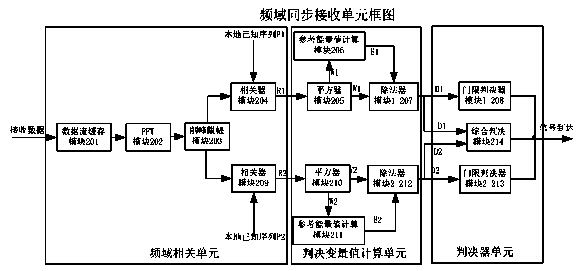
Figure 3
Abstract
Description
technical field
[0001] The invention relates to the technical field of data transmission in a mobile communication system, in particular to a signal transmission and arrival detection method based on frequency domain frame synchronization in an orthogonal frequency division multiplexing system. Background technique
[0002] With the development of digital signal processing technology and high-speed devices, Orthogonal Frequency Division Multiplexing (OFDM) technology is more and more widely used in communication systems. This special multi-carrier transmission method, due to the orthogonality between the sub-carriers, can allow the spectrum between the sub-channels to overlap each other, can maximize the use of spectrum resources and reduce the information rate of the sub-channels, so it has good performance. Anti-noise and anti-multipath interference capabilities, suitable for high-speed data transmission in frequency selective fading channels.
[0003] The main goal and t...
Examples
Embodiment
[0047] combine figure 2 , the specific steps of the frequency domain synchronization sending unit are:
[0048] 1) First use the pseudo-random sequence generator (101) corresponding to the original polynomial 1 with an order of N to generate a segment with a length of 2 N The PN sequence of -1 is mapped into a bipolar PN sequence with a value of +1 and -1 through the mapper (102), and a 0 is added at the beginning of the sequence to obtain a length of 2 N The sequence P1.
[0049] 2) Then use the pseudo-random sequence generator (104) corresponding to the original polynomial 2 with order N to generate a length of 2 N The PN sequence of -1 is mapped into a bipolar PN sequence with a value of +1 and -1 through the mapper (105), and a 0 is added at the beginning of the sequence to obtain a length of 2 N The sequence P2.
[0050] 3) Send the sequences P1 and P2 into the IFFT modules (103, 106) respectively to obtain the sequences P3 and P4, and then concatenate the sequences ...