
Marine diesel engine scr reactor diversion device
A technology for SCR reactors and marine diesel engines, which is applied in mufflers, exhaust devices, machines/engines, etc., which can solve the problem that the catalytic capacity is not fully utilized, which affects the application of SCR systems on ships, and the axial size of the expansion cavity is large, etc. problems, to achieve the effect of improving circumferential unevenness, improving radial unevenness, and uniform flow rate
Patent Information
- Authority / Receiving Office
- CN · China
- Patent Type
- Patents(China)
- Current Assignee / Owner
- Publication Date
- 2014-10-22
Smart Images
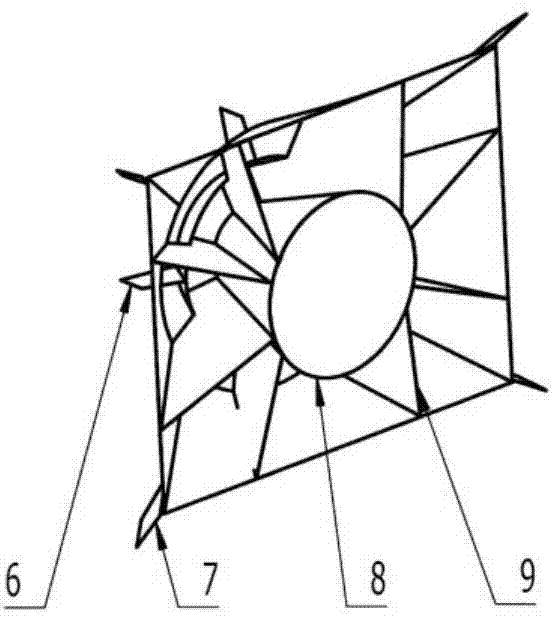
Figure 1 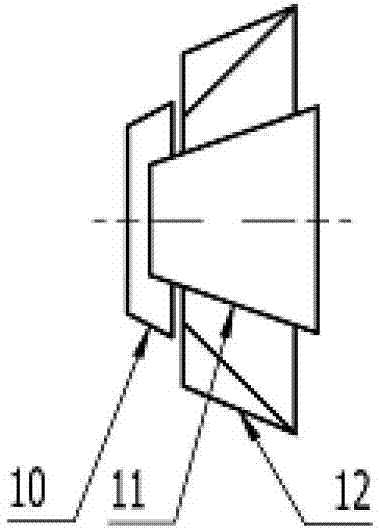
Figure 2 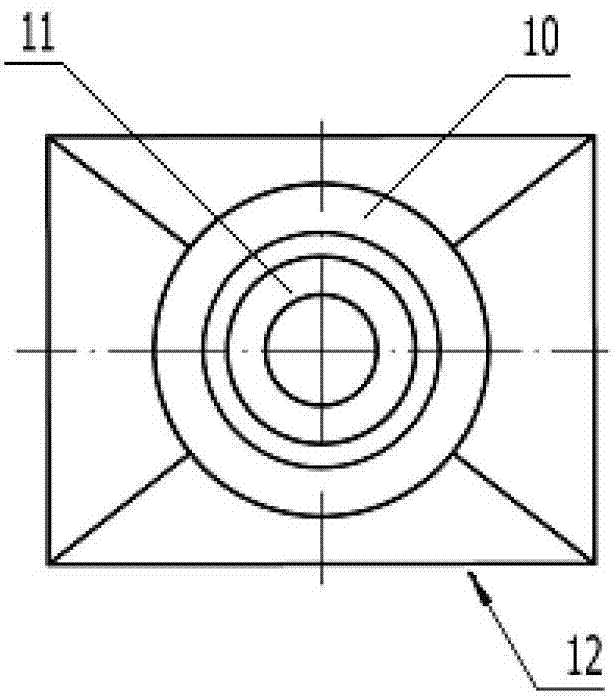
Figure 3
Abstract
Description
technical field
[0001] The invention belongs to the technical field of fluid mechanics application, and in particular relates to a diversion device for an SCR reactor of a marine diesel engine. Background technique
[0002] Selective Catalytic Reduction (SCR, short for Selective Catalytic Reduction) technology is the mainstream technology for exhaust gas treatment of marine diesel engines. The uniformity of the flow field of the SCR reactor is its core technology. If the flow rate of exhaust gas entering the catalyst pores is not uniform, part of the exhaust gas in the area with too high velocity will be discharged before it can react, and the catalytic capacity in the area with too low velocity will not be fully utilized, thereby reducing the performance of the reactor. Usually, in order to ensure uniform flow rate of the exhaust gas entering the catalyst pores, the expansion angle of the expansion chamber cannot be too large, but this will cause the axial dimension of the...
Examples
Embodiment Construction
[0016] The present invention will be described in detail below with reference to the accompanying drawings and examples.
[0017] The invention provides a diversion device for a marine diesel engine SCR reactor, as attached figure 1 As shown, it includes guide ring 8, guide plate 9, front support plate 6 and rear support plate 7, as attached Figure 6 The peripheral device shown is a diesel engine SCR reactor. The dimensions of the diesel engine SCR reactor are 1854mm×1675mm×2924mm. The inlet of the expansion chamber 3 of the diesel engine SCR reactor is connected to the circular chamber 1 of Φ600mm, and the outlet is connected to the square chamber 4 of 1500mm×1140mm. The catalyst 5 is built in the square cavity, and the expansion ratio of the expansion cavity 3 is 6. If a small expansion angle is used, the length of the expansion cavity will exceed 1000mm. Due to actual needs, the length of the expansion cavity 3 is required to be controlled at about 400mm, and the expansion...