
Salt corrosion-resistant and torsion-resistant integral shielding telecommunication cable for offshore wind power and manufacturing method of integral shielding telecommunication cable
A technology of overall shielding and communication cables, which is applied in the direction of cable/conductor manufacturing, conductor/cable insulation, twisted/quad-stranded cables, etc., which can solve the problem of cable end insulation and inner protection Separation of sleeves, lack of resistance to seawater and wet impregnation, unsuitable for marine wind power environments, etc., to eliminate gaps, facilitate continuous transfer, and enhance the effect of impregnation
Patent Information
- Authority / Receiving Office
- CN · China
- Patent Type
- Applications(China)
- Current Assignee / Owner
- Publication Date
- 2013-07-31
Smart Images
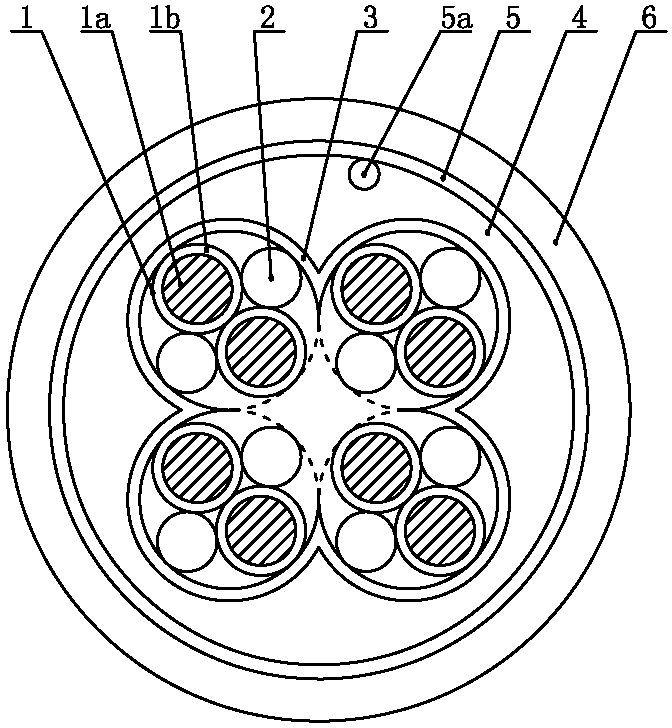
Figure 1 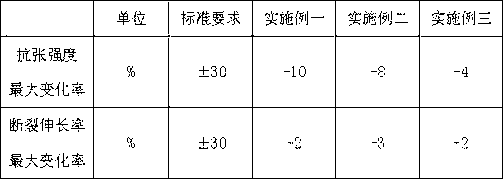
Figure 2 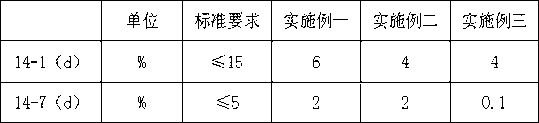
Figure 3
Abstract
Description
technical field
[0001] The invention relates to a communication cable, in particular to a salt-corrosion and torsion-resistant overall shielded communication cable for marine wind power. The invention also relates to a method for manufacturing a salt-corrosion-resistant and torsion-resistant overall shielded communication cable for marine wind power. Background technique
[0002] With the maturity of land-use wind power utilization, the country has begun to promote the use of offshore wind power, but at present there is no cable dedicated to offshore wind power that can fully meet the operating conditions of offshore wind power to match it, and most of them are matched with cables originally used for land-use wind power It is used for offshore wind power, or a cable with certain performance required by the cable for offshore wind power is used. However, the performance of cables for land-use wind power does not take into account the special environment of offshore wind powe...
Examples
Embodiment 1
[0023] Such as figure 1 As shown, the salt-corrosion-resistant and torsion-resistant overall shielded communication cable for marine wind power of the present invention includes the following steps in turn: the outer periphery of the stranded copper conductor 1a is evenly extruded with a salt-corrosion-resistant and torsion-resistant rubber insulating layer 1b to form an insulated core 1, and the insulated wire The core 1 is twisted in pairs to form a pair of twisted wires, and the gap between the pair of twisted wires is filled with a flame-retardant non-hygroscopic fiber core 2. Each pair of twisted wires adopts a different twisting pitch, and multiple pairs of twisted wires The cable core is formed by twisting, and then the outer periphery of the cable core is wrapped with a low-strength non-woven longitudinal cladding 3, and finally the inner sheath 4 is extruded on the outer periphery of the low-strength non-woven longitudinal cladding 3, and the inner sheath 4 will be low...
Embodiment 2
[0028] Such as figure 1As shown, the salt-corrosion-resistant and torsion-resistant overall shielded communication cable for marine wind power of the present invention includes the following steps in turn: the outer periphery of the stranded copper conductor 1a is evenly extruded with a salt-corrosion-resistant and torsion-resistant rubber insulating layer 1b to form an insulated core 1, and the insulated wire The core 1 is twisted in pairs to form a pair of twisted wires, and the gap between the pair of twisted wires is filled with a flame-retardant non-hygroscopic fiber core 2. Each pair of twisted wires adopts a different twisting pitch, and multiple pairs of twisted wires The cable core is formed by twisting, and then the outer periphery of the cable core is wrapped with a low-strength non-woven longitudinal cladding 3, and finally the inner sheath 4 is extruded on the outer periphery of the low-strength non-woven longitudinal cladding 3, and the inner sheath 4 will be lowe...
Embodiment 3
[0033] Such as figure 1 As shown, the salt-corrosion-resistant and torsion-resistant overall shielded communication cable for marine wind power of the present invention includes the following steps in turn: the outer periphery of the stranded copper conductor 1a is evenly extruded with a salt-corrosion-resistant and torsion-resistant rubber insulating layer 1b to form an insulated core 1, and the insulated wire The core 1 is twisted in pairs to form a pair of twisted wires, and the gap between the pair of twisted wires is filled with a flame-retardant non-hygroscopic fiber core 2. Each pair of twisted wires adopts a different twisting pitch, and multiple pairs of twisted wires The cable core is formed by twisting, and then the outer periphery of the cable core is wrapped with a low-strength non-woven longitudinal cladding 3, and finally the inner sheath 4 is extruded on the outer periphery of the low-strength non-woven longitudinal cladding 3, and the inner sheath 4 will be low...