
Apparatus and method for intelligently replacing and locking unmanned aerial vehicle battery
A locking device and machine battery technology, applied in the field of drones, can solve problems such as low efficiency, long battery time consumption, and unsatisfactory work
Patent Information
- Authority / Receiving Office
- CN · China
- Current Assignee / Owner
- Publication Date
- 2019-02-19
- Estimated Expiration
- Not applicable · inactive patent
Smart Images
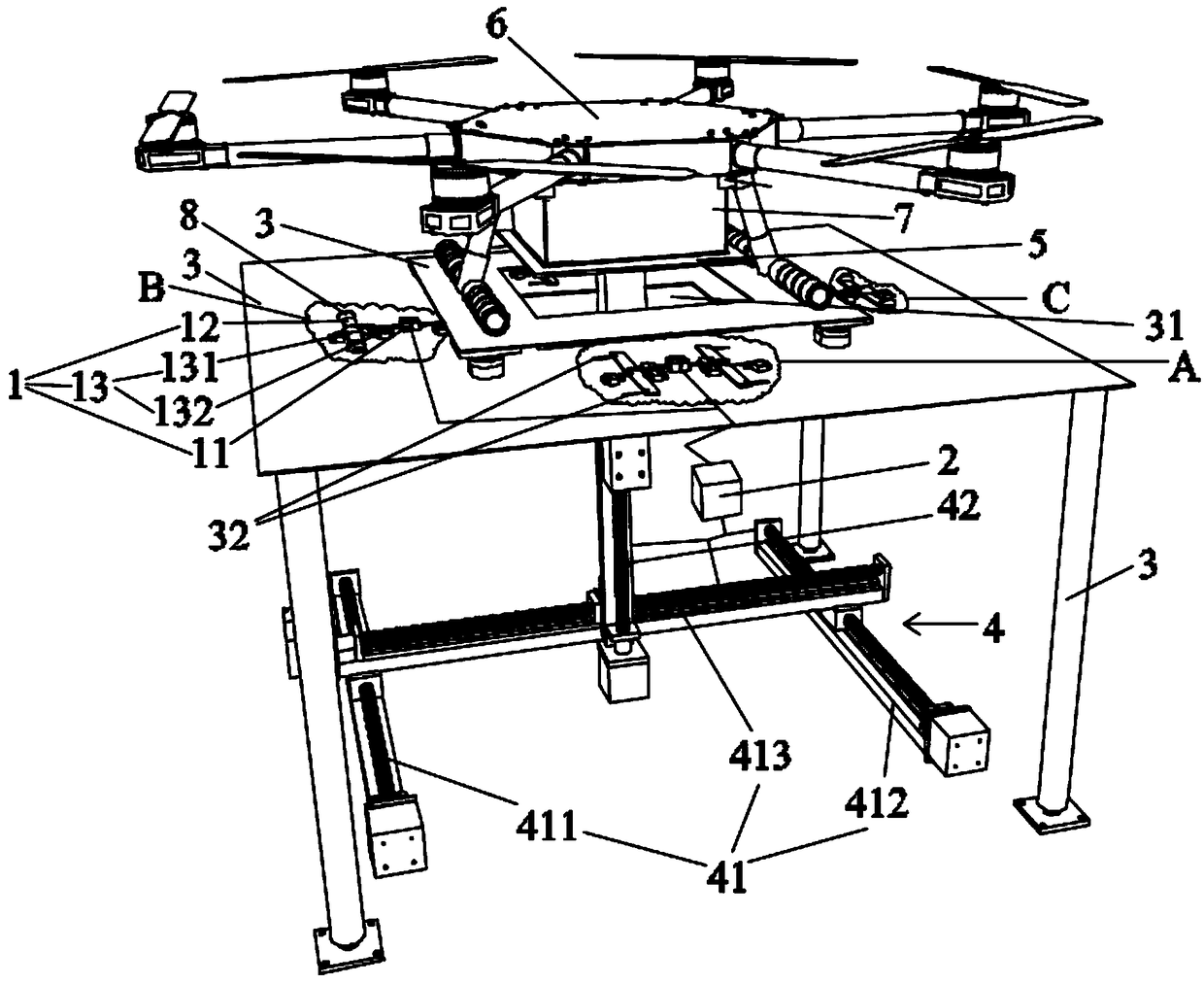
Figure 1 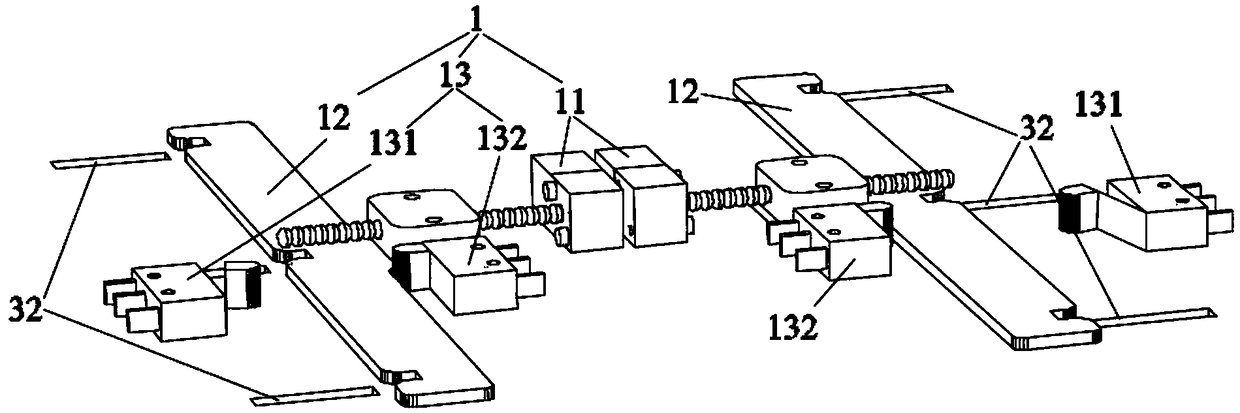
Figure 2 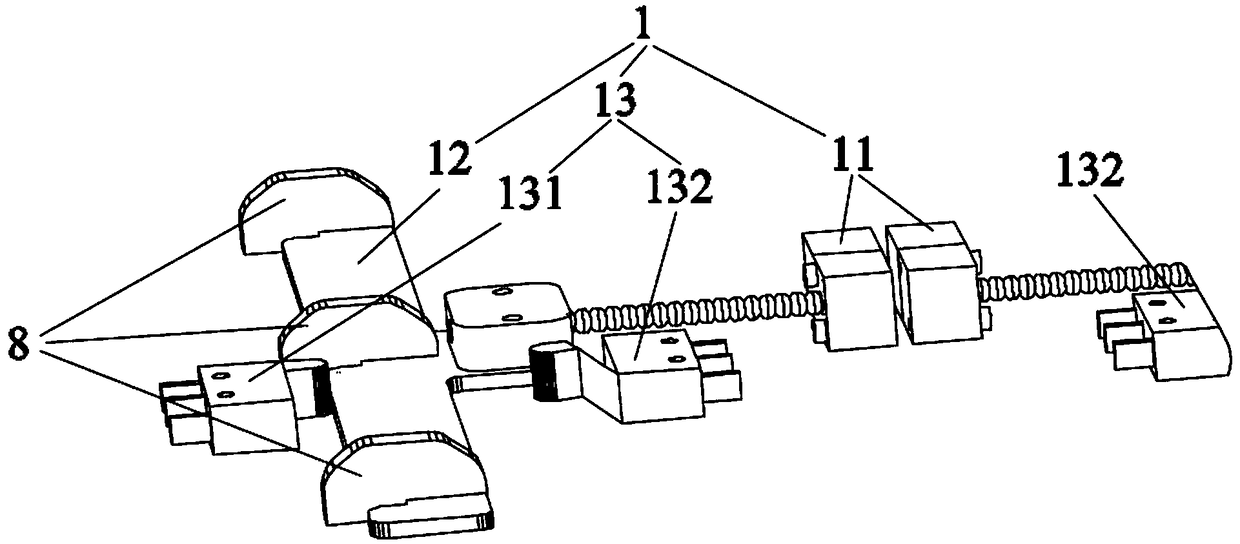
Figure 3
Abstract
Description
technical field
[0001] The invention belongs to the technical field of drones, and in particular relates to a device and method for intelligent battery replacement and locking of drones. Background technique
[0002] In recent years, with the development of science and technology, drones have expanded from the military field to the civilian field, especially in agriculture, forestry, electricity, security, etc., which are widely used in civilian fields. While the application range of UAVs is getting wider and wider, there are also various types of UAVs on the market.
[0003] At present, the drones on the market mainly use lithium polymer batteries as the main power, and the battery life is generally between 20 minutes and 30 minutes, depending on the technology. However, most of the battery life is within 45 minutes. But the charging time is more than an hour. Since drones need to reduce the take-off weight as much as possible, they cannot carry heavy large-capacity batte...
Examples
Embodiment 1
[0041] Such as Figure 1-7 As shown, a device for intelligent replacement and locking of unmanned aerial vehicles includes a locking device 1, and the locking device 1 includes a telescopic device 11, a block 12, a sensing device 13 and a control device 2, and the block 12 and the telescopic The output end of the device 11 is connected, and the sensing device 13 is arranged in the stroke direction of the output end of the telescopic device 11 and cooperates with the block 12 . Both the telescopic device 11 and the sensing device 13 are electrically connected with the control device 2 . In operation, the control device 2 controls the telescopic device 11 to work, and the telescopic device 11 drives the block 12 to move back and forth, thereby realizing the clamping or disengagement between the block 12 and the hook 8 of the battery 7, so as to complete the unmanned aerial vehicle 6 During the replacement and locking of the battery 7, the sensing device 13 plays a role in limiti...
Embodiment 2
[0051] Such as Figure 8 As shown, the difference from Embodiment 1 is that the transmission mechanism 41 in this embodiment is a cross slide, and the lifting mechanism 42 is arranged at the output end of the cross slide. This design makes the mechanism of the device more streamlined.
[0052] Other structures are the same as those in Embodiment 1, and will not be repeated here.
Embodiment 3
[0054] Such as Figure 1-8 As shown, a method for smart replacement and locking of the UAV battery of embodiment 1 or 2 includes the following steps:
[0055] S1, stay the unmanned aerial vehicle 6 that needs to replace the battery 7 on the workbench 3, and correspond the unloaded battery 7 on the unmanned aerial vehicle 6 to the discharge port 31 on the workbench 3;
[0056] S2, the control device 2 controls the conduction device 4 to work, the conduction mechanism 41 adjusts the supporting plate 5 to the position corresponding to the discharge port 31, the lifting mechanism 42 lifts the supporting plate 5, and the supporting plate 5 lifts the empty space of the drone 6 Hold the battery 7;
[0057] S3. The control device 2 controls the locking device 1 in the UAV 6 to work, the telescopic device 11 performs a contraction movement, and the output end of the telescopic device 11 drives the block 12 to move, and the block 12 and the unloaded battery on the UAV 6 7 The hook 8 i...