
Alarm implementation method and system based on dynamic configuration
An implementation method and dynamic configuration technology, applied in the transmission system, software deployment, version control, etc., can solve the problems of large human influence and the inability of users to receive alarm information effectively, so as to reduce the interference of human factors, enrich push channels, The effect of reducing the error rate
Patent Information
- Authority / Receiving Office
- CN · China
- Patent Type
- Applications(China)
- Current Assignee / Owner
- Publication Date
- 2020-10-16
Smart Images
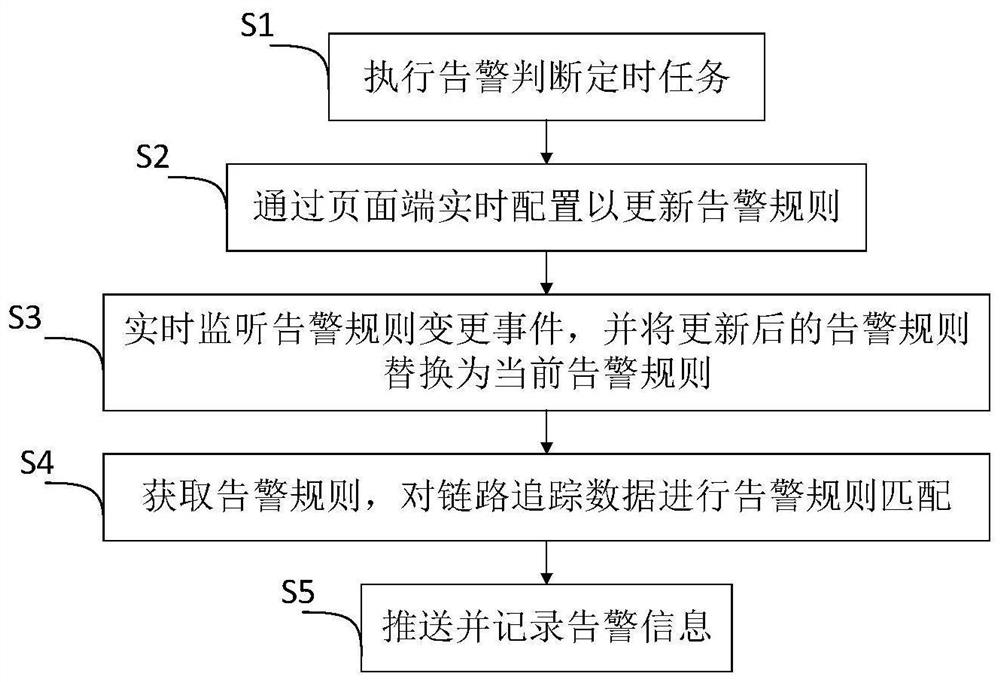
Figure 1 
Figure 2 
Figure 3
Abstract
Description
technical field
[0001] The present invention relates to the technical field of microservice application security, in particular to a dynamic configuration-based alarm realization method and system thereof. Background technique
[0002] With the popularity of the microservice architecture, in order to ensure that the problem can be quickly located and solved when a failure occurs, it is often necessary to use APM (Application Performance Monitoring) tools to help understand system behavior and analyze performance problems. At present, some of the main APM tools are: : Cat, Zipkin, Pinpoint, SkyWalking, among them, Skywalking is an APM tool for distributed systems, especially for microservices, cloud native and containerized (Docker, Kubernetes, Mesos) architectures, providing distributed tracking, performance Indicator analysis, application and service dependency analysis, application topology analysis, alarm and other functions.
[0003] The basic principle of Skywalking se...
Examples
Embodiment
[0037] Such as figure 1 As shown, a dynamic configuration-based alarm implementation method includes the following steps:
[0038] S1. Execute the alarm judgment timing task, and regularly match the alarm rules with the link tracking data from the application end or the server end;
[0039] S2. If there is a need to change the alarm rule, update the alarm rule through real-time configuration on the page, and record the updated alarm rule, otherwise perform step S4, wherein the change requirement includes the rule object and rule threshold in the alarm rule change;
[0040] S3. Monitor the alarm rule change event in real time, and replace the updated alarm rule with the current alarm rule, wherein the alarm rule change event includes the modification, addition and deletion of the alarm rule;
[0041] S4. Obtain an alarm rule, match the link tracking data in step S1 with the alarm rule, and judge whether to trigger the alarm rule. If it is judged to be yes, then execute step S...