
GAN image denoising algorithm fused with improved residual network
An image and residual technology, applied in the field of image processing, can solve the problems of loss of image details and texture, affecting the effect of image reconstruction, and reducing the receptive field of the generator model, so as to achieve the effect of improving the discrimination ability and good denoising effect.
Patent Information
- Authority / Receiving Office
- CN · China
- Current Assignee / Owner
- Publication Date
- 2021-05-25
- Estimated Expiration
- Not applicable · inactive patent
Smart Images
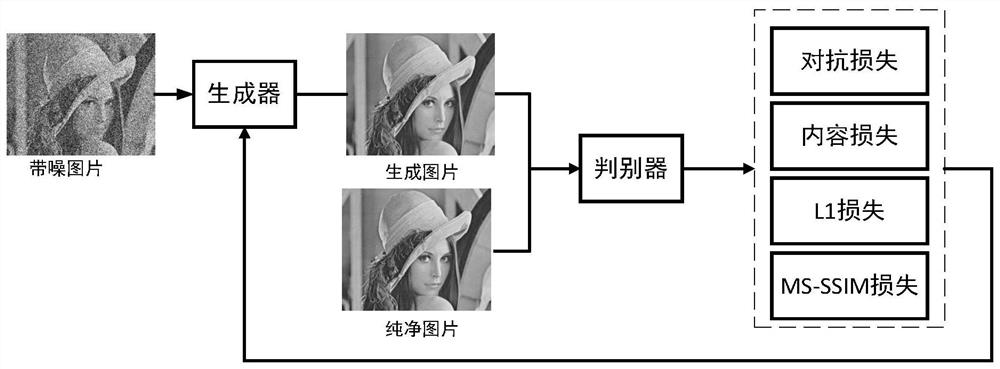
Figure 1 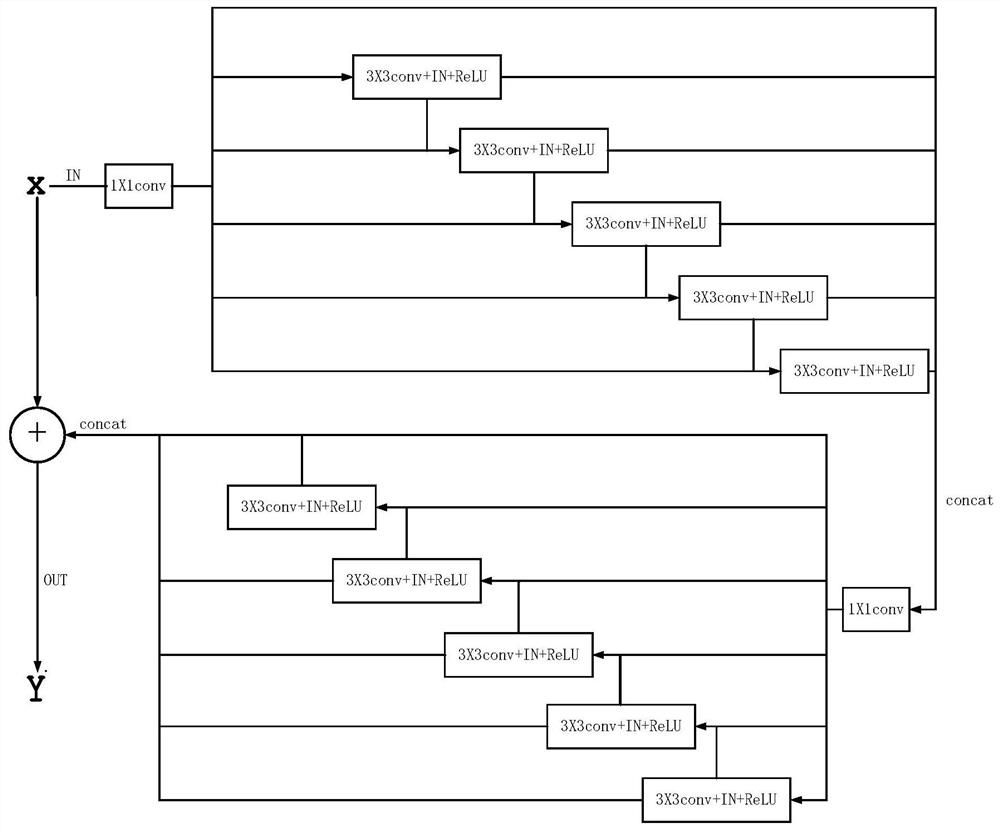
Figure 2 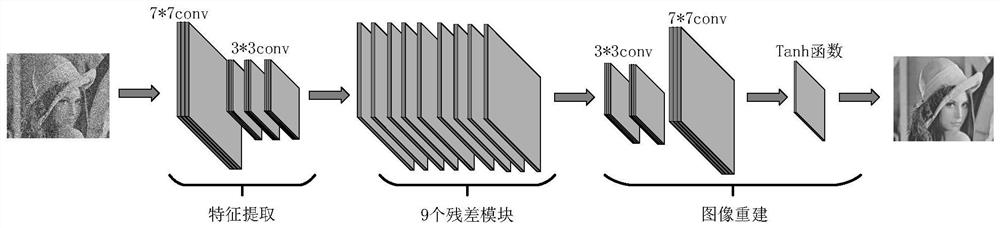
Figure 3
Abstract
Description
technical field
[0001] The invention belongs to the field of image processing, and in particular relates to a target image denoising algorithm based on a generative confrontation network. Background technique
[0002] In recent years, the rapid progress of image processing technology has attracted continuous attention in the application fields of medical imaging, satellite remote sensing and intelligent monitoring. In the applications in the above fields, image acquisition technology is required, but in the process of image acquisition and transmission, the images will be polluted or even damaged to varying degrees, and the use of high-quality images is the premise of all image processing technologies. Therefore, how to remove the pollution and damage to the greatest extent during image collection and transportation without damaging the image information, so as to restore the ideal high-quality lossless image has become a hot issue in various fields. .
[0003] In order to...
Examples
Embodiment Construction
[0034] It should be noted that, in the case of no conflict, the embodiments of the present invention and the features in the embodiments can be combined with each other.
[0035] In describing the present invention, it should be understood that the terms "center", "longitudinal", "transverse", "upper", "lower", "front", "rear", "left", "right", The orientations or positional relationships indicated by "vertical", "horizontal", "top", "bottom", "inner", "outer", etc. are based on the orientation or positional relationships shown in the drawings, and are only for the convenience of describing the present invention Creation and simplification of description, rather than indicating or implying that the device or element referred to must have a specific orientation, be constructed and operate in a specific orientation, and therefore should not be construed as limiting the invention. In addition, the terms "first", "second", etc. are used for descriptive purposes only, and should no...