
Method for detecting content of preservative in cosmetics
A technology for preservatives and cosmetics, applied in the field of preservative determination, can solve the problems of inability to detect multiple preservatives at the same time, low detection efficiency, and high cost, and achieve the guarantee of accuracy and efficiency, high detection efficiency, and low detection cost. Effect
Patent Information
- Authority / Receiving Office
- CN · China
- Current Assignee / Owner
- Publication Date
- 2021-09-07
Smart Images
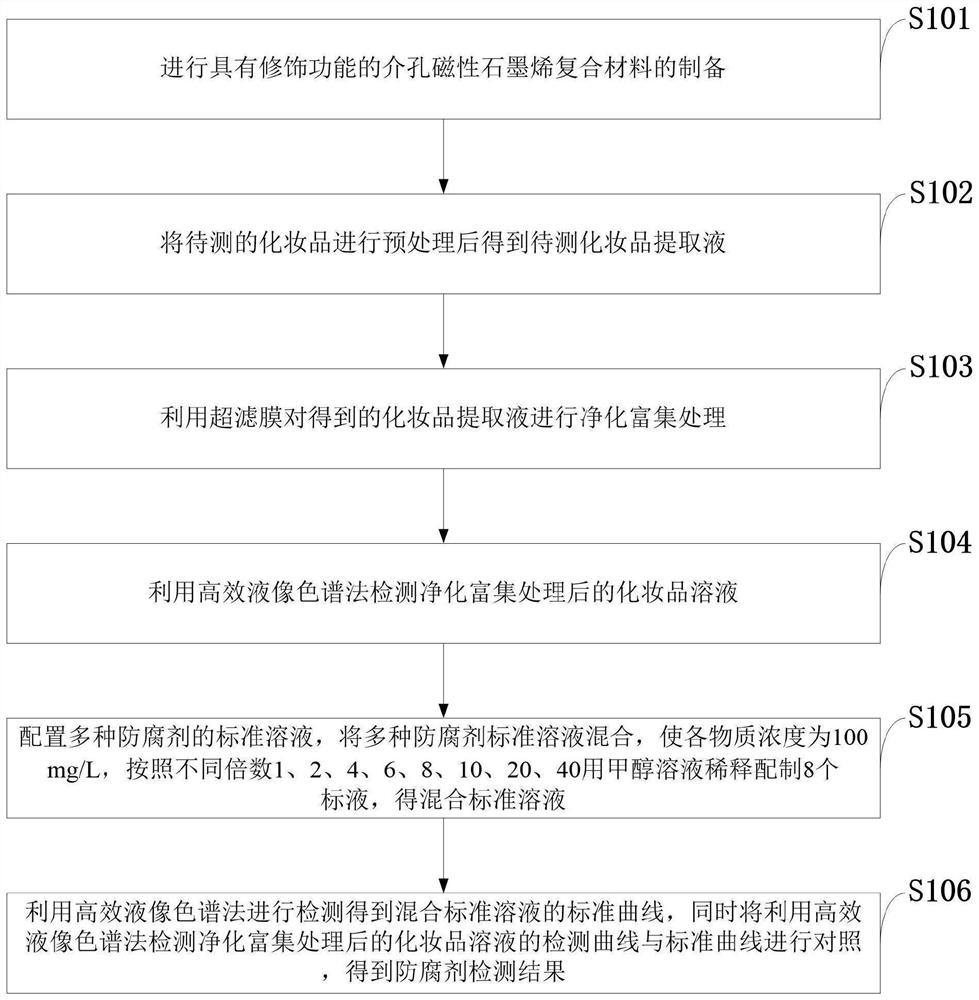
Figure 1 
Figure 2 
Figure 3
Abstract
Description
Technical field
[0001] The present invention belongs to the field of preservative assay, and more particularly to a method of detecting preservative content in cosmetics. Background technique
[0002] At present, due to the addition of various nutrients added to cosmetics, these nutrients are microbial reproduction medium, so in cosmetics production, use and storage, it is possible to cause the product to produce a odor or change the appearance. Inhibit the growth of bacteria, add a certain amount of preservatives in the product, but often has adversely affect human health. Determination of preservatives in cosmetics is a method for evaluating safety, simple and direct ways for cosmetic preservatives. At present, preservative detection in cosmetics is mainly based on liquid chromatography and gas chromatographic tandem spectrometry, but the existing detection method is not high, and the cost is high, and various preservatives cannot be detected at the same time. Therefore, there ...
Examples
Embodiment Construction
[0036] In order to make the objectives, technical solutions and advantages of the present invention, the present invention will be further described in detail below with reference to the embodiments. It should be understood that the specific embodiments described herein are merely intended to illustrate the invention and are not intended to limit the invention.
[0037] For the problems of the prior art, the present invention provides a method of detecting a preservative content in a cosmetic, and a detailed description of the invention will be described in connection with the accompanying drawings.
[0038] like figure 1 As shown, methods of detecting preservatives in cosmetics in the embodiments of the present invention include:
[0039] S101, preparation of mesoporous magnetic graphene composites with modified function;
[0040] S102, the cosmetic to be tested is pre-treated to obtain a cosmetic extract to be tested;
[0041] S103, using ultrafiltration membranes to purify the ...