
Smart device-based radar system for performing gesture recognition using spatio-temporal neural network
A technology of radar system and neural network, applied in the direction of biological neural network model, neural architecture, neural learning method, etc., to achieve the effect of saving power, increasing size, saving power and memory
Patent Information
- Authority / Receiving Office
- CN · China
- Patent Type
- Applications(China)
- Current Assignee / Owner
- Publication Date
- 2022-04-15
Smart Images
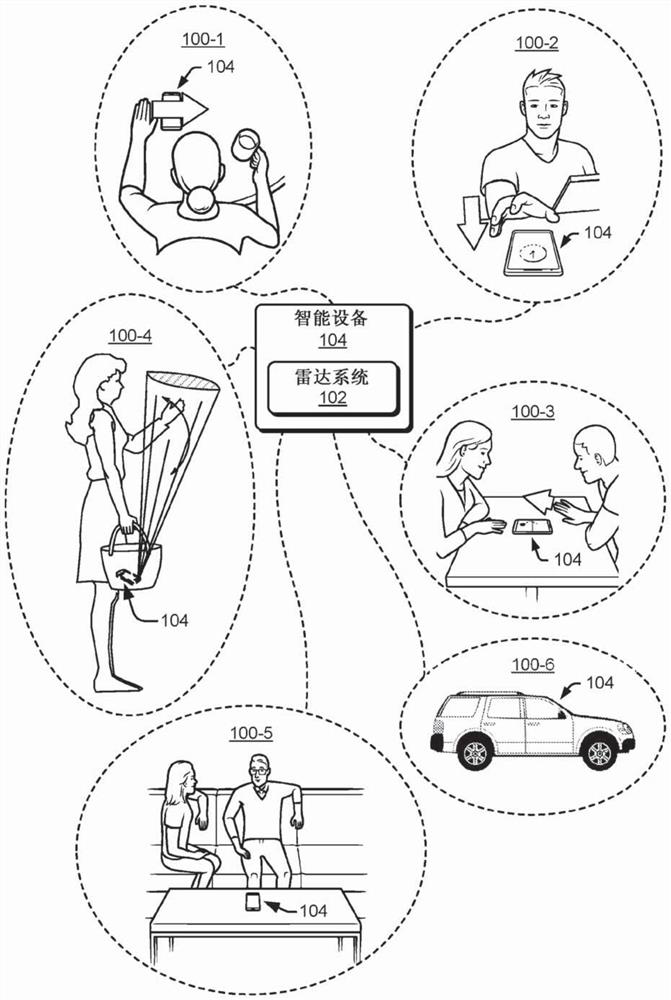
Figure 1 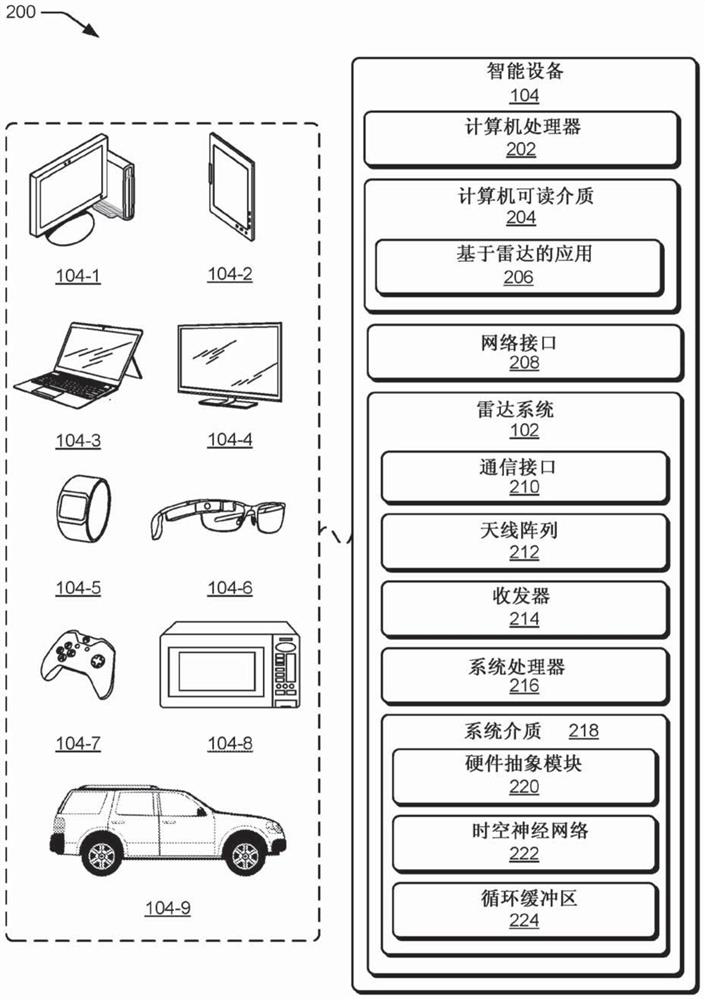
Figure 2 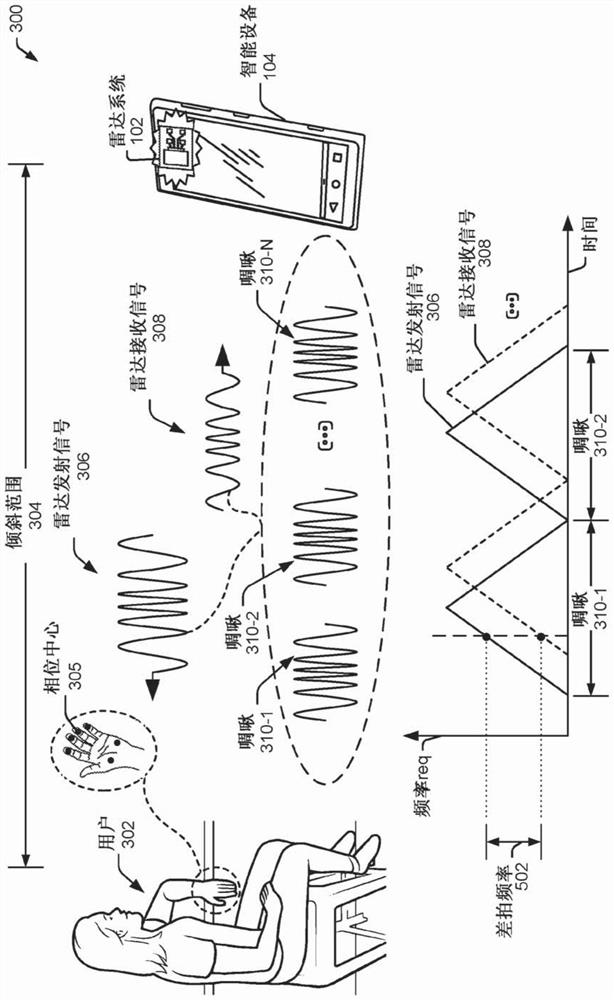
Figure 3
Abstract
Description
Background technique
[0001] Radar is a useful device that can detect objects. Radar can provide improved performance relative to other types of sensors, such as cameras, in the presence of different environmental conditions, such as low lighting and fog, or with moving or overlapping objects. Radar can also detect objects through one or more obscuring objects, such as purses or pockets. While radar has many advantages, there are many challenges associated with integrating radar in electronic devices.
[0002] One challenge involves power constraints within small or mobile electronic devices. The operation of some radars significantly drains the battery of the electronic device and causes the user to frequently recharge the electronic device. Thus, the benefits of utilizing radar may not be realized in situations where effective operation of the radar is curtailed or disabled due to limitations in available power.
[0003] Another challenge concerns the constraints that sma...
Examples
example 1
[0132] Example 1: A method performed by a radar system comprising:
[0133] transmitting a radar transmission using an antenna array of the radar system;
[0134] receiving a radar receive signal comprising a version of a radar transmit signal reflected by at least one user using the antenna array;
[0135] generating composite radar data based on the radar received signal;
[0136] providing the composite radar data to a spatio-temporal neural network of the radar system, the spatio-temporal neural network comprising a multi-stage machine learning architecture; and
[0137] The composite radar data is analyzed using the spatio-temporal neural network to identify gestures performed by the at least one user.
example 2
[0138] Example 2: The method of Example 1, wherein:
[0139] Analysis of the composite radar data includes analyzing both magnitude and phase information of the composite radar data using machine learning techniques to identify the attitude.
example 3
[0140] Example 3: The method of Example 1 or 2, wherein:
[0141] The multi-stage machine learning architecture includes a spatially recurrent network and a temporally recurrent network; and
[0142] Wherein, the analysis to described compound radar data comprises:
[0143] analyzing the composite radar data in the spatial domain using the spatial recurrent network to generate feature data associated with the pose; and
[0144] The feature data is analyzed in the temporal domain using the temporal recurrent network to identify the pose.