
Method and device for configuring a plurality of configurable functions of a vehicle
Patent Information
- Application Number
- EP2023712487
- Authority / Receiving Office
- EP · EP
- Patent Type
- Applications
- Current Assignee / Owner
- Priority Date
- 2022-04-06
- Filing Date
- 2023-03-16
- Publication Date
- 2025-02-12
AI Technical Summary
Existing vehicle configuration systems do not effectively provide a comprehensive and customizable set of functionalities for optimal user comfort, as they lack the ability to automatically adapt to user-specific mood and environmental conditions without manual intervention.
A method and device that allow users to create and modify scenarios using a combination of manually selected or automatically detected parameters, such as facial expressions, driving behavior, and environmental conditions, to activate specific vehicle configurations like ambient lighting, music, and seating positions, using voice commands or predeterminable boundary conditions, and transferable across vehicles.
Enables personalized and adaptive vehicle settings that enhance user comfort by automatically activating scenarios tailored to the user's mood and environment, improving alertness or relaxation, and allowing seamless transfer of user profiles between vehicles with optional software activation of missing functionalities.
Smart Images
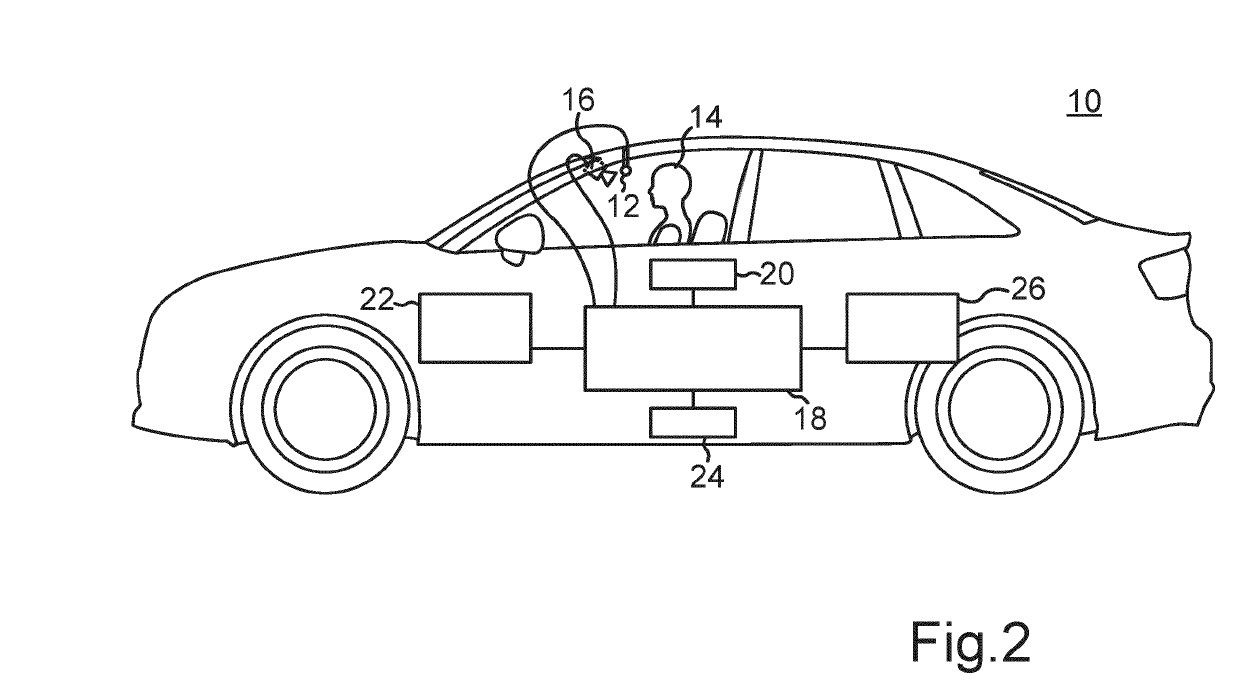
Figure 1.1
Abstract
Description
[0001] Method and device for configuring a plurality of configurable functionalities of a vehicle
[0002] DESCRIPTION:
[0003] The present invention relates to a method for configuring a plurality of configurable functionalities of a vehicle. It also relates to a corresponding device for configuring a plurality of configurable functionalities of a vehicle, wherein the device comprises means for carrying out such a method. Furthermore, the present invention relates to a motor vehicle having such a device.
[0004] In this context, US 2017 / 0285641 A1 discloses a system for adjusting vehicle functions based on context-controlled usage modes. The usage modes are tailored to a driver's mood- and / or destination-specific preferences using machine learning and are configurable by the driver.
[0005] US 2019 / 0196851 A1 discloses a system for configuring vehicle functions for a user. The user is continuously analyzed regarding preferred settings and interactions with the vehicle functions, and an automated learning process creates a profile that can be transferred to other vehicles. Different interaction modes can be activated depending on the user's mood.
[0006] DE 10 2015 121 124 A1 discloses a method for activating a relaxation mode suitable for a driver of a motor vehicle. The relaxation mode is automatically implemented upon detection of a corresponding driver mood via a learned setting of personalized vehicle parameters regarding music, seating position, lighting, fragrance, or the like, and is transferable to other motor vehicles.
[0007] The object of the present invention is to provide a method as mentioned above and a device as mentioned above for configuring a plurality of configurable functionalities of a vehicle for the most comfortable use by a user.
[0008] This problem is solved by the features of the independent patent claims.
[0009] The scenarios can be created manually by a user, but can also be derived from user behavior. With manual creation, the user can decide for themselves which configurable functionalities should be included in a particular scenario. With automatic creation, it can be provided that a user can subsequently make modifications to the configurable functionalities assigned to the scenario.
[0010] A particularly preferred embodiment is characterized in that in step a) a password is assigned to each scenario, wherein in step b) the respective scenario is activated by a voice command which contains at least the password assigned to the respective scenario, wherein step c) is carried out upon receipt of the voice command. In this way, a user can actively activate a scenario, for example in situations in which a respective scenario had not previously been activated, or if he now wishes to have a different scenario activated instead of a scenario which he usually selects in a certain situation. In an alternative embodiment, it can be provided that in step b) the respective scenario is automatically activated depending on at least one predefinable boundary condition.Due to the automatic activation depending on predefined boundary conditions, scenarios can be activated without the user being aware that a certain scenario would be beneficial for him in the current situation, for example for stress management.
[0011] In this context, at least one of the following user parameters can be recorded as a predefined boundary condition and evaluated by comparing it with a previously recorded respective reference parameter of the user: facial expressions, gestures, fatigue, tone of speech, driving behavior, appearance and haptics. From facial expressions, it can be easily concluded that a driver is tense, nervous or stressed, for example through narrowed eyes, a certain mouth position and the like. This can also be concluded from gestures, for example tapping a finger on the steering wheel or dashboard, or through hectic hand movements. Furthermore, the driver's state of mind can be inferred by evaluating a parameter specific to fatigue, for example the duration of an eye blink, the opening angle of an eye and the like.The tone of speech, for example, can also be used to determine a driver's stressed state, as can their driving behavior. Facial expressions, gestures, and fatigue are preferably recorded by evaluating images recorded using interior cameras. The tone of speech, in particular volume and flow of speech, can be recorded using an interior microphone. Driving behavior can preferably be recorded by recording the steering angle and its first derivative over time. Furthermore, the evaluation of lane departure warnings, the actuation angle of the accelerator and / or brake pedal, and their first derivatives over time can also be considered. In terms of optics, optical recording of the pupils, for example using AR glasses, or the recording of a hand, for example using a Leap Motion Controller, can be evaluated.In conjunction with haptics, pressure detection on the steering wheel can detect that the steering wheel is being gripped more tightly, as is typically the case during agitated driving. A humidity and / or temperature sensor on the steering wheel can detect sweaty hands, which also indicates a driver's agitated state of mind. The temperature sensor can rule out the possibility that excessively high interior temperature is the cause of sweaty hands.
[0012] Depending on this, customized scenarios can be activated that, depending on the current situation, have a calming effect on the driver or make them more alert. For example, the color of the ambient lighting can be changed, relaxing or awakening music can be played. The driver's seat can be adjusted to a more comfortable position or to an upright position, a specific scent can be released via the air conditioning, the suspension can be switched to a comfort mode or a sport mode, and so on.
[0013] The numerous scenarios can be actively created, for example, via a connected mobile device or a vehicle's user interface. The scenarios can also be configured as desired in this way.
[0014] Different scenarios can encompass different subsets of the vehicle's multitude of configurable functionalities. This simplifies the manual creation of scenarios, as users can focus on the functionalities that are essential to them in the respective scenario.
[0015] Preferably, the scenarios are stored in a user-specific, user-specific profile, preferably in the vehicle's memory. This allows different users of a vehicle to be provided with their own scenarios.
[0016] A preferred embodiment is characterized in that the scenarios assigned to the user profile are transferred from a first vehicle to a second vehicle, wherein, if a specific scenario cannot be fully implemented in the second vehicle because a subset of the configurable functionalities encompassed by the specific scenario is not available in the second vehicle, a check is carried out to determine whether this subset can be activated and / or loaded upon request. This particularly concerns functionalities that can be activated and / or loaded via software, i.e. the hardware is already present in the vehicle, and the operation of the hardware can be modified depending on the activation or loading of specific software. For example, certain features of the hardware can be activated or loaded retrospectively by paying a designated amount.For example, a specific relaxing music track can be loaded and played through the vehicle's stereo system. Furthermore, the spectrum of colors emitted by ambient lighting can be expanded, and so on.
[0017] In this context, if the check is positive, a corresponding functionality-specific indicator can be displayed on a display device for the user to approve or reject. This allows the user to determine whether or not to take the actions required to fully implement a specific scenario.
[0018] If approval is granted, the corresponding functionality is enabled or loaded in the vehicle. The enabled or loaded functionality is configured via a vehicle user interface and then saved in the user profile for the corresponding scenario. In this context, the user can enter input to configure the corresponding functionality via the user interface.
[0019] When generating or creating a scenario, particularly when creating it manually, it is particularly advantageous if the configuration of at least a first functionality is linked to the configuration of at least a second functionality within a scenario, so that if the configuration of the first functionality is modified, the configuration of the second functionality is automatically modified in a specifiable manner. If, for example, the user selects relaxing music as the background music, the ambient lighting is automatically set to green. Green lighting is recognized as helping a person to relax. Conversely, if aggressive music is selected, for example to prevent a driver from falling asleep on long, monotonous journeys when the clock is late, the ambient lighting can be set to red at the same time.The settings for other functions can be combined in a similar way. This makes it particularly convenient to create scenarios for a user, especially if they aren't aware of the effects of different ambient lighting colors on their mood.
[0020] It has also proven advantageous to determine at least one environmental parameter, whereby the configuration of at least one functionality of an activated scenario is modified depending on the at least one environmental parameter. For example, the air conditioning system can emit a different spray scent when it rains than when it shines. As is well known, nature smells different in rain or shine, in spring or summer, so this effect can be captured and used to intensify an activated scenario. For example, the interval of a windshield wiper, an accelerator pedal characteristic, or the response of a steering system can also be modified depending on environmental conditions in order to support the basic tone of an activated scenario.For example, when it is raining and a “Relax” or “Relaxation Mode” scenario is activated, the accelerator pedal characteristic curve can be set flatter or the steering less direct, so that by adjusting the functionalities depending on the detected ambient conditions, an activated scenario is supported, in particular intensified, in terms of its effect on the user.
[0021] Further advantageous embodiments emerge from the subclaims.
[0022] The invention also includes further developments of the device according to the invention that have features already described in connection with the further developments of the method according to the invention. This applies accordingly to further developments of the motor vehicle according to the invention. For this reason, the corresponding further developments are not described again here.
[0023] The motor vehicle according to the invention is preferably designed as a motor vehicle, in particular as a passenger car or truck, or as a passenger bus or motorcycle.
[0024] The invention also encompasses combinations of the features of the described embodiments. The invention therefore also encompasses implementations that each comprise a combination of the features of several of the described embodiments, unless the embodiments are described as mutually exclusive.
[0025] Exemplary embodiments of the invention are described below. They show:
[0026] Fig. 1 shows a signal flow graph for an embodiment of the method according to the invention; Fig. 2 shows a schematic representation of a motor vehicle according to the invention in which an embodiment of the method according to the invention is implemented; and
[0027] Fig. 3 is a schematic representation to explain an embodiment of the method according to the invention.
[0028] The exemplary embodiments explained below are preferred embodiments of the invention. In the exemplary embodiments, the described components of the embodiments each represent individual features of the invention that can be considered independently of one another, each of which also develops the invention independently of one another. Therefore, the disclosure is intended to encompass combinations of the features of the embodiments other than those shown. Furthermore, the described embodiments can also be supplemented by further features of the invention already described.
[0029] In the figures, the same reference symbols designate elements with the same function.
[0030] Fig. 1 shows a schematic representation of a signal flow graph for an embodiment of a method according to the invention for configuring a plurality of configurable functionalities of a vehicle. In step S1, a plurality of scenarios are generated, each scenario defining a specific configuration of at least a subset with several of the configurable functionalities of the vehicle.Configurable functionalities of the vehicle can be in particular the ambient lighting in terms of light intensity and colour, music playback device in terms of volume and type of music played, accelerator pedal in terms of the accelerator pedal characteristic curve, brake pedal in terms of the brake pedal characteristic curve, air conditioning in terms of ventilation strength, temperature and emitted spray fragrance, vehicle dynamics program, in particular comfort mode or sport mode, seat position, windscreen wiper system in terms of the set interval, steering in terms of directness, displays in terms of displayed videos in the case of at least partially autonomous driving, seat, where for example music impulses, in particular the bass of a piece of music, are transmitted to the user in a pleasant, tactile manner via a massage function, windows, where shading, in particular so-called cocooning, can be carried out.
[0031] In step S2, a respective scenario is activated. This can be done, for example, by assigning a password to each scenario in step S1, with the respective scenario being activated in step S2 by a voice command that contains at least the password assigned to the respective scenario. Alternatively, in step S2, the respective scenario can be activated automatically depending on at least one predeterminable boundary condition. As a predeterminable boundary condition, at least one of the following user parameters can be recorded and evaluated by comparing it with a previously recorded respective reference parameter of the user: facial expressions, gestures, fatigue, tone of voice, driving behavior.
[0032] Finally, in step S3, upon activation by a control device of the vehicle, the respective scenario is set by correspondingly controlling the configurable functionalities of the vehicle included in the respective scenario.
[0033] Fig. 2 shows a schematic representation of a motor vehicle 10 according to the invention, in which the method according to the invention is implemented. The motor vehicle 10 comprises a microphone 12 for recording verbal utterances of a user 14 and comparing them with a previously recorded reference tone of voice of the user, which was recorded when the user was in a balanced state of mind, i.e., a normal state. Similarly, the vehicle comprises a camera 16 for recording the facial expressions, gestures, and fatigue parameters of the user 14, in order to compare these with corresponding reference parameters of the user 14, which were recorded or recorded when the driver was in a balanced state of mind.
[0034] The control device is designated 18 and, as mentioned, is designed to control at least a subset of configurable functionalities of the vehicle 10 depending on an activated scenario. Examples of configurable functionalities of the vehicle 10 are a music system 20, an air conditioning system 22, an ambient light 24, and an accelerator pedal 26.
[0035] Fig. 3 shows exemplary scenarios SZ1 and SZ2, which are stored for a user profile B1. While scenario SZ1 configures the configurable functionalities FU1, FU2, and FU3, scenario SZ2 only includes a configuration of the functionalities FU1 and FU2.
Claims
PATENT CLAIMS:
1. A method for configuring a plurality of configurable functionalities (FU1; FU2; FU3) of a vehicle comprising the following steps: a) generating a plurality of scenarios (SZ1, SZ2), wherein each scenario (SZ1; SZ2) defines a specific configuration of at least a subset with several of the configurable functionalities (FU1; FU2; FU3) of the vehicle (step S1); b) activating a respective scenario (SZ1; SZ2) (step S2); and c) upon activation, a control device (18) of the vehicle (10) sets the respective scenario (SZ1; SZ2) by appropriately controlling the configurable functionalities (FU1; FU2; FU3) of the vehicle encompassed by the respective scenario (SZ1; SZ2) (step S3).
2. Method according to claim 1, characterized in that in step a) a password is assigned to each scenario (SZ1 ; SZ2), wherein in step b) the respective scenario (SZ1 ; SZ2) is activated by a voice command which contains at least the password assigned to the respective scenario (SZ1 ; SZ2), wherein step c) is executed upon receipt of the voice command.
3. Method according to claim 1, characterized in that in step b) the respective scenario (SZ1 ; SZ2) is automatically activated depending on at least one predefinable boundary condition.
4. Method according to claim 3, characterized in that at least one of the following user parameters is captured as a predefinable boundary condition and compared against A previously recorded reference parameter of the user is evaluated: facial expressions; - Gestures; - Fatigue; - Tone of voice; - Driving behavior - Optics - Haptics. Method according to one of the preceding claims, characterized in that different subsets of the plurality of configurable functionalities (FU1; FU2; FU3) of the vehicle (10) are comprised of different scenarios (SZ1; SZ2). Method according to one of the preceding claims, characterized in that the scenarios (SZ1; SZ2) are stored in a user-specific manner and assigned to a user profile.A method according to one of the preceding claims, characterized in that the scenarios (SZ1; SZ2) assigned to the user profile are transferred from a first vehicle to a second vehicle, wherein, if a specific scenario (SZ1; SZ2) cannot be fully implemented in the second vehicle because a subset of the configurable functionalities (FU1; FU2; FU3) encompassed by the specific scenario (SZ1; SZ2) is not present in the second vehicle, it is checked whether this subset can be activated and / or loaded upon request. A method according to claim 7, characterized in that... that, if the test is successful, a corresponding functionality-specific indication is displayed on a display device for the user to approve or reject.
9. Method according to claim 8, characterized in that, if a release is granted, the corresponding functionality (FU1 ; FU2; FU3) is enabled or loaded in the vehicle (10), wherein the enabled or loaded functionality (FU1 ; FU2; FU3) is configured via a user interface of the vehicle and subsequently saved to the corresponding scenario (SZ1 ; SZ2) in the user profile.
10. Method according to one of the preceding claims, characterized in that within a scenario (SZ1 ; SZ2) the configuration of at least one first functionality (FU1 ; FU2; FU3) is coupled with the configuration of at least one second functionality (FU1 ; FU2; FU3), such that when the configuration of the first functionality (FU1 ; FU2; FU3) is modified, the configuration of the second functionality (FU1 ; FU2; FU3) is automatically modified in a predefinable manner.
11. Method according to one of the preceding claims, characterized in that at least one environment parameter is determined, wherein the configuration of at least one functionality (FU1 ; FU2; FU3) of an activated scenario (SZ1 ; SZ2) is modified depending on the at least one environment parameter.
12. Device for configuring a plurality of configurable functionalities (FU1 ; FU2; FU3) of a vehicle (10) with means for carrying out a method according to one of the preceding claims.
13. Motor vehicle (10) with a device according to claim 12.