
Condensing skeletal implant that facilitate insertions
a skeletal implant and condensing technology, applied in the field of bone anchorage implants, can solve the problems of difficult control of the implant position, difficult to achieve the stability of the dental implant in low-density bone, and difficulty in condensing the insertion
Patent Information
- Authority / Receiving Office
- US · United States
- Patent Type
- Applications(United States)
- Current Assignee / Owner
- Publication Date
- 2007-05-03
Smart Images
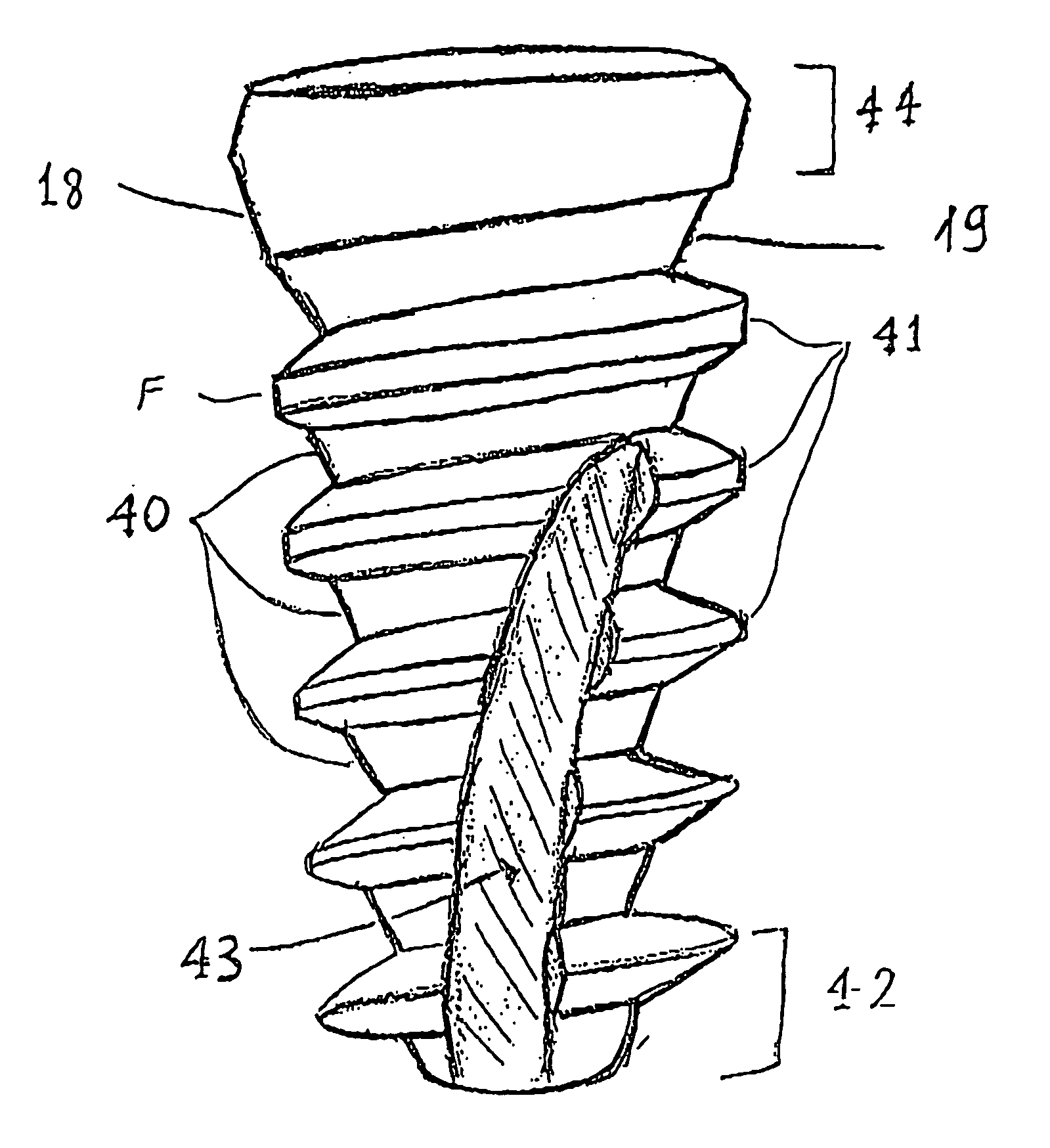
Figure 1 
Figure 2 
Figure 3
Abstract
Description
FIELD AND BACKGROUND OF THE INVENTION
[0001] The disclosures herein relate generally to bone anchorage implants and more particularly to a screw form dental implant having a combination of features designed to produce bone condensation while insertion is easy.
[0002] Many current screw-form dental implants are well designed for use in dense bone. For example, the implant disclosed in U.S. Pat. No. 5,897,319 has sharp cutting features at their apical ends that readily facilitate self-tapping into hard bone.
[0003] The osseous anatomy of the human jaw is complex. While the density of the bone in the anterior regions of the mandible and maxilla is high, the posterior regions, particularly in the maxilla, are of significantly lower density. The height of the bony ridge in the posterior maxilla can be greatly reduced in partially or totally edentulous patients. This can lead to the need for use of shorter dental implants or grafting procedures in order to increase the height of bone avai...
Examples
Embodiment Construction
[0096]FIG. 1 illustrates an embodiment of the novel tapered condensing dental implant. There are five elements in a dental implant that influence the condensation, insertion and stabilization of the implant. 1) The core of the implant 40. 2) The Threads 41. 3) The most apical region 42 which touches the bone first. 4) The bone tap 43. 5) The most coronal region 44 which engages the cortical bone and the sometimes also the gums.
[0097] In order to have good stabilization in low density bone it is recommended to use small diameter drill and tapered implant. As the diameter of the drill is smaller and the implant is more tapered the bone is more preserved and more condensed resulting in improved stabilization, but the insertion is more difficult. In this case controlling the exact path of insertion of the implant becomes also more difficult since the implant has a tendency to slip towards the region with the lowest density. In order to use a small diameter drill and an implant with sig...