
Discovery of physically adjacent neighbor devices using a unidirectional in-band process coupled with an out-of-band follow-up process
a technology of in-band and out-of-band follow-up, which is applied in the field of physical adjacent neighbor devices, can solve the problem of not being able to perform bidirectional interaction using control overhead bytes, and achieve the effect of improving the speed and accuracy of network resource allocation
Patent Information
- Authority / Receiving Office
- US · United States
- Current Assignee / Owner
- Publication Date
- 2007-08-30
Smart Images
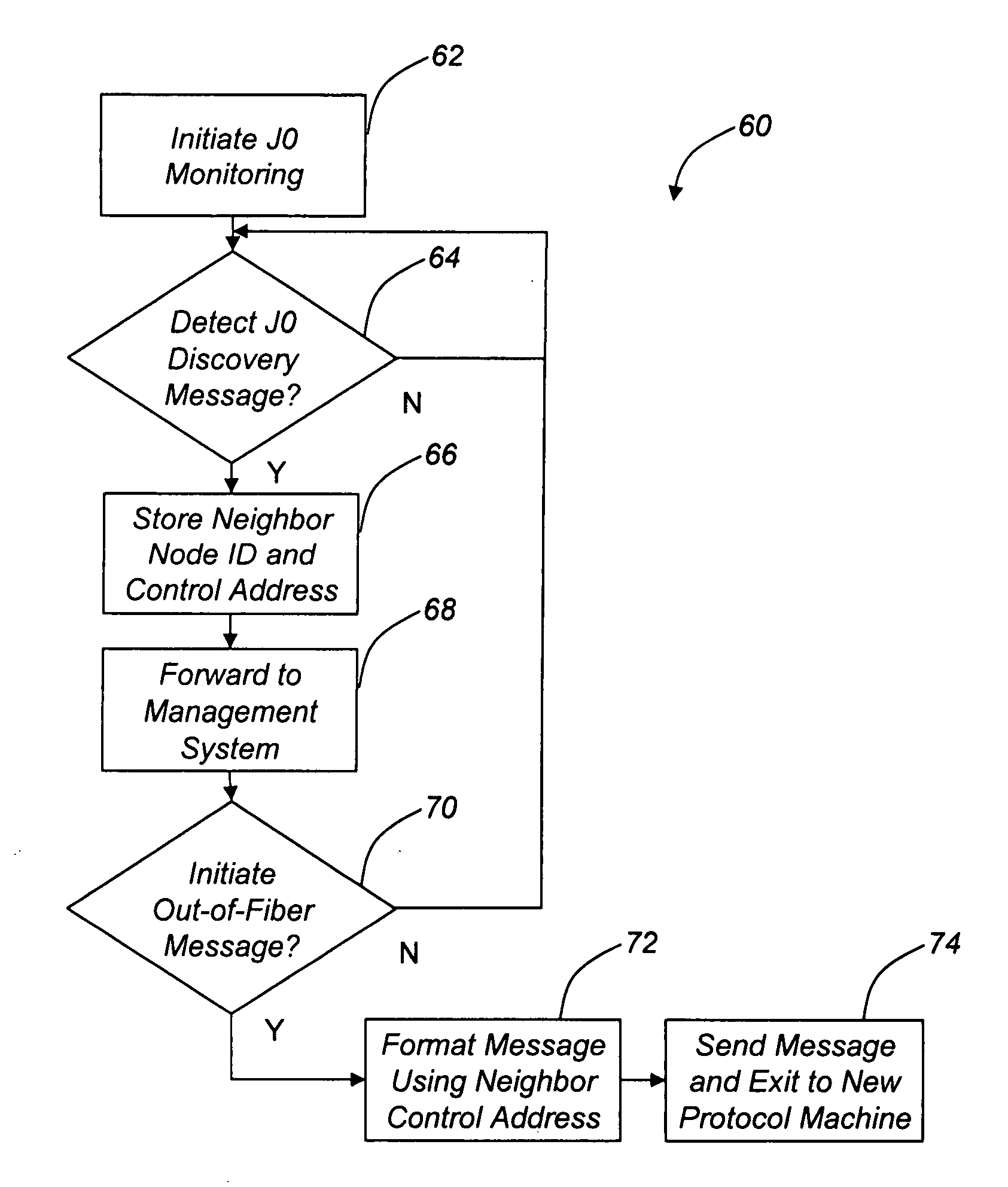
Figure 1 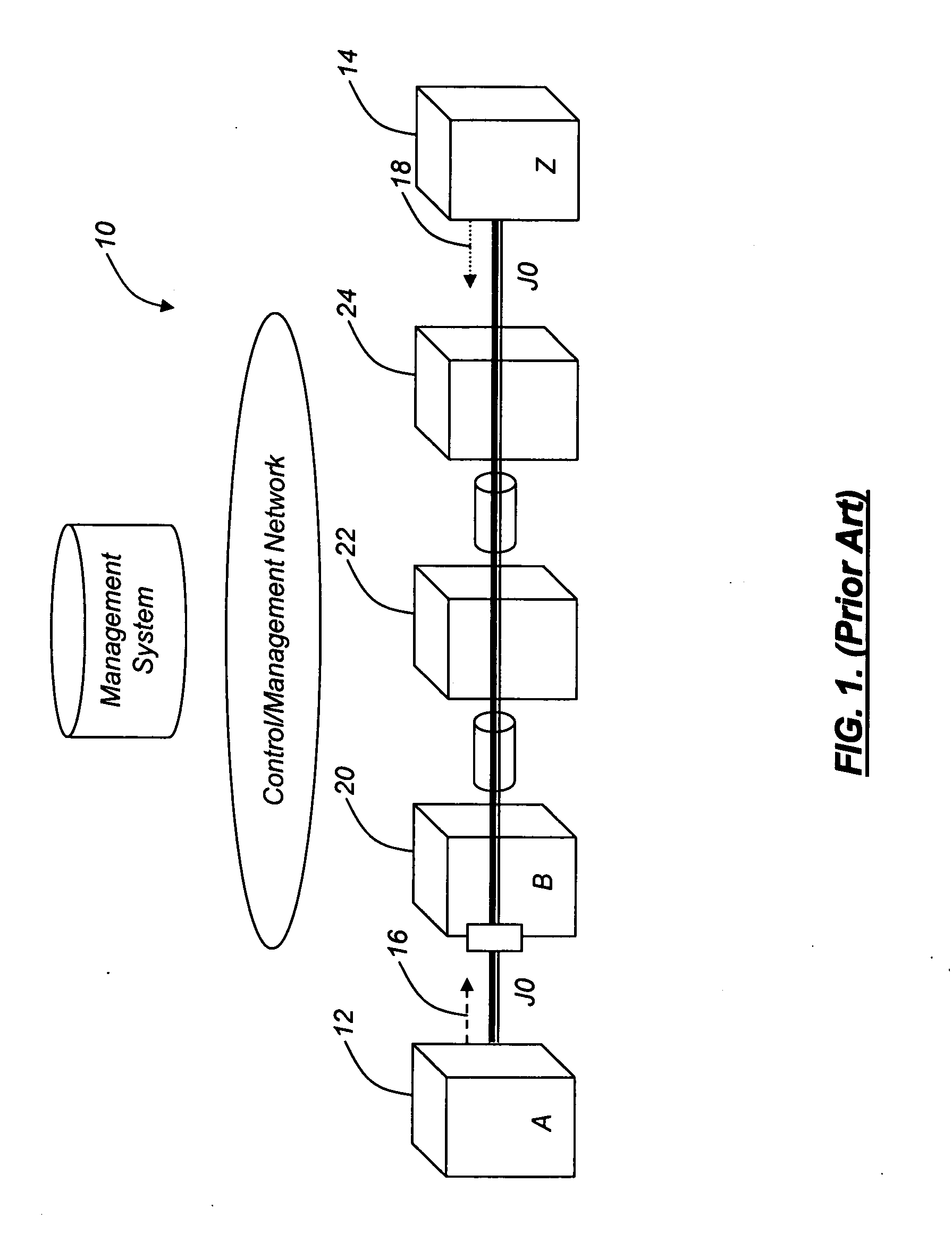
Figure 2 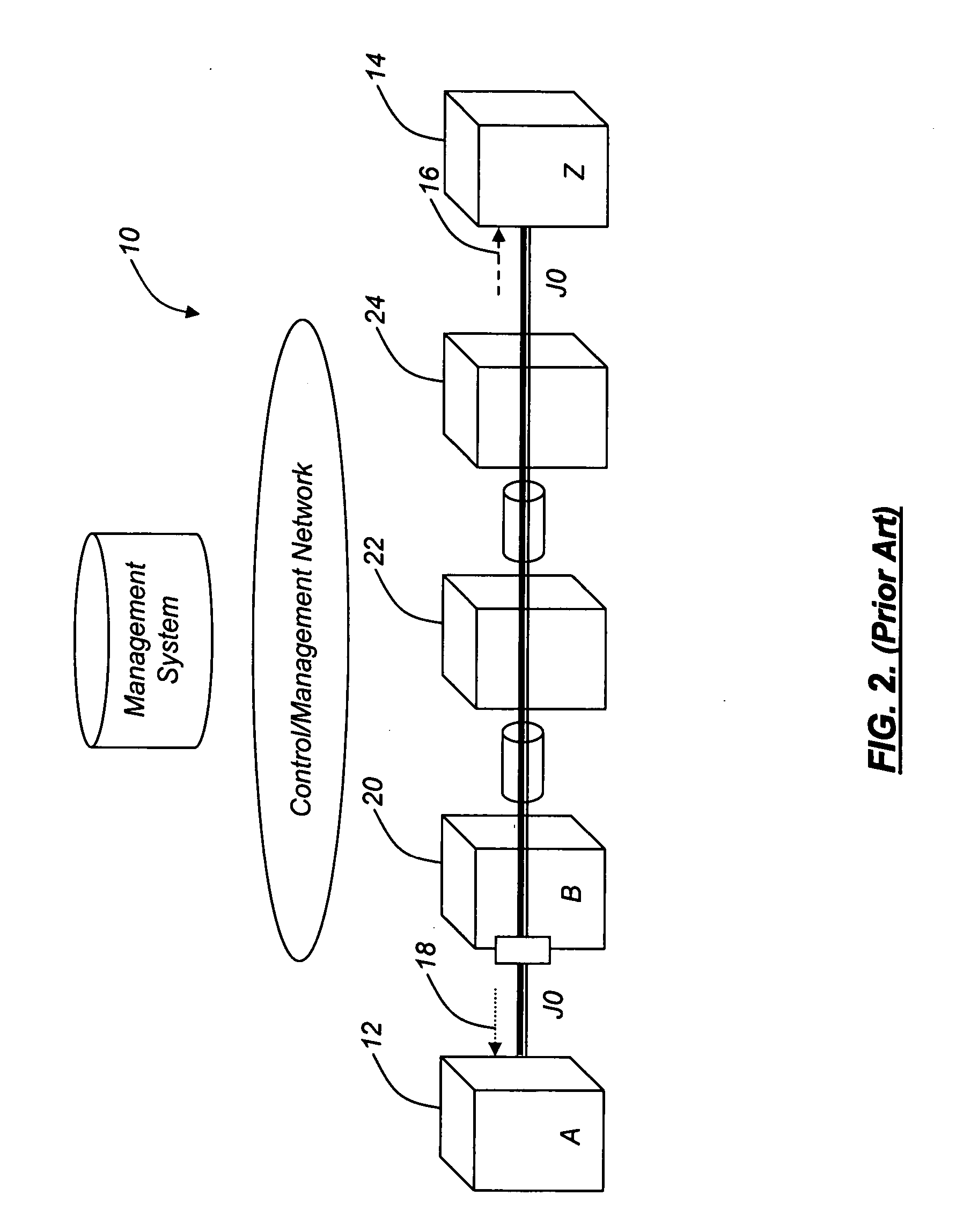
Figure 3
Abstract
Description
FIELD OF THE INVENTION
[0001] The present invention relates generally to the telecommunications and optical networking fields. More specifically, the present invention relates to the discovery of physically adjacent neighbor devices using a unidirectional in-band (in-fiber) process coupled with an out-of-band follow-up process. BACKGROUND OF THE INVENTION
[0002] Discovery is the process whereby neighboring nodes on either side of a link automatically determine each others' identity and verify the connectivity between them. There can be “layer adjacency discovery” between nodes that have interfaces or switching capabilities at the same layer, and “physical adjacency discovery” between nodes that have interfaces or switching capabilities at different layers. Current International Telecommunications Union—Telecommunications Division (ITU-T) standards and Optical Internetworking Forum (OIF) implementation agreements define methods for layer adjacency discovery, wherein there is a bidire...
Examples
Embodiment Construction
[0024] Referring to FIG. 1, illustrating a conventional in-band discovery process 10 that is designed to work between peer entities, as defined in the ITU-T standards and OIF implementation agreements, originating point A 12 and terminating point Z 14 generate discovery messages 16,18, respectively, that are sent over the J0 byte, DCC, GCC, or other control overhead in the connecting link. Intermediate nodes 20,22,24 that are transparent to this control overhead (i.e., that transport the discovery messages 16,18 to / from the originating point A 12 and terminating point Z 14 transparently) do not participate in the discovery process 10 and are not automatically discovered by originating point A 12 and terminating point Z 14, nor do they automatically discover that originating point A 12 and terminating point Z 14 are neighbors. They may, however, through IP identification, be capable of identifying neighbors at their own layer.
[0025] Referring to FIG. 2, also illustrating the convent...