
Method for adaptively controlling other cell interference
a technology of other cell interference and adaptive control, which is applied in the direction of power management, electrical equipment, radio transmission, etc., can solve the problems of both in-cell and other-cell interference still produced, and achieve the effect of reducing transmit power constraints
Patent Information
- Authority / Receiving Office
- US · United States
- Patent Type
- Applications(United States)
- Current Assignee / Owner
- Publication Date
- 2008-02-28
- Estimated Expiration
- Not applicable · inactive patent
Smart Images
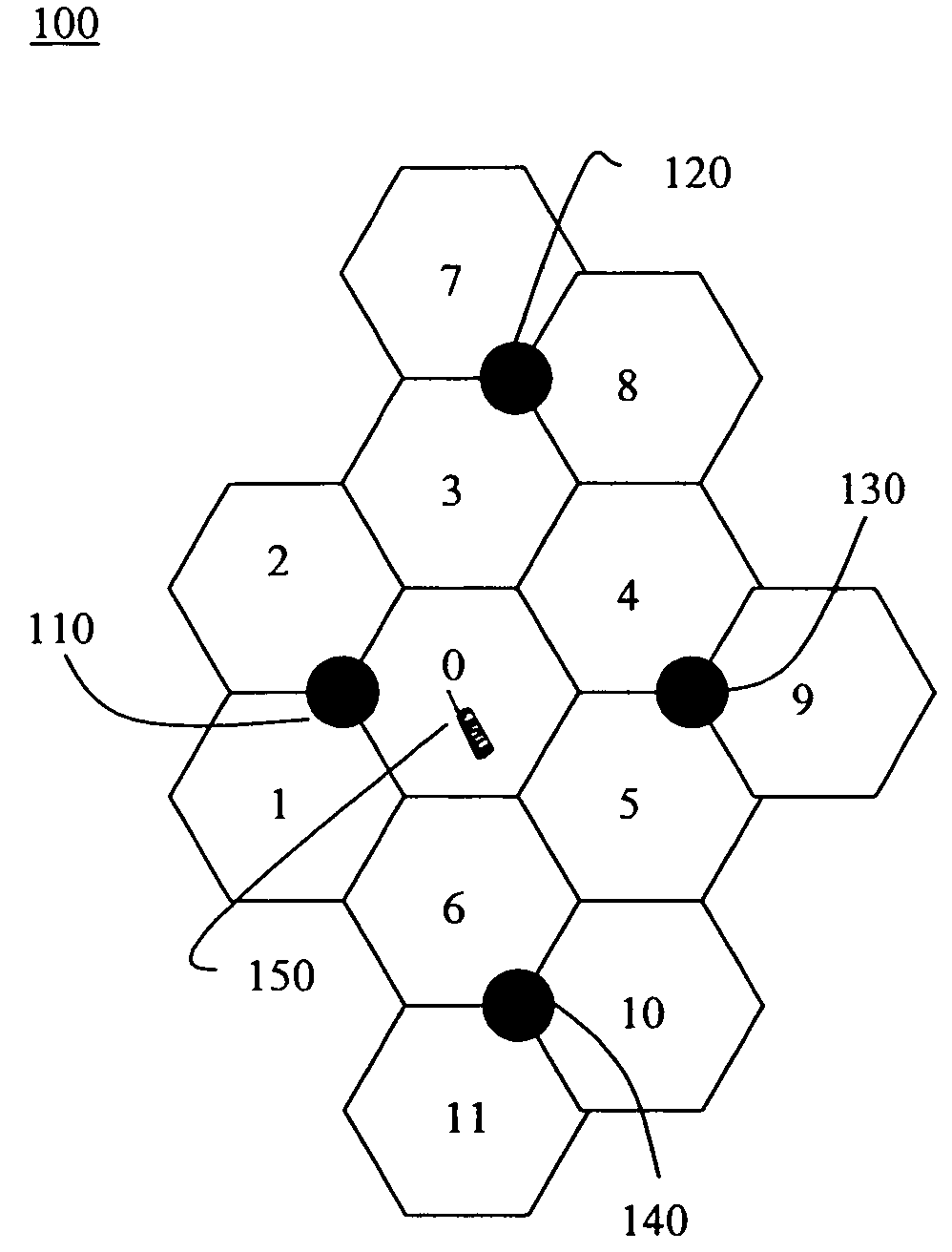
Figure 1 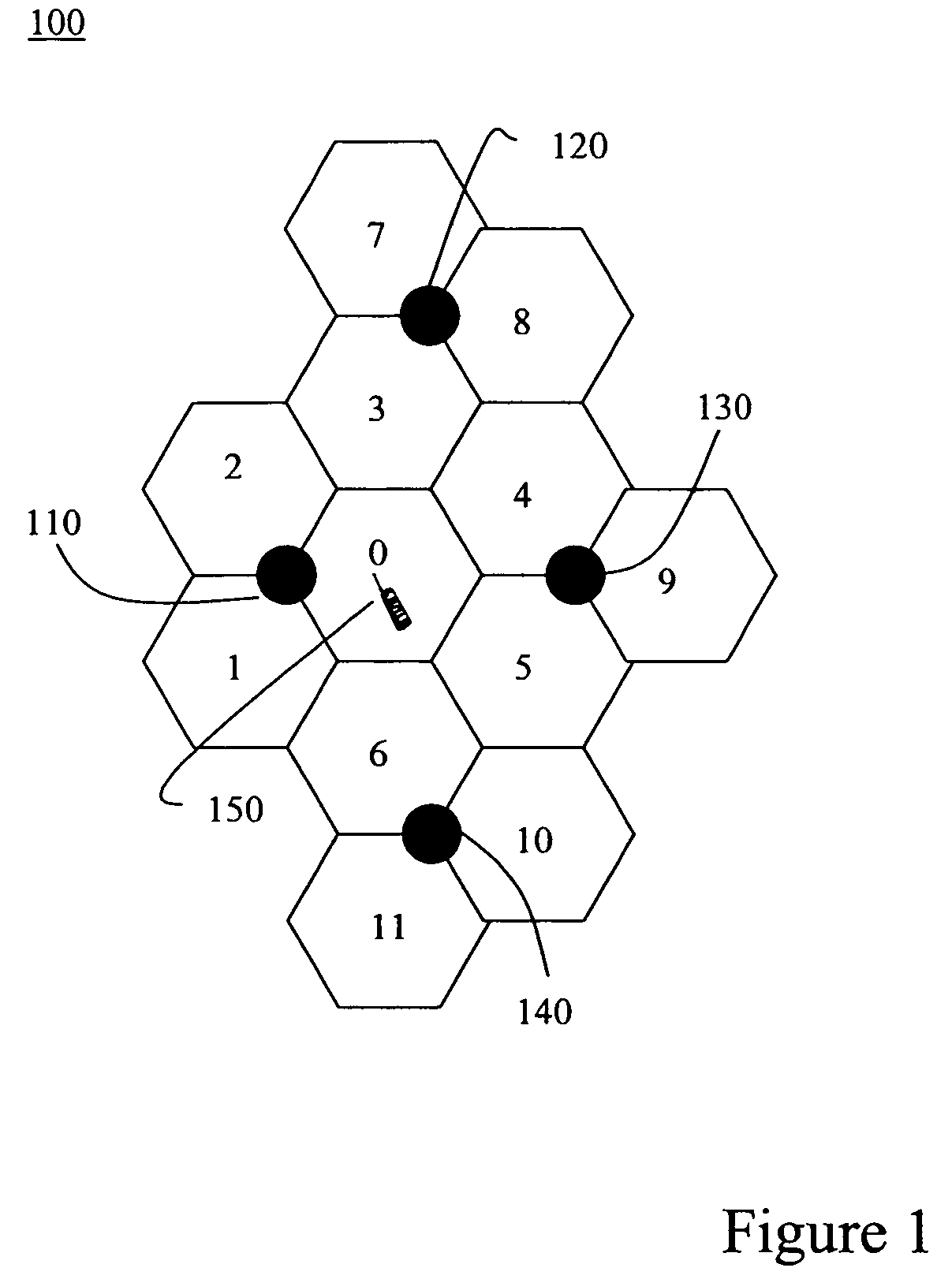
Figure 2 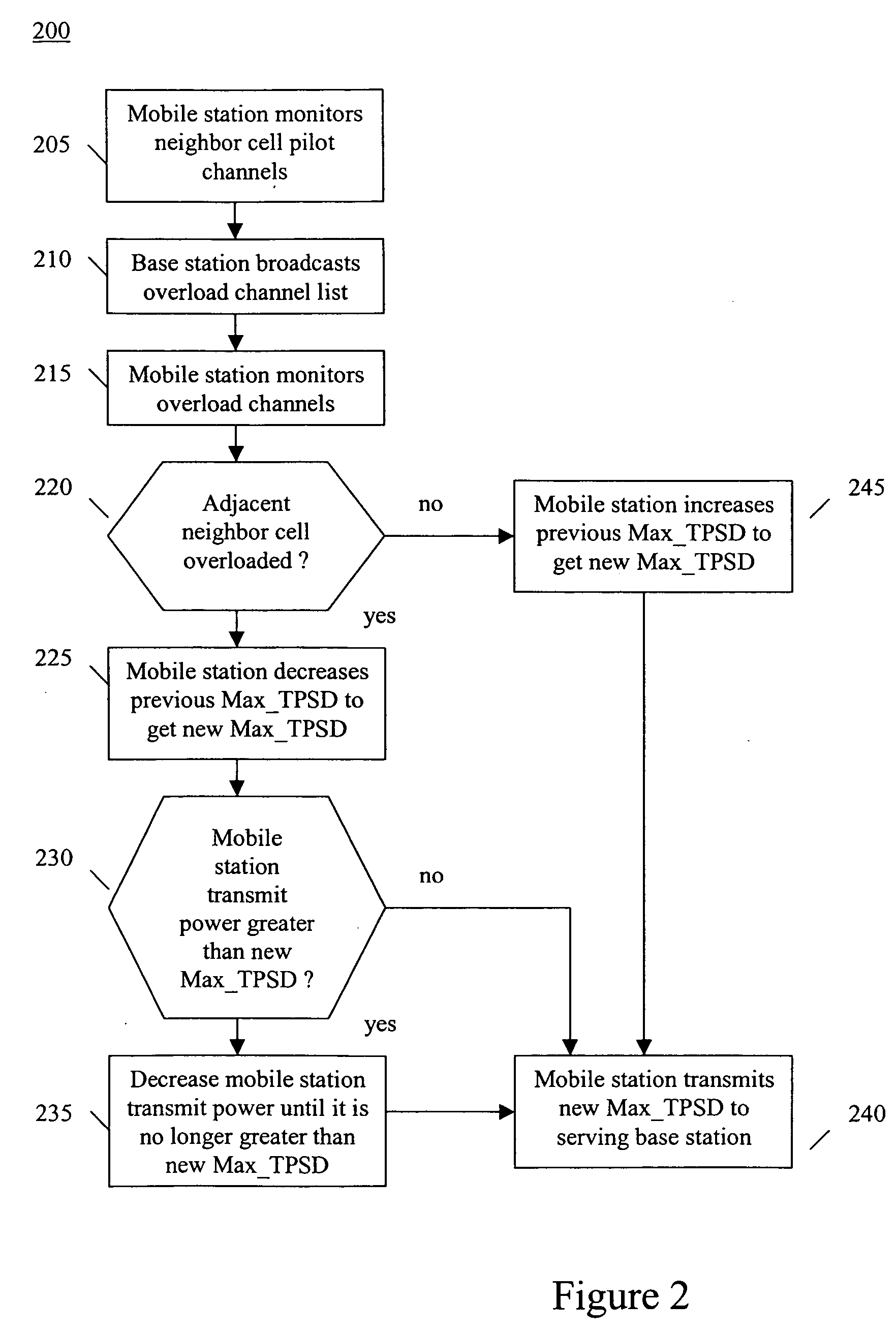
Figure 3
Abstract
Description
FIELD OF THE INVENTION
[0001] The present invention relates generally to wireless communication systems and, in particular, to controlling reverse link transmit power in a wireless communication system.BACKGROUND OF THE RELATED ART
[0002] Universal Mobile Telecommunication System (UMTS) is migrating from a Code Division Multiple Access (CDMA) based air interface to an Orthogonal Frequency Division Multiple Access (OFDMA) based air interface in order to increase reverse link capacity. Reverse link capacity can be increased by limiting interference caused by mobile stations within a same cell (also referred to herein as “in-cell interference”) or by mobile stations in other cells (also referred to herein as “other-cell interference”).
[0003] In-cell and outer-cell Interference are caused, in part, when mobile stations transmit over a same carrier or sub-carrier frequency simultaneously. In a CDMA system, i.e., wireless communication system utilizing a CDMA air interface, mobile stations pro...
Examples
first embodiment
[0014]Wireless communication system 100 may be configured with an adaptive interference control technique or protocol for managing other-cell interference using measurements of the pilot signal strengths, i.e., pilot power. FIG. 2 depicts a flowchart 200 illustrating an adaptive interference control method used in accordance with the present invention. In this embodiment, information indicative of whether a cell is interference overloaded, i.e., interference level in the cell is above a threshold interference level, is communicated to mobile station 150. Such overload information is then used to determine whether an adjustment should be made to the maximum transmit power spectral density (Max_TPSD) constraint. In another embodiment, the adjustment may be made to some other mobile station transmit power constraint, such as a constraint relating to a total maximum allowable mobile station transmit power or to actual mobile station transmit power.
[0015]In step 205, mobile station 150 i...
second embodiment
[0028]FIG. 3 depicts a flowchart 300 illustrating an adaptive interference control method used in accordance with the present invention. In this embodiment, overload information is communicated among base stations 110, 120, 130 and 140, and used by the serving base station, i.e., base station of serving cell, to determine whether an adjustment should be made to the maximum transmit power spectral density (Max_TPSD) constraint. In another embodiment, the adjustment may be made to some other mobile station transmit power constraint, such as a constraint to a total maximum allowable mobile station transmit power, or to actual mobile station transmit power.
[0029]In step 305, mobile station 150 is in a call and is monitoring the pilot channels of its neighbor cells, i.e., measuring pilot signal strengths of neighbor cells. While mobile station 150 is in the call, its transmit power is continuously being adjusted in accordance with well-known power control techniques and limited by the ma...