
Polyvinyl alcohol resin composition and films
a polyvinyl alcohol resin and composition technology, applied in the direction of film/foil adhesives, synthetic resin layered products, transportation and packaging, etc., can solve the problems of difficult to produce a product directly from the pva resin by a melt-forming method, product melt-formed from the resin composition suffers from fish eyes and gelation, and needs improvement. , to achieve the effect of high interlayer adhesive strength and excellent melt-formability
Patent Information
- Authority / Receiving Office
- US · United States
- Patent Type
- Applications(United States)
- Current Assignee / Owner
- Publication Date
- 2009-11-19
Smart Images
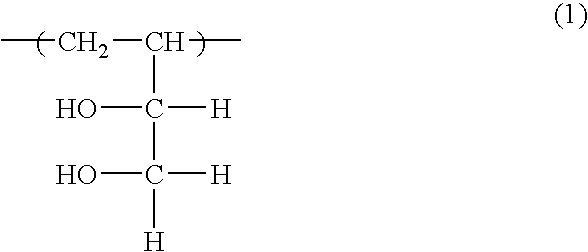
Figure 1 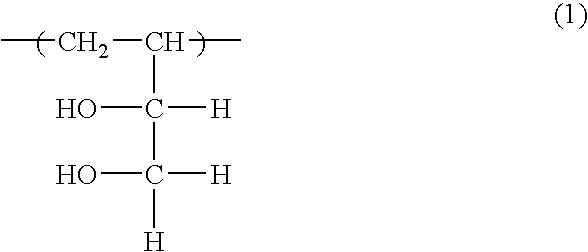
Figure 2 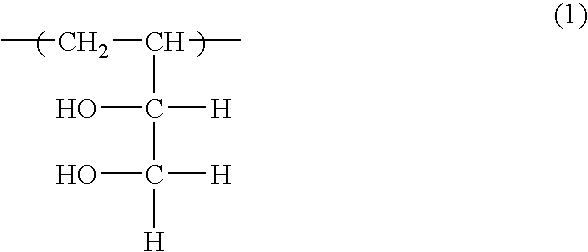
Figure 3
Abstract
Description
RELATED APPLICATIONS
[0001] This application is a continuation of PCT application JP2008-051087 filed Jan. 25, 2008, which is hereby incorporated by reference.BACKGROUND OF THE INVENTION
[0002] 1. Field of the Invention
[0003] The present invention relates to a polyvinyl alcohol resin composition and films. More specifically, the present invention relates to a polyvinyl alcohol (hereinafter abbreviated as “PVA”) resin composition which is free from emanation of odor in a melt-forming process and excellent in transparency, and is capable of providing a product free from residual odor and a laminate film having higher interlayer adhesive strength. The present invention further relates to films produced by using such a PVA resin composition.
[0004] 2. Description of the Related Art
[0005] A PVA resin generally has a fusion starting temperature that is very close to its thermal decomposition temperature. This makes it difficult to produce a product directly from the PVA resin by a melt-forming me...
Examples
example 1
Preparation of PVA Resin Composition
[0097]First, 95 parts by weight of the PVA resin (A1) prepared as the PVA resin (A) and 5 parts by weight of a compound (GLPM-60 available from Nippon Nyukazai Co., Ltd.) prepared as the alkylene oxide adduct (B) of the polyvalent alcohol through a reaction between 1 mole of glycerol and 6 moles of ethylene oxide were blended (in a weight ratio (A) / (B) of 95 / 5), and the resulting mixture was melted and extruded at a resin temperature of 190° C. and pelletized under the following conditions. Extruder: Twin screw extruder (15 mmφ, L / D=60) having full flight screws (CR=3.12), and provided with a vacuum vent, a cooling belt and a pelletizer[0098]Temperature pattern: C1 / C2 / C3 / C4 / C5 / C6 / C7 / C8 / D=90 / 120 / 150 / 170 / 180 / 180 / 190 / 190 / 190° C.
(wherein C1 to C8 indicate kneading portions of the extruder arranged in this order from a hopper side, and D indicates a dice portion)[0099]Screen mesh: 90 / 90[0100]Screw rotation speed: 250 rpm
[0101]Thus, a PVA resin composit...
examples 2 and 3
, and Comparative Examples 1 to 5
[0112]Multilayer films were produced and evaluated in substantially the same manner as in Example 1, except that PVA resins (A) and adducts (B) shown in Table 1 were blended in weight ratios shown in Table 1.
TABLE 1PVA resin (A)Adduct (B)ModificationPolymerizationSaponificationPolyvalentHydroxyl valuedegree (mol %)degreedegree (mol %)alcoholAlkylene oxide(mg KOH / g)(A) / (B)Example 1830095.5GlycerolEthylene oxide47195 / 56 molesExample 2330089.5GlycerolEthylene oxide47195 / 56 molesExample 34.550088GlycerolEthylene oxide34590 / 109 molesComparative650098.6GlycerolEthylene oxide47195 / 5Example 16 molesComparative4.550098.6GlycerolEthylene oxide34590 / 10Example 29 molesComparative850098.6GlycerolEthylene oxide62895 / 5Example 32 molesComparative650078GlycerolEthylene oxide47195 / 5Example 46 molesComparative4.550088GlycerolEthylene oxide93590 / 10Example 52 moles
TABLE 2Adhesive strength (N)OdorMFRMelting pointTransparencyLong-run formabilityImmediatelyAfter 7organolept...