
Self-expanding pseudo-braided intravascular device
a self-expanding, pseudo-braided technology, applied in the field of self-expanding, knitted devices, can solve the problems of inaccessible many vasculature areas, high patient risk, and narrowing of the vessel, and achieves improved radial strength, high flexibility, and large expansion ratio
Patent Information
- Authority / Receiving Office
- US · United States
- Patent Type
- Applications(United States)
- Current Assignee / Owner
- Publication Date
- 2010-01-07
- Estimated Expiration
- Not applicable · inactive patent
Smart Images
Figure 1 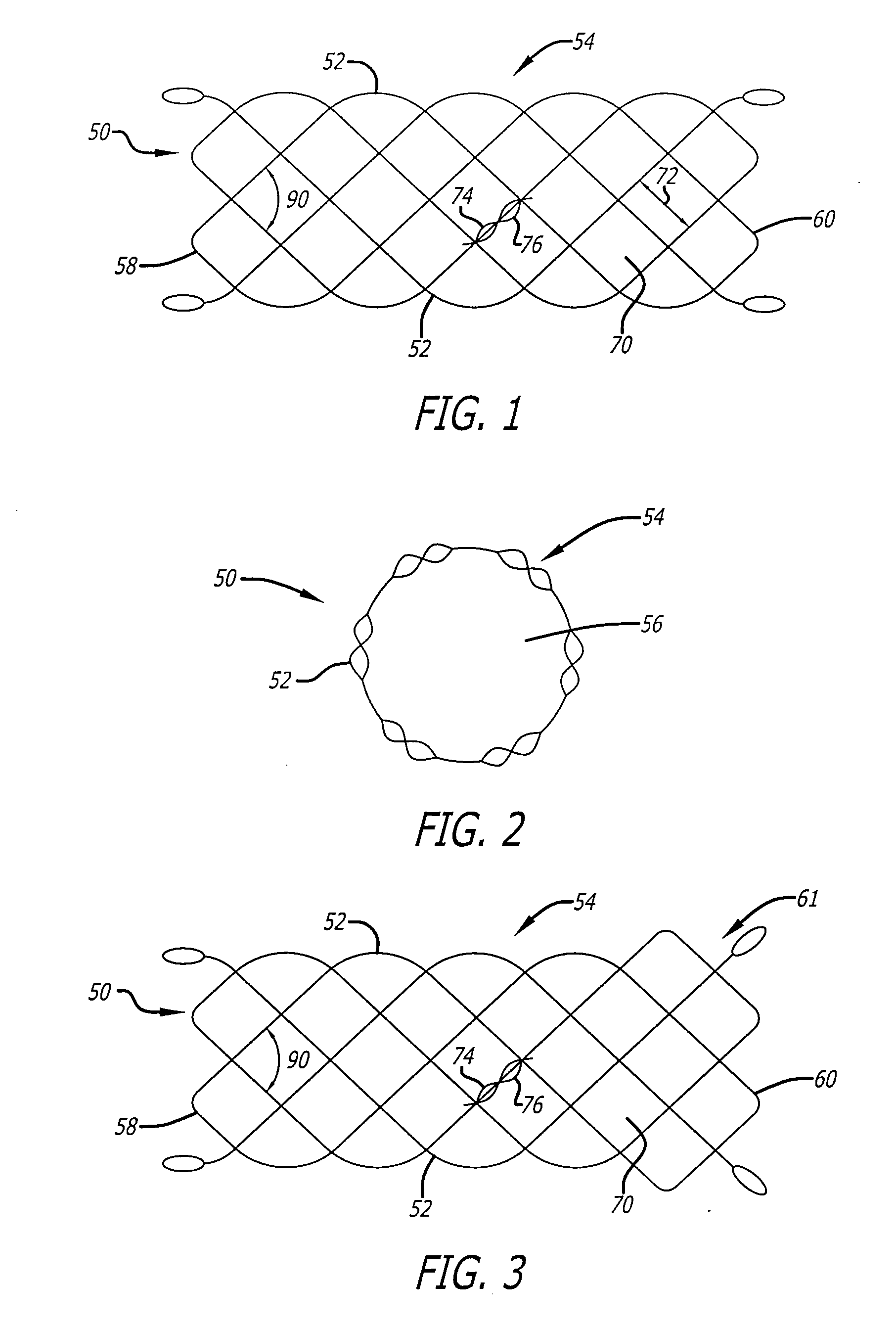
Figure 2 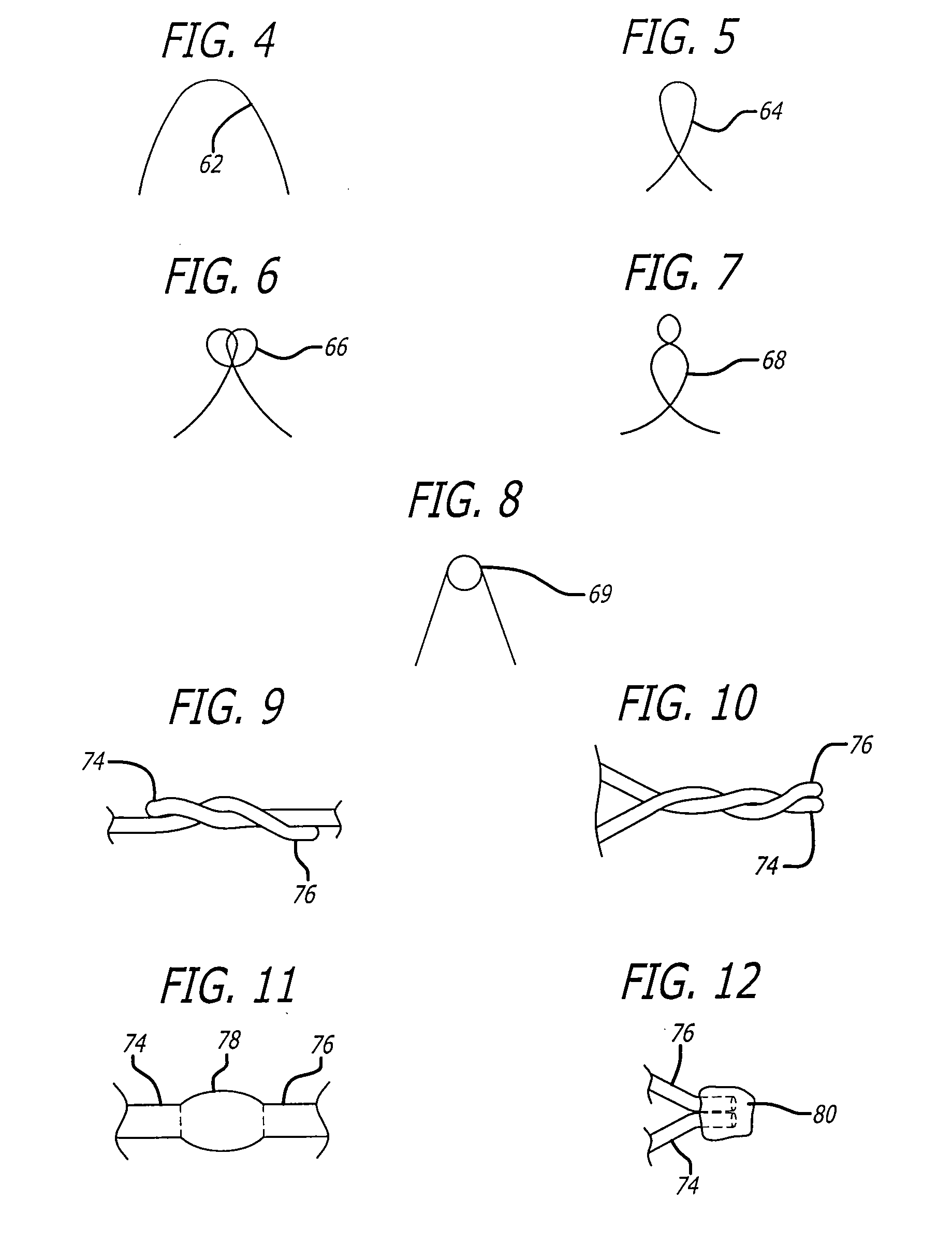
Figure 3
Abstract
Description
BACKGROUND OF THE INVENTION
[0001] The present invention relates to self-expanding, knitted devices and more particularly, to a self-expanding knitted device for intravascular repair of distal and tortuous vasculature.
[0002] The vasculature of an animal or a human characteristically suffers from a variety of maladies. Vessel walls can weaken and become distended over time in response to blood flow and pressures, thereby resulting in formation of aneurysms. Such aneurysms can take on a myriad of forms. In particular, aneurysms may form at or near bifurcated vessels creating enlarged areas about the bifurcation, or may form a pocket, for example, in side walls of vessels. Due to the complications associated with aneurysms that rupture or otherwise fail, it is critical that an aneurysm be treated expeditiously and effectively. Intravascular treatment procedures include placing grafts within the aneurysm in a manner to ensure that blood flows through the graft rather than through the weake...
Examples
Embodiment Construction
[0045]Turning now to the drawings, and particularly to FIGS. 1 and 2, there is shown a self-expanding pseudo-braided structure 50 of the present invention. The pseudo-braided device 50 is contemplated for use in highly tortuous and very distal vasculature of an animal or human. Due to its novel structure, the pseudo-braided device 50 is flexible in a compressed configuration and conformable to tortuous anatomy in a relaxed condition. Moreover, the device embodies high flexibility and a large expansion capability while providing sufficient radial force (i.e., hoop stiffness).
[0046]In a presently preferred embodiment, the pseudo-braided device 50 of the present invention is formed from the single filament 52. The filament 52 is configured into a repeating helical pattern that is interlaced upon itself by passing the end of the filament over then under the filament forming the helix as the end of the filament is wound down and back up the length of the structure to thereby form a gener...