
Method for avoiding interference
a technology of interference prevention and interference prevention, applied in the field of radio communication, can solve the problems of inability to perform a communication with the bs, inability to perform a communication with the ms, and inability to perform a communication with an inferior communication quality, so as to reduce the influence of interference, reduce interference, and reduce interferen
Patent Information
- Authority / Receiving Office
- US · United States
- Patent Type
- Applications(United States)
- Current Assignee / Owner
- Publication Date
- 2011-12-22
Smart Images
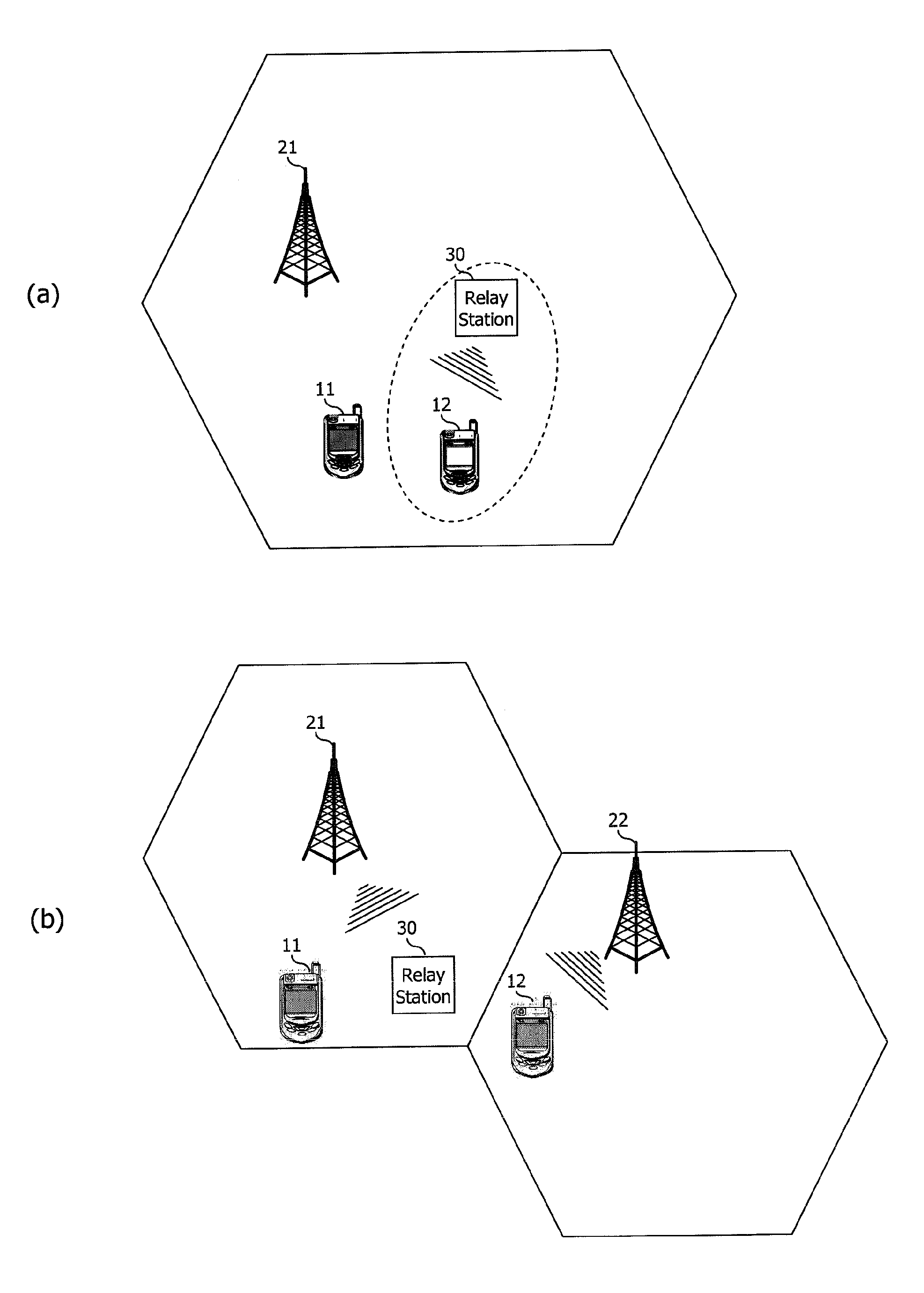
Figure 1 
Figure 2 
Figure 3
Abstract
Description
TECHNICAL FIELD
[0001] The present invention relates to radio communications, and more particularly, to a method for avoiding interference due to the addition of a relay station in a radio communications system.Background Art
[0002] A radio communications system may be largely categorized into an FDD (Frequency Division Duplex) scheme and a TDD (Time Division Duplex) scheme.
[0003] According to the FDD scheme, an uplink transmission and a downlink transmission are performed through different frequency bands. According to the TDD scheme, an uplink transmission and a downlink transmission are performed through the same frequency band and at different times. According to the TDD scheme, channel responses are substantially reciprocal to each other. This means that a downlink channel response and an uplink channel response are almost the same in a given frequency region. Accordingly, in a TDD-based radio communications system, a downlink channel response can be acquired from an uplink channel ...
Examples
first embodiment
[0063]FIG. 5 is an exemplary view illustrating the present invention.
[0064]As can be seen from FIG. 5, a first base station 210 and a second base station 220 are adjacent to each other. A first relay station 310 is positioned at an outer periphery of the coverage of the first base station 210. And, a first terminal 110 is placed within the coverage of the first base station 210, and a second terminal 120 is placed within the coverage of the second base station 220. The first base station 210 and the second base station 220 are controlled by a control station 500 (e.g., RNC or SGSN of UTRAN, or MME (Mobility Management Entity) or Serving-GW of EPC (Evolved Packet Core), or IEEE 802.16dml ASN-GW or CSN).
[0065]An entity in the first base station 210 schedules UL radio resources and DL radio resources. Alternatively, the control station 500 schedules UL radio resources and DL radio resources of the first base station 210.
[0066]The first base station 210 transmits, to the first relay sta...
second embodiment
[0072]FIG. 6 is an exemplary view of the present invention.
[0073]As can be seen from FIG. 6, a first base station 210 and a second base station 220 are adjacent to each other. A first relay station 310 is positioned at an outer periphery of the coverage of the first base station 210. And, a first terminal 110 is placed within the coverage of the first base station 210, and a second terminal 120 is placed within the coverage of the second base station 220.
[0074]The first base station 210 schedules UL radio resources and DL radio resources.
[0075]A method for scheduling radio resources of the first relay station 310 includes a center-concentrated scheduling method and a distribution-type scheduling method. According to the center-concentrated scheduling method, the first base station 210 directly allocates radio resources of the first relay station. On the other hand, according to the distribution-type scheduling method, the first base station 210 schedules radio resources to the first...
fourth embodiment
[0101]FIG. 9 is an exemplary view of the present invention.
[0102]Referring to FIG. 9, in a similar manner to FIG. 8, the first relay station 310 may transmit backhaul data to the first base station 210 in some cases (e.g., when UL resources are deficient). Data transmission by the relay station with using DL resources may be referred to as DL band stealing or DL subframe stealing.
[0103]In this case, a transmission signal of the first relay station 310 may cause interference with DL transmission to the second terminal 120 by the adjacent second base station 220.
[0104]In order to solve the interference, in the fourth embodiment, the second base station 220 identifies the DL resources through which the backhaul data is transmitted, in a similar manner to the third embodiment. And, the second base station 220 schedules its DL resources, based on the identified DL resources. For instance, the second base station 220 may not allocate its radio resources corresponding to a time point when ...