
Noninvasive, Accurate Glucose Monitoring with OCT By Using Tissue Warming and Temperature Control
a tissue warming and temperature control technology, applied in the field of noninvasive, accurate glucose monitoring with oct by using tissue warming and temperature control, can solve the problems of inability to monitor and monitor with temperature and/or pressure control for high accuracy, no suitable noninvasive device available, and difficulty in achieving continuous monitoring and monitoring with oct. , to achieve the effect of improving contrast, enhancing glucose specificity, and efficient removal
Patent Information
- Authority / Receiving Office
- US · United States
- Patent Type
- Applications(United States)
- Current Assignee / Owner
- Publication Date
- 2012-11-15
- Estimated Expiration
- Not applicable · inactive patent
Smart Images
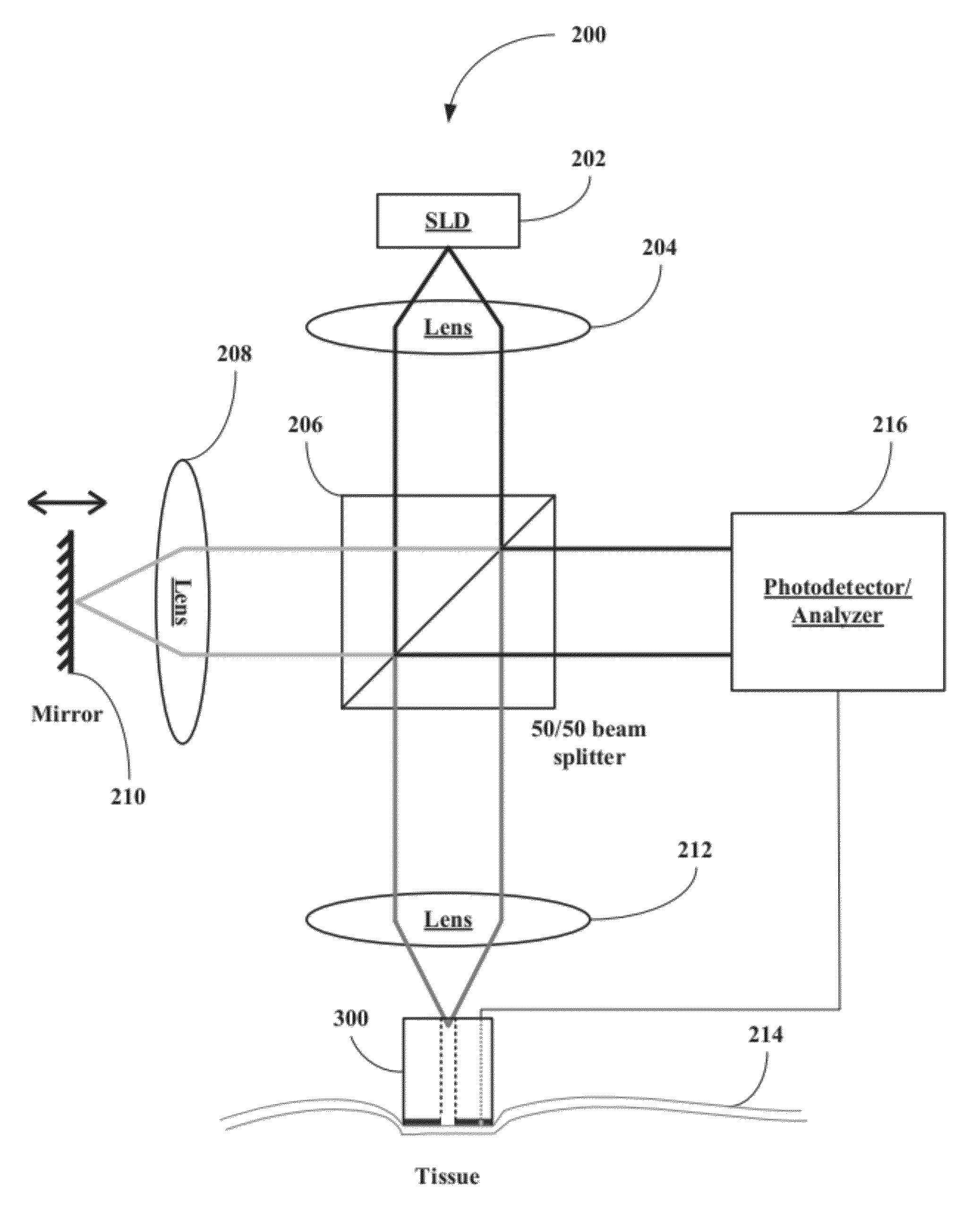
Figure 1 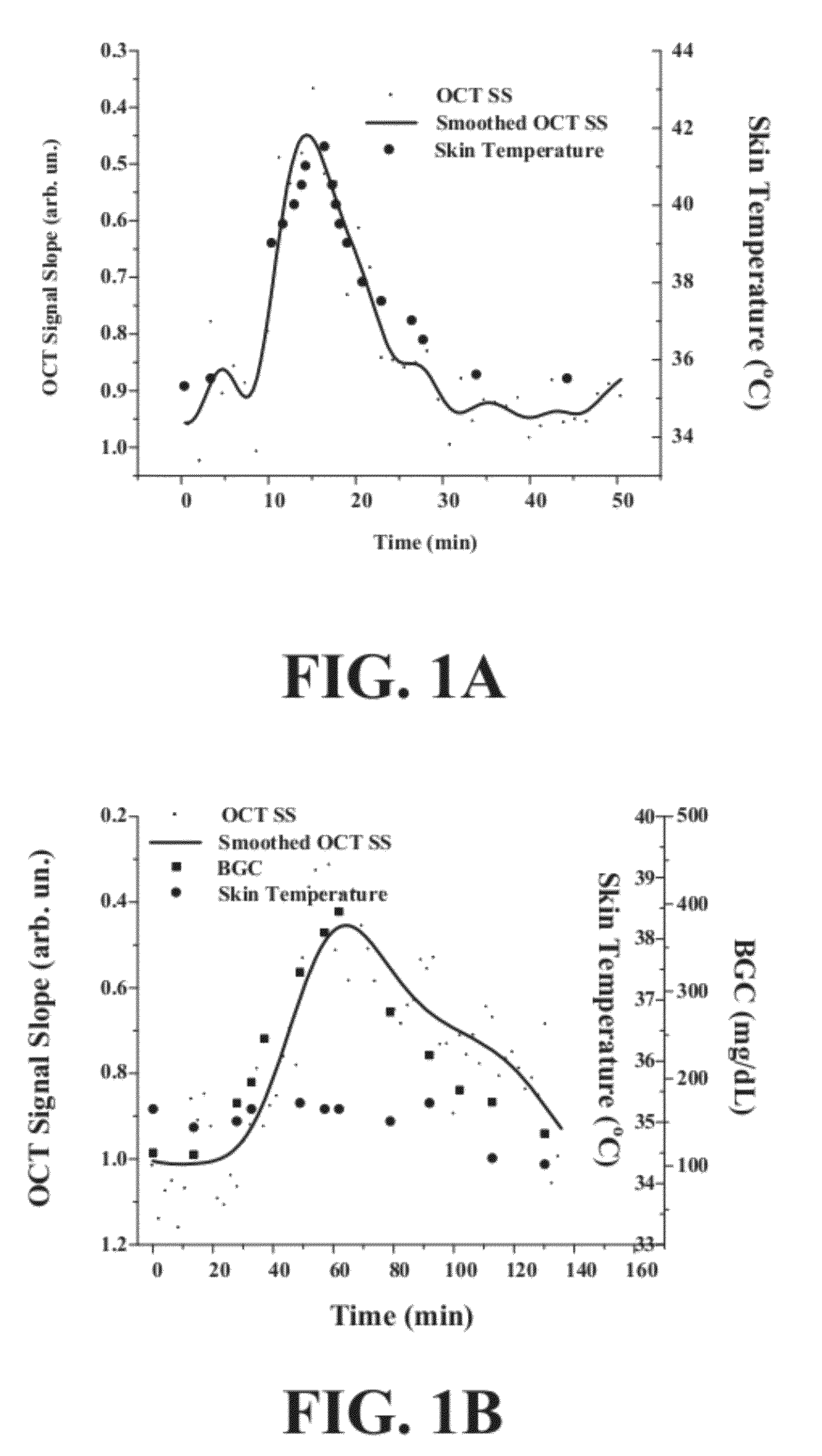
Figure 2 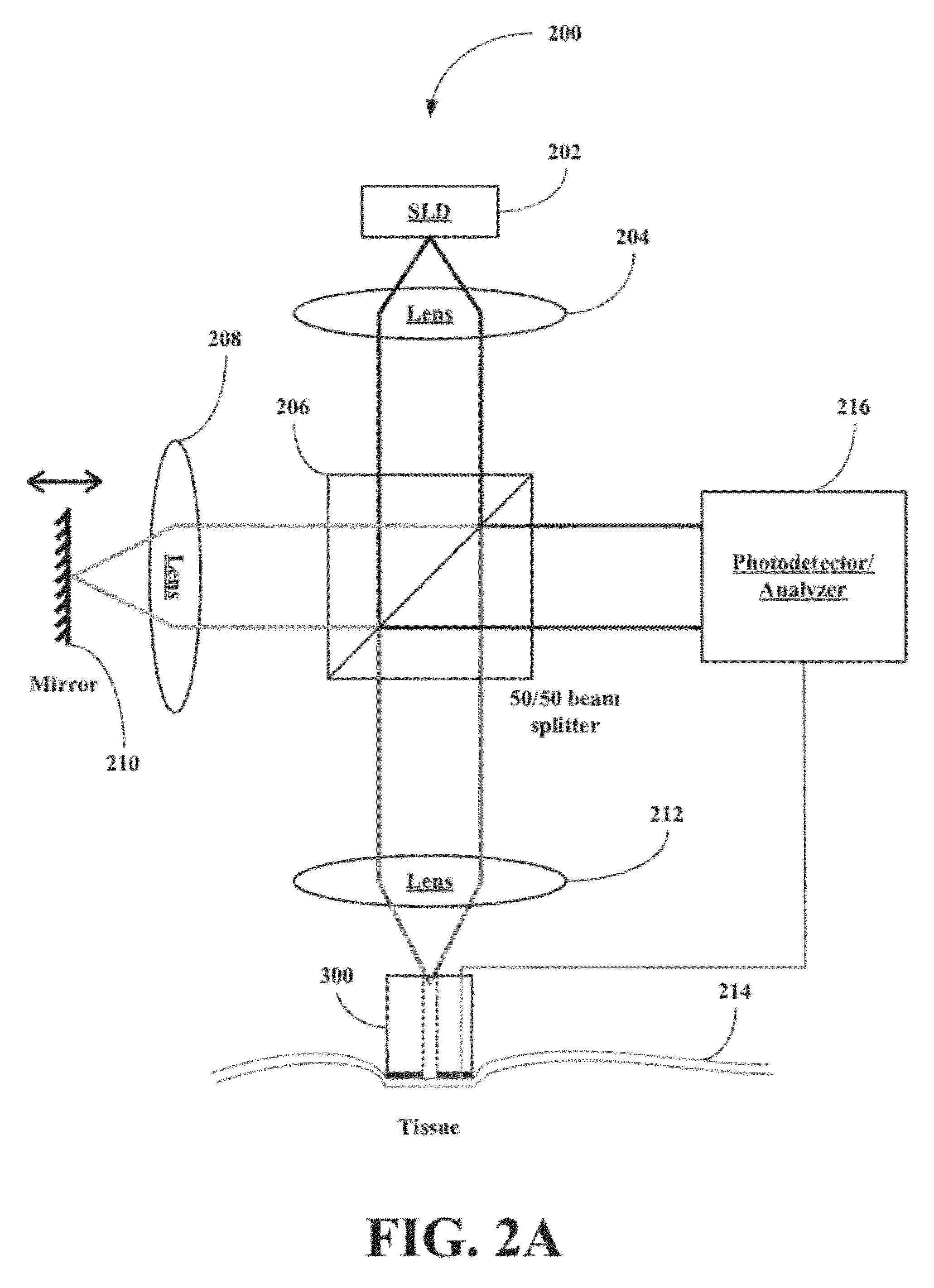
Figure 3
Abstract
Description
CROSS REFERENCE TO RELATED APPLICATIONS
[0001] This application is a continuation application of U.S. patent application Ser. No. 11 / 685,677, filed Mar. 13, 2007, which claims priority from U.S. Provisional Application Ser. No. 60 / 783,173 filed Mar. 16, 2006, both of which are incorporated herein by reference.STATEMENT REGARDING GOVERNMENT INTERESTS
[0002] This work was supported in part by the following United States Government grants: RO1 EB001467 and R21 DK 5838002 from the National Institutes of Health. The Government may have certain rights in this invention.FIELD OF THE INVENTION
[0003] The present invention relates to a method and system for continuous, noninvasive glucose monitoring in an animal including a human using an optical coherence tomography (OCT) based glucose monitoring system under conditions of a temperature of a tissue site and / or a pressure exerted on the tissue site sufficient to increase an accuracy of a calculated OCT glucose concentration.
[0004] More particularly...
Examples
Embodiment Construction
[0047]The inventors have developed a novel optical coherence tomography (OCT) technique for noninvasive, continuous glucose monitoring based on interferometric measurement and analysis of low-coherent light backscattered from specific layers of tissues under temperature controlled conditions. The inventors demonstrated that the accuracy and reproducibility of noninvasive glucose monitoring is dependent on tissue temperature. The inventors have shown that temperature variation of less than 1° C. do not worsen accuracy of glucose monitoring, but temperature variation of more than 1° C. results in changes of the OCT signal. The inventors have demonstrated that temperature variations of more than 1° C. substantially worsen accuracy of glucose monitoring in animals including humans and, therefore, may substantially worsen accuracy of glucose monitoring in non-diabetic and diabetic patients. The inventors have found that tissue temperature control can be used to minimize adverse temperatu...