
mTOR SELECTIVE KINASE INHIBITORS
a selective kinase and mtor technology, applied in the field of mtor selective kinase inhibitors, can solve the problems of limited cell type arrest, modest effect on protein synthesis, and blockage of mtor's ability to do this, and achieve the effect of treating or lessening the severity of mtor modulated
Patent Information
- Authority / Receiving Office
- US · United States
- Current Assignee / Owner
- Publication Date
- 2013-03-21
- Estimated Expiration
- Not applicable · inactive patent
Smart Images
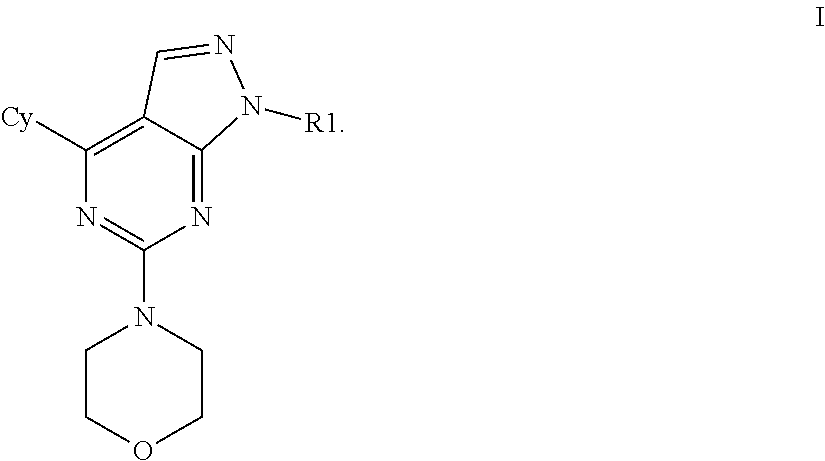
Figure 1 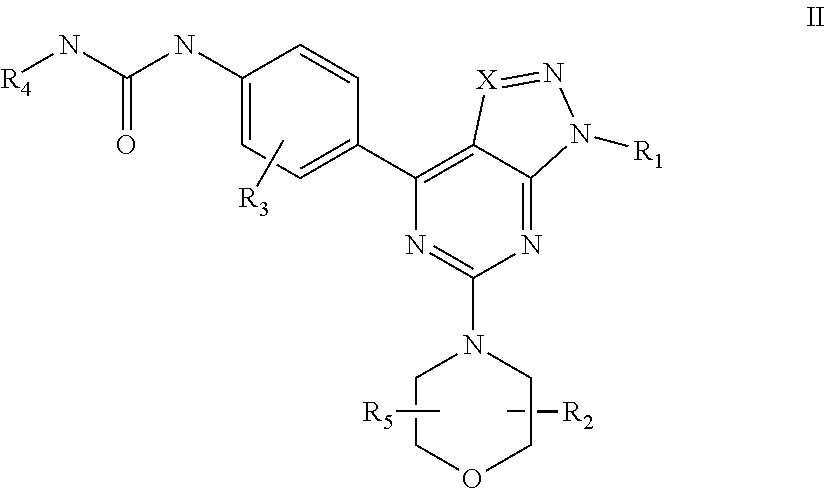
Figure 2 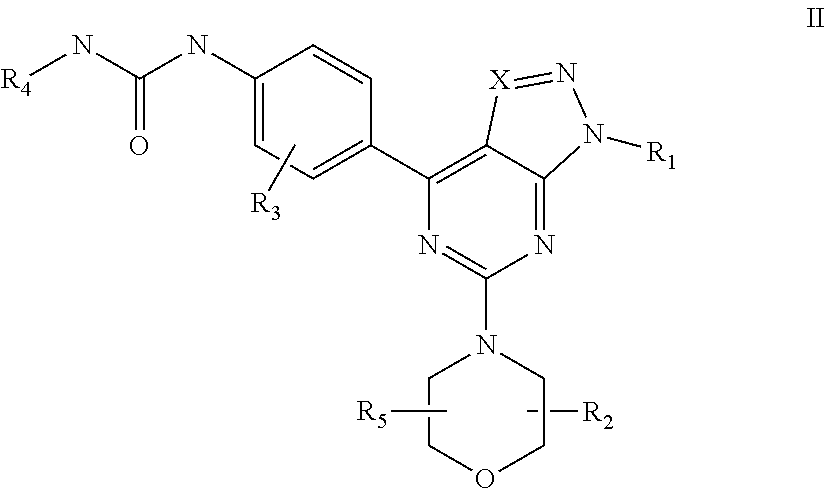
Figure 3
Abstract
Description
RELATED APPLICATIONS
[0001] This application claims the benefit of U.S. provisional application U.S. Ser. No. 61 / 346,278, filed May 19, 2010, the contents of which are incorporated herein in its entirety.TECHNICAL FIELD OF THE INVENTION
[0002] This invention relates to novel 4-urea-phenyl substituted 6-morpholin-4-yl-pyrazolo[3,4-d]pyrimidine derivatives, their salts, solvates, hydrates and polymorphs thereof. The invention also provides compositions comprising a compound of this invention and the use of such compositions in methods of treating diseases and conditions associated with kinase modulation, especially the mTOR kinase.BACKGROUND OF THE INVENTION
[0003] The mammalian target of rapamycin (mTOR) pathway is considered a major regulator of cell growth (Guertin, D. A., and Sabatini, D. M. Cancer Cell 2007, 12, 9). The mTOR serine / threonine kinase is the founding component of the pathway and the catalytic subunit of two functionally distinct protein complexes, mTORC1 and mTORC2. mTORC...
Examples
example 1
1-ethyl-3-[4-[1-(2-hydroxy-2-methyl-propyl)-6-morpholino-pyrazolo[3,4-d]pyrimidin-4-yl]phenyl]urea
[0271]
[0272]Step 1: A mixture of 1a (20.0 g, 400.0 mmol) and 1b (2.17 g, 20.0 mmol) in ethanol (50 mL) was refluxed overnight, then evaporated under high vacuum. The residue was dissolved in ethanol and the resulting solid was filtered off. The filtrate was concentrated to give crude 1c (1.98 g, 95%) which was used directly for the next step.
[0273]Step 2: DMF (9.5 g, 130 mmol) was added drop-wise to POCl3 (47 mL) at 10° C. To this mixture, was slowly added 1d (10 g, 78.1 mmol) over a period of 20 min at −10° C. After the addition was complete, the resulting mixture was heated to reflux overnight, then evaporated. The residue was slowly added to water with stirring, then filtered and dried to give 1e (9.96 g, 60.4%).
[0274]Step 3: To a solution of 1e (2.45 g, 11.6 mmol) in EtOH (150 mL) was added dropwise a solution of 1c (1.21 g, 11.6 mmol) in EtOH (10 mL), followed by TEA (4.9 mL, 34.9 ...
example 2
1-[4-[1-(2-hydroxy-2-methyl-propyl)-6-morpholino-pyrazolo[3,4-d]pyrimidin-4-yl]phenyl]-3-methyl-urea
[0277]
[0278]The procedure from 1f to 2 was similar to that of 1f to 1 which provided 2 (294 mg, 34.5% from 1f). 1H-NMR (300 MHz, DMSO-d6): δ=1.12 (s, 6H), 2.68 (d, 3H), 3.68-3.75 (m, 4H), 3.83-3.88 (m, 4H), 4.18 (s, 2H), 4.76 (s, 1H), 6.14 (q, 1H), 7.61 (d, 2H), 8.19 (d, 2H), 8.39 (s, 1H), 8.93 (s, 1H). LC-MS [M+H]+: 426.3.
example 3
1-[4-(1-isopropyl-6-morpholino-pyrazolo[3,4-d]pyrimidin-4-yl)phenyl]-3-methyl-urea
[0279]
[0280]The procedure from 1e to 3 was similar to that of 1e to 1 which provided 3 (91 mg, 41% from 1e). 1H-NMR (300 MHz, DMSO-d6): δ=1.42 (d, 6H), 2.64 (s, 3H), 3.69-3.84 (m, 8H), 4.90-4.99 (m, 1H), 6.14 (d, 1H), 7.58 (d, 2H), 8.14 (d, 2H), 8.33 (s, 1H). LC-MS [M+H]+: 396.2.